Modernizing Cybersecurity for K-12 Education Solution BriefSupport connected, resilient learning environments
Available Languages
Bias-Free Language
The documentation set for this product strives to use bias-free language. For the purposes of this documentation set, bias-free is defined as language that does not imply discrimination based on age, disability, gender, racial identity, ethnic identity, sexual orientation, socioeconomic status, and intersectionality. Exceptions may be present in the documentation due to language that is hardcoded in the user interfaces of the product software, language used based on RFP documentation, or language that is used by a referenced third-party product. Learn more about how Cisco is using Inclusive Language.
Cybersecurity for modern K-12 education
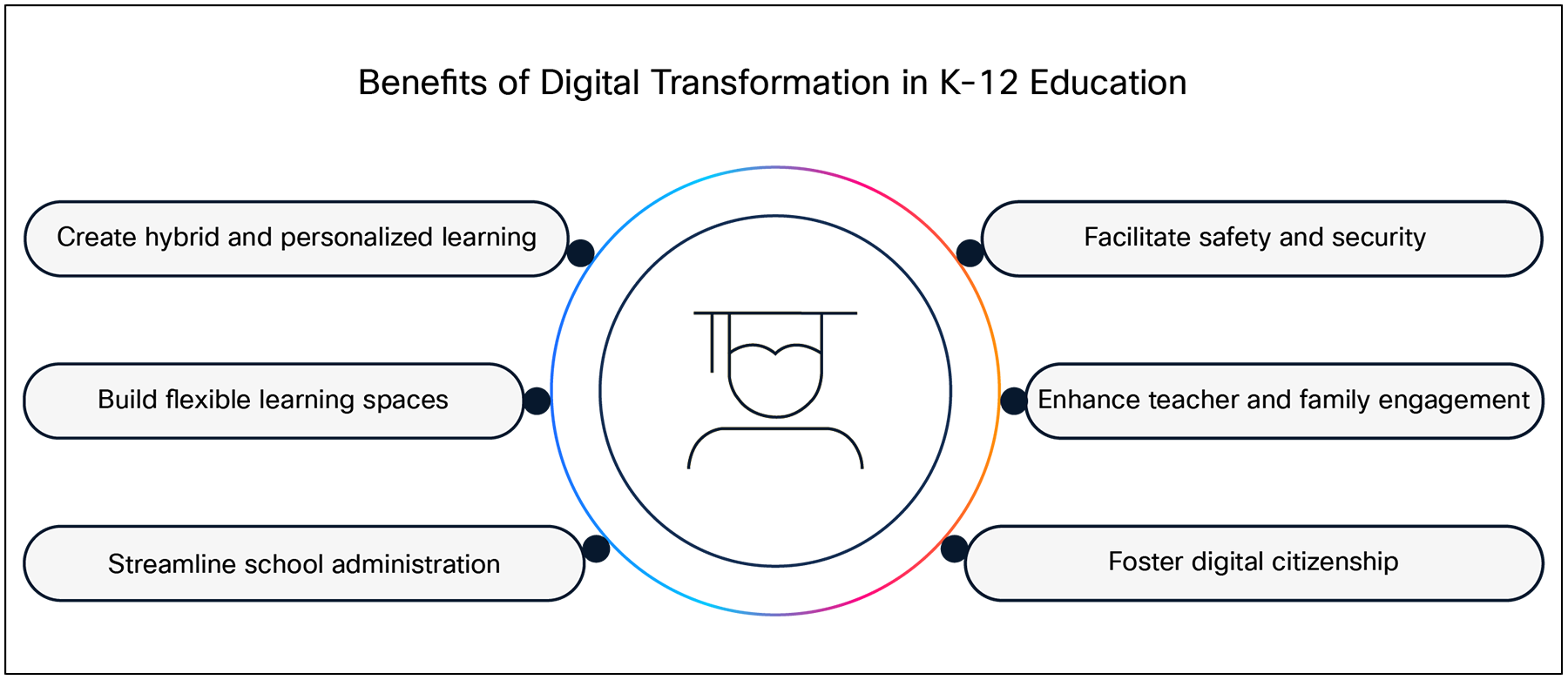
K-12 schools depend on technology to support instruction, communication, student services, and daily operations. From classrooms and school-issued devices to cloud-based learning platforms and AI-enabled tools, schools seek to support students, manage sensitive information, and maintain important educational and operational services while fostering connected learning environments.
This solution brief explores approaches for developing a modern cybersecurity strategy aligned to the needs of K-12 education. Learn how institutions can support student well-being, address student privacy considerations, enhance cyber resilience, enable responsible AI adoption, and leverage integrated security solutions and services to support security and educational objectives.
Supporting safe and connected learning
K-12 schools support students, educators, administrators, families, and staff across classrooms, campuses, and digital learning environments. From school-issued devices and learning platforms to cloud applications and AI-enabled tools, technology plays a central role in supporting instruction, communication, and daily operations. As schools expand digital learning experiences, cybersecurity becomes increasingly important to helping safeguard students, sensitive information, and school services.
Effective cybersecurity programs help schools strengthen resilience, support privacy obligations, reduce risk, and maintain trust among families, educators, and the broader community.
District priorities
● Support student well-being across digital learning environments
● Support student privacy and sensitive information management
● Support educational continuity and school operations
● Enable responsible AI adoption with governance and oversight considerations
● Support cyber resilience efforts across school and cloud environments
Navigating the compliance maze
K-12 schools manage a wide range of sensitive information, including student records, educator and staff data, financial information, and digital learning activity. As technology becomes increasingly integrated into instruction and school operations, districts often need to balance innovation with privacy, security, and regulatory obligations.
Understanding applicable privacy and cybersecurity requirements helps districts prioritize security investments, manage risk, and support safe and trusted learning environments.
Common compliance and security drivers
● Family Educational Rights and Privacy Act (FERPA) helps govern access to and disclosure of student education records by educational institutions that are subject to the law.
● Children's Online Privacy Protection Act (COPPA) may affect online services used by schools and vendors that collect personal information from children under age 13.
● Children's Internet Protection Act (CIPA) establishes requirements for certain schools and libraries receiving E-Rate funding, including the adoption of internet safety policies and technology protection measures.
● Center for Internet Security (CIS) Controls provides a prioritized set of cybersecurity best practices that school districts can use to help strengthen security, reduce risk, and support safe and connected learning environments.
● NIST Cybersecurity Framework (CSF) 2.0 provides a voluntary framework that organizations can use to understand, assess, prioritize, and manage cybersecurity risk.
● State privacy and cybersecurity laws may impose additional requirements related to data protection, reporting, and governance.
Understanding where student, educator, and district data resides, how it is used, and who can access it helps support privacy, security, governance, and community trust.
Protecting students in a digital world
Technology is an essential part of the modern learning experience. Students, educators, and staff rely on digital learning platforms, educational applications, connected devices, and AI-enabled tools to support instruction, collaboration, and school operations. As technology becomes more integrated into the classroom, schools often need to balance innovation with privacy, safety, and responsible use.
Effective cybersecurity programs help districts reduce risk, support safe digital learning experiences, safeguard sensitive information, and maintain trust among students, families, educators, and the broader school community.
Student safety
● Support connected digital learning experiences
● Help address student, educator, and district information privacy considerations
● Promote responsible technology and AI use
● Help prepare for and respond to cyber incidents
● Support community confidence in technology initiatives
Responsible AI considerations
As schools explore AI-enabled technologies, key considerations include:
● Data privacy and protection
● Visibility into AI-enabled applications
● Governance and acceptable-use policies
● Educator awareness and training
● AI-enabled cyber threats
Supporting connected learning environments requires a balanced approach that combines cybersecurity, privacy, governance, and responsible AI practices.
Zero Trust: A foundation for secure learning
K-12 schools depend on digital learning platforms, cloud applications, school-issued devices, and online services to support teaching and operations. Students, educators, and staff need secure access to resources from school, home, and hybrid learning environments.
Traditional security models that rely on trusted networks are no longer sufficient. Zero Trust is a security strategy based on the principle of "never trust, always verify." Access decisions are continuously evaluated using identity, device health, user behavior, and risk signals.
K-12 benefits
● Support student, educator, and district information privacy efforts
● Support access across learning environments
● Help limit unauthorized movement across networks
● Support privacy and access management practices
● Support operational resilience and learning continuity
Zero Trust provides a strategy for managing access across learning environments by continuously evaluating users, devices, and access requests.
Student safety
● Unsafe online activity
● Inappropriate content
● Cyberbullying concerns
Privacy and data protection
● Student data protection
● Staff data protection
● Unauthorized data access
Identity and access security
● Phishing attacks
● Credential theft
● Excessive access privileges
Learning continuity
● Ransomware attacks
● Service disruption
● Technology outages
Cloud and AI security
● Cloud misconfigurations
● Shadow IT and SaaS
● AI data leakage
Network and device security
● Unauthorized access
● Lateral movement
● School-issued device risks
See the Cisco Security portfolio.
K-12 schools manage increasingly complex environments that span classrooms, district offices, school-issued devices, cloud platforms, AI-enabled applications, and distributed users. As cybersecurity requirements grow, technology teams need more than individual tools. They need a unified approach that delivers visibility, context, and coordinated action across the district.
Modern cybersecurity is increasingly driven by platforms that connect security operations, policy management, intelligence, and automation. By reducing silos and bringing together information from across school, cloud, and security environments, districts can simplify operations, improve decision-making, and strengthen cyber resilience.
A platform approach to cybersecurity
Security in Cisco Cloud Control provides centralized, AI-driven management and policy orchestration across Cisco and third-party firewalls. It delivers intelligent, intent-based policy enforcement that adapts dynamically to network changes, simplifying firewall administration and enhancing security posture. This unified platform enables consistent policy application, real-time visibility, and streamlined workflows, supporting compliance through automated policy optimization and multi-vendor integration.
Benefits of a platform approach
● Broad visibility
Connect information across users, devices, applications, networks, and cloud environments.
● Shared context
Bring together telemetry, policy, and operational data to support analysis and decision-making.
● Consistent policy application
Define policy objectives and apply them across distributed environments.
● AI-assisted operations
Support analysis, risk identification, and operational workflows using AI-enabled capabilities.
● Operational efficiency
Support security management through centralized operations and common workflows.
Built for the AI era
As AI transforms teaching, learning, and security, schools need a security architecture capable of supporting increasingly connected and dynamic learning environments. A platform-based approach can provide a foundation for helping secure innovation while improving operational efficiency and resilience.
From intelligence to coordinated response
K-12 technology and security teams must rapidly identify threats, understand their impact, and respond effectively across school, cloud, and digital learning environments. Integrating intelligence, analytics, and automation helps districts improve security operations, reduce risk, and support continuity of learning.
● Detect threats earlier
Identify suspicious activity across users, devices, applications, networks, and cloud environments.
● Prioritize what matters most
Reduce noise and focus resources on threats that pose the greatest risk to students, staff, and district operations.
● Accelerate investigations
Correlate activity across multiple security domains to improve context and decision-making.
● Automate response actions
Contain threats through coordinated actions such as isolating devices, restricting access, or updating security policies.
● Support learning continuity
Reduce the impact of cyber incidents through faster detection, investigation, and response.
Cisco Security portfolio for K-12 education
A modern security strategy requires integrated capabilities that help districts reduce risk, improve visibility, and strengthen resilience across schools, cloud, and digital learning environments. Cisco's security portfolio helps districts address cybersecurity priorities through solutions that support secure access, network protection, cloud security, threat detection, analytics, and incident response.
Help verify users, devices, and access requests across campus, cloud, remote, and hybrid learning environments. As students, educators, administrators, and staff access resources from a variety of locations and devices, Cisco solutions help institutions apply consistent access policies while improving visibility across digital environments.
Cisco solutions help districts:
● Enhance authentication controls
● Verify device trust signals
● Support secure remote access
● Help address credential risks
● Improve visibility into access activity
| Cisco Solutions |
| Provides phishing-resistant authentication and identity verification to help secure access to applications and institutional resources. |
| Cisco Identity Services Engine (ISE) Delivers identity-based network access control, device visibility, and segmentation across campus environments. |
| Delivers Zero Trust access to applications and resources across distributed environments. |
| Provides secure connectivity, device posture assessment, and endpoint visibility across distributed environments. |
| Cisco Secure Email Threat Defense Helps protect users from phishing, malware, business email compromise, and other email threats. |
Network Protection and Segmentation
Help support school, data center, and cloud-connected environments with network security and segmentation capabilities. As district networks continue to expand across schools/campuses, cloud services, and remote users, Cisco solutions help districts manage connectivity and security requirements across diverse environments.
Cisco solutions help districts:
● Help safeguard school networks
● Support segmentation of important learning and operational environments
● Help restrict unauthorized movement across networks
● Support consistent policy application
● Help mitigate the impact of ransomware
| Cisco Solutions |
| Provides advanced threat protection and policy enforcement with unified management through Security in Cisco Cloud Control. |
| Extends threat protection and segmentation across campus, data center, cloud, and application environments. |
| Cisco Identity Services Engine (ISE) Enables dynamic segmentation and identity-based access controls across campus and research environments. |
| Security in Cisco Cloud Control Centralizes security policy management and visibility across distributed environments. |
Cloud and Application Security
Help support applications, workloads, APIs, AI-enabled services and digital learning environments across school, cloud, and hybrid infrastructure. Cisco solutions help districts manage security considerations across diverse application environments while supporting teaching, learning, student services, and district operations.
Cisco solutions help districts:
● Help safeguard hybrid workloads
● Support application and API security
● Help manage cloud exposure
● Support AI governance efforts
● Apply more consistent policies
| Cisco Solutions |
| Provides consistent security and policy enforcement across hybrid and multicloud environments. |
| Provides workload visibility, segmentation, and protection across on-premises and cloud environments. |
| Delivers distributed security enforcement and protection for applications, workloads, and infrastructure. |
| Cisco Web Application and API Protection (WAAP) Helps protect web applications and APIs from attacks, bots, and distributed denial-of-service (DDoS) threats. |
| Provides visibility, governance, and protection for AI applications and AI-enabled services. |
Security Analytics and Operational Visibility
Help turn security, network, application, and operational data into actionable insights across school, cloud, and digital learning environments. As institutional environments become increasingly distributed, Cisco solutions help districts collect, analyze, and share telemetry across security and operations teams to improve visibility and support monitoring activities.
Cisco solutions help districts:
● Improve situational awareness
● Support audit preparation
● Investigate incidents faster
● Identify anomalous behavior
● Drive data-informed decisions
| Cisco Solutions |
| Cisco Secure Network Analytics Detect threats across private and public multicloud environments, even in encrypted traffic. |
| Collects and distributes security telemetry to improve visibility and analytics. |
Help detect, investigate, and respond to threats across users, devices, applications, networks, and cloud environments. Cisco and Splunk solutions help security teams aggregate and analyze data from multiple sources, providing context that supports threat investigation, incident management, and response activities.
Cisco and Splunk solutions help districts:
● Identify potential threats earlier
● Correlate activity across domains
● Support incident prioritization
● Streamline investigations
● Support response automation
| Cisco Solutions |
| Correlates telemetry across security domains to accelerate threat detection, investigation, and response. |
| Cisco Secure Malware Analytics (ThreadGrid) Helps analyze malware with advanced sandboxing and threat intelligence in one simple solution. |
| Cisco Security Analytics and Logging Combined security logs provide consolidated security-log context, at a glance, across all networks and devices. |
| Provides endpoint detection and response (EDR) capabilities to detect, contain, and remediate threats. |
| Splunk Enterprise Security (ES) Unified security operations platform combining SIEM, automation, and behavioral analytics to support threat response. |
| Automates security workflows and incident response processes. |
| Automates phishing and malware investigation by analyzing attack chains and delivering actionable threat insights. |
| Cisco Talos Threat Intelligence Delivers global threat intelligence to help identify and respond to emerging threats. |
Cisco Security Suites simplify security adoption by combining complementary capabilities to speed deployment, streamline procurement, and improve security outcomes.
Cisco solutions help districts:
● Support security operations
● Streamline deployment efforts
● Help manage security tool complexity
● Improve visibility across domains
● Increase the value of existing investments
| Cisco Solutions |
| Integrates detection, investigation, and response capabilities to accelerate threat detection and remediation. |
| Combines identity, access, endpoint, and email security to help protect users from phishing, malware, and credential-based attacks. |
| Secures applications, data, and workloads across hybrid and multicloud environments. |
Cisco Services: Turning strategy into action
Cisco Services help school districts plan, design, implement, and operate cybersecurity programs. Our unified services and support portfolio helps districts assess risk, strengthen resilience, support digital learning initiatives, and improve security operations across school, cloud, and hybrid environments.
By combining deep expertise with AI-driven intelligence from Cisco IQ™, Cisco Services help districts better understand their environments, prioritize actions, and support ongoing improvements in security operations.
Advisory and Assessment Services
Cisco advisory services help districts evaluate their security posture, identify gaps, and develop actionable roadmaps aligned to educational priorities.
● Zero Trust Advisory
Assess Zero Trust maturity and develop a practical roadmap for strengthening identity, device, application, and network security.
● Advanced Persistent Threat Resiliency Assessment
Identify security gaps and strengthen defenses against threats targeting school, cloud, and district environments.
● AI Security Trust and Assurance Program
Assess AI adoption, identify security and governance risks, and establish controls to support trusted and responsible AI use.
Plan, Design, and Implement Services
Cisco experts help districts design and deploy security architectures that support modernization, Zero Trust, and cyber resilience goals.
● Application Microsegmentation Service
Reduce attack surfaces and limit lateral movement through application-level segmentation policies across school and cloud environments.
Incident Response Services
Cyber incidents can disrupt learning and school operations. Cisco Talos services help districts strengthen readiness, improve response capabilities, and support recovery efforts when incidents occur.
24x7 expert support for incident investigation, containment, recovery, and remediation during active cyber incidents.
Assess readiness, improve incident response plans, conduct tabletop exercises, and strengthen operational preparedness.
Access global threat intelligence and actionable insights to help identify and respond to emerging threats.
● Talos Vulnerability Research
Benefit from ongoing vulnerability research and research that helps organizations reduce exposure to newly identified threats.
Flexible engagement models
Cisco Services are available through project-based and ongoing engagements, allowing districts to align support with their operational needs, priorities, and budgets.
To engage Cisco Services and learn more about available offerings, districts can work with their Cisco account team or an authorized Cisco partner.
Extend security operations with Cisco partners
In addition to Cisco Services, school districts can work with Cisco partners to extend internal capacity, access specialized expertise, and support ongoing security operations.
Cisco’s partner ecosystem includes partners with demonstrated capabilities across areas such as security, networking, observability, collaboration, lifecycle practices, and Cisco Powered Services. These partner-delivered services can help design, provision, manage, and support outcomes using Cisco technologies.
Cisco partners can help school districts:
● Deploy integrated solutions across security, networking, cloud, and school environments
● Support managed security operations and threat monitoring activities
● Support Zero Trust, SASE, segmentation, and ransomware resilience initiatives
● Provide specialized expertise for implementation, lifecycle services, and technology adoption
● Build a partner ecosystem aligned to district needs, geography, services, industry focus, and technical specialization
● Support digital resilience efforts while enabling internal teams to focus on teaching and learning
For districts with lean security teams or distributed IT environments, partner-managed services offer a flexible way to scale expertise without building every capability in-house. Districts retain responsibility for their environments, policies, data classification, contracts, and compliance decisions while Cisco partners provide operational support and specialized delivery expertise.
Developing cybersecurity talent
Cybersecurity requires continuous learning. As technologies and threats evolve, school districts need skills that support secure learning environments and district operations. Ongoing development helps strengthen expertise, readiness, and resilience.
Facilitated sessions designed to help districts assess cybersecurity priorities, explore emerging technologies, strengthen security strategies, and align modernization initiatives with district objectives. Workshops focus on topics such as Zero Trust, AI readiness, cloud security, ransomware preparedness, and security operations.
Delivers role-based learning paths, hands-on labs, certification preparation, continuing education, and product training to help IT and security professionals develop and maintain important technology skills.
Industry-recognized certifications that are designed to validate expertise across cybersecurity, networking, cloud, automation, and security operations, helping professionals advance their careers and demonstrate technical proficiency.
Provides authorized instructor-led training and customized learning programs that help districts accelerate skills development, support technology adoption, and achieve operational outcomes.
Provides skills-to-jobs training, cybersecurity education, and career development resources to help build foundational IT and cybersecurity skills.
K-12 education increasingly relies on connected digital experiences to support teaching, learning, and operations. Cisco helps districts address evolving technology and cybersecurity considerations through integrated solutions, services, and expertise designed for modern educational environments.
Next steps
● Assess your environment
Identify critical services, sensitive data, compliance obligations, and security gaps across school, cloud, and digital learning environments.
● Prioritize what matters most
Focus on initiatives that reduce risk, strengthen resilience, and support district priorities.
Build a modernization roadmap
Align security investments with educational priorities, budget cycles, staffing resources, and long-term technology plans.
Work with Cisco experts
Cisco, Cisco Services, and trusted partners can help districts turn priorities into practical security roadmaps, accelerate deployment, and support ongoing operations.
Ready to take the next step?
● Speak with a Cisco specialist
● Explore Cisco solutions for K-12 Education
● Connect with a Cisco partner
● Schedule a cybersecurity assessment
Help support student safety, privacy, and learning continuity with a cybersecurity strategy designed for K-12 education.
● Cisco Solutions for U.S. K-12 Education
● Cisco Portfolio for Education
● Cisco SAFE Guides for Campus and Branch
● Cultivate Smart Learning Environments
● Facilitate Safety and Security in Education