Overview
This topic explains tunnel high availability, including how Cisco IoT FND manages tunnels, the dependencies for tunnel redundancy, and the configuration steps required to ensure reliable tunnel operation in the network.
Tunnel high availability refers to the ability of the network to maintain continuous tunnel connectivity by leveraging redundancy in links, FARs, and HERs.
-
Tunnels are managed by Cisco IoT FND, but HER is not managed by Cisco IoT FND.
-
Cisco IoT FND reads and maintains a copy of the configuration made on HER.
-
Tunnel redundancy depends on link redundancy, FAR redundancy, and HER redundancy.
Dependencies and redundancy options for Tunnel HA
The redundancy of the tunnel source (CGR), the redundancy of the tunnel destination (HER), and the link between HER and FAR over which the tunnel is formed are critical for tunnel redundancy.
The following options are possible for high availability:
-
Option 1: There can be one FAR, one HER, but more than one link and hence more than one tunnel.
-
Option 2: There can be one FAR, but more than one link and one HER.
Figure 1. Option 2 Topology 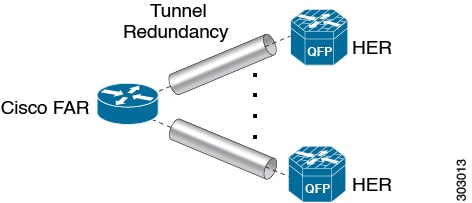
To configure tunnel redundancy at Cisco IoT FND, perform the following steps:
-
Configure Tunnel Provisioning Policies: Add HER to the tunnel provisioning group and define policies that determine the mapping between FAR and HER (ASR) interfaces.
-
Modify the Tunnel Provisioning Templates: Use the sample FAR tunnel addition template and HER tunnel addition template as provided.
If a tunnel fails, traffic flows through another tunnel.