Overview
This topic explains the concept of High Availability (HA) deployment for Cisco IoT FND, including its key components, how HA is achieved, and the required configurations at different levels.
High Availability (HA) deployment for Cisco IoT FND is a solution that ensures continuous operation and minimal downtime by providing redundancy at both the server and database levels.
-
Cisco IoT FND Server HA is achieved by connecting multiple Cisco IoT FND servers to a load balancer, distributing traffic among cluster servers.
-
Cisco IoT FND Database HA is achieved by configuring a primary and standby database server, with an Observer program monitoring and promoting the standby if the primary fails.
High Availability in Cisco IoT FND is implemented at both the server and database levels, each with specific configurations and operational mechanisms.
-
Cisco IoT FND Server HA: Multiple servers connected to a load balancer distribute traffic from Mesh Endpoints (ME), Field Area Routers (FAR), and Aggregation Services Routers (ASR).
-
Cisco IoT FND Database HA: A primary and standby database server are configured, with an Observer program monitoring the servers and promoting the standby if the primary fails.
To set up an Observer server running Oracle 12c on a separate server (distinct from the Cisco IoT FND Database servers), refer to the instructions in the Oracle 12c (12.1.0.2): Documentation Library.
The following image illustrates the High Availability deployment for Cisco IoT FND:
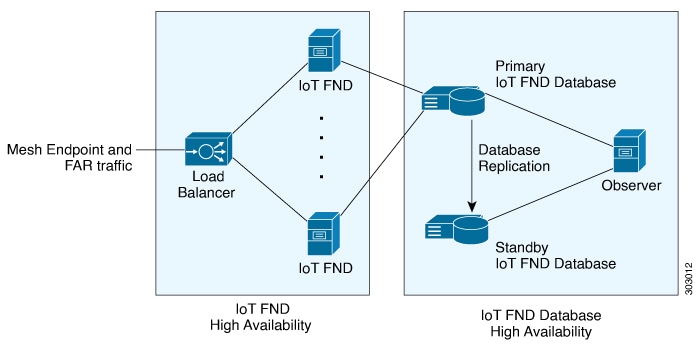
Example of High Availability Deployment
For example, in a typical Cisco IoT FND deployment, multiple servers are connected to a load balancer to ensure server HA, while the database HA is maintained by configuring a primary and standby database with an Observer program to monitor and manage failover.