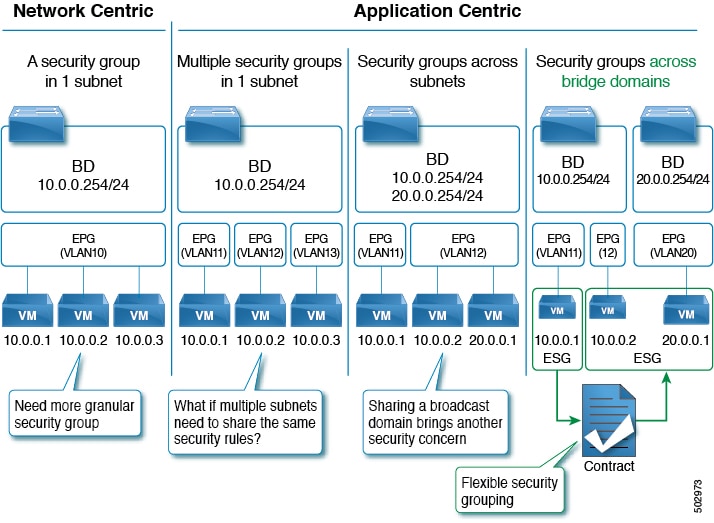
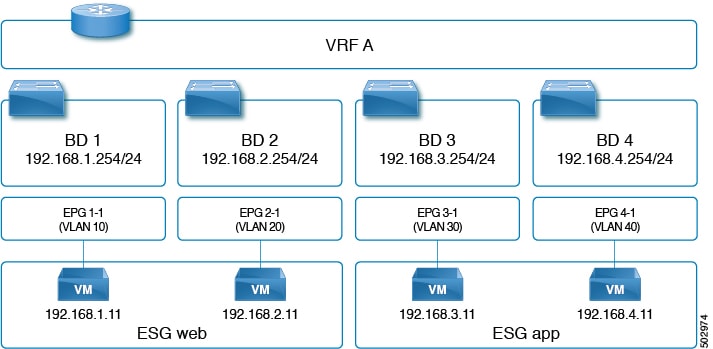
Endpoint security groups (ESGs) define security zones that can span multiple bridge domains within a single virtual routing and forwarding (VRF) instance.
An ESG is a logical collection of physical or virtual endpoints that share the same security requirements.
-
An ESG is associated with one VRF instance rather than one bridge domain.
-
Selectors classify endpoints into an ESG by attributes such as IPv4 addresses, IPv6 addresses, or endpoint tags.
-
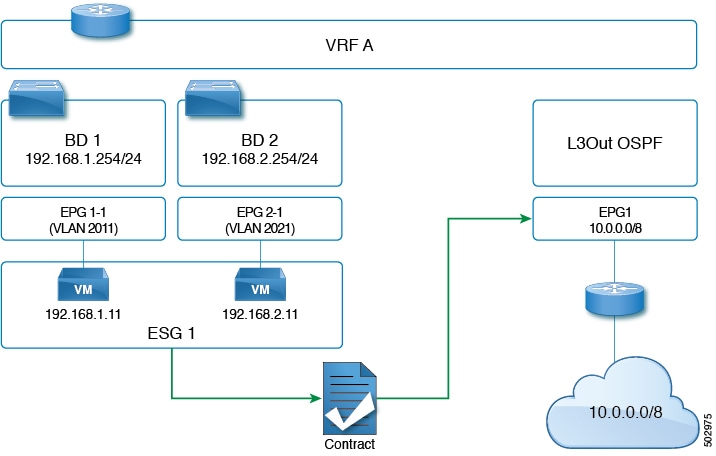
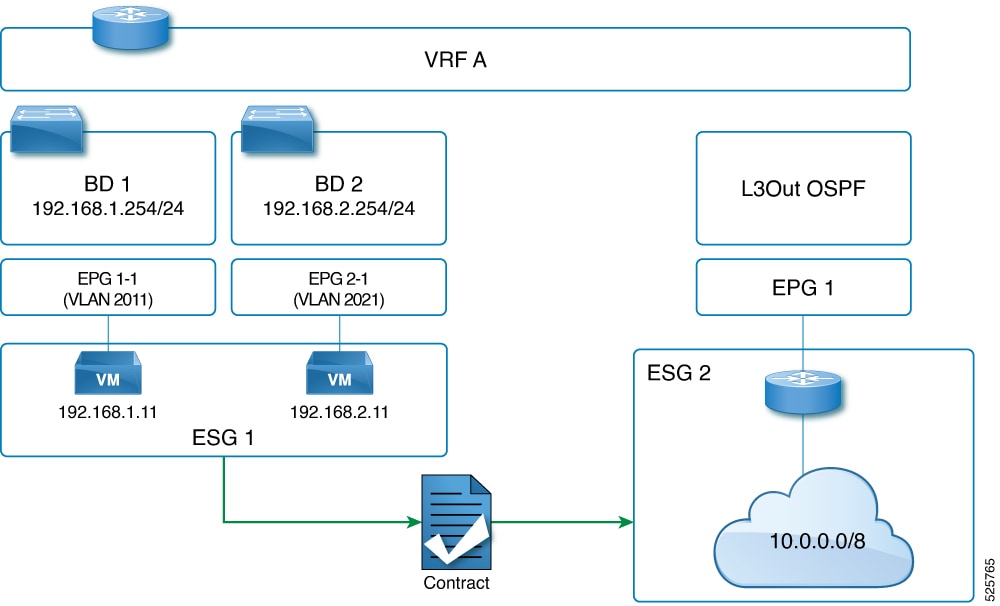
Contracts enforce communication policies between ESGs.
-
Endpoint groups (EPGs), bridge domains, and other networking objects continue to provide the forwarding configuration.
ESG membership and policy enforcement
ESGs separate security classification from the forwarding configuration of an EPG. This separation allows one security zone to include endpoints from different bridge domains in the same VRF instance.
-
A selector defines the matching criteria for ESG membership.
-
A contract defines the traffic that can pass between ESGs.
-
Endpoints on external devices can be classified into ESGs and communicate through contracts across the fabric.
Contracts between an EPG and an ESG are not supported.
EPG and ESG comparison
|
Attribute |
EPG |
ESG |
|---|---|---|
|
Association |
One bridge domain |
One VRF instance |
|
Segmentation function |
Forwarding and security segmentation |
Security segmentation |
|
Classification attributes |
VLAN and interface bindings |
IPv4 addresses, IPv6 addresses, and endpoint tags |
|
Contract usage |
Contracts between EPGs |
Contracts between ESGs |