Enables classification and marking of traffic based on BGP route attributes, allowing QoS policies to be applied according to routing information.
A QoS Policy Propagation via BGP (QPPB) mechanism is a Quality of Service (QoS) classification technique that
-
enables QoS classification by leveraging BGP attributes distributed through the BGP control plane
-
facilitates destination-based (or source-based) traffic classification by associating BGP routes with QoS groups, and
-
simplifies packet marking and prioritization without relying solely on access control lists (ACLs).
A QoS group is a numeric value associated with a route in the forwarding information base (FIB). The router uses this value to determine the traffic class or priority for packets that match that route.
| Feature Name |
Release Information |
Feature Description |
|---|---|---|
| QoS Policy Propagation via BGP |
Release 26.1.1 |
Introduced in this release on: Centralized Systems (8400 [ASIC: K100]) (select variants only*) *This feature is now supported on the Cisco 8404-SYS-D routers. |
| QoS Policy Propagation via BGP |
Release 25.4.1 |
Introduced in this release on: Fixed Systems (8010 [ASIC: A100])(select variants only*) *This feature is supported on:
|
| QoS Policy Propagation via BGP |
Release 25.1.1 |
Introduced in this release on: Fixed Systems (8010 [ASIC: A100])(select variants only*) *This feature is now supported on the Cisco 8011-4G24Y4H-I routers. |
| QoS Policy Propagation via BGP |
Release 24.4.1 |
Introduced in this release on: Fixed Systems (8200 [ASIC: P100], 8700 [ASIC: P100, K100])(select variants only*); Modular Systems (8800 [LC ASIC: P100])(select variants only*) *This feature is now supported on:
|
| QoS Policy Propagation via BGP |
Release 7.5.2 | You now have the ability to install a BGP route in the routing table with a QoS Group so that IP packets that match the route receive the QoS policies associated with the QoS group. This functionality enables convenient classification and marking when BGP is deployed, overcoming the administrative challenges of classifying based on ACLs. |
QPPB integration of BGP and QoS groups
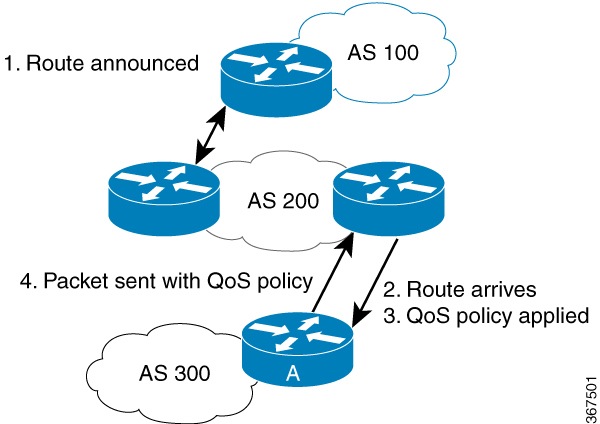
QPPB integrates the BGP control plane with the IP data forwarding plane. It uses routing policies and table maps to match specific prefixes learned through BGP neighbors and assigns a QoS group value. The FIB retains this value so the data plane can apply QoS actions such as remarking, shaping, or policing.
QPPB for Prioritizing Business-Critical Traffic
In an enterprise network, an administrator may want to prioritize mission-critical traffic, such as web-based business applications, over general data traffic. Using QPPB, the administrator can tag destination prefixes representing these business applications within the BGP route policy. When packets arrive at the ingress interface, the router automatically classifies and marks them according to their associated QoS group, ensuring consistent prioritization across the network.