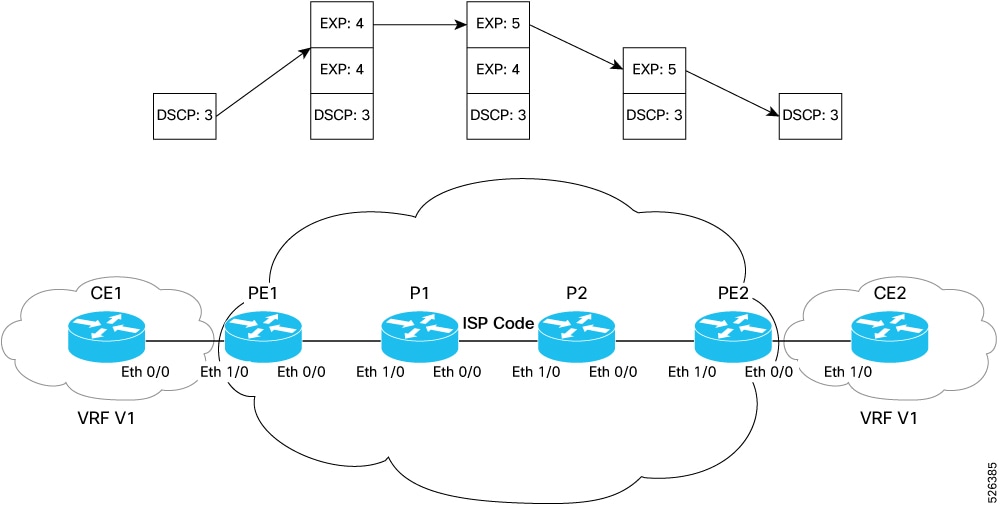
Details the short-pipe tunneling mode, which uses the inner IP DSCP value to determine packet treatment at the egress router after MPLS decapsulation. It outlines best practices and configuration steps to preserve end-to-end service differentiation for VPN and tunneled traffic.
Short-pipe mode is a QoS classification mechanism that
-
uses the Differentiated Services Code Point (DSCP) value from the inner IP header to determine packet treatment at the egress router
-
applies per-hop behavior (PHB) based on the original IP packet markings after MPLS decapsulation, and
-
preserves end-to-end service differentiation for user and application traffic as it exits the MPLS core.
| Feature Name |
Release Information |
Feature Description |
|---|---|---|
| Short-pipe mode |
Release 26.2.1 |
Introduced in this release on: Fixed Systems (8200 [ASIC: P100], 8700 [ASIC: P100, K100], 8010 [ASIC: A100]); Centralized Systems (8400 [ASIC: K100]); Modular Systems (8800 [LC ASIC: P100]) You can now prioritize MPLS-to-IP L3VPN traffic by explicitly applying short-pipe classification to packets undergoing MPLS disposition. This capability enables the router to classify MPLS-to-IP decapsulated packets using the DSCP value in the inner IP header and assign the appropriate traffic class or QoS group for queuing. Use the match mpls disposition class-map CLI command to associate a class map with MPLS disposition-based classification. The feature introduces this change: CLI: |
| Short-pipe mode |
Release 25.4.1 |
Introduced on Fixed Systems (8200 [ASIC:Q200], Centralized Systems (8600 [ASIC:Q200]), Modular Systems (8800 [LC ASIC: Q200]) Short-pipe mode ensures that your device applies QoS policies only to customer traffic, excluding network overhead such as tunnel headers or the MPLS encapsulation header. This helps you achieve fairer bandwidth allocation and better prioritization of user data, especially in service provider or large-scale enterprise networks. |