Outlines congestion detection and handling methods that monitor queue behavior, identify congestion conditions, and apply queue management actions to maintain traffic performance.
The table lists congestion detection and handling techniques. Each technique includes a brief description and an analogy to help you relate it to a real-world scenario.
| Technique |
Short Description |
Highway Traffic Analogy |
|---|---|---|
| Drops incoming packets once the queue reaches its configured limit; processes packets in arrival order with no traffic differentiation. |
Like a toll booth that shuts its gate when the line of cars reaches the maximum allowed length (no exceptions). |
|
| Moves a VOQ from on-chip Shared Memory System (SMS) to HBM when congestion thresholds are exceeded. |
Like diverting cars from the main highway lane to an overflow lane when the main lane gets jammed. |
|
| Configures two queue thresholds—one for high-priority traffic and one for low-priority traffic—to ensure critical flows continue during congestion. |
Like having an express lane that closes early to non-emergency vehicles so ambulances can always get through. |
|
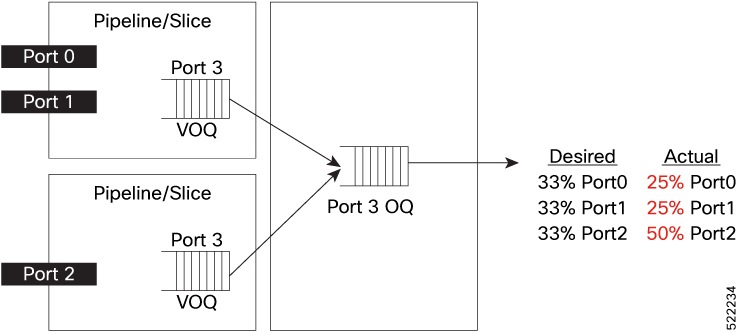
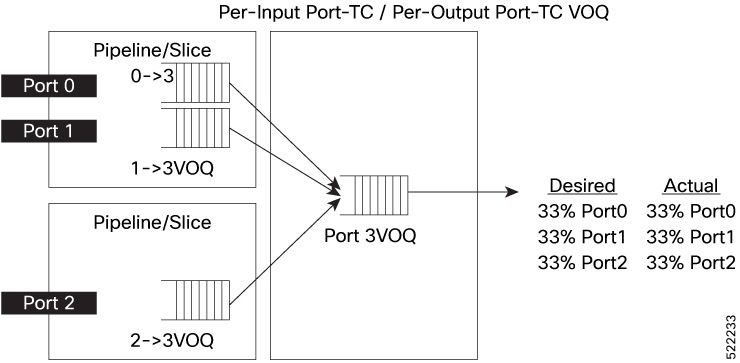
| Allocates dedicated Virtual Output Queues (VOQs) per source to destination port pair to ensure fair bandwidth distribution across ports. |
Like giving every on-ramp its own dedicated lane to the highway so no one ramp hogs the traffic flow. |
|
| Randomly drops packets before queues fill to signal senders to slow down, preventing sudden congestion. |
Like a traffic light that occasionally turns red early to prevent gridlock at an intersection. |
|
| Marks packets instead of dropping them to signal congestion, preserving flow without packet loss. |
Like flashing a warning sign telling drivers to slow down before a traffic jam, instead of stopping them completely. |
|
| Detects and clears VOQs that are stuck and not transmitting, even when packets are queued. |
Like a traffic sensor detecting a blocked lane and triggering a tow truck to clear it. |