Cisco Optical Network Planner Configuration Guide, Releases 26.x.x

PDF

Cisco Optical Network Planner

Want to summarize with AI?

Log in

Overview

Describes the functionality of this web application for modeling and validating optical networks, encompassing supported hardware platforms, various network topologies, protection schemes, service types, DWDM interfaces, and compatible fiber types for comprehensive network design.

Cisco Optical Network Planner is a web application that

  • models and tests Optical Transport Networks (OTN) and Dense Wavelength Division Multiplexing (DWDM) networks,

  • provides a graphical environment for network design and validation, and

  • supports creating and comparing multiple network instances.

Cisco ONP enables you to visualize their network designs. It allows you to generate bills of materials and access detailed reports for network planning and validation.

Purpose

The primary purpose of Cisco ONP is to design and validate networks for the NCS 1001, NCS 1004, NCS 1010, NCS 2000, and NCS 4000 series.

With Cisco ONP, you can create multiple instances of a network, modify various parameters for each instance, and perform comparisons. The tool generates a rack view of all the sites deployed in the network, highlights the differences between instances, and provides a complete Bill of Materials (BoM).

Detailed network information

Cisco ONP models the network and generates the BoM. You can view detailed reports, including:

  • Cabling report

  • Optical report

  • Device Configuration file

  • Traffic matrix

Features and compliance

You can use the features of Cisco ONP, including protection scenarios, topology and service support, to support protection scenarios, topology and service support, and compliance with the Cisco Secure Development Lifecycle (CSDL). You can also set up the graphical display.

Additional resources

For more detailed information about Cisco ONP, see the data sheet.

Supported platforms

Table 1. Feature History

Feature Name

Release Information

Feature Description

Support for NCS 1001 Network Creation

Cisco ONP Release 24.3.1

This release supports the design of C-band NCS 1001 networks. The NCS 1001 is a 1RU, DWDM line system optimized for data center environments. It includes support for amplifiers, PSM modules, and various colored add/drop modules such as MD-32-EVEN, FLD-4, MD-48-ODD, MD-48-EVEN, and MD-64.

Cisco ONP supports unprotected, terminal section, and terminal path protection over the NCS 1001 network. Also, the NCS 1001 network is compatible with optical sources such as NCS 1004, CIM8, Bright ZR, QDD, and CFP2.

Addition of new NCS 1020 Chassis for NCS 1010 Networks

Cisco ONP Release 24.3.1

NCS 1020 is a 10RU optical line system that supports the OLTs and NCS1K14-CCMD-16-C card in the NCS 1010 networks. The NCS 1020 chassis optimizes the NCS 1010 networks design, extending the reach of NCS 1010 networks. With OLTs and NCS1K14-CCMD-16-C, the NCS 1020 chassis provides a wide range of configuration options to NCS 1010 networks.

Cisco ONP supports these platforms:

Table 2. Supported platforms and releases

Platforms

Recommended and Supported Releases

NCS 1001

7.10.1, 25.4.1

NCS 1014

24.3.1, 25.1.1, 26.1.1

NCS 1010

7.10.1, 7.11.1, 24.3.1, 25.1.1, 26.1.1

NCS 2000

11.1.0, 25.1.1, 26.1.1

NCS 4000

6.5.33


Supported topologies

Cisco ONP supports several network topologies, each offering different configurations and benefits.

  • Linear topology: In a linear topology, the nodes are arranged in a line and are connected to two adjacent nodes. However, the first and last nodes are not connected to each other.

  • Mesh topology: In a mesh topology, each node is connected to one or more nodes. This configuration provides maximum redundancy to the network.

  • Ring topology: In a ring topology, each node is connected to exactly two other nodes, forming a circular configuration. It requires at least three nodes to form a ring.


Supported protection schemes

Cisco ONP offers a variety of protection schemes to enhance network reliability and resilience.
Table 3. Feature History

Feature Name

Release Information

Feature Description

Protection Types Supported

Cisco ONP Release 4.1

The following protection schemes are supported:

  • 1+R: For each service, Cisco ONP automatically finds one working path. You can define the restoration path.

  • 1+1+R: For each service, Cisco ONP finds one working path, and one protected path. You can define the restoration path.

  • 1+1+R+R: For each service, Cisco ONP finds one working path and one protected path. You can define the restoration paths.

Cisco ONP offers a variety of protection schemes to enhance network reliability and resilience.
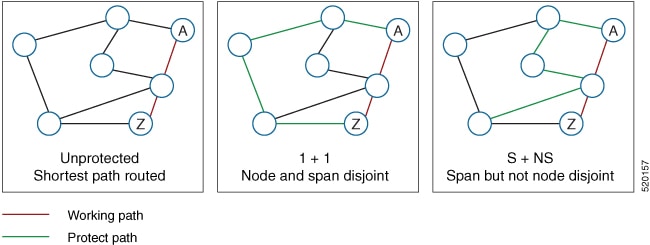
Figure 1. Protection schemes

Supported protection schemes include:

  • Unprotected: In unprotected mode, the tool routes the service on the shortest path without any backup.

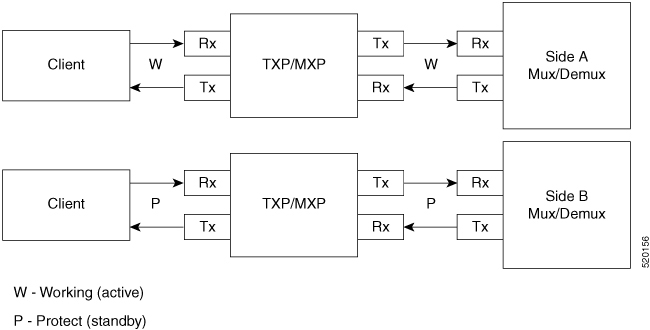
  • 1+1: In this scheme, two client signals are transmitted to separate line cards or transponder cards, rather than using a Y-cable to split one client signal into two. Client 1+1 protection allows the client system to control failure events and to manage the switchover.

    Figure 2. 1+1 protection
  • 1+R: Supported on SSON networks, this scheme allows Cisco ONP to automatically find one working path for each service. You can define the restoration path.

  • 1+1+R: Also supported on SSON networks, this scheme involves Cisco ONP finding one working path and one protected path for each service, and users can define the restoration path.

  • 1+1+R+R: Supported on SSON networks, this scheme involves Cisco ONP finding one working path and one protected path. You can define additional restoration paths.

  • S+NS: Supported on both SSON and non-SSON NCS 4000 and NCS 2000 networks, Cisco ONP uses the shortest path for the working service and the next shortest path for protection. The paths are span-disjoint but not node-disjoint

  • Unprotected disjoint: Supported on both SSON and non-SSON NCS 4000-NCS 2000 network, this scheme provides two cards following two completely disjoint paths in the network to reach their destination.

  • PSM-Channel protection: This protection scheme is supported on NCS 2000 non-SSON networks.


Supported services

Cisco ONP supports these OTN, Ethernet, and STS services.

  • ODU demands:

    • ODU-1

    • ODU-2

    • ODU-3, and

    • ODU-4

  • Ethernet services:

    • GE

    • 10GE

    • 100GE

    • 400GE

      The 400GE service is supported on the NCS 1010 networks.

  • Synchronous Transport Signal (STS) services:

    • STS-3

    • STS-12

    • STS-48

    • STS-192

  • Virtual Container (VC) services:

    • VC-4-4

    • VC-4-16

    • VC-4-64

  • Synchronous Transport Module services such as STM-64.


Supported DWDM Channel Interfaces

Cisco ONP supports several DWDM channel interfaces that provide high-capacity optical transport and are compatible with industry-standard wavelengths. For more information about the DWDM channel interfaces supported by Cisco ONP, see Supported Cards and Pluggables and Supported Optical Sources.


Supported fiber types

Cisco ONP supports these fiber types.
  • Standard single-mode fibers:

    • G652-SMF

    • G652-SMF-28E

    • SMF-28 ULL (only NCS 1010)

    • SMF28-Ultra (only NCS 1010)

  • True Wave fiber series:

    • True Wave Reach

    • True Wave RS

    • True-Wave Plus

    • True-Wave Minus

    • True-Wave Classic

  • Other type of fibers:

    • Free-Light

    • Tera-Light

    • Metro-Core

    • ELEAF

    • NDSF (only NCS 1010)

    • ALLWave (only NCS 1010)