Release Notes for Cisco Agile Metro, Release 2.0
Available Languages
Bias-Free Language
The documentation set for this product strives to use bias-free language. For the purposes of this documentation set, bias-free is defined as language that does not imply discrimination based on age, disability, gender, racial identity, ethnic identity, sexual orientation, socioeconomic status, and intersectionality. Exceptions may be present in the documentation due to language that is hardcoded in the user interfaces of the product software, language used based on RFP documentation, or language that is used by a referenced third-party product. Learn more about how Cisco is using Inclusive Language.
- US/Canada 800-553-2447
- Worldwide Support Phone Numbers
- All Tools
 Feedback
 Feedback
Cisco Agile Metro, Release 2.0
Cisco Agile Metro, Release 2.0
Cisco Agile Metro Release 2.0 introduces advanced automation and enhanced scalability with key features such as Provider Connectivity Assurance User Experience (PCA UE) for real-time traffic visibility and AI-driven insights using Crosswork AI. The release also integrates Cisco Crosswork Network Controller 7.2, offering flexible device templates, software lifecycle management, and enhanced routing analytics for improved network reliability. These enhancements deliver greater operational efficiency, scalability, and consistent service assurance across multi-vendor environments.
The release also introduces the support for a set of new hardware, powered by Cisco Silicon One, thereby enhancing hardware capabilities of Agile Metro solution.
Cisco Agile Metro overview
Cisco Agile Services Networking is an architecture evolution of Cisco Converged SDN Transport (CSDN-T) that is focused on converging network infrastructure in multiple dimensions to change the way networks are built. The Metro solution considers edge as a set of functions which can be enabled anywhere in the network.
Cisco Agile Metro is a dynamic and flexible edge solution that is part of Cisco Agile Services Networking. The solution introduces new Silicon One A100, K100, and P100-based fixed and centralized routers and line cards to deliver improved experiences for residential, business and mobile services with a network that is simpler and more cost-effective to build, operate, and scale from locations closer to end-users.
Benefits of Agile Metro
These are the key benefits of Agile Metro:
· Technology benefits:
· High-capacity edge silicon
· Convergence of network service functions
· Flexible network design and systems to fit any size location in the network
· Business benefits:
· Deliver services closer to users and applications
· Cost savings
· Sustainability benefits
· Operational benefits:
· Improved services resilience
· Network efficiency
· Enhanced operations through network automation and orchestration
Agile Metro architecture
Metro network evolution is driven by increasing bandwidth demands, resulting in network functions distributed in the network closer to the end user. This evolution is driving a consequent network architecture evolution. The classical split between access, pre-aggregation, aggregation, and edge leaves room for a more homogeneous network without distinct boundaries between the domains.
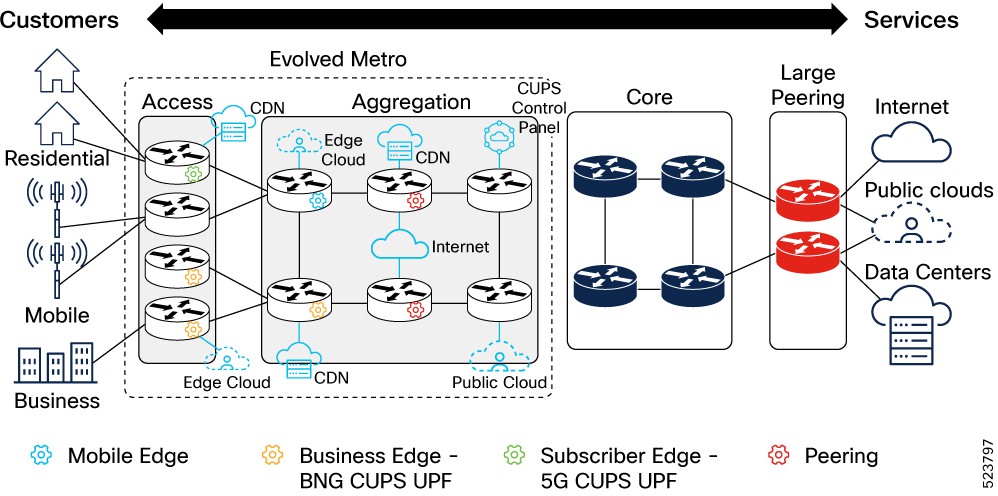 |
The Agile Metro architecture focuses on these key aspects:
• Enhanced scale and resiliency through distributed networking
• Simplified packet transport and overlay services
• Simplified and converged business, residential, and transport infrastructure
• Enhanced automation
Metro Edge Fabric
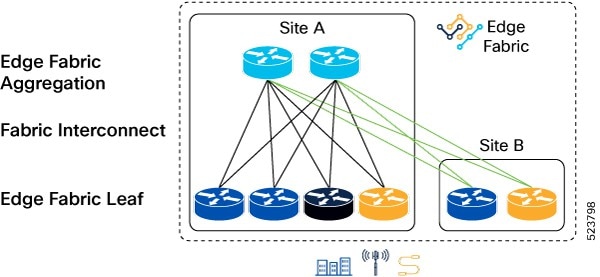
The Metro Edge Fabric is a component of Cisco Metro solution architecture that is designed to provide scalable edge services termination. The Metro Edge Fabric is designed to enhance network efficiency and scalability by separating network functions into distinct physical layers. Cisco Fabric-based Edge solution is a composition of multiple routers in a leaf-spine architecture to accommodate required functionality and scale that cannot be met in a standalone multi-service edge (MSE) model.
 |
Network technologies and protocols
The table gives a comparison of the common network technologies and protocols that are used in legacy networks vs. the Agile Metro
Table 1. Common network technologies and protocols used in legacy networks versus the Agile Metro
| Network technology and protocol |
Legacy network |
Agile Metro |
|
| xVPN Services |
LDP |
BGP |
BGP for all L2VPN, and L3VPN |
| IP Network Scaling |
BGP-LU |
Segment Routing |
|
| Traffic Engineering Fast Reroute
|
RSVP-TE |
Segment Routing |
|
| MPLS Overlay Protocol |
RSVP-TE |
LDP |
Segment Routing |
| IPv6 Transport Overlay |
None |
Segment Routing |
|
| IP to DWDM Transition |
Transponder or Muxponder |
Routed Optical Networking |
|
| Grey Router Interface |
Routed Optical Networking |
||
| Private Line Services |
Dedicated OTN |
Dedicated Ethernet over DWDM |
Private Line Emulation |
| Subscriber BNG |
Physical Integrated BNG |
Cisco CUPS using Cloud Native BNG |
|
| PON Access |
Dedicated PON Equipment |
Cisco Routed Passive Optical Networking |
|
Key pillars of Agile Metro architecture
These are the key pillars of Agile Metro architecture:
• Wide range of supported interfaces:
• 1/10/25/50/100/400GE and beyond on unified family of Metro devices
• Any speed user–network interface (UNI) with any service
• High speed network-to-network interfaces (NNI) and Routed Optical Networking
• Simplified connectivity model and protocols:
• Segment Routing IPv6 (SRv6) and SR-MPLS underlay networks; SRv6-TE and SR-MPLS TE for advanced Traffic Engineered use cases
• Secured infrastructure using Trusted Cisco platforms and advanced distributed DDoS protection
• Co-existence with legacy underlay and overlay technologies
• Business, residential, and mobile subscriber services:
• EVPN and L3VPN in services layer
• Private Line Emulation (PLE) for bit-transparent transport of Ethernet and non-Ethernet (OTN, SONET, Fiber Channel)
• Next-generation subscriber edge using control plane and user plane separation (CUPS)
• Converged business and subscriber access using Cisco Routed PON
• High performance end-to-end timing and synchronization
• Automation across all components in the architecture covering provisioning, monitoring, and service assurance
High-level use cases of Agile Metro
The Agile Metro architecture covers these high-level use cases:
• Next-generation residential subscriber networks deployments
• Enterprise business services
• Mobile network IP transport
• Centralized and edge datacenter connectivity including networks that are built to support artificial intelligence
• Internet peering, content delivery, and cloud connectivity
Table 2. New software features for Agile Metro, Release 2.0
| Feature |
Description |
| Provider Connectivity Assurance User Experience |
Provider Connectivity Assurance User Experience (PCA UE) is an automation solution that provides real-time visibility into user traffic flows, provides intelligent reporting of user traffic flows, and Quality of Experience (QoE) metrics for individual users. It also combines the user data with underlying transport infrastructure data to give an end-to-end view of the entire service. The solution provides quick access and visualization tools with real-time actionable AI insights. It characterizes any type of traffic and encapsulation including QUIC, TCP, UDP, GTP, and MPLS/SR/SRv6. It offers visibility at the granularity of individual cell sites and applications |
| Cisco Crosswork Network Controller 7.2 use cases |
Cisco Crosswork Network Controller (CNC) 7.2 enhances Agile Metro deployments with advanced automation and analytics. Key features include: · Golden configuration for standardized, compliant device setups · Routing analytics for real-time and historical path monitoring, and · AI-driven predictive analytics to proactively identify and address network issues. These capabilities support consistent operations, faster troubleshooting, and improved network reliability across multi-vendor environments. |
Table 3. New hardware support for Agile Metro, Release 2.0
| Product impact |
Feature |
Introduced Cisco IOS XR software release |
| The Cisco 8711-48Z-M is a high-performance, fixed-port router built on the advanced K100 silicon chip, delivering up to 5.6 Tbps of network bandwidth. Designed in a compact, one rack-unit form factor, it is ideal for high-density deployments. The 8711-48Z-M supports a range of high-speed interfaces, including QSFP-DD 400GbE, QSFP 200GbE, and SFP56 ports. |
25.4.1
|
|
| 8011-12G12X4Y-A 8011-12G12X4Y-D
|
The Cisco 8011-12G12X4Y-A and 8011-12G12X4Y-D are fixed-port routers powered by the A100 silicon chip, delivering up to 244 Gbps of network bandwidth. These medium-density routers feature a compact, one rack-unit (1RU) form factor, making them well-suited for space-constrained environments. Both models offer flexible connectivity with support for 1/10/25G SFP28, 1/10G SFP10, and 1G cSFP ports. |
25.4.1
|
| The Cisco 8011-32Y8L2H2FH is a high-performance, fixed-port router powered by the A100 silicon chip, offering up to 1.6 Tbps of network bandwidth. Designed in a compact one rack-unit (1RU) form factor, it is ideal for high-density environments. This model provides flexible connectivity options, supporting 400G QSFP-DD, 100G QSFP28, 10/25/50G SFP56, and 1/10/25G SFP28 ports. |
25.4.1
|
There are no changes in behavior in this release.
There are no open issues in this release.
To know about the open caveats associated with the Cisco Agile Metro components, see the product Release Notes for the respective release.
• Release Notes for Cisco IOS XR Software products
• Release Notes for Cisco Crosswork Network Controller
Agile Metro components
The table lists the main hardware and software components of Agile Metro release 2.0 and their compatible versions.
Table 4. Compatibility matrix for Agile Metro components
| Agile Metro component |
Hardware or software component |
Version |
| Cisco routers |
Cisco IOS XR Software release 25.4.1 |
|
| Cisco IOS XE Software release 17.15.4c |
||
| Cisco Catalyst SD-WAN Solution |
Not applicable |
|
| Edge Fabric Management |
Metro Fabric Manager Function Pack |
1.0 |
| DDoS Controller |
Cisco Secure DDoS Edge Protect |
25.09.01.3774
|
| IP Controller |
7.2.0
|
|
| Multi-Layer Controller |
11.0 |
|
| Network Services Orchestrator |
6.4.8.1
|
|
| Workflow Management |
2.1 |
|
| SD-WAN Controller |
20.15.4.1
|
|
| Provider Connectivity Assurance Sensor Management |
CPCA Sensor Control |
25.07.2 |
| CPCA Legacy Orchestrator |
24.09.1 |
|
| PON Management |
5.0 |
|
| CUPS Control Plane |
2025.04.0 with Cloud Native Deployment Platform |
|
| CUPS User Plane |
Cisco Cloud Native BNG (cnBNG) User Plane: Cisco ASR 99XX modular chassis with Cisco ASR 9000 5th generation High Density Ethernet line cards: |
25.4.1 |
| CNBNG SMI-NSO CFP |
2025.04.0 |
Automation components of Agile Metro
The table lists the main automation components of Agile Metro and their compatible versions.
Table 5. Automation components of Agile Metro and their compatible versions, Agile Metro Release 2.0
| Automation component |
Component version |
| 7.2 |
|
| 11.0 |
|
| 6.4.8.1 |
|
| 2.1 |
|
| 2025.04.0 with Cloud Native Deployment Platform (CNDP) 25 |
|
| Cisco Cloud Native BNG NSO SMI Deployer |
2025.04.0 |
| Crosswork Planning |
7.1.1 |
| Cisco Provider Connectivity Assurance |
24.2 |
| CX Fabric Manager |
1.0 |
Supported Cisco IOS XR routing products for Agile Metro
Table 6. The table lists the supported Cisco IOS XR routing products for Agile Metro.
| Product |
Product ID |
Introduced Agile Metro release |
| Cisco ASR 9000 Series Routers |
ASR 9902 ASR 9903 |
1.0 |
| Cisco 8000 Series Routers (Q200-based) |
8201-24H8FH 8201-32FH 8202-32FH-M
|
1.0 |
| Cisco 8608 (Centralized): 86-MPA-14H2FH-M 86-MPA-24Z-M 86-MPA-4FH-M |
1.0 |
|
| Cisco 8000 Series Routers (P100-based) |
8711-32FH-M 8212-48FH-M |
1.0 |
| Cisco 8000 Series Routers (K100-based) |
8712-MOD-M |
1.0 |
| 8711-48Z-M |
2.0 |
|
| Cisco 8000 Series Routers (A100-based) |
8011-4G24Y4H-I |
1.0 |
| 8011-12G12X4Y-A 8011-12G12X4Y-D 8011-32Y8L2H2FH |
2.0 |
|
| Cisco NCS 5500 Series Routers |
NCS 55A1: NCS-55A1-24Q6H-S NCS-55A1-24Q6H-SS (MACsec) |
1.0 |
| Cisco NCS 55A2 Series Routers Cisco NCS 57C3 Series Routers |
NCS-55A2-MOD-SE NCS-57C3-MOD-SE-S NCS-55A2-MOD-S NCS-57C3-MOD-S |
1.0 |
| Cisco NCS 5700 Series Routers |
NCS-57B1-5DSE-SYS NCS-57B1-6D24-SYS NCS-57D2-18DD NCS-57C1-48Q6-SYS |
1.0 |
| Line cards for Cisco NCS 5500 Series Routers |
NC57-48Q2D-S NC57-48Q2D-SE-S NC57-36H6D-S |
1.0 |
| Cisco NCS 540 Series Routers |
N540-24Z8Q2C-SYS N540-ACC-SYS N540-24Q8L2DD-SYS N540X-16Z4G8Q2C-D/A N540-28Z4C-SYS-D/A |
1.0 |
| Cisco IOS XRv 9000 Router |
Cisco IOS XRv 9000 |
1.0 |
| Cisco IOS XRd virtual router |
Cisco IOS XRd vRouter |
1.0 |
Table 7. Related resources
| Resource |
Description |
| Cisco Agile Metro Solution Guide
|
Provides architectural overviews and deployment best practices for metro-area network designs. |
|
|
Offers comprehensive guides for managing wide-area networks through software-defined automation and security. |
| Explains how to achieve multi-layer, multi-vendor visibility and control across IP and optical networks. |
|
| Provides details on automating and optimizing service provider networks via centralized SDN control. |
|
| Details the model-driven framework for automating the full lifecycle of complex network services. |
|
| Guides users through designing and executing automated workflows to streamline operational tasks. |
|
| Covers the architecture and configuration of the virtualized control plane for Broadband Network Gateway solutions. |
|
| Focuses on the high-performance packet processing and traffic management aspects of the virtualized BNG. |
|
| Provides information on monitoring service levels and ensuring end-to-end performance for service provider links. |
|
| Explains the integration of IP and optical layers into a single, unified network architecture. |
|
| Detailed guide on deploying PON technology within a routed architecture for efficient last-mile delivery. |
Cisco and the Cisco logo are trademarks or registered trademarks of Cisco and/or its affiliates in the U.S. and other countries. To view a list of Cisco trademarks, go to this URL: www.cisco.com/go/trademarks. Third-party trademarks mentioned are the property of their respective owners. The use of the word partner does not imply a partnership relationship between Cisco and any other company. (1110R)
Any Internet Protocol (IP) addresses and phone numbers used in this document are not intended to be actual addresses and phone numbers. Any examples, command display output, network topology diagrams, and other figures included in the document are shown for illustrative purposes only. Any use of actual IP addresses or phone numbers in illustrative content is unintentional and coincidental.
© 2026 Cisco Systems, Inc. All rights reserved.