An omnidirectional topology is a network architecture that
enables each optical channel to be dynamically routed through any available degree of a multidegree node,
allows channel rerouting after fiber cuts without requiring physical fiber reconnections, and
supports flexible and scalable add/drop configurations for redundancy or increased capacity.
Omnidirectional topologies are often implemented in optical networks using open-line terminal (OLT) hardware and compatible passive modules. They are supported over C+L bands and can scale beyond four network degrees. Dual omnidirectional add/drop configurations provide increased reliability and add/drop bandwidth.
NCS2K-MF-4x4-COFS based colorless omnidirectional topologies
A colorless omnidirectional topology is an optical network configuration that
uses colorless modules to add or drop channels without wavelength constraints,
aggregates and routes channels from multiple degrees using compatible passive hardware assemblies, and
enables retuning of channel frequencies or wavelengths from connected transponders or muxponders without physical cabling changes.
Topology components
To build this topology, you need these hardware:
NCS 1010 OLT devices
NCS2K-MF-4x4-COFS modules
NCS2K-MF-MPO-8LC modules
NCS1K-BRK-8 modules
Specific cable configurations for interconnecting the modules:
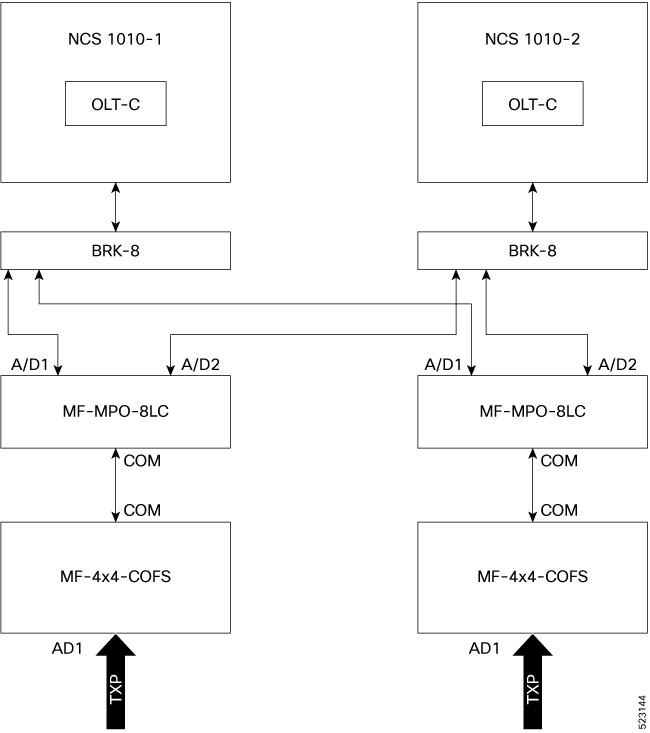
The MF-4x4-COFS modules are interconnected using standard MPO 8 or 12 fibers (15454-MPO-MPO-x or ONS-12MPO-MPO-x )
The MF-4x4-COFS modules and NCS1K-BRK-8 module are interconnected using standard LC-LC fibers.
This image shows the COFS-based colorless omnidirectional topology
Figure 1. MF-4x4-COFS based colorless omnidirectional topology
Limitations
This configuration is supported only for C-band ROADM.
This configuration is scalable only up to a maximum of 4 degrees. More OSNR penalty is induced by the MF-4x4-COFS as you add more degrees.
One MF-4x4-COFS module can support up to only four channels. To scale up to 32 channels, you would require 8 MF-4x4-COFS modules.
The terminal node in this configuration can be connected only to NCS 1004 line cards, line cards with CFP2-400G-DCO as a trunk interface, and DP04QSDD pluggable.
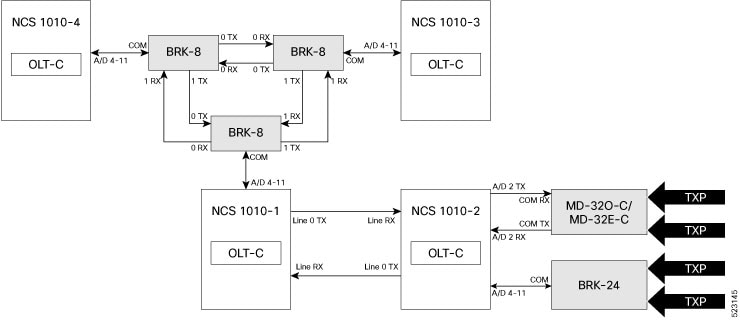
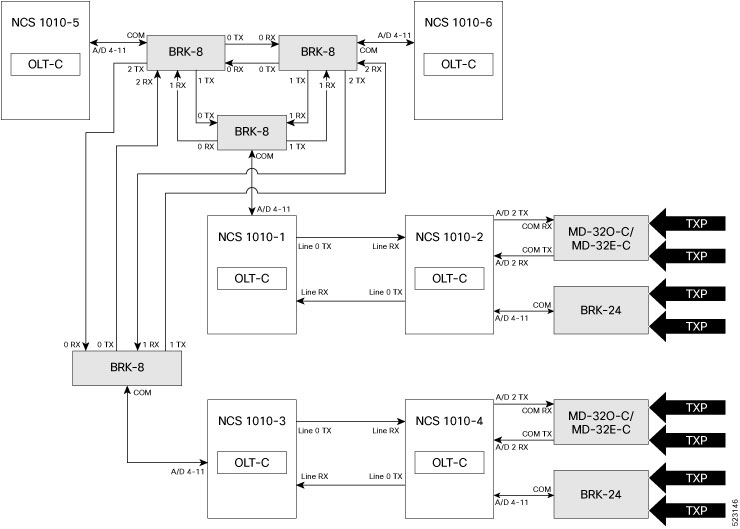
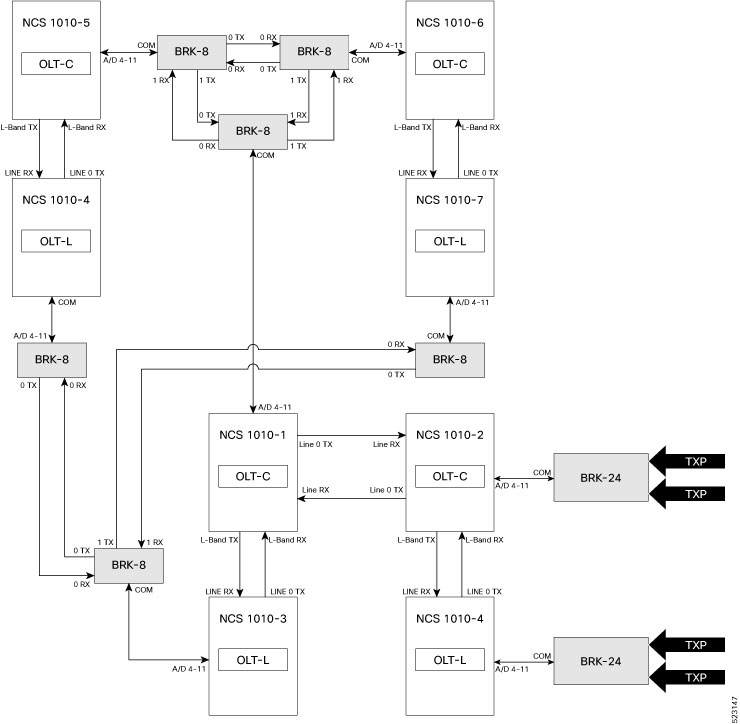
OLT-based omnidirectional add/drop topologies
OLT-based omnidirectional add/drop topologies are optical network designs that
implement omnidirectional routing by interconnecting OLT devices such as OLT-C and OLT-L back-to-back,
enable multiple add/drop stages within a single ROADM site, improving flexibility and scalability, and
support integration with a variety of transponders and trunk interfaces without major restrictions.
Topology components
To build this topology, you need these hardware:
NCS 1010 OLT-C devices
NCS 1010 OLT-L devices
NCS1K-BRK-24 modules
NCS1K-BRK-8 modules
NCS1K-MD32-C modules
Specific configurations and applications that are required for this configuration:
The interconnection between the terminal OLT-C, where the traffic is terminated and the omnidirectional degree is managed as a 0dB span.
OSC-C and OSC-L controllers can be used with unnumbered IP on OSC interfaces of the omni span.
Link tuner and Gain estimator must be disabled on the Omni span.
APC must be enabled on Omni span.
ASE loading is enabled (both static and dynamic).
Specific configuration for optical applications such as span length and fiber type are not required.
To have the Preamplifier of OLT-C working in proper condition (minimum gain 12dB), the Line-Tx PSD must be set to –12.9 dBm/12.5 GHz (considering 80% CH_SD).