IP Addresses and Services Configuration Guide for Cisco 8000 Series Routers, IOS XR Releases

PDF

IP Addresses and Services Configuration Guide for Cisco 8000 Series Routers, IOS XR Releases

VRRP over BVI

Want to summarize with AI?

Log in

This topic describes how VRRP runs over Bridge-Group Virtual Interfaces (BVIs) to provide default gateway redundancy for a LAN, including supported scale and topology.


The VRRP session over a Bridge-Group Virtual Interface (BVI) is a redundancy configuration that

  • provides default gateway protection for a LAN

  • enables a group of routers to behave as a single virtual gateway, and

  • utilizes a routed interface to manage bridge group traffic.

Layer 2 functionality is applicable to the interfaces which are part of a bridge group and BVI is the routed interface for that bridge group.

The network architecture assigns the primary role to the router with the highest priority, while all other routers function as backups. The Bridge-Group Virtual Interface (BVI) provides Layer 3 functionality to a bridge group, which allows the system to treat a bridged network as a routable entity. Configure VRRP sessions on the BVI to ensure that the redundancy protocol functions correctly within the bridge group environment.

These are the requirements for configuring these sessions:

  • The system designates the router with the highest priority as the primary gateway.

  • The BVI acts as the routed interface that enables Layer 3 functionality for the bridge group.

  • Administrators restrict the configuration of VRRP sessions to the BVI to maintain compatibility.

Table 1. Feature History Table

Feature Name

Release Information

Feature Description

VRRP over BVI

Release 26.2.1

Introduced in this release on: Fixed Systems (8010 [ASIC: A100])

This feature is supported on:

  • 8011-4G24Y4H-I

  • 8011-32Y8L2H2FH

  • 8011-12G12X4Y-A/D

VRRP over BVI

Release 26.1.1

Introduced in this release on: Centralized Systems (8400 [ASIC: K100]) (select variants only*)

*This feature is supported on Cisco 8404-SYS-D router.

VRRP over BVI

Release 25.4.1

Introduced in this release on: Fixed Systems (8700 [ASIC: K100])(select variants only*)

* This feature is supported on:

  • 8712-MOD-M

  • 8711-48Z-M

VRRP over BVI

Release 25.2.1

Introduced in this release on: Fixed Systems (8200 [ASIC: P100], 8700 [ASIC: P100])(select variants only*); Modular Systems (8800 [LC ASIC: P100])(select variants only*)

*This feature is supported on:

  • 8212-48FH-M

  • 8711-32FH-M

  • 88-LC1-36EH

VRRP over BVI

Release 25.1.1

Introduced in this release on: Modular Systems (8800 [LC ASIC: P100])(select variants only*)

*This feature is supported on:

  • 88-LC1-12TH24FH-E

  • 88-LC1-52Y8H-EM

VRRP over BVI

Release 7.5.2

Virtual Router Redundancy Protocol (VRRP) runs on top of interfaces of multiple routers in the same home network that has both Cisco and other vendor routers. It allows a group of routers to behave as a single virtual default gateway router, thereby providing default gateway redundancy and minimizing traffic loss. VRRP now supports Bridge-Group Virtual Interface (BVI), which means that VRRP sessions can run between BVI interfaces of multiple routers.

Topology

This topology showcases how VRRP functions over BVI.
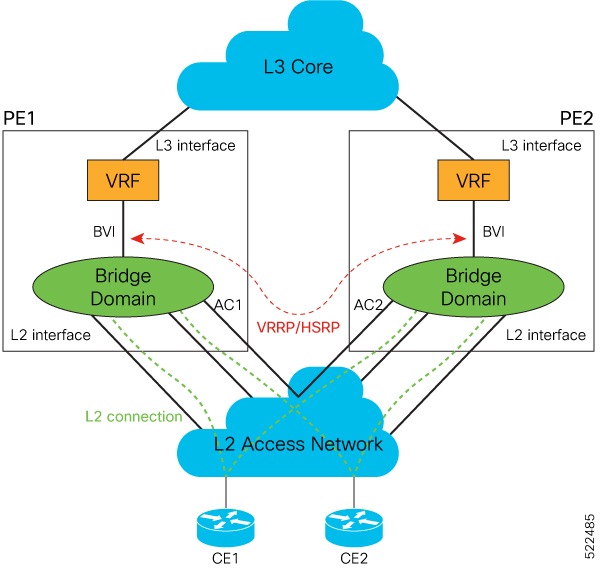
In this topology, PE1 and PE2 are paired in a redundant group. This group provides Layer 3 gateway service to CE1 and CE2. VRRP is configured over BVI interfaces on PE1 and PE2. VRRP ensures one BVI is the active gateway. The other is the standby gateway.

You can configure one of the BVIs to be active and the other BVI as standby by setting the VRRP priority value. The active BVI is programmed with the virtual MAC address chosen by VRRP. Hosts, CE1 and CE2 send the traffic to the virtual destination MAC address and the active BVI forwards the traffic.

During failover, the standby BVI becomes active and is programmed with the virtual MAC address. The traffic from the hosts is forwarded through this active BVI.

Supported scale and systems

VRRP over Bridge Virtual Interfaces (BVIs) is supported:

  • You can configure upto 512 VRRP groups (IPv4 and IPv6 combined) over BVIs on:

    • Cisco Silicon One Q100 ASIC-based systems

    • Cisco Silicon One Q200 ASIC-based systems

    • Cisco Silicon One P100 ASIC-based systems

  • Where the underlay IRB bridge domains consist of bridge members on L2 main or subinterfaces. Only physical and bundle interfaces are supported for L2 bridging in IRB.

  • When both IPv4 and IPv6 are configured on a BVI interface, IPv4 and IPv6 each requires a session. A total of two sessions are consumed on a BVI interface.

  • For IPv4 and IPv6 configurations, in both the default and VRF tables.

  • On both the fixed and distributed systems.

  • VRRP on BVI is supported on the 88-LC1-12TH24FH-E line card from Cisco IOS XR Release 25.1.1.


Restrictions for VRRP over BVI

Consider these restrictions before you configure VRRP over BVIs:
  • The minimum supported VRRP Hello timer is 100 ms. At the minimum timer, a total of 50 sessions are supported. Above 100 ms timers, the sessions scale goes up proportionately. A maximum of 255 VRRP groups and 510 sessions are supported.

  • VRRP on BVI is not supported on the 88-LC1-12TH24FH-E line card in Cisco IOS XR Release 24.3.1.


Configure VRRP over BVI

To configure VRRP sessions over BVI, complete the following configurations on PE1 and PE2 in the specified order:

  1. Configure a set of interfaces as Layer 2 interfaces and a set of VLAN sub-interfaces.

  2. Configure a bridge group.

  3. Configure a BVI.

  4. Configure VRRP over BVI.

Procedure

  1. Enter the global configuration mode and configure a set of interfaces as Layer 2 interfaces and a set of VLAN sub-interfaces.

    Example:

    Router# configure
    Router(config)# interface HundredGigE0/0/1/0.1 l2transport
    Router(config-subif)# encapsulation dot1q 1
    Router(config-subif)# rewrite ingress tag pop 1 symmetric
    Router(config-subif)# commit
    Router(config-subif)# exit
    Router(config)# interface HundredGigE0/0/1/1.1 l2transport
    Router(config-subif)# encapsulation dot1q 1
    Router(config-subif)# rewrite ingress tag pop 1 symmetric
    Router(config-subif)# commit
    Router(config-subif)# exit
  2. Enter the Layer 2 VPN configuration mode and configure a bridge group.

    Example:

    Router(config)# l2vpn
    Router(config-l2vpn)# bridge group 5
    Router(config-l2vpn-bg)# bridge-domain 5
    Router(config-l2vpn-bg-bd)# interface HundredGigE0/0/1/0.1
    Router(config-l2vpn-bg-bd-ac)# exit
    Router(config-l2vpn-bg-bd)# interface HundredGigE0/0/1/1.1
    Router(config-l2vpn-bg-bd-ac)# exit
    Router(config-l2vpn-bg-bd)# routed interface BVI 10
    Router(config-l2vpn-bg-bd-bvi)# commit
    Router(config-l2vpn-bg-bd-bvi)# exit
  3. Configure a BVI in the global configuration mode.

    Example:

    Router(config)# interface BVI 10
    Router(config-if)# ipv4 address 209.165.200.225 255.255.255.0
    Router(config-if)# ipv6 address 2001:DB8:A:B::1/64
    Router(config-if)# commit
  4. Configure VRRP over BVI in the global configuration mode for the IPv4 address.

    Example:

    Router(config)# router VRRP
    Router(config-vrrp)# interface BVI 10
    Router(config-vrrp-if)# address-family ipv4
    Router(config-vrrp-address-family)# VRRP 10
    Router(config-vrrp-virtual-router)# priority 101
    Router(config-vrrp-virtual-router)# address 209.165.200.226
    Router(config-vrrp-virtual-router)# commit
  5. Configure VRRP over BVI in the global configuration mode for the IPv6 address.

    Example:

    Router(config)# router VRRP
    Router(config-vrrp)# interface BVI 10
    Router(config-vrrp-if)# address-family ipv6
    Router(config-vrrp-address-family)# VRRP 11
    Router(config-vrrp-virtual-router)# address global 2001:DB8:A:B::2
    Router(config-vrrp-virtual-router)# address linklocal autoconfig
    Router(config-vrrp-virtual-router)# commit
  6. Verify the bridge domain details by using the show l2vpn bridge-domain detail command.

    Example:

    Router# show l2vpn bridge-domain detail
    
    Legend: pp = Partially Programmed.
    Bridge group: 5, bridge-domain: 5, id: 1, state: up, ShgId: 0, MSTi: 0
    Coupled state: disabled
    VINE state: BVI Resolved
    MAC learning: enabled
    MAC withdraw: enabled
    MAC withdraw for Access PW: enabled
    MAC withdraw sent on: bridge port up
    MAC withdraw relaying (access to access): disabled
    Flooding:
    Broadcast & Multicast: enabled
    Unknown unicast: enabled
    MAC aging time: 300 s, Type: inactivity
    MAC limit: 32768, Action: none, Notification: syslog
    MAC limit reached: no, threshold: 75%
    MAC port down flush: enabled
    MAC Secure: disabled, Logging: disabled
    Split Horizon Group: none
    Dynamic ARP Inspection: disabled, Logging: disabled
    IP Source Guard: disabled, Logging: disabled
    DHCPv4 Snooping: disabled
    DHCPv4 Snooping profile: none
    IGMP Snooping: disabled
    IGMP Snooping profile: none
    MLD Snooping profile: none
    Storm Control: disabled
    Bridge MTU: 1500
    MIB cvplsConfigIndex: 2
    Filter MAC addresses:
    P2MP PW: disabled
    Multicast Source: Not Set
    Create time: 26/05/2020 17:08:54 (00:11:30 ago)
    No status change since creation
    ACs: 3 (3 up), VFIs: 0, PWs: 0 (0 up), PBBs: 0 (0 up), VNIs: 0 (0 up)
    List of ACs:
    AC: BVI10, state is up
    Type Routed-Interface
    MTU 1514; XC ID 0x80000001; interworking none
    BVI MAC address:
    c472.95a6.8b90
    Virtual MAC addresses:
    0000.5e00.010a
    0000.5e00.020b
    Split Horizon Group: Access
    AC: HundredGigE0/0/1/0.1, state is up
    Type VLAN; Num Ranges: 1
    Rewrite Tags: []
    VLAN ranges: [1, 1]
    MTU 1500; XC ID 0x1; interworking none
    MAC learning: enabled
  7. Verify VRRP details for IPv4 by using the show vrrp ipv4 detail command.

    Example:

    Router# show vrrp ipv4 detail
    
    BVI10 - IPv4 vrID 10
    State is Master
    2 state changes, last state change 00:11:57
    State change history:
    May 26 17:08:59.470 UTC Init -> Backup Delay timer expired
    May 26 17:09:03.075 UTC Backup -> Master Master down timer expired
    Last resign sent: Never
    Last resign received: Never
    Virtual IP address is 209.165.200.226
    Virtual MAC address is 0000.5E00.010a, state is active
    Master router is local
    Version is 2
    Advertise time 1 secs
    Master Down Timer 3.605 (3 x 1 + (155 x 1/256))
    Minimum delay 1 sec, reload delay 5 sec
    Current priority 101
    Configured priority 101, may preempt
    minimum delay 0 secs
  8. Verify VRRP details for IPv6 by using the show vrrp ipv6 detail command.

    Example:

    Router# show vrrp ipv6 detail
    
    BVI10 - IPv6 vrID 11
    State is Master
    2 state changes, last state change 00:04:29
    State change history:
    May 26 17:16:43.476 UTC Init -> Backup Virtual IP configured
    May 26 17:16:47.085 UTC Backup -> Master Master down timer expired
    Last resign sent: Never
    Last resign received: Never
    Virtual IP address is fe80::200:5eff:fe00:20b
    Secondary Virtual IP address is 2001:db8:a:b::2
    Virtual MAC address is 0000.5E00.020b, state is active
    Master router is local
    Version is 3
    Advertise time 1 secs
    Master Down Timer 3.609 (3 x 1 + (156 x 1/256))
    Minimum delay 1 sec, reload delay 5 sec
    Current priority 100
    Configured priority 100, may preempt
    minimum delay 0 secs
    
    Router# show vrrp interface BVI10 detail
    BVI10 - IPv4 vrID 10
    State is Master
    2 state changes, last state change 00:12:35
    State change history:
    May 26 17:08:59.470 UTC Init -> Backup Delay timer expired
    May 26 17:09:03.075 UTC Backup -> Master Master down timer expired
    Last resign sent: Never
    Last resign received: Never
    Virtual IP address is 209.165.200.226
    Virtual MAC address is 0000.5E00.010a, state is active
    Master router is local
    Version is 2
    Advertise time 1 secs
    Master Down Timer 3.605 (3 x 1 + (155 x 1/256))
    Minimum delay 1 sec, reload delay 5 sec
    Current priority 101
    Configured priority 101, may preempt
    minimum delay 0 secs
    BVI10 - IPv6 vrID 11
    State is Master
    2 state changes, last state change 00:04:51
    State change history:
    May 26 17:16:43.476 UTC Init -> Backup Virtual IP configured
    May 26 17:16:47.085 UTC Backup -> Master Master down timer expired
    Last resign sent: Never
    Last resign received: Never
    Virtual IP address is fe80::200:5eff:fe00:20b
    Secondary Virtual IP address is 2001:db8:a:b::2
    Virtual MAC address is 0000.5E00.020b, state is active
    Master router is local
    Version is 3
    Advertise time 1 secs
    Master Down Timer 3.609 (3 x 1 + (156 x 1/256))
    Minimum delay 1 sec, reload delay 5 sec
    Current priority 100
    Configured priority 100, may preempt
    minimum delay 0 secs

    You have successfully configured and verified VRRP over BVI for IPv4 and IPv6 addresses.