This topic describes how HSRP runs over Bridge-Group Virtual Interfaces (BVIs) to provide default gateway redundancy for a LAN, including supported scale, topology, and systems.
Bridge Group Virtual Interface (BVI) is a virtual interface which provides Layer 3 or routed functionality to a bridge group. Layer 2 functionality is applicable to the interfaces which are part of a bridge group and BVI is the routed interface for that bridge group.
The HSRP and BVI configuration is a redundancy mechanism that
-
provides resilient gateway services for a local area network
-
allows multiple routers to share a single virtual IP address, and
-
enables Layer 3 functionality for bridge groups.
|
Feature Name |
Release Information |
Feature Description |
|---|---|---|
|
HSRP over BVI |
Release 26.2.1 |
Introduced in this release on: Fixed Systems (8010 [ASIC: A100]) *This feature is supported on:
|
|
HSRP over BVI |
Release 26.1.1 |
Introduced in this release on: Centralized Systems (8400 [ASIC: K100]) (select variants only*) *This feature is supported on Cisco 8404-SYS-D router. |
|
HSRP over BVI |
Release 25.4.1 |
Introduced in this release on: Fixed Systems (8700 [ASIC: K100])(select variants only*) * This feature is supported on:
|
|
HSRP over BVI |
Release 25.2.1 |
Introduced in this release on: Fixed Systems (8200 [ASIC: P100], 8700 [ASIC: P100])(select variants only*); Modular Systems (8800 [LC ASIC: P100])(select variants only*) *This feature is supported on:
|
|
HSRP over BVI |
Release 25.1.1 |
Introduced in this release on: Fixed Systems (8700 [ASIC: P100])(select variants only*); Modular Systems (8800 [LC ASIC: P100])(select variants only*) *This feature is supported on:
|
|
HSRP over BVI |
Release 7.5.2 |
Hot Standby Router Protocol (HSRP) runs on top of interfaces of multiple routers in the same home network that has only Cisco routers. It allows a group of routers to behave as a single virtual default gateway router, thereby providing default gateway redundancy and minimizing traffic loss. HSRP now supports Bridge-Group Virtual Interface (BVI) on Cisco Silicon One Q100 systems, which means that HSRP sessions can run between BVI interfaces of multiple routers. |
Participating routers function as a single virtual entity, which maintains network availability even if an individual device fails. These routers share a virtual IP address and a corresponding virtual MAC address, which hosts identify as the default first-hop gateway. While the active router handles packet forwarding, the standby router monitors the active device and assumes its duties if a failure occurs. The Bridge Group Virtual Interface (BVI) extends this capability by acting as a routed interface that provides Layer 3 functionality to members of a bridge group.
The following components define the operation of this redundancy configuration:
-
Participating routers share a virtual IP address and virtual MAC address to act as a single gateway for connected hosts.
-
The active router forwards all traffic while the standby router maintains readiness to take over in the event of a failure.
-
The BVI provides a routed interface that allows Layer 3 operations within a bridge group.
Topology
This topology showcases how HSRP functions over BVI.
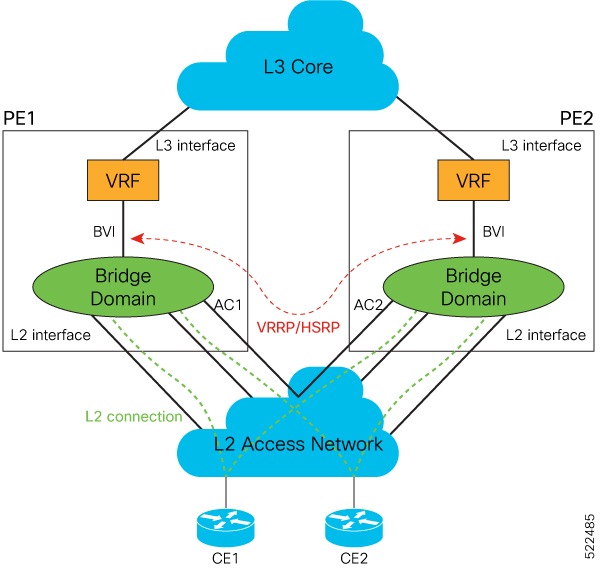
In this topology, PE1 and PE2 are paired in a redundant group. This group provides Layer 3 gateway service to CE1 and CE2. HSRP is configured over BVI interfaces on PE1 and PE2. HSRP ensures one BVI is the active gateway. The other is the standby gateway.
You can configure one of the BVIs to be active and the other BVI as standby by setting the HSRP priority value. The active BVI is programmed with the virtual MAC address chosen by HSRP. Hosts, CE1 and CE2 send the traffic to the virtual destination MAC address and the active BVI forwards the traffic.
During failover, the standby BVI becomes active and is programmed with the virtual MAC address. The traffic from the hosts is forwarded through this active BVI.
Supported scale and systems
HSRP over Bridge Virtual Interfaces (BVIs) is supported:
-
You can configure upto 512 HSRP groups (IPv4 and IPv6 combined) over BVIs on:
-
Cisco Silicon One Q100 ASIC-based systems
-
Cisco Silicon One Q200 ASIC-based systems
-
Cisco Silicon One P100 ASIC-based systems
-
-
Where the underlay IRB bridge domains consist of bridge members on L2 main or subinterfaces. Only physical and bundle interfaces are supported for L2 bridging in IRB.
-
For IPv4 and IPv6 configurations, in both the default and VRF tables.
-
On both the fixed and distributed systems.
-
HSRP on BVI is supported on the 88-LC1-12TH24FH-E line card from Cisco IOS XR Release 25.1.1.