IP Addresses and Services Configuration Guide for Cisco 8000 Series Routers, IOS XR Releases

PDF

IP Addresses and Services Configuration Guide for Cisco 8000 Series Routers, IOS XR Releases

Address resolution

Want to summarize with AI?

Log in

Summarizes ARP address resolution, cache entries, proxy behavior, cache management controls, duplicate packet policing, and direct-attached gateway redundancy configuration guidance.


Use this chapter to understand Address Resolution Protocol (ARP) behavior and configure ARP cache, proxy, traffic-control, and gateway-redundancy functions.

The chapter organizes ARP information into these content areas:

Table 1. ARP content areas

Content area

Included information

ARP fundamentals

ARP restrictions, address resolution, and the address resolution process.

ARP cache entries

Dynamic and static ARP cache entries and their use on router interfaces.

Proxy ARP

Proxy ARP and local proxy ARP behavior.

ARP cache management

Cache purge delays, entry timeouts, per-interface entry limits, and duplicate-packet policers.

Direct-attached gateway redundancy

Direct-attached gateway redundancy (DAGR) behavior and operational restrictions.

The topics progress from ARP behavior to cache configuration, proxy functions, cache controls, duplicate-packet policing, and DAGR. Restrictions appear before the related configuration tasks.

How address resolution works

A device can have a local data-link address that identifies it on its LAN and a network address that identifies its network. On Ethernet, Cisco IOS XR software resolves an IP address to a 48-bit MAC address before sending traffic.

Communication between different LANs uses the router process only when proxy ARP is enabled.

Summary

The address-resolution process involves these components:

  • The source device broadcasts an ARP request and stores the received mapping.

  • The destination device replies when the source and destination are on the same LAN.

  • A router replies on behalf of a destination on another LAN when proxy ARP is enabled.

The resulting ARP cache entry lets the source send later frames without repeating the initial request.

Workflow

These stages describe address resolution on a single LAN and across LANs interconnected by a router.

  1. Address resolution on a single LAN

    The source device broadcasts an ARP request on its LAN to learn the destination device's MAC address.

    Every device on the LAN receives and processes the request.

  2. When the destination is on the same LAN, only that destination sends an ARP reply that contains its MAC address.

    The source saves the mapping between the destination's IP address and MAC address in its ARP cache.

    The source programs the learned adjacency in hardware, which forwards subsequent packets to the destination.

  3. Address resolution when interconnected by a router

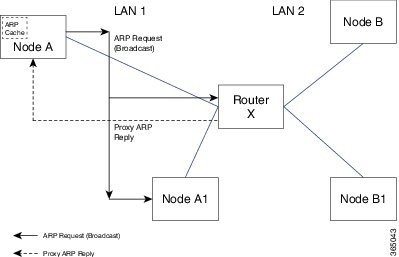
    In this topology, the source and destination are on different LANs that are interconnected by a router. The router must have proxy ARP enabled for this process.

    Figure 1. Address resolution when interconnected by a router

    A source and destination on separate LANs interconnected by a router

    The source broadcasts an ARP request for the remote destination. Devices on the source LAN, including the router, receive and process the request.

    The router checks its routing table to determine whether it can reach the destination and replies with its own MAC address.

    The source stores the router's MAC address in the ARP cache entry for the remote destination.

  4. The source sends subsequent frames for the remote destination to the router's MAC address without broadcasting another ARP request.

    The router receives the traffic, resolves the destination on the other LAN as needed, and forwards the traffic to the destination.

Result

The source obtains a usable data-link destination and can forward traffic to a local device or through a router to a remote device.