550-Watt DC-Input Power Supply Replacement Instr.
Available Languages
Table Of Contents
DC-Input Power Supply Overview
Electrical Equipment Guidelines
Preventing Electrostatic Discharge Damage
Ensuring Easy Access to the Router
Removing and Replacing a DC-Input Power Supply
Single Power Supply Configuration
Removing the DC-Input Power Supply
Replacing the DC-Input Power Supply
Dual Power Supply Configuration in a Cisco uBR7246 VXR or Cisco uBR7246
Removing the DC-Input Power Supply
Replacing the DC-Input Power Supply
Cisco uBR7200 Series Universal Broadband Router 550-Watt DC-Input Power Supply Replacement Instructions
Product Numbers: PWR-UBR7200-DC, PWR-UBR7200-DC=, PWR-UBR7200/2-DC, CHAS-UBR7246VXR=, CHAS-UBR7246=, CHAS-UBR7223=
This document explains how to remove and replace the 550-watt (W) DC-input power supply in the Cisco uBR7200 series universal broadband routers (which consist of theCisco uBR7246 VXR, Cisco uBR7246, and the Cisco uBR7223). It includes instructions for powering down the router, removing an installed power supply, and installing a new power supply. This document also includes steps for verifying the initialization of the system after you power up a Cisco uBR7200 series router.

Note
Use this document in conjunction with the and Regulatory Compliance and Safety Information for the Cisco uBR7200 Series Universal Broadband Router that shipped with your Cisco uBR7246 VXR, Cisco uBR7246, or Cisco uBR7223.
The following sections are included in this document:
•
•
If You Need More Information
The Cisco IOS software running on your router contains extensive features and functionality. The effective use of many of these features is easier if you have more information available. For additional information on configuring and maintaining a Cisco uBR7200 series router, the following documentation resources are available:
•
Note
•
•
•
DC-Input Power Supply Overview
A fully configured Cisco uBR7200 series router comes equipped with one 550W, DC-input power supply. For a Cisco uBR7246 VXR or Cisco uBR7246, an optional, second DC-input power supply can be ordered. The Cisco uBR7200 series operates with one installed power supply; however, the second power supply installed in a Cisco uBR7246 VXR or Cisco uBR7246 provides hot-swappable, load-sharing redundant power.
Note
Do not mix AC-input and DC-input power supplies in the same Cisco uBR7246 VXR or Cisco uBR7246 chassis.
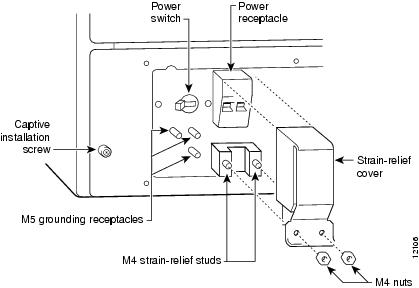
The faceplate of the 550W DC-input power supply has a green OK LED, a power switch, a handle for removing, installing, and handling the power supply, two DC-input power receptacles, two M5 grounding receptacles, a strain-relief cover that attaches to two M4 studs to secure the DC-input power leads, and two captive installation screws. (See .)
Figure 1 Cisco uBR7200 Series DC-Input Power Supply Faceplate
The DC-input power supply operates at -48 volts direct current (VDC) input voltage and supplies +3.5V, +5.2V, +12.2V, -12.2V, +16V, and -16V DC power to the router's internal components through the router midplane.
Note
The power supply handle provides a grip point for pulling the power supply out of the router. (See .) The two captive installation screws secure the power supply in the router. Three DC-input leads (-48, +48 [return], and ground) connect the DC-input power supply to the site DC power source.

Caution When the input power to a Cisco uBR7200 series power supply is disconnected or lost, the power supply will enter a reset cycle for 90 seconds. Wait at least 90 seconds or move the power switch from one position to the other to restart the power supply. For example, if the power supply was ON when the power was disconnected or lost, move the power switch to the OFF position then back to the ON position. If you do not wait the full 90 seconds or move the power switch from one position to the other, the power supply will not restart.
Installation Prerequisites
This section provides a list of parts and tools you need to remove and replace the DC-input power supply in the Cisco uBR7200 series. This section also includes safety and ESD-prevention guidelines to help you avoid injury to yourself and damage to the equipment. (See the "Cisco Connection Online" section for ordering information.)
Parts and Tools
You need the following tools and parts to remove and replace the DC-input power supply in the Cisco uBR7200 series. If you need additional equipment, contact a service representative for ordering information.
•
•
•
•
•
•
•
•
Note
Safety Guidelines
Following are safety guidelines that you should follow when working with any equipment that connects to electrical power or telephone wiring.
Safety Warnings
Safety warnings appear throughout this publication in procedures that, if performed incorrectly, might harm you. A warning symbol precedes each warning statement.

Warning

This warning symbol means danger. You are in a situation that could cause bodily injury. Before you work on any equipment, be aware of the hazards involved with electrical circuitry and be familiar with standard practices for preventing accidents. To see translations of the warnings that appear in this publication, refer to the Regulatory Compliance and Safety Information document that accompanied this device.
Waarschuwing Dit waarschuwingssymbool betekent gevaar. U verkeert in een situatie die lichamelijk letsel kan veroorzaken. Voordat u aan enige apparatuur gaat werken, dient u zich bewust te zijn van de bij elektrische schakelingen betrokken risico's en dient u op de hoogte te zijn van standaard maatregelen om ongelukken te voorkomen. Voor vertalingen van de waarschuwingen die in deze publicatie verschijnen, kunt u het document Regulatory Compliance and Safety Information (Informatie over naleving van veiligheids- en andere voorschriften) raadplegen dat bij dit toestel is ingesloten.
Varoitus Tämä varoitusmerkki merkitsee vaaraa. Olet tilanteessa, joka voi johtaa ruumiinvammaan. Ennen kuin työskentelet minkään laitteiston parissa, ota selvää sähkökytkentöihin liittyvistä vaaroista ja tavanomaisista onnettomuuksien ehkäisykeinoista. Tässä julkaisussa esiintyvien varoitusten käännökset löydät laitteen mukana olevasta Regulatory Compliance and Safety Information -kirjasesta (määräysten noudattaminen ja tietoa turvallisuudesta).
Attention Ce symbole d'avertissement indique un danger. Vous vous trouvez dans une situation pouvant causer des blessures ou des dommages corporels. Avant de travailler sur un équipement, soyez conscient des dangers posés par les circuits électriques et familiarisez-vous avec les procédures couramment utilisées pour éviter les accidents. Pour prendre connaissance des traductions d'avertissements figurant dans cette publication, consultez le document Regulatory Compliance and Safety Information (Conformité aux règlements et consignes de sécurité) qui accompagne cet appareil.
Warnung Dieses Warnsymbol bedeutet Gefahr. Sie befinden sich in einer Situation, die zu einer Körperverletzung führen könnte. Bevor Sie mit der Arbeit an irgendeinem Gerät beginnen, seien Sie sich der mit elektrischen Stromkreisen verbundenen Gefahren und der Standardpraktiken zur Vermeidung von Unfällen bewußt. Übersetzungen der in dieser Veröffentlichung enthaltenen Warnhinweise finden Sie im Dokument Regulatory Compliance and Safety Information (Informationen zu behördlichen Vorschriften und Sicherheit), das zusammen mit diesem Gerät geliefert wurde.
Avvertenza Questo simbolo di avvertenza indica un pericolo. La situazione potrebbe causare infortuni alle persone. Prima di lavorare su qualsiasi apparecchiatura, occorre conoscere i pericoli relativi ai circuiti elettrici ed essere al corrente delle pratiche standard per la prevenzione di incidenti. La traduzione delle avvertenze riportate in questa pubblicazione si trova nel documento Regulatory Compliance and Safety Information (Conformità alle norme e informazioni sulla sicurezza) che accompagna questo dispositivo.
Advarsel Dette varselsymbolet betyr fare. Du befinner deg i en situasjon som kan føre til personskade. Før du utfører arbeid på utstyr, må du vare oppmerksom på de faremomentene som elektriske kretser innebærer, samt gjøre deg kjent med vanlig praksis når det gjelder å unngå ulykker. Hvis du vil se oversettelser av de advarslene som finnes i denne publikasjonen, kan du se i dokumentet Regulatory Compliance and Safety Information (Overholdelse av forskrifter og sikkerhetsinformasjon) som ble levert med denne enheten.
Aviso Este símbolo de aviso indica perigo. Encontra-se numa situação que lhe poderá causar danos físicos. Antes de começar a trabalhar com qualquer equipamento, familiarize-se com os perigos relacionados com circuitos eléctricos, e com quaisquer práticas comuns que possam prevenir possíveis acidentes. Para ver as traduções dos avisos que constam desta publicação, consulte o documento Regulatory Compliance and Safety Information (Informação de Segurança e Disposições Reguladoras) que acompanha este dispositivo.
¡Advertencia! Este símbolo de aviso significa peligro. Existe riesgo para su integridad física. Antes de manipular cualquier equipo, considerar los riesgos que entraña la corriente eléctrica y familiarizarse con los procedimientos estándar de prevención de accidentes. Para ver una traducción de las advertencias que aparecen en esta publicación, consultar el documento titulado Regulatory Compliance and Safety Information (Información sobre seguridad y conformidad con las disposiciones reglamentarias) que se acompaña con este dispositivo.
Varning! Denna varningssymbol signalerar fara. Du befinner dig i en situation som kan leda till personskada. Innan du utför arbete på någon utrustning måste du vara medveten om farorna med elkretsar och känna till vanligt förfarande för att förebygga skador. Se förklaringar av de varningar som förkommer i denna publikation i dokumentet Regulatory Compliance and Safety Information (Efterrättelse av föreskrifter och säkerhetsinformation), vilket medföljer denna anordning.
Electrical Equipment Guidelines
Follow these basic guidelines when working with any electrical equipment:
•
•
•
•
•
•
•
•
•
•
Telephone Wiring Guidelines
Use the following guidelines when working with any equipment that is connected to telephone wiring or to other network cabling:
•
•
•
•
Preventing Electrostatic Discharge Damage
Electrostatic discharge (ESD) damages equipment and impairs electrical circuitry. ESD occurs when printed circuit boards are improperly handled and results in complete or intermittent failures.
The I/O controller, network processing engine, cable modem cards, and port adapters consist of a printed circuit board that is fixed in a metal carrier. Electromagnetic interference (EMI) shielding, connectors, and a handle are integral components of the carrier. Handle the I/O controller, network processing engine, cable modem cards, and port adapters by the carrier edges and handle only; never touch the printed circuit board components or connector pins.
Although the metal carrier helps to protect the printed circuit boards from ESD, wear a preventive antistatic strap whenever handling the network processing engine, I/O controller, cable modem cards, or port adapters. Ensure that the strap makes good skin contact and connect the strap's clip to an unpainted chassis surface to safely channel unwanted ESD voltages to ground. If no wrist strap is available, ground yourself by touching the unpainted metal part of the chassis.
Caution Make sure to tighten the captive installation screws on the network processing engine, cable modem cards, and the I/O controller (use a number 2 Phillips screwdriver). These screws prevent accidental removal, provide proper grounding for the router, and help to ensure that the network processing engine, cable modem cards, and the I/O controller are properly seated in the router midplane.
Following are guidelines for preventing ESD damage:
•
•
•
Caution Periodically check the resistance value of the antistatic strap. The measurement should be within the range of 1 and 10 megohm (Mohm).
Ensuring Easy Access to the Router
If your Cisco uBR7200 series router is installed in a standard 19-inch-wide, 4-post equipment rack or telco-type equipment rack, cables from other equipment in the rack might obstruct access to the rear of the router. Also, rack power strips or other permanent fixtures might obstruct access to the router. Review the following guidelines to ensure easy access to the rear of the router when it is installed in a rack. If the router is not installed in a rack, or if you already have clear access to the rear of the router, proceed to the "Removing and Replacing a DC-Input Power Supply" section.
Use the following guidelines to ensure easy access to the rear of the router when it is installed in a rack:
•
•
•
Caution Make sure that at least one other person is available to support the front of the router as you slide it out from the rack and, if necessary, to continue to support it while you remove and insert the power supply, network processing engine, or subchassis.
Removing and Replacing a DC-Input Power Supply
The following sections explain how to remove and replace a DC-input power supply in a Cisco uBR7200 series router for a single power supply configuration and a dual power supply configuration.
Single Power Supply Configuration
Removing and replacing the DC-input power supply in a single power supply configuration involves the following tasks:
•
•
These tasks are described in detail in the following subsections.
Powering Down the Router
Note
Step 1
Step 2
•
•
•
•
•
Step 3
This completes the procedure for powering down the router. Proceed to the following section "Disconnecting DC-Input Power."
Disconnecting DC-Input Power
Warning

Before completing any of the following tasks, and to prevent short-circuit or shock hazards, ensure that power is removed from the DC circuit. To ensure that all power is OFF, locate the circuit breaker on the panel board that services the DC circuit, switch the circuit breaker to the OFF position, and tape the switch handle of the circuit breaker in the OFF position.
Warning

When installing the unit, the ground connection must always be made first and disconnected last.
Warning
Warning
Step 1
Step 2
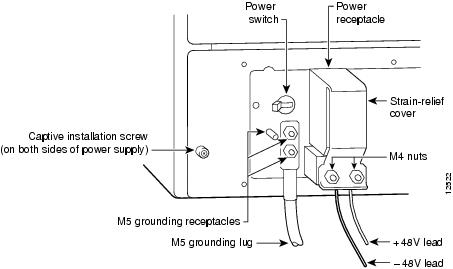
Figure 2 Removing the Strain-Relief Cover from a Cisco uBR7200 Series DC-Input Power Supply
Step 3
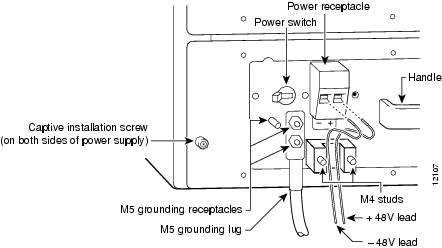
Figure 3 Disconnecting Power from a Cisco uBR7200 Series DC-Input Power Supply
Step 4
Note
This completes the procedure for disconnecting DC-input power. Proceed to the following section "Removing the DC-Input Power Supply."
Removing the DC-Input Power Supply
Step 1
Note
If the router is not installed in a standard 4-post or telco rack, skip to Step 5. If the router is installed in a rack, determine if any permanent rack fixtures, such as a power strip, are obstructing access to the power supply. If a rack fixture is obstructing access to the power supply, proceed to Step 2, otherwise, proceed to Step 5.
Step 2
Step 3
Step 4
Step 5
Caution To maintain agency compliance requirements and meet EMI emissions standards for the Cisco uBR7246 with a single power supply, the power supply filler plate and its attached air dam must remain in the power supply adjacent to the installed power supply. Do not remove this filler plate or the attached air dam from the router unless you intend to install a redundant power supply.
This completes the procedure for removing the DC-input power supply from a Cisco uBR7200 series router. Proceed to the following section "Replacing the DC-Input Power Supply."
Replacing the DC-Input Power Supply
Step 1
Note
Step 2
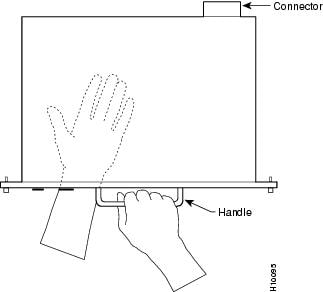
Figure 4 Holding the DC-Input Power Supply
Step 3
Step 4
Caution When inserting a power supply into the router, do not use unnecessary force; slamming the power supply into the bay can damage the connectors on the rear of the supply and on the midplane.
Step 5
Note
Step 6
Step 7
Step 8
Caution To maintain agency compliance requirements and meet EMI emissions standards for the Cisco uBR7246 VXR and Cisco uBR7246 with a single power supply, the power supply filler plate and its attached air dam must remain in the power supply adjacent to the installed power supply. Do not remove this filler plate or the air dam from the router unless you intend to install a redundant power supply.
This completes the procedures for replacing a power supply in the router. Proceed to the following section "Reconnecting DC-Input Power."
Reconnecting DC-Input Power
The following procedures explain how to reconnect DC-input power to a Cisco uBR7200 series, power up the router, and verify a successful system boot.
Note
Warning

Before completing any of the following steps, and to prevent short-circuit or shock hazards, ensure that power is removed from the DC circuit. To ensure that all power is OFF, locate the circuit breaker on the panel board that services the DC circuit, switch the circuit breaker to the OFF position, and tape the switch handle of the circuit breaker in the OFF position.
Warning

When installing the unit, the ground connection must always be made first and disconnected last.
Step 1
Step 2
Step 3
Step 4
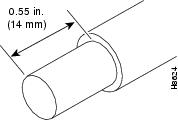
Figure 5 Stripping the DC-Input Leads
Step 5
Note
Step 6
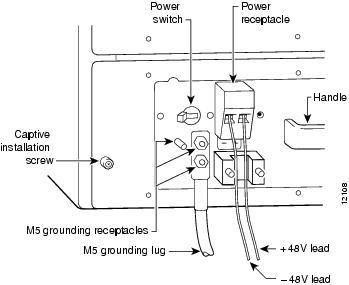
Figure 6 Connecting DC-Input Power to a Cisco uBR7200 Series
Step 7
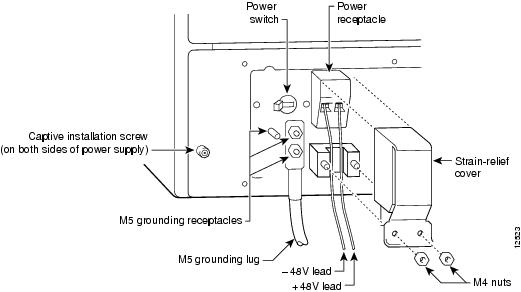
Figure 7 Replacing the Strain-Relief Cover on a Cisco uBR7200 Series DC-Input Power Supply
Step 8
Note
This completes the procedure for connecting DC-input power. Proceed to the following section "Powering Up the Router."
Warning
Powering Up the Router
Step 1
•
•
•
•
•
•
•
•
•
Step 2
Step 3
Step 4
Step 5
Cisco Internetwork Operating System SoftwareIOS (tm) uBR7200 Software (uBR7200-I-M), Version 11.3(2)XA1 [smith 100]Copyright (c) 1986-1998 by cisco Systems, Inc.Compiled Sun 09-Mar-98 04:10 by smithThis completes the procedures for powering up the router. This also completes the procedure for replacing the DC-input power supply in a single Cisco uBR7200 series power supply configuration. If you have questions or need assistance, see the "Cisco Connection Online" section. Otherwise, if your Cisco uBR7246 VXR or Cisco uBR7246 has a dual power supply configuration, proceed to the next section "Dual Power Supply Configuration in a Cisco uBR7246 VXR or Cisco uBR7246."
Dual Power Supply Configuration in a Cisco uBR7246 VXR or Cisco uBR7246
Removing and replacing a DC-input power supply in a dual power supply configuration in a Cisco uBR7246 VXR or Cisco uBR7246 involves the following tasks:
•
•
These tasks are described in detail in the following subsections.
Turning Off the Power Supply
Step 1
Step 2
•
•
Step 3
This completes the procedure for turning off the power supply. Proceed to the following section "Disconnecting DC-Input Power."
Disconnecting DC-Input Power
Warning

Before completing any of the following steps, and to prevent short-circuit or shock hazards, ensure that power is removed from the DC circuit. To ensure that all power is OFF, locate the circuit breaker on the panel board that services the DC circuit, switch the circuit breaker to the OFF position, and tape the switch handle of the circuit breaker in the OFF position.
Warning

When installing the unit, the ground connection must always be made first and disconnected last.
Warning
Warning
Step 1
Step 2
Step 3
Step 4
Note
This completes the procedure for disconnecting DC input power. Proceed to the "Removing the DC-Input Power Supply" section.
Removing the DC-Input Power Supply
Step 1
If the router is not installed in a standard 4-post or telco rack, skip to Step 5. If the router is installed in a rack, determine if any permanent rack fixtures, such as a power strip, are obstructing access to the power supply. If a rack fixture is obstructing access to the power supply, proceed with Step 2, otherwise, proceed to Step 5.
Step 2
Step 3
Step 4
Step 5
This completes the procedure for removing the DC-input power supply. Proceed to the following section "Replacing the DC-Input Power Supply."
Replacing the DC-Input Power Supply
Step 1
Step 2
Note
Step 3
Step 4
Caution When inserting a power supply into the router, do not use unnecessary force; slamming the power supply into the bay can damage the connectors on the rear of the supply and on the midplane.
Step 5
Note
Step 6
Step 7
This completes the procedures for installing a power supply in the router. Proceed to the following section "Reconnecting DC-Input Power."
Reconnecting DC-Input Power
The following procedures explain how to reconnect DC-input power to a Cisco uBR7200 series power supply, turn on the power supply, and verify the power supply is operating properly.
Note
Warning

Before completing any of the following steps, and to prevent short-circuit or shock hazards, ensure that power is removed from the DC circuit. To ensure that all power is OFF, locate the circuit breaker on the panel board that services the DC circuit, switch the circuit breaker to the OFF position, and tape the switch handle of the circuit breaker in the OFF position.
Warning

When installing the unit, the ground connection must always be made first and disconnected last.
Step 1
Step 2
Step 3
Step 4
Step 5
Note
Step 6
Step 7
Step 8
Note
This completes the steps for connecting DC input power to a Cisco uBR7200 series. Proceed to the following section "Turning on the Power Supply."
Warning
Turning on the Power Supply
Step 1
Step 2
•
•
This completes the procedures for turning on the power supply. This also completes the procedure for removing and replacing the DC-input power supply in a Cisco uBR7200 series. If you have questions or need assistance, see the "Cisco Connection Online" section.
Cisco Connection Online
Cisco Connection Online (CCO) is Cisco Systems' primary, real-time support channel. Maintenance customers and partners can self-register on CCO to obtain additional information and services.
Available 24 hours a day, 7 days a week, CCO provides a wealth of standard and value-added services to Cisco's customers and business partners. CCO services include product information, product documentation, software updates, release notes, technical tips, the Bug Navigator, configuration notes, brochures, descriptions of service offerings, and download access to public and authorized files.
CCO serves a wide variety of users through two interfaces that are updated and enhanced simultaneously: a character-based version and a multimedia version that resides on the World Wide Web (WWW). The character-based CCO supports Zmodem, Kermit, Xmodem, FTP, and Internet e-mail, and it is excellent for quick access to information over lower bandwidths. The WWW version of CCO provides richly formatted documents with photographs, figures, graphics, and video, as well as hyperlinks to related information.
You can access CCO in the following ways:
•
•
•
•
•
For a copy of CCO's Frequently Asked Questions (FAQ), contact cco-help@cisco.com. For additional information, contact cco-team@cisco.com.
Note
Cisco Documentation CD-ROM
Cisco documentation and additional literature are available on a CD-ROM, which ships with your product. The Documentation CD-ROM, a member of the Cisco Connection Family, is updated monthly; therefore, it might be more up to date than printed documentation. To order additional copies of the Documentation CD-ROM, contact your local sales representative or call customer service. The CD-ROM is available as a single item or as an annual subscription. You can also access Cisco documentation on the World Wide Web at http://www.cisco.com, http://www-china.cisco.com, or http://www-europe.cisco.com.
If you are reading Cisco product documentation on the World Wide Web, you can submit comments electronically. Click Feedback on the toolbar and select Documentation. After you complete the form, click Submit to send it to Cisco. We appreciate your comments.
78-5358-03 Rev. B0
 Feedback
Contact Cisco
- Open a Support Case

- (Requires a Cisco Service Contract)
This Document Applies to These Products
- Collaboration Endpoints - Retired Products
- Conferencing - Retired Products
- Contact Center - Retired Products
- Optical Networking - Retired Products
- Routers - Retired Products
- Security - Retired Products
- Servers - Unified Computing (UCS) Retired Products
- Storage Networking Retired Products
- Switches - Retired Products
- Video - Retired Products
- Wireless - Retired Products