CPC overview
Converged Policy and Charging (CPC) is a cloud-native network function (CNF) that provides unified, 3GPP-compliant policy control for both 4G and 5G networks. It integrates subscriber authentication, authorization, accounting (AAA), and policy management into a single, streamlined solution.
Benefits:
-
Simplified Migration: CPC eliminates the need for manual migration of user subscriptions or reconfiguration of policy and charging functions (CPC) during the transition from 4G to 5G.
-
Reduced Network Complexity: It supports incremental deployment of Standalone (SA) 5G networks by removing the requirement for complex inter-circle mesh connectivity, thus facilitating smoother network evolution.
System Composition:
-
CPC offers a containerized, cloud-native architecture based on a three-tier microservices framework.
-
It supports AAA components using Diameter servers for subscriber management, with protocol, service, and session tiers managing authentication, authorization, accounting, and data persistence.
-
The solution includes operational tools such as Policy Builder and Ops-Center for configuration and management, integrated with Cisco Cloud Native Data Plane (CNDP) services for logging, metrics, and alerts.
CPC architecture
The CPC architecture is built on a multi-layer platform, which enables efficient policy control and management in the 5G Core network.
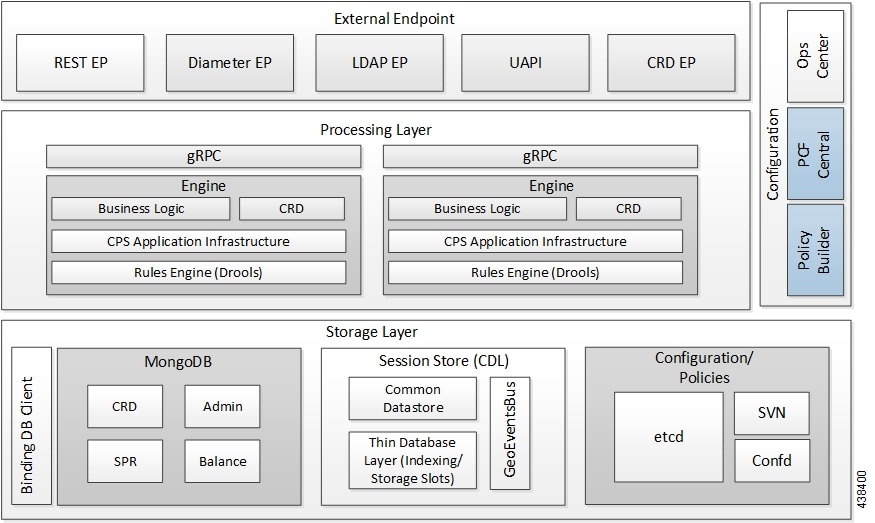
At a high level, the components in the architecture perform the following:
-
External Endpoint
-
REST-EP—It is a RESTful interface, which provides a channel for the 5G inbound and outbound messages.
-
LDAP-EP, UAPI, and CRD API—Provides interfaces for CPC communications.
-
Diameter-EP—Responsible for routing the Diameter traffic.
-
-
Processing Layer
-
grPC—Provides a framework that enables the internal processes to communicate with each other and synchronize their events.
-
CPC-Engine—Hosts the business logic of CPC and responsible for driving the rules engine for making crucial policy decisions.
-
-
Configurations
-
Policy Builder—Allows configuration of the CPC cluster of virtual machines (VMs) and configuration of services and advanced policy rules.
-
CPC Central—Provides a unified GUI that allows you to configure Policy Builder, manage custom reference table data, and start the Web-based applications and utilities.
-
Ops Center—Allows you to configure and manage the applications and pods configuration.
-
-
Storage Layer
-
Binding Database Client—Provisions the client to look up the PCRF Mongo Binding Database for information about the secondary key lookup across 4G and 5G.
-
MongoDB—Preserves the subscriber-specific, balance data, and admin configuration data.
-
Session store—Contains the data which CDL accesses for processing a session persistence activity. Stores the CPC sessions.
-
Etcd—Contains the Diameter endpoint configurations.
-
CPC deployment
The CPC reduces the deployment complexity by integrating CPC and PCF in a unified environment.
This figure illustrates the CPC deployment.
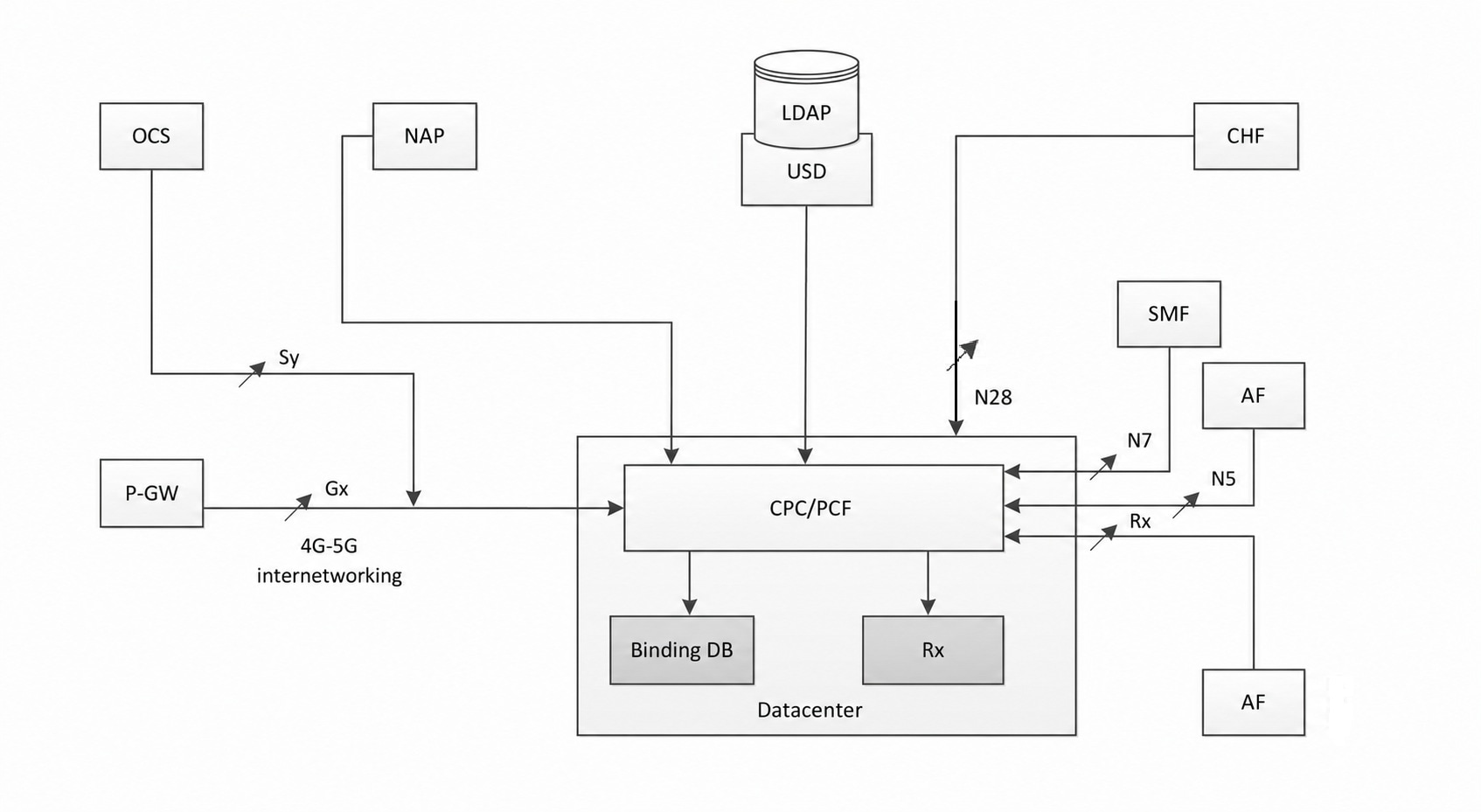
The CPC deployment architecture includes:
-
One Region = Two sites. Each site has one cluster (total two clusters in a region).
-
Noncloud-native deployment along with cloud-native 5G CPC.
-
External binding database is the local database for PCRF.
-
MongoDB is the dedicated session database for PCRF.
The CPC's deployment architecture includes:
-
One Region = Two sites. Each site has one cluster (total two clusters in a region).
-
Cloud-native deployment that deployed along with 4G PCRF.
-
Cisco CDL is the dedicated session database for CPC.
Supported Interfaces
CPC and other NFs in 5GC use these:
-
Rx– Reference point for interworking with AF, PCRF, and CPC
-
N5– Reference point between CPC and AF
-
N7– Reference point between CPC and SMF
-
N15– Reference point between CPC and AMF
-
N28– Reference point between CPC and CHF
-
N36– Reference point between CPC and UDR
-
LDAP– Reference point between CPC and external subscriber profile
 Feedback