N26-based Handover Procedures - EPC Interworking

Feature Summary and Revision History

Summary Data

Table 1. Summary Data

Applicable Product(s) or Functional Area

AMF

Applicable Platform(s)

SMI

Feature Default Setting

Enabled - Always-on

Related Documentation

Not Applicable

Revision History

Table 2. Revision History

Revision Details

Release

First introduced.

2022.01.0

Feature History

Table 3. Feature History

Feature Name

Release Information

Description

IPv6 Enablement on N26 Interface

2025.04.0

AMF already supporting the N26 interface messages over IPv4 protocol is now enhanced to support the existing N26 message interaction with MME over IPv6 protocol.

Command introduced:

interface n26 { instancetype { dual | ipv4 | ipv6 } } — Used to set the IP stack type for the N26 interface.

Default Setting: Disabled – Configuration Required

Feature Description

The N26 interface supports the following handover procedures:

  • 5G to 4G (EPC) Handover

  • 4G to 5G Handover

How it Works

This section describes how this feature works.

Call Flows

This section describes the key call flows for this feature.

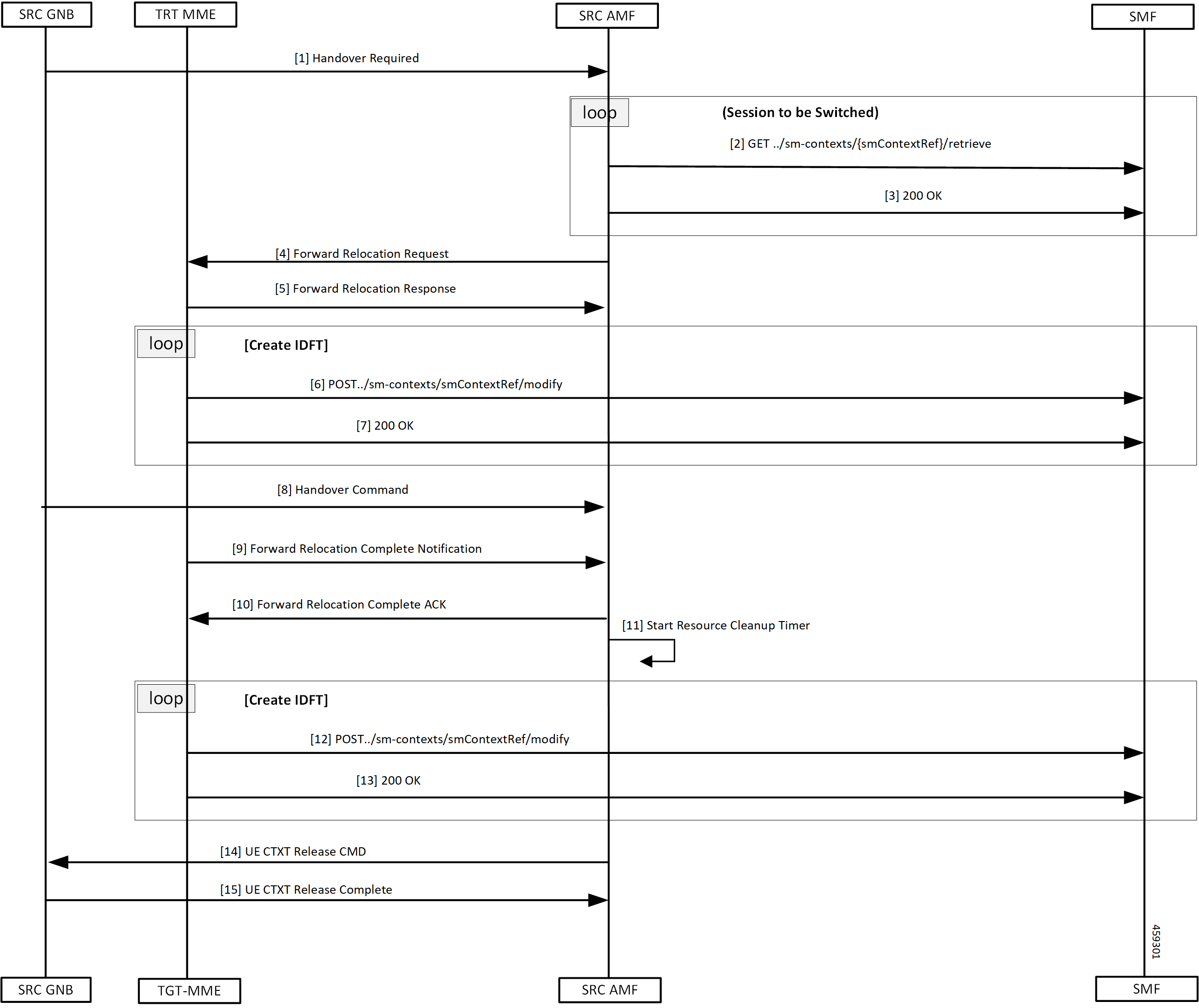
5G to 4G Handover Call Flow

This section describes the 5G to 4G handover call flow.

Table 4. 5G to 4G Handover Call Flow Description

1

The SRC GNB (source gNB) sends a Handover Required message to the SRC AMF (source AMF).

2, 3

The source AMF finds MME based on the received target ID. AMF finds the MME IP address through the AMF configuration or NRF discovery for the matching target ID.

4

When source AMF finds the IP address, it sends a Forward Relocation Request to the TGT-MME (target MME).

5

The target MME sets up resources at the enodeB, updates the S-GW, and responds to the source AMF with Forward Relocation Reponse.

6, 7

AMF requests SMF to setup Indirect Forwarding Tunnels.

The SMF responds to the request from the AMF.

8

The source AMF sends a Handover Command to the source gNB.

9

As the handover completes on the MME, the target MME notifies the source AMF by sending a Forward Relocation Complete Notification.

10

The source AMF responds with a Forward Relocation Complete ACK to target MME.

11

The AMF starts a timer to clean up all the local resources and indirect tunnels.

12, 13

The AMF requests the SMF to clean up the IDFT tunnels created.

The SMF responds to the AMF request.

14

The source AMF sends a UE Context Release Command to the source gNB to clean up all the resources at source gNB.

15

The source gNB responds with a UE Context Release Complete to the source AMF.

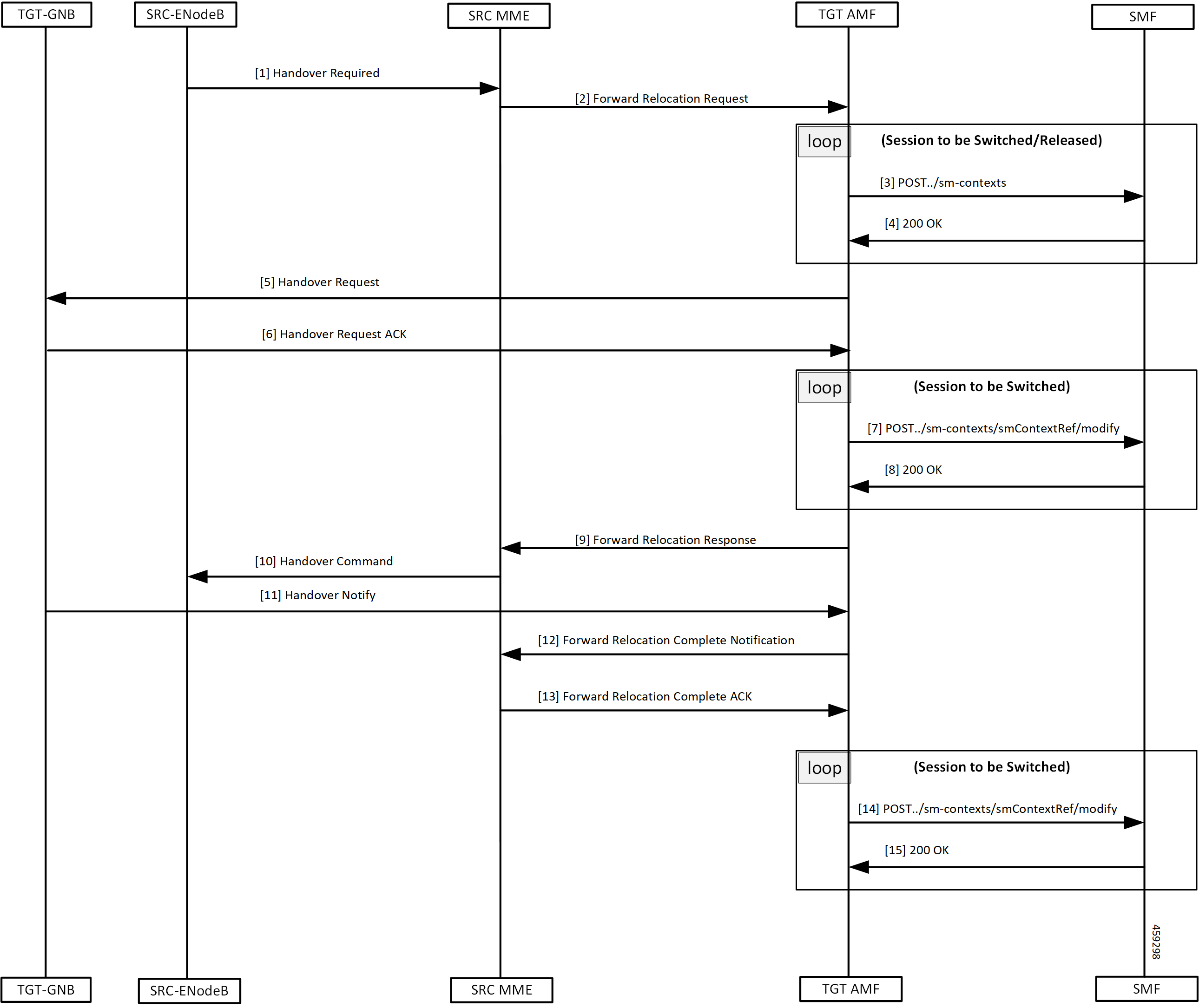
4G to 5G Handover Call Flow

This section describes the 4G to 5G handover call flow.

Table 5. 4G to 5G Handover Call Flow Description

Step

Description

1

As the UE transitions to 5GC, the SRC-ENodeB (source eNB) sends a Handover Required message to the SRC MME (source MME).

2

The MME does target-ID analysis, and chooses the TGT AMF (target AMF). The source MME sends a Forward Relocation Request to the TGT AMF (target AMF).

3

The target AMF creates associations with the SMF for the PDU sessions that are acceptable on the target AMF.

4

The SMF responds to the Create Request from the target AMF.

5

The target AMF selects the TGT GNB (taget gNB) that serves the UE, and sends a Handover Request to the target GNB.

6

After the GNB has allocated resources to the UE, it responds with a Handover Request ACK to the target AMF.

7, 8

The target AMF updates the SMF with information from the target GNB.

8

The SMF responds to the target AMF.

9

The target AMF responds to the request from the source MME using a Forward Relocation Response message.

10

The source MME sends a Handover Command to the SRC ENodeB (source eNB) to complete the handover.

11

Target gNB sends a Handover Notify to the target AMF when the UE handover gets completed.

12

The target AMF notifies the source MME using a Forward Relocation Complete notification.

13

The source MME acknowledges the message with a Forward Relocation Complete acknowledge.

14, 15

The target AMF notifies the SMF on the completion of the handover.

The SMF acknowledges the notification.


Note


When AMF receives the Registration Request message, it performs the following:

  • When the message is received in Uplink NAS Transport, it assumes that the HO is successful and doesn't send the Context Request to the MME.

  • When the message is received in Initial UE message, it sends the Context Request to the MME.


Standards Compliance

This feature complies with the following standards specifications:

  • 3GPP TS 23.401 "General Packet Radio Service (GPRS) enhancements for Evolved Universal Terrestrial Radio Access Network (E-UTRAN) access"

  • 3GPP TS 23.502 "Procedures for the 5G System (5GS)"

  • 3GPP TS 29.274 "3GPP Evolved Packet System (EPS); Evolved General Packet Radio Service (GPRS) Tunnelling Protocol for Control plane (GTPv2-C); Stage 3"

Limitations

N26-based handover doesn't support the following:

  • Handling of PGW-C-initiated and SMF-initiated N2 request by AMF, when other handover is in progress

  • Non-IP PDN type

  • Home routed roaming

  • Direct tunneling

  • Emergency fallback

  • N3 Interworking Function

Feature Configuration

Configuring this feature involves the following steps:

Configuring the Handover from 4G to 5G

To configure this feature, use the following configuration:

config 
    amf-global 
        call-control-policy policy_name 
            default-slice name n26 sst sst_value sdt sdt_value 
            end 

NOTES:

  • call-control-policy policy_name —Specify the policy name.

  • default-slice name n26 sst sst_value sdt sdt_value —Specify the Slice/Service type (SST) value and Slice Differentiator Type (SDT) value respectively. SST value must be an integer in the range of 0-255. SDT value must be a string.

Configuration Example

The following is an example configuration.

config
   amf-global
      call-control-policy ccp1
         default-slice name n26 sst 12 sdt 123456
            end

Configuring the Handover from 5G to 4G

To configure this feature, use the following configuration:

config 
    amf-services service_name 
        peer-mme tai-match priority priority_value mcc mcc_value mnc mnc_value tac tac_value [ to end_tac_value ] address mme_address 
        exit 
        peer-mme gummei mcc mcc_value mnc  mnc_value group-id  group_id  mme-code  mme_code  address ip_address 
    instance instance-id instance_id 
        endpoint gtp 
            nodes node_replicas 
            interface n26 
               instancetype { Dual | IPv6 | IPv4 } 
               vip-ip vip_ip_address 
               vip-ipv6 vip_ipv6_address 
            retransmission { max-retry maximum_number_of_retries | timeout  retransmission_timeout_value } 
            internal-vipinternal_vip_ip_address 
            end 

NOTES:

  • peer-mme tai-match priority priority_value mcc mcc_value mnc mnc_value tac tac_value [ to end_tac_value ] address mme_address

    • peer-mme tai-match priority priority_value —Specify the priority value.

    • mcc mcc_value —Specify the three-digit Mobile Country Code. Must be an integer with three digits.

    • mnc mnc_value —Specify the two or three-digit Mobile Network Code. Must be an integer with three digits.

    • tac tac_value —Specify the Tracking Area Code value. Must be an integer in the range of 1-65535.

    • to end_tac_value—Specify the Tracking Area Code range for peer MME.

    • addressip_address—Specify the MME IP address. It can be IPv4, IPv6.

  • group-id group_id —Specifies the MMEs belong to one MME group within a PLMN.

  • mme-code mme_code —Specify an individual MME within that group.

  • instancetype { Dual | IPv6 | IPv4 } —Specify the mode of deployment for the instance type.

  • nodes node_replicas —Specify the replica nodes for resiliency.

  • vip-ip vip_node_replicas —Specify the replica nodes for resiliency.

  • max-retry maximum_number_of_retries —Specify the number of request retry attempts. Must be an integer in the range 0–5 (default value: 3). To disable retransmission, set this value to zero (0).

  • timeout retransmission_timeout_value —Specify the retransmission interval in seconds. Must be an integer in the range 0–10 (default value: 2). To disable retransmission, set this value to zero (0).

  • internal-vip internal_vip_ip_address —Specify the internal VIP IP address used for internal pod to pod communication.


Note


For a specific gummei and tai, the peer mme configuration can be either IPv4 or IPv6.


Configuration Example

The following is an example of dual stack configuration.

instance instance-id 1
 endpoint gtp
  nodes        2
  retransmission timeout 4 max-retry 5
  internal-vip 209.165.200.225
  interface n26
   instancetype Dual
   vip-ip 209.165.200.225
   vip-ip6 6666::209:165:200:225
  exit
 exit
exit

The following is an example of IPv6 configuration.

instance instance-id 1
 endpoint gtp
  nodes        2
  retransmission timeout 4 max-retry 5
  internal-vip 209.165.200.225
  interface n26
   instancetype IPv6
   vip-ip6 6666::209:165:200:225
  exit
 exit
exit

The following is an example of IPv4 configuration.

instance instance-id 1
 endpoint gtp
  nodes        2
  retransmission timeout 4 max-retry 5
  internal-vip 209.165.200.225
  interface n26
   instancetype IPv4
   vip-ip 209.165.200.225
  exit
 exit
exit