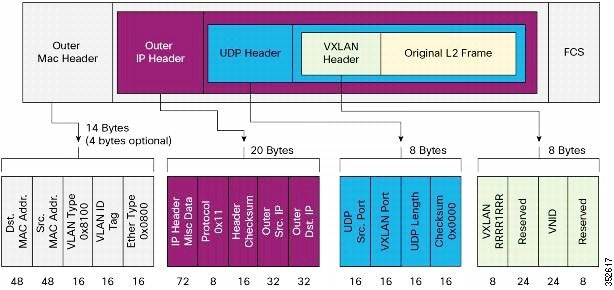
Most data center transport networks are designed with multiple redundant paths and employ multipath load-sharing technologies to distribute traffic loads efficiently. VXLAN encapsulated packets traverse these paths based on the underlying network's forwarding decisions.
Summary
The key components involved in the process are:
-
VTEPs: Serve as the source and destination for VXLAN packets in the network.
-
ECMP: Allows simultaneous use of multiple best paths in the transport network by balancing traffic loads.
-
UDP port numbers (source and destination): Used in VXLAN packet headers; the source UDP port uniquely identifies flows for load-sharing.
Load sharing with VXLANs enables efficient traffic distribution across multiple redundant paths in transport networks. The process utilizes ECMP and the variable VXLAN source UDP port to differentiate flows and optimize path usage.
Workflow
The process involves these stages:
- Multipath design and ECMP deployment: Transport networks are configured as IP-routing networks that use ECMP to balance traffic load among multiple best paths.
- VXLAN packet flow creation: VTEPs encapsulate packets with identical destination IP and UDP port numbers. The source UDP port is varied for each VXLAN flow, creating unique flow identifiers.
- Load-share hashing and flow differentiation: The transport network uses the VXLAN source UDP port for load-share hashing, ensuring that flows are distributed across available ECMP paths. This helps avoid out-of-sequence packet forwarding and maximizes path utilization.
- Packet forwarding and distribution: As VXLAN packets enter the transport network, the source UDP port guides their distribution across multiple redundant paths, ensuring efficient load balancing.
Result
The transport network can distinguish VXLAN flows by source UDP port and distribute them across ECMP paths, maximizing bandwidth utilization and minimizing congestion.