L3VPN Configuration Guide for Cisco 8000 Series Routers, Cisco IOS XR Releases

PDF

L3VPN Configuration Guide for Cisco 8000 Series Routers, Cisco IOS XR Releases

Inter-AS Option B for L3VPN

Want to summarize with AI?

Log in

Introduces Inter-AS Option B for L3VPN, describing its primary functions and operational topology, including how data flows between autonomous systems and key mechanisms for connectivity.


An Inter-AS Option B method is an Inter-AS VPN approach that

  • uses ASBR ports and router subinterfaces to receive MPLS traffic

  • employs MP-BGP sessions to distribute labeled VPN prefixes between ASBRs, and

  • assigns a VPN label each time the BGP next hop changes.

Feature history

The feature history table lists release support for this feature.

Table 1. Feature History Table

Feature Name

Release

Description

Inter-AS Support for L3VPN

Release 25.4.1

Introduced in this release on: Fixed Systems (8700 [ASIC: K100])(select variants only*)

*This feature is supported on:

  • 8711-48Z-M

  • 8011-32Y8L2H2FH

  • 8011-12G12X4Y-A/D

Inter-AS Support for L3VPN

Release 25.1.1

Introduced in this release on: Fixed Systems (8010 [ASIC: A100])(select variants only*)

*This feature is supported on Cisco 8011-4G24Y4H-I routers.

Inter-AS Support for L3VPN

Release 24.4.1

Introduced in this release on: Fixed Systems (8200 [ASIC: P100], 8700 [ASIC: K100])(select variants only*); Modular Systems (8800 [LC ASIC: Q100, P100])(select variants only*)

You can now enhance cross-provider VPN connectivity with Inter-AS Option - A and C, enabling seamless Layer 3 VPN communication between different autonomous systems. This feature facilitates the exchange of VPN routing information and forwarding data across provider boundaries, enhancing flexibility and scalability in network designs. Inter-AS Option - A utilizes static routing for simple setups, while Option - C provides comprehensive MPLS label-swapping capabilities for more complex configurations. These options support effective management of multi-provider network.

*Previously this feature was supported on Q200 and Q100. It is now extended:

  • 8712-MOD-M

  • 8212-48FH-M

  • 8711-32FH-M

  • 88-LC1-52Y8H-EM

  • 88-LC1-12TH24FH-E

  • 88-LC1-36EH

Additional reference information

A Multiprotocol Label Switching (MPLS) Layer 3 VPN consists of multiple interconnected sites using an MPLS provider core network. Within each customer site, one or more customer edge (CE) routers attach to provider edge (PE) routers. Inter-AS Option B is one of the methods for sharing VPN routes among sites.

When configuring Inter-AS Option B, router subinterfaces enable ASBR ports to receive MPLS traffic. ASBRs use MP-BGP sessions to distribute labeled VPN prefixes with each other. A VPN label is assigned whenever the BGP next hop is changed.

Functions of Inter-AS Option B

  • This feature allows an iBGP VPNv4 session between routers within an autonomous system (AS) and also an eBGP VPNv4 session between edge routers and WAN routers.

  • BGP distributes the label between ASBRs. The label mapping information for a particular route is included in the same BGP update message that distributes the route itself.

  • When BGP distributes a particular route, it also distributes an MPLS label mapped to that route. Many ISPs prefer this method because it ensures complete IGP isolation between different sites.


How Inter-AS Option B works

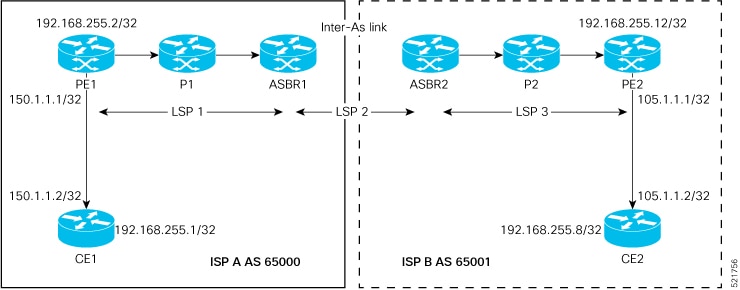
In Inter-AS Option B deployments, Layer 3 VPN (L3VPN) services are extended across multiple autonomous systems by connecting provider edge (PE), provider (P), and autonomous system boundary routers (ASBRs) in each domain. This configuration requires careful alignment of routing protocols (such as IS-IS and BGP), MPLS label distribution, and VRF assignments to ensure seamless VPN connectivity. Properly coordinating these settings across all relevant routers is essential for successful inter-domain transport and isolation of VPN traffic, while also addressing resource limitations related to label handling.

Summary

Inter-AS Option B enables L3VPN services by connecting two different autonomous systems (AS) and exchanging both routing and MPLS label information across their boundaries. The architecture uses a combination of protocols, role-specific routers, and selective label distribution mechanisms to ensure traffic can traverse ISP networks seamlessly.

The key components involved in the process are:

  • Customer edge routers: Connect customer sites to the provider network using eBGP as the routing protocol.

  • Provider edge (PE) routers: Exchange VPN routes with customer sites and the ASBRs via MP-iBGP and eBGP VPNv4 sessions.

  • Provider (P) routers: Function within the ISP core, running IGP (such as IS-IS) and LDP to maintain label-switched paths.

  • Autonomous System Border Routers (ASBRs): Interconnect the two ISPs’ MPLS networks, exchange VPN information via eBGP VPNv4 peering, and handle label exchange over the inter-AS link.

  • IGP and LDP: Provide label distribution and routing within each ISP’s domain.

  • MP-BGP: Carries VPNv4 routes and labels between PEs and ASBRs within a customer network.

  • Cisco IOS XR does not send or receive routing updates with eBGP peers unless a route policy is configured. A route policy is configured with pass-all which enables sending and receiving all updates.

Workflow

Figure 1. L3VPN Inter-AS Option B

These stages describe how Inter-AS Option B works:

  1. CE to PE Routing: eBGP is configured between CE and PE routers, enabling route exchange at the customer-provider boundary.
  2. Core IGP/LDP Setup: All core ISP links run IS-IS (IGP) with LDP to build MPLS label-switched paths except on the inter-ASBR link.
  3. ASBR interconnection: Between ASBR1 and ASBR2, LDP and IGP are not configured. Instead, the ASBRs form eBGP VPNv4 peering and exchange labels using BGP; MPLS is not enabled with LDP on this inter-AS link.
  4. Route exchange and label binding:
    • MP-iBGP distributes routes between PE and ASBR within each ASN.
    • On ASBRs, eBGP VPNv4 sessions allow VPN label exchange between ISPs.
    • When eBGP VPNv4 peering is established, the mpls bgp forwarding feature automatically configures the inter-AS link for BGP label exchange.
  5. Route Policy Requirements: On platforms such as Cisco IOS XR, a route policy (for example, pass-all ) must be configured for eBGP peers to send and receive routing updates.
  6. Route handling considerations:
    • No VRF is required on ASBRs.
    • The retain route-target all command on the ASBR prevents the automatic dropping of updates from VRFs without a locally configured route target (RT).
    • A static /32 route to the remote ASBR's next-hop address is needed to correctly bind MPLS labels; without this, the control plane may function, but traffic forwarding fails.
  7. Platform limitations: Note that BGP-LU is not supported as an underlay for Inter-AS Option B topologies.

Result

The Inter-AS Option B topology enables seamless end-to-end MPLS VPN services across multiple ISPs by efficiently utilizing specialized routing and label distribution mechanisms. Proper setup of the routing and label exchange ensures full interoperability and secure VPN connectivity between networks.