- Preface
- Overview
- Installing the Server Operating System or Hypervisor
- Managing the Server
- Managing Storage Using RAID
- Viewing Server Properties
- Viewing Server Sensors
- Managing Remote Presence
- Managing User Accounts
- Configuring Network-Related Settings
- Configuring Communication Services
- Managing Certificates
- Configuring Platform Event Filters
- Firmware Management
- Viewing Faults and Logs
- Server Utilities
- Diagnostic Tests
- Index
Diagnostic Tests
This chapter includes the following sections:
- Diagnostic Tests Overview
- Mapping the Diagnostics Image to the Host
- Running Diagnostic Tests—E-Series Servers and SM E-Series NCE
- Running Diagnostic Tests—EHWIC E-Series NCE and NIM E-Series NCE
Diagnostic Tests Overview
Diagnostics is a standalone utility that runs on the E-Series Server or NCE independent of the operating system or applications running on the server. If you experience problems with the E-Series Server or NCE, you can use diagnostics tests to run a preliminary check and isolate the problem. Diagnostic tests can be executed on the server CPU, memory, and block devices. Block devices include hard drive, USB drive, and SD cards.
If the diagnostic tests pass successfully, it indicates that there is no problem with the server CPU, memory, or block devices. The problem could be with some other hardware component or with the software configuration. Open a service request with Cisco Technical Assistance Center (TAC) at: http://www.cisco.com/cisco/web/support/index.html to isolate the problem.
If the diagnostic tests fail, open a service request with Cisco TAC for further assistance.
 Caution | Diagnostic tests are non-destructive, but if there is a power or equipment failure when the tests are running, there is a possibility that the disk data might get corrupted. We highly recommend that you backup the data before running these tests. |
Basic Workflow for Executing Diagnostic Tests
-
Backup data.
-
The diagnostics image is pre-installed on the E-Series Server or NCE at the time of purchase. You can also choose to download the most current diagnostics image from a specified FTP or HTTP server onto the CIMC internal repository.
-
Mount the diagnostics image onto the HDD virtual drive of a USB controller.
-
Set the boot order to make the Internal EFI Shell as the first boot device.
-
Reboot the server. 
Note
-
For E-Series Servers and SM E-Series NCE—On server reboot, the EFI Shell displays.
-
For EHWIC E-Series NCE and NIM E-Series NCE—On server reboot, the AMIDiag EFI Shell displays.
-
-
Run diagnostic tests from the EFI Shell or the AMIDiag EFI Shell as appropriate.
-
Reset the virtual media boot order to its original setting.
Mapping the Diagnostics Image to the Host
-
Backup data.
-
Log in to CIMC as a user with admin privileges.
-
The diagnostics image is pre-installed on the E-Series Server at the time of purchase. You can also choose to download the most current diagnostics image from a specified FTP or HTTP server onto the CIMC internal repository. See Obtaining Software from Cisco Systems.
Note | If you start an image update while an update is already in process, both updates will fail. |
| Step 1 | In the Navigation pane, click the Server tab. | ||||||||||||||||||
| Step 2 | On the
Server tab, click
Host
Image Mapping.
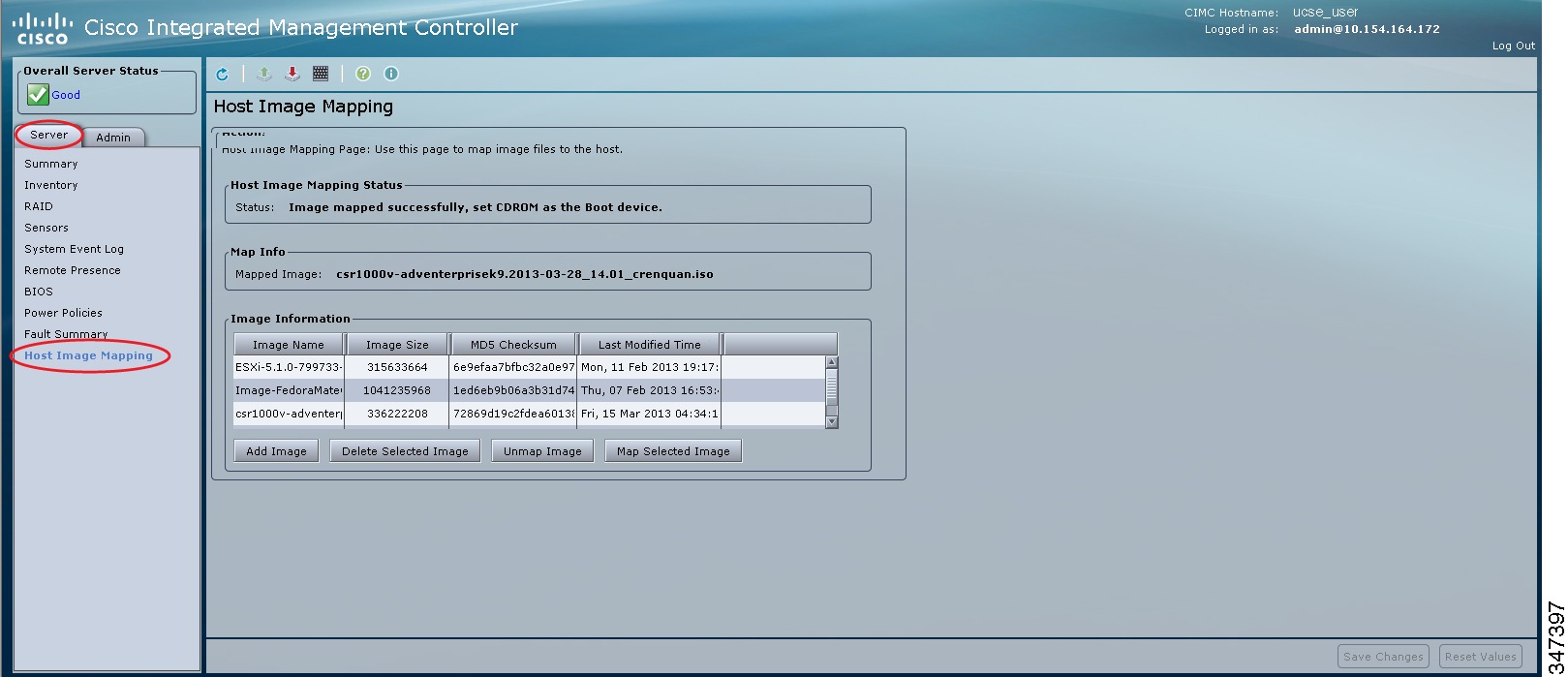 | ||||||||||||||||||
| Step 3 | From the
Host
Image Mapping page, click
Add
Image.
| ||||||||||||||||||
| Step 4 | Click
Download.
The Host Image Mapping page opens. You can view the status of the image download in the Host Image Mapping Status area. After the image is downloaded and processed successfully, refresh the page. After the page refreshes, the new image displays in the Image Information area. | ||||||||||||||||||
| Step 5 | From the Image Information area, select the image to map, and then click Map Selected Image. The image is mapped and mounted on the virtual drive of a USB controller. | ||||||||||||||||||
| Step 6 | Set the boot
order to make
EFI
Shell as the first boot device.
To set the boot order, see Configuring the Server Boot Order Using the CIMC GUI. | ||||||||||||||||||
| Step 7 | Reboot the
server.
The EFI Shell appears. |
What to Do Next
Run diagnostic tests.
Running Diagnostic Tests—E-Series Servers and SM E-Series NCE
From the EFI shell, use the following procedure to run diagnostic tests on the E-Series Servers and the SM E-Series NCE.
-
Back up data. All tests are non-destructive, but if there is power or equipment failure when the tests are running, there is a possibility that the disk data might get corrupted. We highly recommend that you back up data before executing these tests.
-
Use the CIMC CLI or the CIMC GUI to download and map the diagnostics image onto the HDD virtual drive of the USB controller.
-
Reboot the server. The EFI shell displays.
This example runs all diagnostic tests:
Shell > dir fs1:
		06/27/12  07:48p            1,435,424  Dsh.efi
  06/27/12  08:03p               10,036  dsh-e140d.pkg
  06/25/12  06:00p               10,140  dsh-e140s.pkg
  06/27/12  08:04p               10,042  dsh-e160d.pkg
          4 File(s)   1,465,642 bytes
Shell > fs1:
fs1:\> cp dsh-e140d.pkg dsh.pkg
copying fs0:\OBD\dsh-e140d.pkg -> fs0:\OBD\dsh.pkg
- [ok]
fs1:\> dsh
Diagnostics is a standalone utility that runs on the server module independent
of the operating system or applications running on the module.All tests are
non-destructive, but there is a possibility of disk datacorruption during
power or equipment failure when the tests are in progress. Therefore, before
executing these tests, we highly recommend that you backup the data.


For questions or concerns with this utility, please open a Service Request
with Cisco TAC at http://www.cisco.com/cisco/web/support/index.html

(Y)es to continue test. (N)o to exit(y/n): Y
Cisco Diagnostics  Shell 1.03(0.3) Thu 06/28/-16:35:08.95-canis-diag@cisco.com
UCS-E140D-M1/K9:SRV>

Server: SRV > run all
Server: SRV > results
Test Name          : all
Test Status        : Passed
Failed/Run History : 0/17
Start Time         : 06/27/12 14:38:19
End Time           : 06/27/12 14:43:36
Diag Version       : 1.03(0.3) Mon 04/02/-17:07:57.19-canis-diag@cisco.com
Board S/N          : FOC160724BY

Server: SRV > show
Server: SRV > exit
Reset the virtual media boot order to its original setting.
Running Diagnostic Tests—EHWIC E-Series NCE and NIM E-Series NCE
Diagnostic tests are run on the server CPU, memory, and block devices. Block devices include SSD drive and USB drive.
-
Back up data. All tests are non-destructive, but if there is power or equipment failure when the tests are running, there is a possibility that the disk data might get corrupted. We highly recommend that you back up data before executing these tests.
-
Delete previous versions of AMIDIAG_OBD.log files if any.
-
Use the CIMC CLI or the CIMC GUI to download and map the diagnostics image onto the HDD virtual drive of the USB controller.
-
Launch the KVM console.
-
Reboot the server. The AMIDiag EFI Shell displays in the KVM console: Found AMI DIAG on fs0: Diagnostics is a standalone utility that runs on the server module independent of the operating system or applications running on the module.All tests are non-destructive, but there is a possibility of disk datacorruption during power or equipment failure when the tests are in progress. Therefore, before executing these tests, we highly recommend that you backup the data. For questions or concerns with this utility, please open a Service Request with Cisco TAC at http://www.cisco.com/cisco/web/support/index.html Enter 'q' to quit, any other key to continue: fs0:\>
| Command or Action | Purpose | |||
|---|---|---|---|---|
| Step 1 | From the AMIDiag EFI Shell, press any key (except q) to run the diagnostic tests. |
Executes all available diagnostic tests and displays the progress. After the tests are completed, the Pass or Fail test status displays.
| ||
| Step 2 | (Optional) fs0:\> type AMIDIAG_OBD.log |
Displays the Onboard Diag log files with details. | ||
| Step 3 | Server: fs0:\> exit |
Exits from AMIDiag EFI Shell. | ||
| Step 4 | Open a service request with Cisco TAC. |
If the diagnostic tests pass successfully, it indicates that there is no problem with the server CPU, memory, or block devices. The problem could be with some other hardware component or with the software configuration. Open a service request with Cisco TAC to isolate the problem. If the diagnostic tests fail, open a service request with Cisco TAC for further assistance. |
Reset the virtual media boot order to its original setting.
 Feedback