Set Up Users and Roles

As part of Secure Workload onboarding:

  • Create users and assign user roles

  • Configure licenses

  • Install software agents

Before you begin, ensure that:

  • The cluster is deployed and configured. For the initial deployment and configuration, contact Cisco Advanced Services.

  • You can login to the cluster.

  • Valid Cisco Secure Workload licenses are reflecting under the Smart Software Manager Virtual accounts. Cisco Secure Workload offers two modes for licensing–Connected mode and Air-Gapped mode.

    For more information, see Cisco Smart Licensing in the Secure Workload user guide.

  • The following firewall ports must remain open to ensure the proper functioning of the cluster:

    • Outbound Firewall Rules:

      • Port 25: Allow traffic from AppServer-1 and AppServer-2 to the customer's SMTP server.

      • Port 389/636: Allow traffic from AppServer-1 and AppServer-2 to the customer's LDAP server.

      • NTP (UDP Port 123): Allow traffic from collectordatamovers to the customer's NTP servers.

    • Inbound Firewall Rules:

      • Port 9000: Allow traffic from the customer's administrator source IP addresses to the penultimate IP address in the cluster subnet, to enable upgrades or reboots.


        Note


        Restrict the source IP addresses only to the administration team's machines. Do not allow the entire enterprise access to port 9000.


  • The following ports must remain open for CIMC GUI access and KVM access on a cluster:

    • For external CIMC GUI access:

      • For 39RU: 8901–8936

      • For 8RU: 8901–8906

    • For external Kernel-based Virtual Machine (KVM) access:

      • For 39RU: 2068–2103

      • For 8RU: 2068–2073

  • The following ports are recommended to be whitelisted:

    Protocol

    Port

    TCP

    443

    TCP

    5640

    UDP

    5640

    TCP

    5660

    TCP

    25

    UDP

    123

    UDP

    53

    TCP

    389/386

    UDP

    514

    TCP

    22

    TCP

    9000

    TCP

    8001–8006

Add a User

Before you begin

  • A default username is created with site administrator privileges while setting up the cluster. As a first-time user, you can log in using this default username, then click Forgot Password to create a password. After logging in, the first-time user is assigned the site administrator privileges.

  • You must be a Site Admin to add users in Secure Workload.

  • If a user is assigned a scope for multitenancy, only roles that are assigned to the same scope may be selected.

  • To recover passwords for users, a Site Admin with an email account can use the username of the user to generate a random password to recover the password.


Note


This page is filtered by the scope preference that is selected on the page header.


Procedure


Step 1

If applicable, select the appropriate root scope from the page header.

Step 2

From the navigation pane, choose Manage > User Access > Users.

Step 3

Click Create New User.

The User Details page is displayed.

Step 4

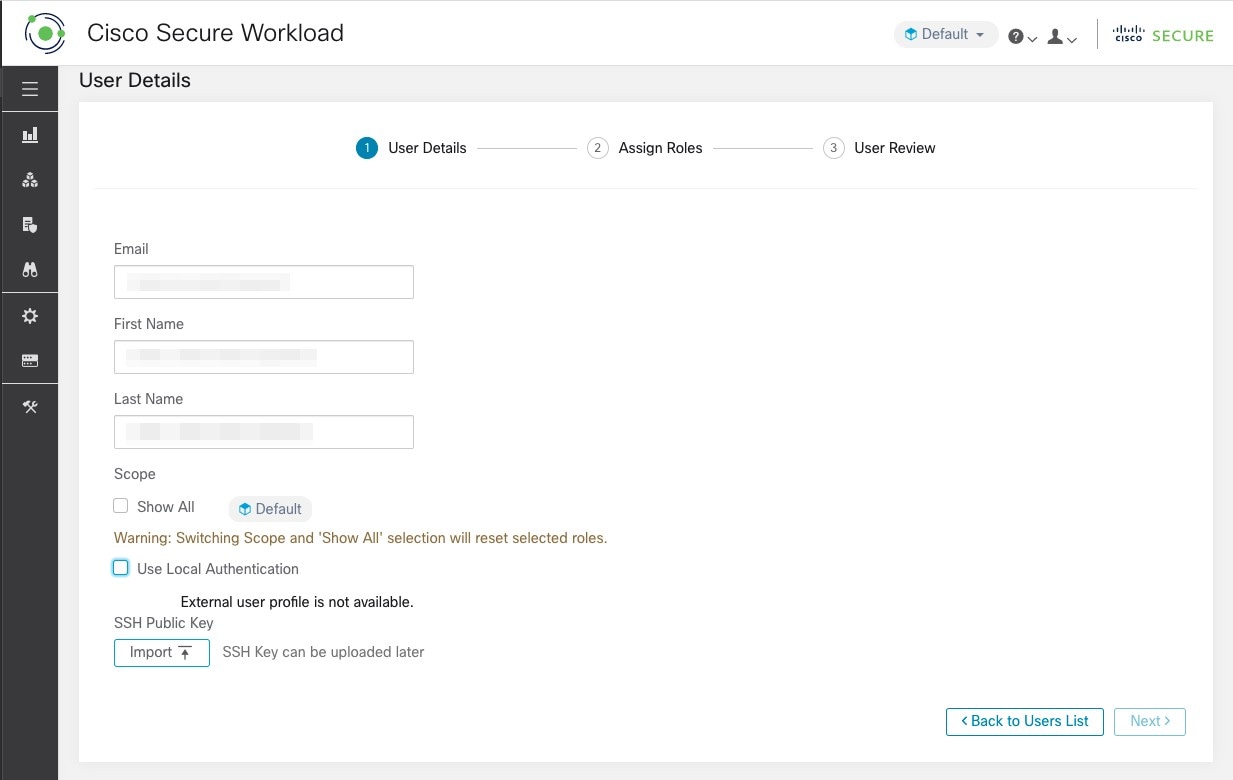
Update the following fields under User Details.

Table 1. User Details Field Descriptions

Field

Description

Email or Username

Enter the email ID of the user. The email addresses are non-case sensitive. If your email contains letters, we use the lowercase version of the letters.

Enter the username of the user; usernames are non-case sensitive and cannot contain @ or spaces.

First Name

Enter the user’s first name.

Last Name

Enter the user’s last name.

Scope

Root scope that is assigned to the user for multitenancy. (Available to Site Admins)

SSH Public Key

(Optional) Click Import to import an SSH public key or you can import a key later.

Step 5

Click Next.

Step 6

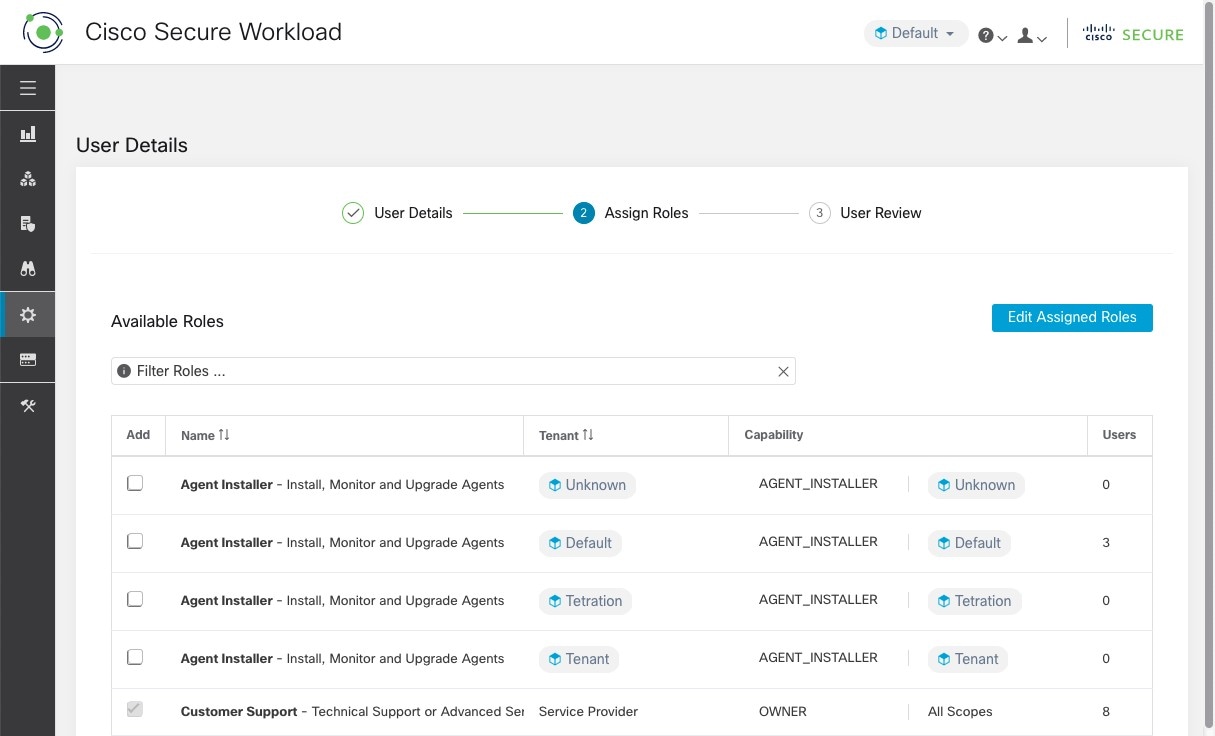
Under Assign Roles, add or remove assigned roles to the user.

  • Click Add Roles to assign new roles, and then click the Add check box.

    Figure 1. Assigned User Roles
  • Select the assigned roles, click Edit Assigned Roles, and then click the Remove icon.

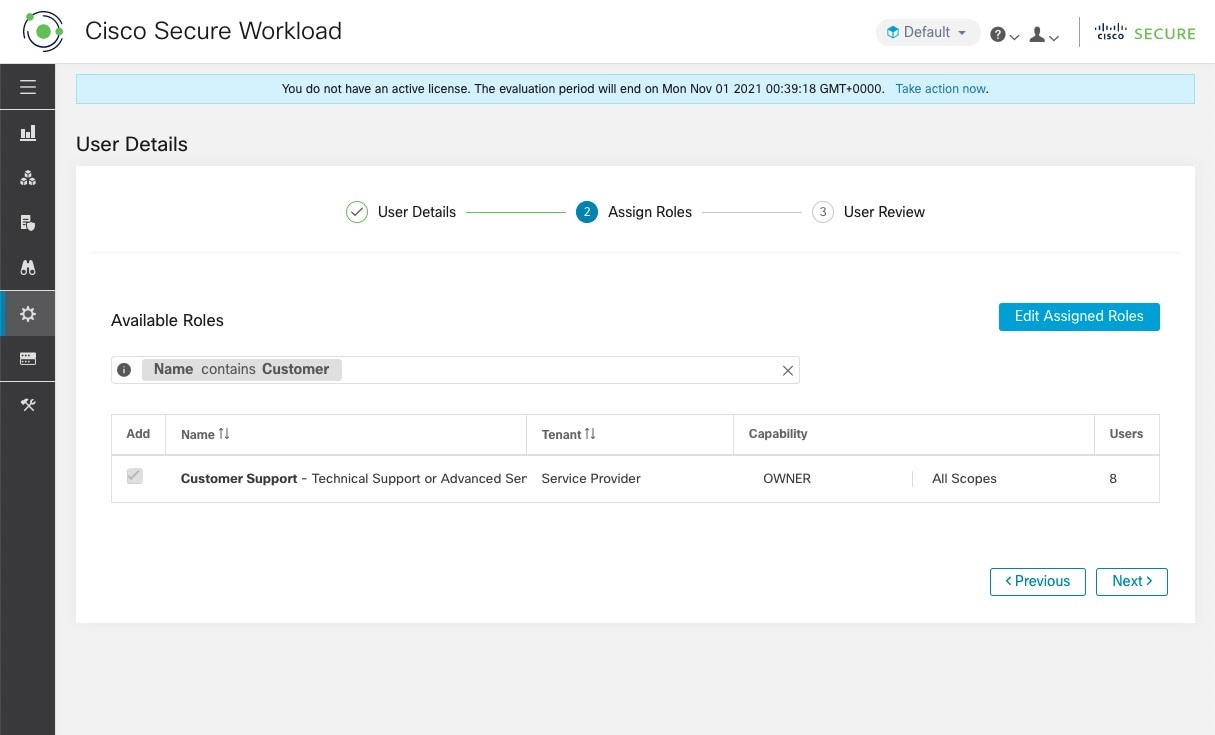
  • You can filter the user roles using Name or Tenant.

    Figure 2. Filter User Roles

Step 7

Click Next.

Step 8

Under User Review, review the user details and the assigned roles. Click Create.

If external authentication is enabled, the authentication details are displayed.

After the user is added in Secure Workload, an activation email is sent to the registered email ID to set up the password.

Note


Users without an email ID can log in using the username and the temporary password shared by the Site Admin. At first login, users are redirected to set their permanent password.


Add a User when SMTP is Disabled

Before you begin

  • You must be a Site Admin to add users in Secure Workload.

  • If a user is assigned a scope for multitenancy, only roles that are assigned to the same scope may be selected.

  • To recover passwords for users, a Site Admin with an email account can use the username of the user to generate a random password to recover the password.


Note


This page is filtered by the scope preference that is selected on the page header.


Procedure


Step 1

If applicable, select the appropriate root scope from the page header.

Step 2

From the navigation pane, choose Manage > User Access > Users.

Step 3

Click Create New User.

The User Details page is displayed.

Step 4

Update the following fields under User Details.

Table 2. User Details Field Descriptions

Field

Description

Username

Enter the username of the user; usernames must be non-case sensitive and witthout @ or spaces.

Note


If the SMTP server is configured as disabled, Site Admins can create users only with a username.

First Name

Enter the user’s first name.

Last Name

Enter the user’s last name.

Generate Temporary Password

Generate a temporary password for the username created for the user.

Note


Site Admins will need to share the temporary password with the user.

Scope

Root scope that is assigned to the user for multitenancy (available to Site Admins).

SSH Public Key

(Optional) Click Import to import an SSH public key or you can import a key later.

Step 5

Click Next.

Step 6

Under Assign Roles, add or remove assigned roles to the user.

  • Click Add Roles to assign new roles, and then click the Add check box.

    Figure 3. Assigned User Roles
    Assigned User Roles
  • Select the assigned roles, click Edit Assigned Roles, and then click the Remove icon.

  • You can filter the user roles using Name or Tenant.

    Figure 4. Filter User Roles
    Filter User Roles

Step 7

Click Next.

Step 8

Review the user details and the assigned roles in User Review.

Step 9

Click Create.


User Login

To login to Secure Workload, use the username and the temporary password provided by the Site Admin.

Procedure

  Command or Action Purpose

Step 1

After you login to Secure Workload, create a permanent password in the Reset password page.

Note


If SMTP is disabled for site configuration, the Forgot password button will be disabled for users at login.

Step 2

To secure the account, enter a new password on the Reset password page. After resetting the password, enter the username and the newly set password in the login page.

Note


New password must meet the following conditions:

  • Length of the password must be at least 8 characters.

  • Password must contain at least one upper-case letter.

  • Password must contain at least one lower-case letter.

  • Password must contain at least number.

  • Password must contain at least one of the special characters: !@#$%^*&-_+={}[/}|\?:;",'

Tip

 
  • Note that if SMTP server configuration is disabled, existing users logging in with their email addresses can continue to do so using their current passwords. However, new users cannot be created using email addresses if SMTP server configuration is disabled.

  • In Secure Workload 3.10 release, when SMTP is disabled, only LDAP authentication is supported for external authentication, however, SSO authentication is not available for this configuration.

  • Existing users can change their email addresses to usernames using the User Edit page if they choose to, though this is not mandatory.

Edit User Details or Roles

Before you begin

You must be a Site Admin to edit users in Secure Workload.


Note


This page is filtered by the scope preference that is selected on the page header.


Procedure


Step 1

If applicable, select the appropriate root scope from the page header.

Step 2

From the navigation pane, choose Manage > User Access > Users.

Step 3

For the required user account, under Actions, click Edit.

The User Details page is displayed.

Step 4

Update the following fields under User Details.

Table 3. User Details Field Descriptions

Field

Description

Email or Username

Update the email ID of the user. The usernames are non-case sensitive and cannot contain @ or spaces in the username.

Note


In case of users without an email ID, a Site Admin uses the username of the user. The maximum length of a username is 255 characters.

First Name

Update the user’s first name.

Last Name

Update the user’s last name.

Scope

Root scope that is assigned to the user for multitenancy. (Available to Site Admins)

Note


Users with username will have the option to update their login ID from a username to an email address, or vice versa. After upgrade, existing users with email address will have the option to update their login ID from email to username.

Step 5

Click Next.

Step 6

Under Assign Roles, add or remove assigned roles to the user.

  • Click Add Roles to assign new roles, and then click the Add check box.

  • Select the assigned roles, click Edit Assigned Roles, and then click the Remove icon.

Step 7

Under User Review, review the user details and the assigned roles. Click Update to update the user account.

If external authentication is enabled, the authentication details are displayed.

Step 8

Click Next.


Deactivating a User Account


Note


To maintain consistency of change log audits, users can only be deactivated, they are not deleted from database.


Before you begin

You must be a Site Admin or Root Scope Owner user.


Note


This page is filtered by the scope preference that is selected on the page header.


Procedure


Step 1

In the navigation bar on the left, click Manage > User Access > Users.

Step 2

If applicable, select the appropriate root scope from the top right of the page.

Step 3

In the row of the account you want to deactivate, click Deactivate button in the right-hand column.

To view deactivated users, toggle Hide Deleted Users button.


Reactivating a User Account

If a user has been deactivated, you can reactivate the user.

Before you begin

You must be a Site Admin or Root Scope Owner user.


Note


This page is filtered by the scope preference that is selected on the page header.


Procedure


Step 1

In the navigation bar on the left, click Manage > User Access > Users.

Step 2

If applicable, select the appropriate root scope from the top right of the page.

Step 3

Toggle Hide Deleted Users to display all users, including deactivated users.

Step 4

For the required deactivated account, click Restore in the right-hand column to reactivate the account.


Import SSH Public Key

To enable SSH access as ta_guest user via one of the collector IP addresses, SSH public key can be imported for each user. This menu will only be available to Site Admins and users with the SCOPE_OWNER ability on the root scope. The SSH Public Key automatically expires in 7 days.

Login Page Message

Site Admins and Customer Support users can enter a message of up to 1600 characters that users see on the sign-in page.

To create or change the login page message:

  1. From the navigation page, choose Platform > Login Page Message.

  2. Enter or edit the message. The character limit is less than or equal to 1600 characters.

  3. Click Save.

Change Log

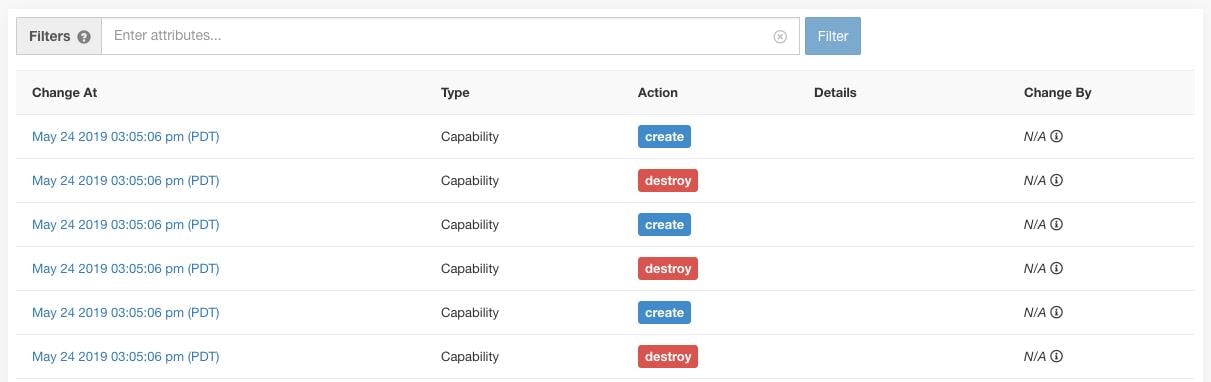
Site Admins can access the Change Log page under the Manage menu in the navigation bar at the left side of the window. This page displays the most recent changes that are made within Cisco Secure Workload.


Note


Change Log Retention Period: Secure Workload manages change logs for a duration of up to one year on both SaaS and On-premises clusters. An hourly job deletes change logs that exceed a one-year timeframe.


Figure 5. Change Log Page

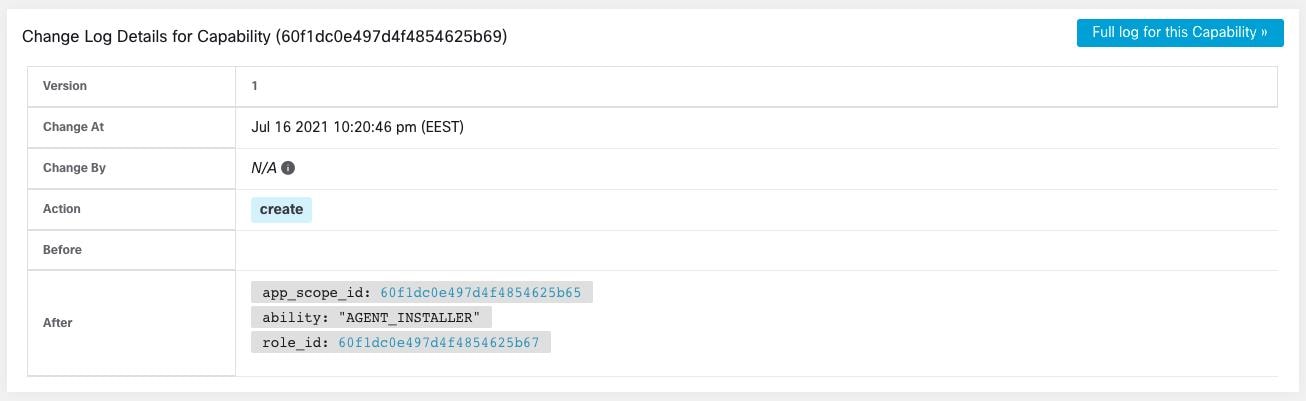
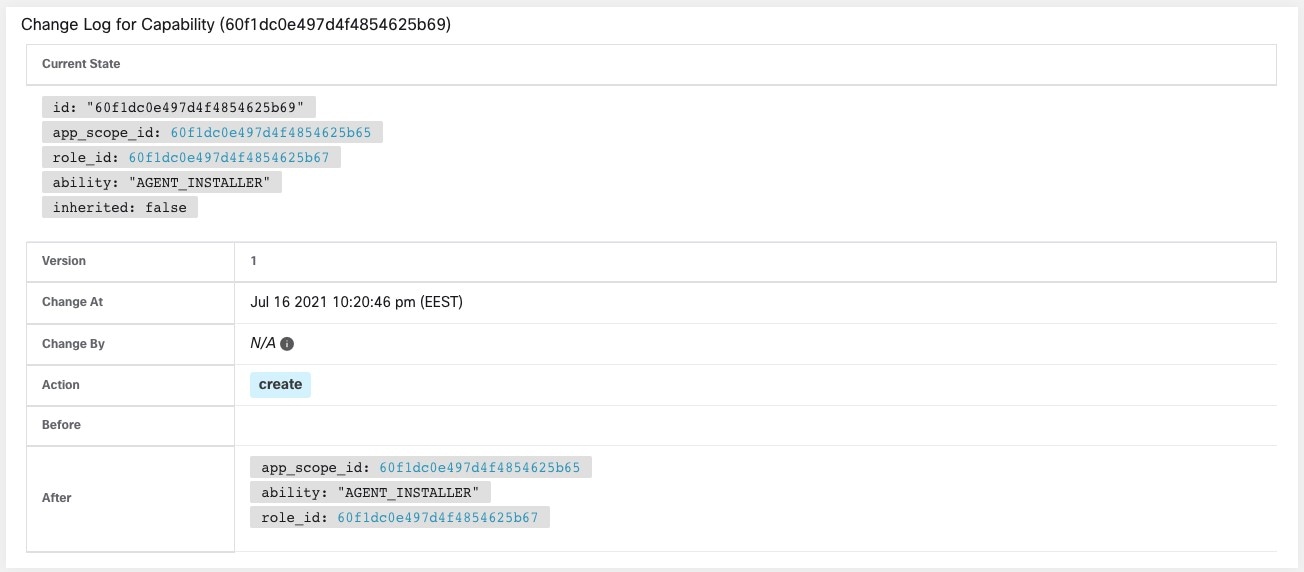
The details of each change log entry can be viewed by clicking on the link in the Change At column. This page includes a Before and After snapshot of the fields changed. The fields may include technical names that require some interpretation to understand how they are surfaced elsewhere throughout Secure Workload.

Figure 6. Change Log Details Page

The complete list of changes for an entity can be viewed by clicking the button in the upper-right corner, titled Full log for this <entity type>. This page displays the details of each change. It also includes the Current State of the entity, when available.

Figure 7. Full Change Log for Entity

Roles

You can restrict access to features and data using role-based access control (RBAC) model.

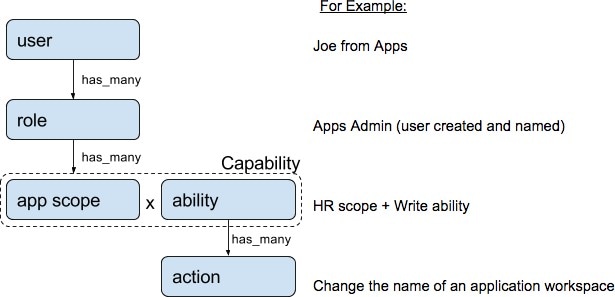
  • User - someone with login access to Cisco Secure Workload.

  • Role - user created set of capabilities that is assigned to a user.

  • Capability - scope + ability pair

  • Ability - collections of actions

  • Action - low-level user action such as “change workspace name”

Figure 8. Role Model

A user can have any number of roles. Roles can have any number of capabilities. For example, the “HR Search Engineer” role could have two capabilities: “Read on the HR Scope” to give visibility and context and “Execute on “HR:Search” capability to allow the engineers assigned this role to make specific changes that are related to their applications.

Use the Users page to assign users to the different roles. Roles have several capabilities and you can assign users to any number of roles.

System roles are defined to allow users to get started more quickly. They define different levels of access to all Scopes, that is, all data on the system. These system roles are defined below.

Role

Description

Agent Installer

Provide the ability to manage agents life cycle including install, monitor, upgrade, and convert, but cannot delete agents and access agent config profile.

Customer Support

For Technical Support or Advanced Services. Provides access to cluster maintenance features. Allows the same access as Site Admin, but cannot modify users.

Customer Support Read Only

For Technical Support or Advanced Services. Provides access to cluster maintenance features. Allows the same access as Site Admin, but cannot modify users.

Site Admin

Provides the ability to manage users, agents, and so on. Can view and edit all features and data. There must be at least one site admin.

Global Application Enforcement

Provides the Enforce ability on every scope.

Global Application Management

Provides the Execute ability on every scope.

Global Read Only

Provides the Read ability on every scope.


Note


If required, you can create a SecOps user role to provide the ability to access flows, alerts, vulnerabilities, and forensics events within a specific scope.


Abilities and Capabilities

Roles are made up of capabilities which include a scope and an ability. These define the allowed actions and the set of data that they apply to. For example, the (HR, Read) capability should be read and interpreted as “Read ability on the HR scope”. This capability would allow access to the HR scope and all its children.

Ability

Description

Installer

Install, monitor, and upgrade software agents.

Audit

Global appliance data read support and access to change logs.

Read

Read all data including flows, application, and inventory filters.

Write

Make changes to applications and inventory filters.

Execute

Perform Automatically discover policies run and publish policies for analysis.

Enforce

Enforce policies that are defined in application workspaces that are associated with the given scope.

Owner

Required to toggle an application workspace from secondary to primary. Access to Data Tap Admin abilities, such as managing User App sessions, adding Data Taps, and creating Visualization Data Sources.

SecOps Read

Read all flows, alerts, vulnerabilities, and forensics events for the assigned scope.


Important


Abilities are inherited, for example, the Execute ability allows all the Read, Write, and Execute actions.


Important


Abilities apply to the scope and all the scope’s children.


Menu Access by Role

The menu items you see and use on the navigation pane depend on the assigned role:

Table 4. Overview Menu

Menu

Option

Site Admin

Customer Support

Customer Support Read Only

Global Application Enforcement

Global Application Management

Global Read Only

Agent Installer

Overview

Overview

Yes

Yes

Yes

Yes

Yes

Yes

No

Table 5. Organize Menu

Menu

Option

Site Admin

Customer Support

Customer Support Read Only

Global Application Enforcement

Global Application Management

Global Read Only

Agent Installer

Organize

Scopes and Inventory

Yes

Yes

Yes

Yes

Yes

Yes

No

Organize

Label Management

Yes

Yes

Yes

Yes

Yes

Yes

No

Organize

Inventory Filters

Yes

Yes

Yes

Yes

Yes

Yes

No

Table 6. Defend Menu

Menu

Option

Site Admin

Customer Support

Customer Support Read Only

Global Application Enforcement

Global Application Management

Global Read Only

Agent Installer

Defend

Segmentation

Yes

Yes

Yes

Yes

Yes

Yes

No

Defend

Enforcement Status

Yes

Yes

Yes

Yes

Yes

Yes

No

Defend

Policy Templates

Yes

Yes

Yes

Yes

Yes

Yes

No

Defend

Forensic Rules

Yes

Yes

Yes

Yes

Yes

Yes

No

Table 7. Investigate Menu

Menu

Option

Site Admin

Customer Support

Customer Support Read Only

Global Application Enforcement

Global Application Management

Global Read Only

Agent Installer

SecOps

Investigate

Traffic

Yes

Yes

Yes

Yes

Yes

Yes

No

Yes

Alerts

Yes

Yes

Yes

Yes

Yes

Yes

No

Yes

Vulnerabilities

Yes

Yes

Yes

Yes

Yes

Yes

No

Yes

Forensics

Yes

Yes

Yes

Yes

Yes

Yes

No

Yes

Table 8. Reporting Menu

Menu

Option

Tenant Owner

Agent Installer

SecOps

Reporting

Reporting Dashboard

Yes

No

Yes

Table 9. Manage Menu

Menu

Option

Site Admin

Customer Support

Customer Support Read Only

Global Application Enforcement

Global Application Management

Global Read Only

Agent Installer

Manage

Alerts Configs

Yes

Yes

Yes

Yes

Yes

Yes

No

Manage

Change Logs

Yes

No

Yes

No

No

No

No

Manage

Connectors

Yes

Yes

No

No

No

No

No

Manage

External Orchestrators

Yes

Yes

No

No

No

No

No

Manage

Secure Connector

Yes

Yes

No

No

No

No

No

Manage

Virtual Appliances

Yes

Yes

No

No

No

No

No

Manage

Users

Yes

No

No

No

No

No

No

Manage

Roles

Yes

Yes

Yes

No

No

No

No

Manage

Threat Intelligence

Yes

Yes

Yes

No

No

No

No

Manage

Licenses

Yes

No

No

No

No

No

No

Manage

Collection Rules

Yes

Yes

Yes

Yes

Yes

Yes

No

Manage

Session Configuration

Yes

Yes

No

No

No

No

No

Manage

Usage Analytics

Yes

Yes

No

No

No

No

No

Manage

Data Tap Admin

Yes

No

No

No

No

No

No

Table 10. Platform menu

Menu

Option

Site Admin

Customer Support

Customer Support Read Only

Global Application Enforcement

Global Application Management

Global Read Only

Agent Installer

Platform

Tenants

Yes

Yes

No

No

No

No

No

Platform

Cluster Configuration

Yes

Yes

No

No

No

No

No

Platform

Outbound HTTP

Yes

Yes

No

No

No

No

No

Platform

Collectors

Yes

Yes

No

No

No

No

No

Platform

External Authentication

Yes

Yes

No

No

No

No

No

Platform

SSL Certificate

Yes

Yes

No

No

No

No

No

Platform

Login Page Message

Yes

Yes

No

No

No

No

No

Platform

Federation

See below

See below

No

No

No

No

No

Platform

Data Backup

See below

See below

No

No

No

No

No

Platform

Data Restore

See below

See below

No

No

No

No

No

Platform

Upgrade/ Reboot/ Shutdown

Yes

Yes

No

No

No

No

No


Note


  • Enable the Federation option to make Federation available for Site Admin and Customer Support roles.

  • Enable the Data Backup and Restore option to make data backup and restore available for Site Admin and Customer Support roles.


Table 11. Troubleshoot Menu

Menu

Option

Site Admin

Customer Support

Customer Support Read Only

Global Application Enforcement

Global Application Management

Global Read Only

Agent Installer

Troubleshoot

Service Status

Yes

Yes

Yes

No

No

No

No

Troubleshoot

Cluster Status

See below

See below

No

No

No

No

No

Troubleshoot

Virtual Machine

Yes

Yes

Yes

No

No

No

No

Troubleshoot

Snapshots

Yes

Yes

No

No

No

No

No

Troubleshoot

Maintenance Explorer

Yes

Yes

No

No

No

No

No

Troubleshoot

Resque

Yes

Yes

No

No

No

No

No

Troubleshoot

Hawkeye (Charts)

Yes

Yes

Yes

No

No

No

No

Troubleshoot

Abyss (Pipeline)

Yes

Yes

Yes

No

No

No

No


Note


The Cluster Status option is available to Site Admin and Customer Support roles for physical clusters.


Create a Role

Before you begin

You must have a Site Admin or a Customer Support role.

  1. From the navigation pane, choose Manage > User Access > Roles.

  2. Click Create New Role. The Roles panel appears.

Creating a role using the Create Role Wizard is three-step process.

Procedure


Step 1

  1. Enter the appropriate values in the following fields:

    Field

    Description

    Name

    The name to identify the role.

    Description

    A short description to add context about the role.

  2. Click the Next button to move to the next step or Back to Roles Page to go back to Roles Page.

Step 2

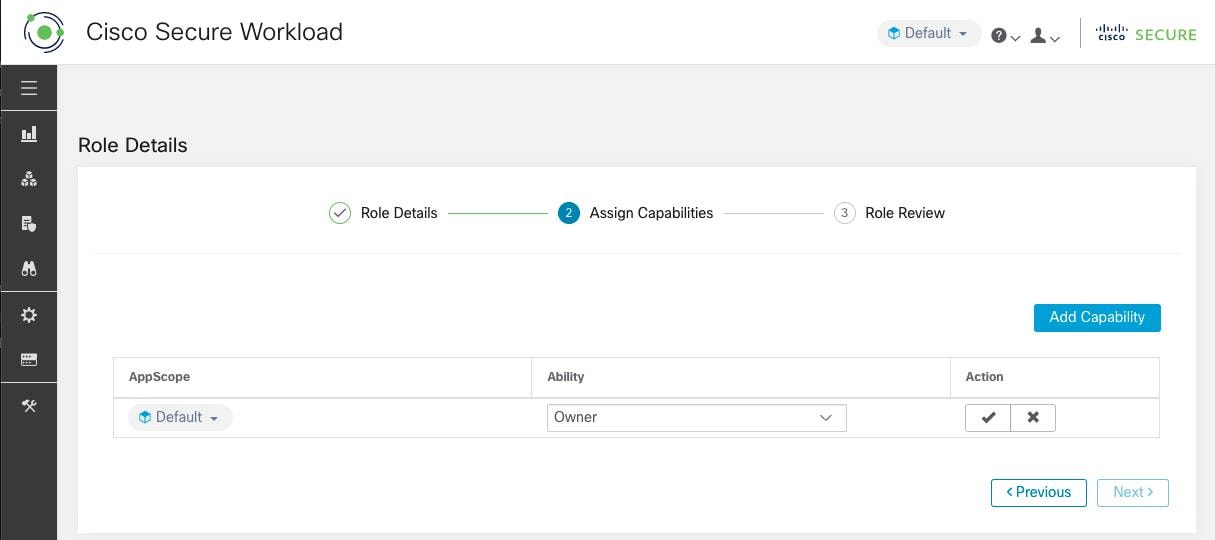
  1. Click the Add Capability button to show the creation form in the top row.

  2. Select scope and ability.

  3. Click the Checkmark button to create a new capability or Cancel button to cancel.

  4. Click Next to review role details or Previous to go back and edit.

Figure 9. Capability Assignment
Capability Assignment

Step 3

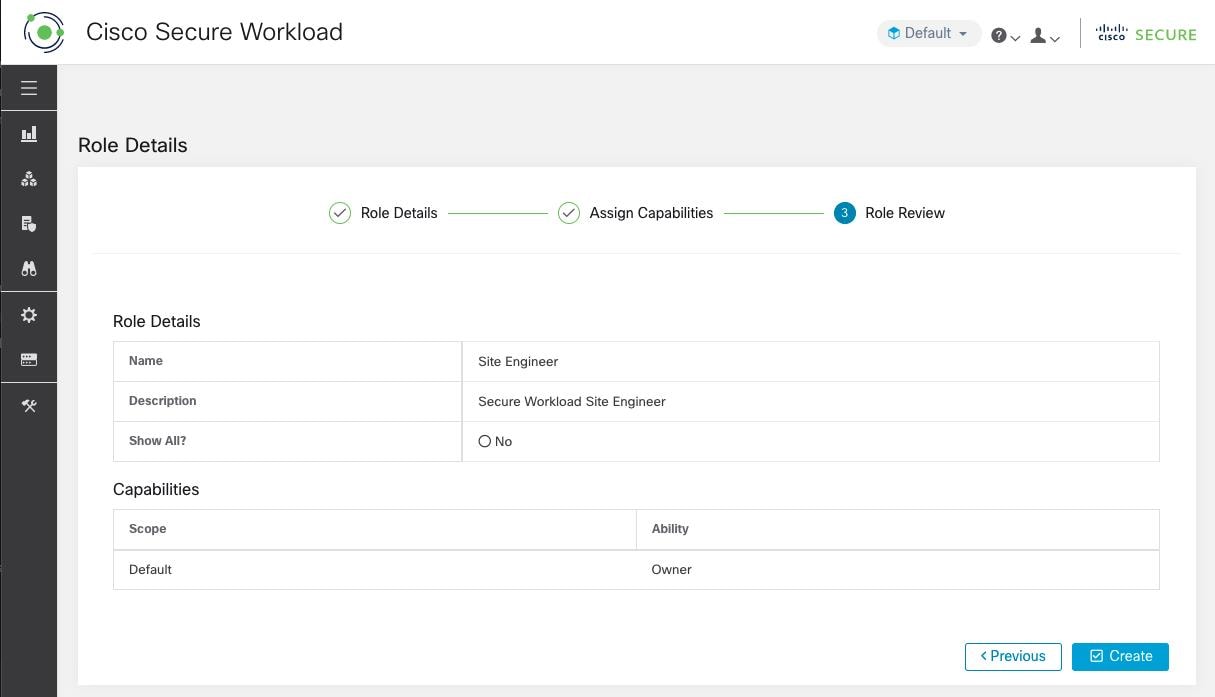
  1. Review the role details and capabilities.

  2. Click Create to create role.

Figure 10. Role Review
Role Review

Edit a Role

Editing a role using the Edit Role Wizard is a three-step process. This section explains how Site Admins and Customer Support users can edit roles.

Before you begin

You must be Site Admin or Customer Support User.

  1. From the navigation pane, choose Manage > User Access > Roles.

  2. In the row of the role to edit, click the Edit button in the right-hand column. The Roles panel appears.

Procedure


Step 1

  1. Update the name or description if desired.

  2. Click the Next button to move to the next step or Back to Roles Page to go back to Roles Page.

Step 2

  1. Remove any capability as needed. In the row of the capability to delete, click the Delete icon in the right-hand column.

  2. To add, click the Add Capability button to show the creation form in the top row.

  3. Select scope and ability.

  4. Click Next to review role details or Previous to go back and edit.

Step 3

  1. Review the role details and capabilities.

  2. Click Update to create the role or Previous to go back and edit. Changes to role details and capability assignment are saved after Update.

Note


Capabilities cannot be edited, they must be deleted and recreated.


Change Log

Site Admins can access the Change Log page under the Manage menu in the navigation bar at the left side of the window. This page displays the most recent changes that are made within Cisco Secure Workload.


Note


Change Log Retention Period: Secure Workload manages change logs for a duration of up to one year on both SaaS and On-premises clusters. An hourly job deletes change logs that exceed a one-year timeframe.


Figure 11. Change Log Page

The details of each change log entry can be viewed by clicking on the link in the Change At column. This page includes a Before and After snapshot of the fields changed. The fields may include technical names that require some interpretation to understand how they are surfaced elsewhere throughout Secure Workload.

Figure 12. Change Log Details Page

The complete list of changes for an entity can be viewed by clicking the button in the upper-right corner, titled Full log for this <entity type>. This page displays the details of each change. It also includes the Current State of the entity, when available.

Figure 13. Full Change Log for Entity

Collectors

Site Admins and Customer Support users can access the Collectors page under the Platform menu in the navigation bar at the left side of the window. This page displays the currently configured collectors. The Secure Workload agents send flow data to the commissioned collectors, so it is important for all of the commissioned collectors to be available. By default, all collectors are periodically checked for their health and they are either commissioned or decommissioned based on their health. You can opt out of this automated process using the toggle Auto Commission Opt Out. With this toggle on, the Play and Stop icons under the far right column can be used to commission and decommission respectively.

Figure 14. Collectors Page
Collectors Page

Collection Rules

Site Admins and Customer Support users can access the Collection Rules page under the Manage > Service Settings menu in the navigation bar at the left side of the window. This page displays the hardware collection rules by VRF that is used by switches running the Cisco Secure Workload agent. There is a row in the table for each VRF.

Rules

Click the Edit button on a VRF to modify its collection rules. By default, every VRF is configured with two default catch-all rules, one for IPv4 (0.0.0.0/0 INCLUDE) and one for IPv6 (::/0 INCLUDE). These default rules can be removed, but do so with caution.

Extra include and exclude rules can be added. Enter a valid subnet, select include or exclude, and click Add Rule. The priority of these rules can be adjusted via drag-and-drop. Click-and-hold on a rule in the list and drag it to adjust the order.

Changes may take several minutes to propagate to your switches. Click the Back button in the upper-right corner to return to the VRF list.

Priority

Collection Rules are ordered in decreasing order priority. No longest prefix match is done to determine the priority. The rule appearing first has higher priority over all the subsequent rules. Example:

  1. 1.1.0.0/16 INCLUDE

  2. 1.0.0.0/8 EXCLUDE

  3. 0.0.0.0/0 INCLUDE

In the earlier example, all addresses belonging to 1.0.0.0/8 subnet are excluded except subnet 1.1.0.0/16 which is included.

Another Example with changed order:

  1. 1.0.0.0/8 EXCLUDE

  2. 1.1.0.0/16 INCLUDE

  3. 0.0.0.0/0 INCLUDE

In the above example, all addresses belonging to 1.0.0.0/8 subnet are excluded. Rule number-2 does not get exercised here because of a higher-order rule already defined for its subnet.

Company

You can set the following company-wide (per Secure Workload cluster) configurations.

Outbound HTTP Connection

To ensure the latest Threat Intelligence Datasets are retrieved from Cisco Cloud, we highly recommend that you set up an outbound HTTP connection.


Warning


Your enterprise outbound HTTP request may require allowing traffic to periscope.tetrationcloud.com and uas.tetrationcloud.com from enterprise firewall outbound rules in addition to setting up the HTTP Proxy as shown below.

The TLS connection to periscope.tetrationcloud.com is used to transport Threat Intelligence Data for identifying known vulnerabilities. Therefore, it is essential for Cisco Secure Workload to verify the authenticity of the domain name by verifying the domain’s X.509 certificate’s signing CA cert against reputable root CA certificates included with Secure Workload. Tampering with the X.509 trust chain prevents the feature from working correctly.


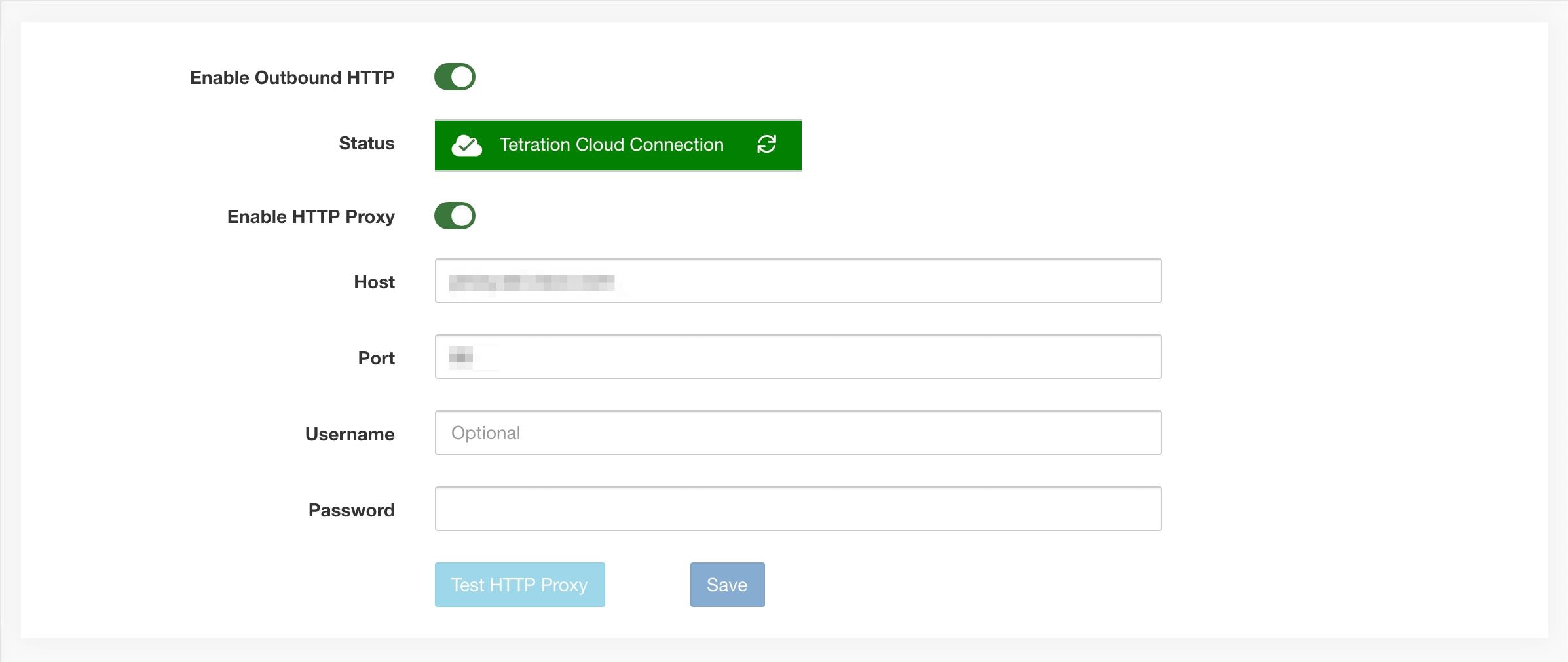
Figure 15. Outbound HTTP Connection
Outbound HTTP Connection

Site Admins and Customer Support users can access Outbound HTTP settings. In the navigation bar on the left, click Platform > Outbound HTTP.

Field

Description

Status

Indicates whether Secure Workload appliance can reach to Secure Workload Cloud to retrieve Threat Intelligence Dataset updates. The status check can be retriggered by clicking on the refresh button. The following HTTP proxy settings can be used to configure HTTP Proxy settings based on your Secure Workload deployment.

Enable HTTP Proxy

All external HTTP connections use HTTP proxy if this option is enabled

Host

HTTP proxy host address

Port

HTTP proxy port number

Username

Required only if your HTTP proxy server uses basic authentication

password

Required only if your HTTP proxy server uses basic authentication

Login Page Message

Site Admins and Customer Support users can enter a message of up to 1600 characters that users see on the sign-in page.

To create or change the login page message:

  1. From the navigation page, choose Platform > Login Page Message.

  2. Enter or edit the message. The character limit is less than or equal to 1600 characters.

  3. Click Save.

Configure External Authentication

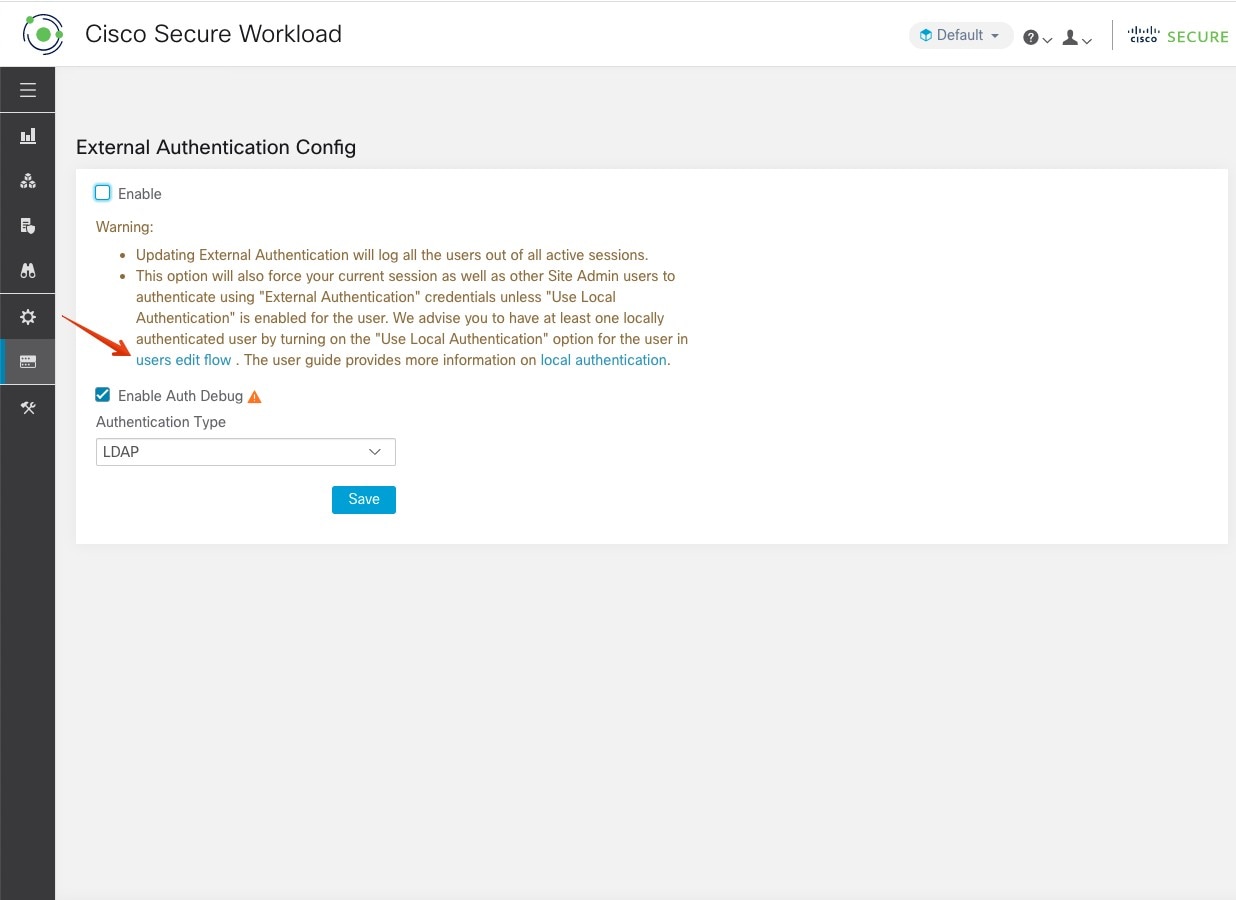
If the external authentication is enabled, authentication can be handed off to an external system. The current options for authentication are Lightweight Directory Access Protocol (LDAP) and Single Sign-On (SSO). This means that once this is enabled, all users signing in will use the chosen mechanism to authenticate. It is important to establish that the LDAP connection is configured correctly, especially if no users are on the ‘Use Local Authentication’ option. The recommended approach is to have at least one locally authenticated user with Site Admin credentials by turning on the ‘Use Local Authentication’ option. This user can make sure that the LDAP configuration is set up correctly. Once the connection is successfully set up, this user can also be transitioned to external authentication by unchecking the ‘Use Local Authentication’ option in the user edit flow.

Site Admins can enable more debug messages which are useful to debug external connection issues, user sign-in failures and so on. This can be enabled by checking the ‘External Auth Debug’ option. Once this is turned on, more descriptive log messages are written into a separate log file titled ‘external_auth_debug.log’. The recommendation is to turn off ‘External Auth Debug’ once debugging is done to prevent extra logs being written into the log file.


Note


You can bypass external authentication once it is enabled on a per user basis as indicated in ‘Use Local Authentication’ option. This option can also be enabled by going to the user edit flow from link through the warning message when external authentication is also enabled.


External Authentication with SSO is the recommended authentication approach if Federation is enabled. From the navigation bar, choose Platform > External Authentication.


Note


Starting from Secure Workload release 3.7.1.5 and later, external authentication session for eviction time is increased from six hours to nine hours. This setting is applicable for external authentication or on-premises only.


Both Site Admins and Customer Support can configure external authentication. Note that only Site Admins have the ability to generate recovery codes and if external authentication is enabled, recovery code generation is not supported.​

Figure 16. Configure External Authentication

Note


  • Each admin user is provided with six recovery codes for download. These recovery codes will have to be downloaded after the admin user logs in.​

  • Recovery codes must be used during login in conjunction with the username. Enter the recovery code in the password field.​

  • When logging in with the username and the recovery code as the password, users will be redirected to the password reset screen to set a new password. Note that the used recovery code will not be valid for subsequent logins.​

  • We suggest users to regenerate their recovery codes before exhausting all available codes.​


Figure 17. Configure External Authentication Continued
Configuring External Authentication Continued
Figure 18. Configure External Authentication Continued
Configuring External Authentication Continued
Figure 19. External Authentication Warning
External Authentication Warning

Configure Lightweight Directory Access Protocol

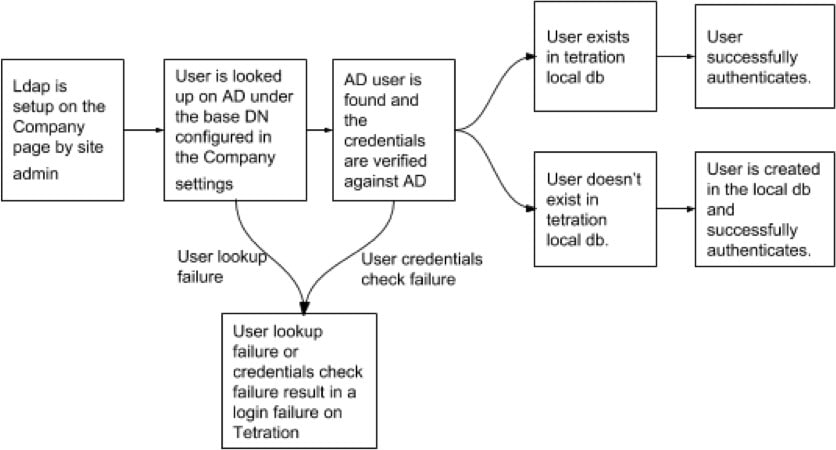
Choose the Lightweight Directory Access Protocol (LDAP) option to authenticate users. This means that once this is enabled all users will be logged out and subsequent signing in will use their LDAP email and password to authenticate.

LDAP is currently not recommended as the authentication mechanism if you have ‘Federation’ enabled.

If you have enabled LDAP, the recommended workflow for new user creation is as follows.

Site Admins are encouraged to first create new users with their emails and assign the appropriate roles by Configuring LDAP Authorization (AD authorization) before new users logs in using LDAP for the first time. If a new user logs in through LDAP without the appropriate role, no default role is assigned to the user.

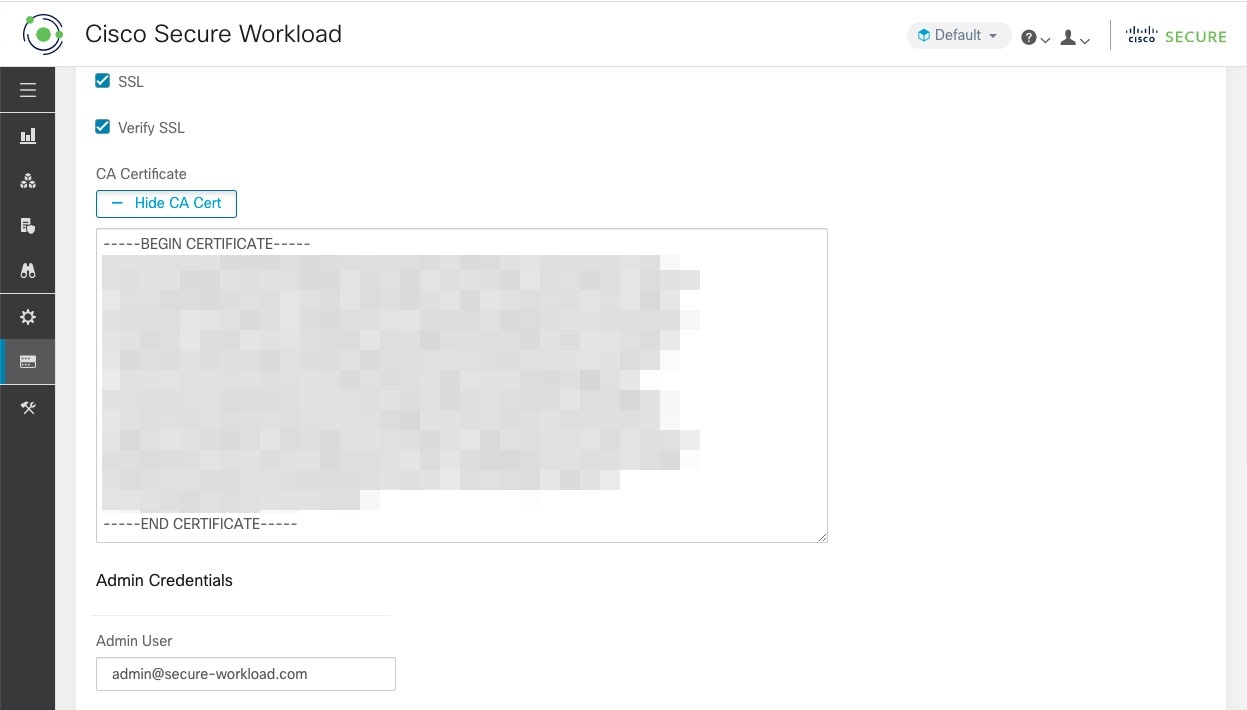
Figure 20. Configure Lightweight Directory Access Protocol

Field

Description

Auto Create Users

Turning on ‘Auto Create Users’ will create users if they don’t exist at first login. This saves the site admins from having to preprovision users before allowing users to log in. This option should be turned off if Secure Workload access should be limited to users manually created on the Users page.

Host

LDAP Host which will be used for authentication.

Port

LDAP Port which will be used for authentication.

Email Attribute

The Attribute field in the external authentication configuration for LDAP supports comma-separated values. This allows for multiple LDAP attributes to be used as filters during authentication.​​

Note


If users in the LDAP database have samAccountName as their username, samAccountName must be included in the Attribute field for proper user authentication.

Base

LDAP base dn from where users will be searched.

SSL

Enable encryption and use ‘ldaps://’.

SSL Verify

Verify server’s SSL attributes such as Fully Qualified Domain Name (FQDN) based on server’s certificate.

SSL Certificate Authority Cert

Signing cert for LDAP server’s SSL Cert. Required if server cert chain cannot be publicly verified.

Admin User

LDAP Admin user (not Secure Workload user) name used to bind against the LDAP server. For example: [User]@[Domain] or [Domain]\\[User]

Admin Password

LDAP Admin password that is used to bind against the LDAP server.

Ldap Authorization

LDAP Authorization can be enabled and configured as explained in Configuring LDAP Authorization (AD authorization).


Note


Without SMTP server configuration, Site Admins will not be able to authenticate users using their emails as email-based authentication will be affected without configuring an SMTP server.


Once the LDAP config is enabled all users except users with ‘Use Local Authentication’ option enabled will be logged out of their sessions.

The LDAP config can be saved once the ‘Save’ button is clicked. We recommend that you wait for a minute after the LDAP config is saved successfully before attempting to test the LDAP connection.

The LDAP connection can be tested out after the LDAP config has been saved using the ‘Test Connection’ button. This tries a bind against the LDAP server with the admin credentials entered.

Figure 21. Authentication Workflow
Authentication Workflow
Troubleshoot LDAP Issues

If an error is raised when you test the ldap connection, check the following:

  • Check whether the LDAP admin credentials are correct.

  • Check the connection params such as host, port, ssl and so on.

  • Check whether the LDAP server can be reached from Secure Workload UI VIPs.

  • Check whether the AD server is up.

  • Use command-line tools such as ‘ldapsearch’ with the connection details to see whether a bind can be made.

If an error is raised during login for a user, check the following:

  • Check whether the user can log in with their LDAP credentials to other company websites which use LDAP authentication.

  • Check whether the ‘base’ dn that is specified in the Company LDAP settings is correct. This can be done by using command-line tools such as ‘ldapsearch’ to look up the user against the base dn.

Example ‘ldapsearch’ query to search a user by email:

ldapsearch -H "ldap://<host>:<port>" -b "<base-dn>" -D "<ldap-admin-user>" -w <ldap->admin-password> "(mail=<users-email-address>)"

Configure LDAP Authorization (AD Authorization)

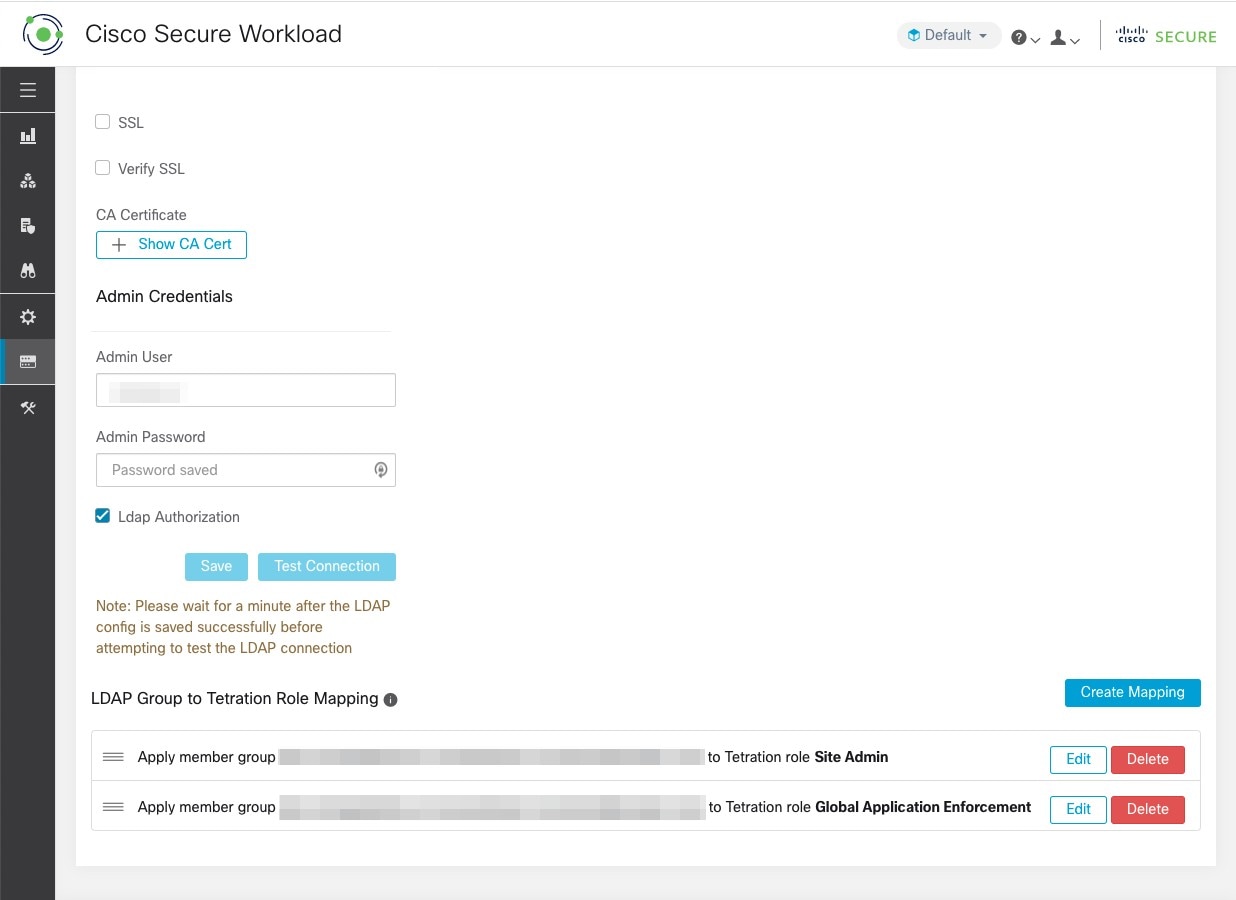
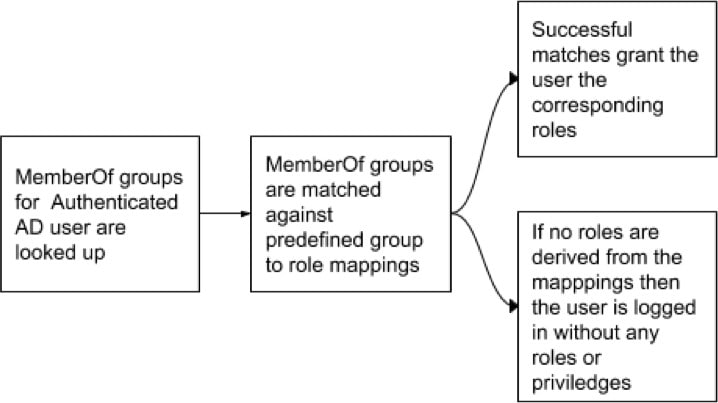
Active Directory Authorization can be configured by enabling the ‘LDAP Authorization’ checkbox in the ‘Admin Credentials’ section of the External Authentication LDAP configuration. Once this setting is enabled, Site Admin must set up mappings of LDAP ‘MemberOf’ groups to Secure Workload Roles in the section below. By default, without this configuration, Active Directory users must be preconfigured with one or more Secure Workload roles prior to a login attempt.

LDAP MemberOf Group to Secure Workload Role Mapping must be set up if LDAP external authentication is enabled. ‘Create Mapping’ allows setting up an LDAP MemberOf group value to be mapped to a Secure Workload Role. The roles in the role dropdown are prepopulated based on the scope that is selected in the scope selector. Once these mappings are saved, all users get authorized based on these values on their subsequent login.

These mappings can be reordered, edited, or deleted. Any modifications to the mappings will be reflected on the roles assigned to users on their subsequent login. A maximum of 50 LDAP MemberOf Group to Secure Workload Role Mappings can be created.

Duplicate LDAP MemberOf group names are not allowed. However multiple LDAP MemberOf groups can map to the same role. If more than one group maps to the same role, the last mapping will be stored in the user as the matched LDAP MemberOf to Secure Workload role.

Figure 22. LDAP Group to Secure Workload Role SetUp
LDAP Group to Secure Workload Role SetUp
Figure 23. LDAP Group to Secure Workload Role Mapping
LDAP Group to Secure Workload Role Mapping

A site admin user can reconcile the assignment of roles based on the above role mapping with the help of external user’s information that is obtained from the user’s last successful login.


Note


Users can bypass external authentication once it is enabled on a per user basis as indicated in ‘Use Local Authentication’ option. These users will also bypass the authorization process set up for AD authorization.


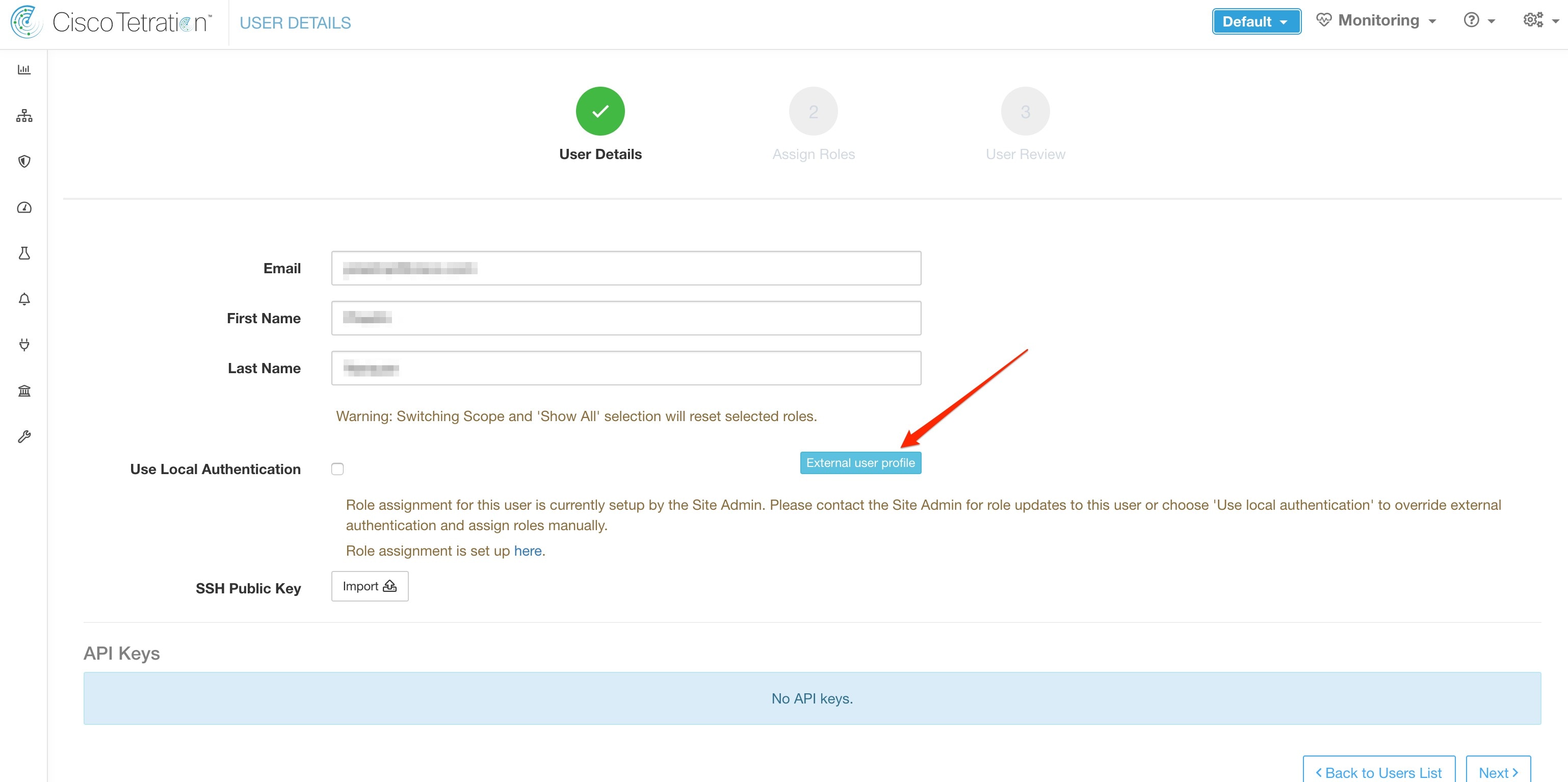
Figure 24. External User Information
External User Information

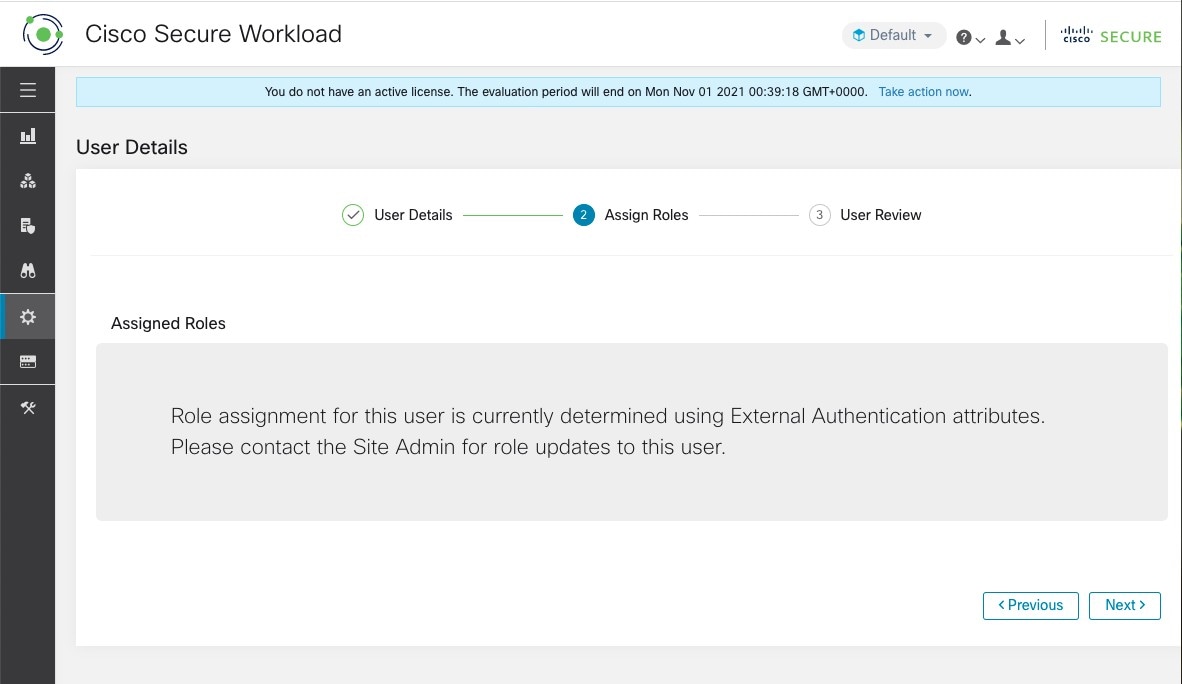
Once authorization is enabled, manual Secure Workload Role selection in the user creation (Add a User) and user edit flows (Editing a User Account) is disallowed.

Figure 25. Users Page
Users Page

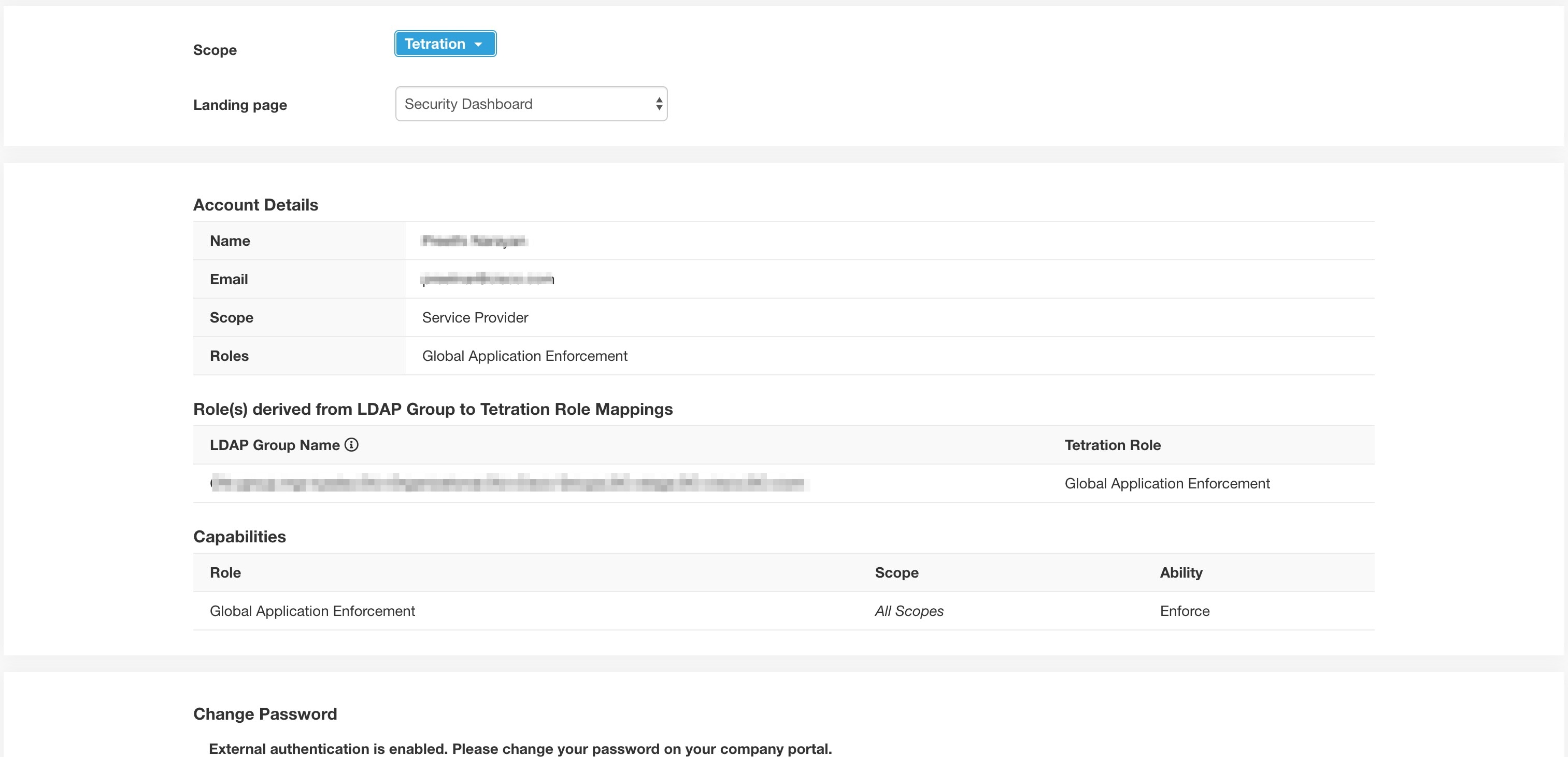
The mapped LDAP MemberOf groups to Secure Workload Roles are visible on the user profile page.

Figure 26. User Profile Page
User Profile Page
Figure 27. Authorization Workflow
Authorization Workflow

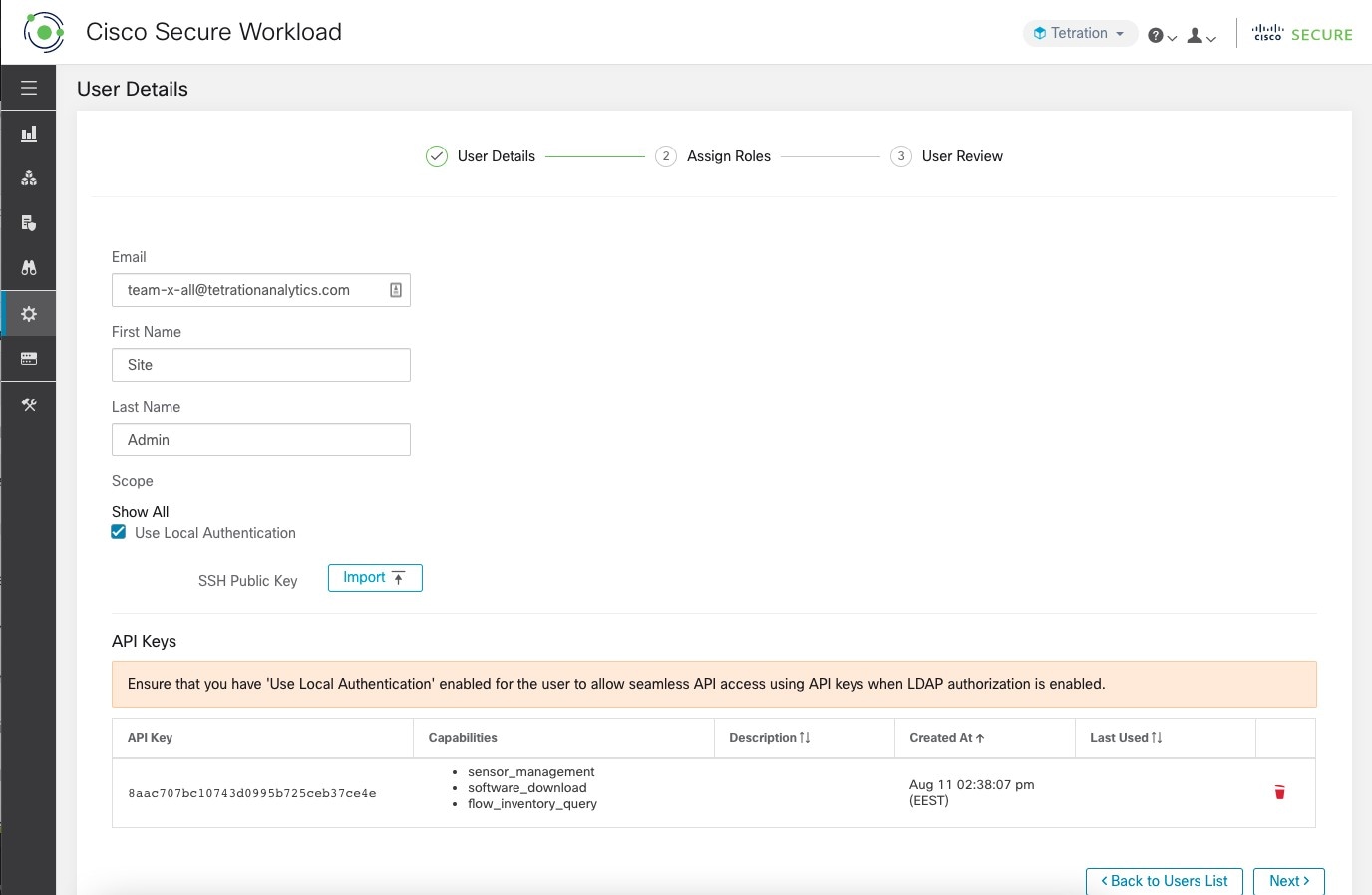
If LDAP Authorization is enabled, access to OpenAPI via API Keys cease to work seamlessly because Secure Workload roles that are derived from LDAP MemberOf groups are reassessed once the user session terminates. Hence to ensure uninterrupted OpenAPI access, we recommend that users with API Keys have ‘Use Local Authentication’ option enabled.

Figure 28. LDAP Authorization API Key Warning
LDAP Authorization API Key Warning
Figure 29. LDAP Authorization API Key Warning on Users Page
LDAP Authorization API Key Warning on Users Page
Troubleshoot LDAP Authorization Issues

If the roles are not getting assigned to users based on the mappings defined in the ‘External Authentication’, ‘LDAP Group to Role Mappings’ section, check the role mappings setup and format once more.

  • Group string must be of the string format. For example: CN=group.jacpang,OU=Organizational,OU=Cisco Groups,DC=stage,DC=cisco,DC=com

  • Group names must be exact from what is present in AD with no spaces or extra characters.

  • Role mapping for the group must be selected from the role selector.

User Role Mapping Debug Steps

  • You must have two users, one that is Site Admin, the email of this user should not be the same as the AD user.

  • This user is called ‘SA User’ for the steps below.

    • SA user has previously set up the role-mapping configs on the Company page External Auth Config as described earlier. Let’s assume ‘SA User’ will be logging in with [site-admin]@[Domain].

    • We assume that ‘AD User’ is [ad-user]@[Domain]. We assume that the LDAP setup is done and the AD user is able to log in but not getting his role that is assigned.

  • As AD User, log in using incognito browser session. This splits the browser state from SA User session.

  • As SA User, login and go to Users page.

  • Click on the Edit Icon for the AD User that must have Role Mapping configured.

  • Click the ‘External User Profile’ button on the User Profile page.

  • You will see an External Auth Profile Table that includes a ‘memberof’ section.

  • This is one of the ‘memberof’ values that you can use for role mapping on Company page, External Auth Config, LDAP Group to Role-Mapping section.

  • You must provide the whole ‘memberof’ per-line string to match. Once you create this role mapping, anyone who has the same attribute ‘memberof’ will be assigned the mapped role.

  • For the AD User to be granted the newly mapped role, the user needs to log out then log back in to allow re-evaluation of this mapping profile.

  • Once a user logs in and has roles that are assigned successfully as a result of group role mappings, the matching rules are visible on the ‘Preferences’ page for that user.

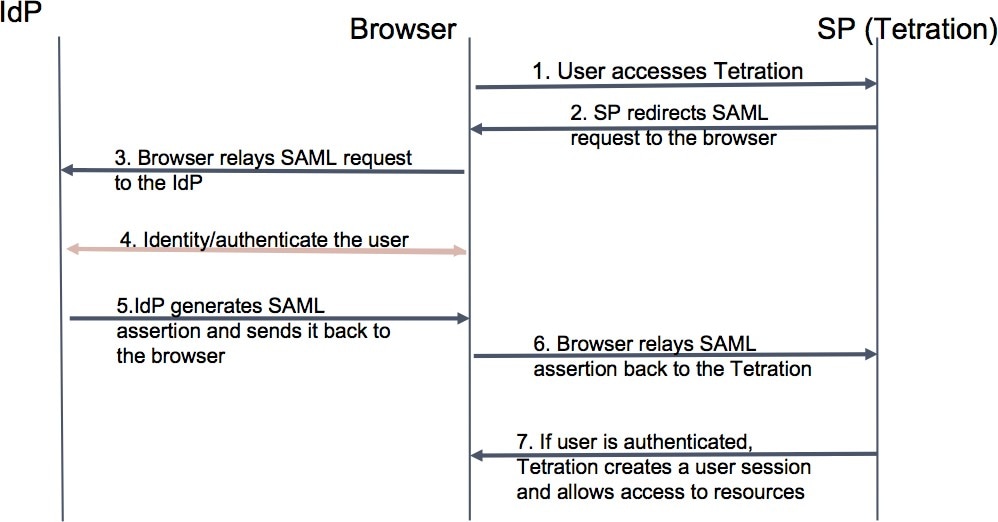
Configure Single Sign-On

If this option is selected, single sign-on (SSO) can be used to authenticate users. This means that when this is enabled all users will be redirected to the identity provider sign-in page to authenticate. Users with ‘Use Local Authentication’ option enabled can use the email and password sign-in form in the sign-in page to authenticate.

It is important to establish that the SSO configuration is set up correctly, especially if no users are on the ‘Use Local Authentication’ option. The recommended approach is to have at least one locally authenticated user with Site Admin credentials by turning on the ‘Use Local Authentication’ option. This user can make sure that the SSO configuration is set up correctly. When the connection is successfully set up, this user can also be transitioned to external authentication by unchecking the ‘Use Local Authentication’ option in the user edit flow.

If you enable SSO, the recommended workflow for new user creation is as follows.

Site Admins and Scope Owners are encouraged to first create new users with their emails and assign the appropriate roles and scopes before the new user logs in via SSO for the first time. If a new user logs in using SSO without the appropriate role, no default role is assigned to the user.


Note


Sending password reset instructions, which is reliant on email communication will be affected without an SMTP server configuration.


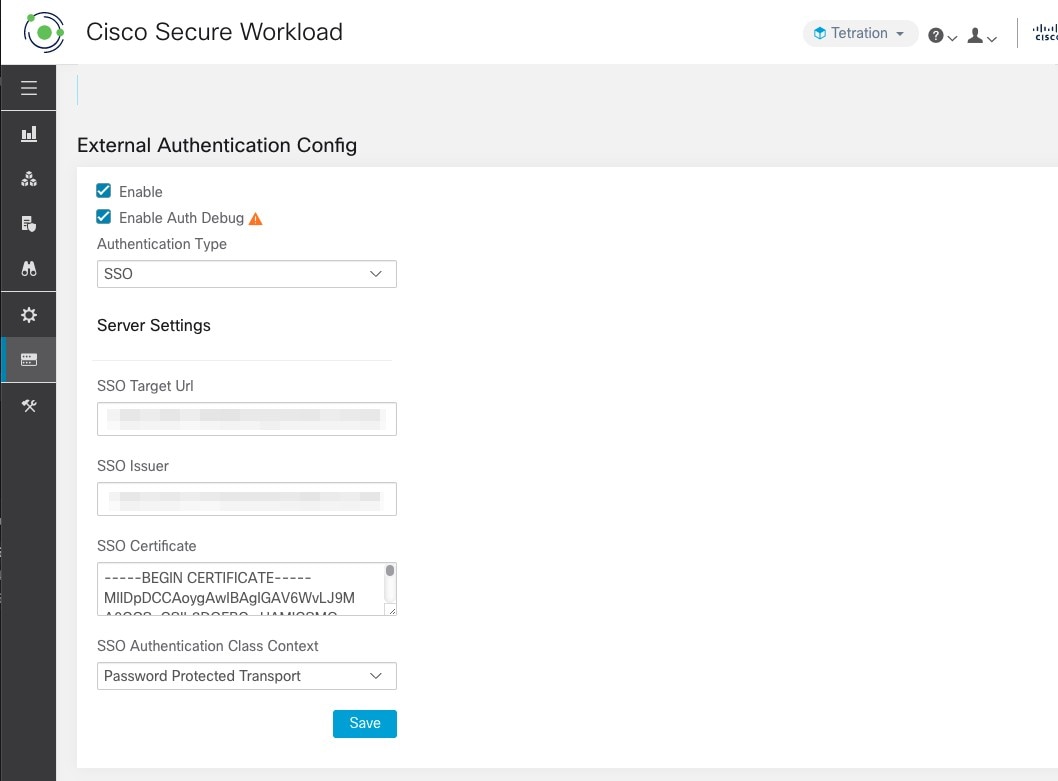
The following table describes the fields that must be set up to configure SSO on Secure Workload. Secure Workload is the service provider in this case.

Figure 30. Configure Single Sign-On
Configuring Single Sign-On

Field

Description

SSO Target Url

SSO IdP target URL to which users will be redirected to for login.

SSO Issuer

SSO Entity Id of your SP, a URL that uniquely identifies your SP. This is generally the metadata for the SP. In this case it is:
https://<tetration-cluster-fqdn>/h4_users/saml/metadata

SSO Certificate

SSO certificate that is provided by the Identity Provider (IdP).

SSO AuthN Context

Choice for SSO AuthN Context which is specified in the SAML Request. The default option is ‘Password Protected Transport’. The other choices are ‘Integrated Windows Authentication’ and ‘X.509 Certificate’ for Windows and PIV-based authentication.

After the SSO configuration is enabled, all users, except the users who have enabled the Use Local Authentication option, are logged out of their sessions.

The SSO configuration is saved after the Save button is clicked.

Figure 31. Authentication Workflow
Authentication Workflow
Information Shared to Identity Provider (IdP)

The IdP requires some information from Secure Workload (SP) to set up SSO for authentication. The following table describes the fields that must be set up.

Field

Description

SSO Url

The authentication endpoint (url) which will consume the SAML assertion (response from the IdP). In our case, it will be:
https://<tetration-cluster-fqdn>/h4_users/saml/auth

Entity Id

This is the metadata for the SP. In this case it is:
https://<tetration-cluster-fqdn>/ h4_users/saml/metadata

Name ID format

NameId is email i.e


'urn:oasis:names:tc:SAML:1. 1:nameid-format:emailAddress'

Attributes

User attributes are fetched from the IDP. We fetch these attributes as part of authentication:

  • email

  • firstName

  • lastName

Ensure that the attribute names are as specified previously.

Troubleshoot SSO Issues
  • Set up some downtime for this SSO config setup since the only way to verify authentication works (from the Service Provider) it is after setting it up.

  • Check and validate the IdP metadata generated.

  • Check all configuration parameters that are exchanged between IdP and SP.

    • Config at the IdP - SSO url, Audience, Name ID, attributes and so on

    • Config on Secure Workload Company page - SSO Target url, SSO issuer, and SSO certificate.

  • Get a sample SAML assertion returned from the IdP from the server app logs. Validate it against a SAML validator to make sure it is a valid SAML response.

  • Errors in the SP SSO setup may result in an error that is generated from the IdP. Using the browser inspect element, you can see the network requests being made.

  • If a user has issues logging in, have the IdP admin check whether the user has access to the Secure Workload app.

Use Local Authentication’ Option

After setting up the configuration, site administrators can permit users to bypass external authentication. This can be achieved on an individual user basis by enabling the 'Use Local Authentication' flag in the user edit section. Selecting this option for a user will log them out of all active sessions.

Figure 32. Use Local Authentication
Use Local Authentication

Warning


Ensure that at least one user has local authentication access!

If the ‘Use Local Authentication’ option is removed (i.e unchecked) for a user and this user happens to be the last user with the option, then no user has local authentication access to sign in to Secure Workload. This means that no user can sign in if there is any disruption with the external authentication system, such as config issues, connectivity issues, and so on. You see a warning if you try to delete the last locally authenticated user.


Users logging via external authentication has shorter sessions and will be prompted to log in when the session expires. Users logging via external authentication cannot reset their password on the site (they have to do it on their company website). However if the ‘Use Local Authentication’ flag is set for the user, password reset is possible.

SSL Certificate and Key

To enable a fully verifiable HTTPS access to the Secure Workload UI, an SSL certificate specific to the U I’s domain name and the RSA private key that matches the SSL certificate’s public key can be uploaded into the cluster.

An SSL Certificate can be obtained in two ways depending on the format of the Fully Qualified Domain Name (FQDN) used to refer to the Secure Workload UI Virtual IP (VIP) address. If the Secure Workload FQDN is based on an enterprise domain name such as tetration.cisco.com, your enterprise Certificate Authority (CA) who owns the base domain issues you an SSL Certificate. Otherwise, you may use a reputable SSL Certificate vendor to issue you an SSL Certificate for your FQDN.


Note


It is important to note that although the Secure Workload UI supports Server Name Indication (SNI), subject alternative names (Sans) specified in the certificate will not be matched. For instance, if the common name (CN) of the certificate is tetration.cisco.com and the certificate includes a SAN for tetration1.cisco.com, HTTPS requests sent with an Incompatible browser to the cluster with tetration1.cisco.com as the host name will not be served with that certificate. HTTPS requests made to the cluster with a host name other than the host name specified in the CN will be served using the default, self-signed certificate that is installed on the cluster. These requests result in browser warnings.


Site Admins and Customer Support users can work with SSL Certificates. From the navigation pane, click Platform > SSL Certificate.

The Maintenance UI or set-ups, which is used for major upgrade releases and patches, has been migrated to an HTTPS URL schema. After upgrading to a Secure Workload, Release, administrators are required to upload separate certificates for the Maintenance UI.

To import the certificate and key, click the Import New Certificate and Key button.

To generate the signing request, click the Generate New Certificate Signing Request button.


Note


The first import of SSL certification and the private key should be performed through a trusted network connection to the cluster so that the private key cannot be intercepted by malicious parties who have access to the transport layer.


Enter the following information for your SSL certificate and key:

NAME can be any name for the certificate key pair. This name is for your benefit when looking at which SSL certificate is installed.

X509 Certificate field accepts SSL certificate string in Privacy Enhanced Mail (PEM) format. If your SSL certificate requires an intermediary CA bundle, concatenate the CA bundle after your cert so that the SSL certificate for your Secure Workload FQDN is in the beginning of the certificate file.

It should have the following format:

-----BEGIN CERTIFICATE-----

< Certificate for Secure Workload FQDN >

-----END CERTIFICATE-----

-----BEGIN CERTIFICATE-----

< Intermediary CA 1 content >

-----END CERTIFICATE-----

-----BEGIN CERTIFICATE-----

< Intermediary CA 2 content >

-----END CERTIFICATE-----

-----BEGIN CERTIFICATE-----

< Root CA content >

-----END CERTIFICATE-----

RSA Private Key field should be the RSA private key of the public key that is signed in the previous certificate. It should have the following format:

-----BEGIN RSA PRIVATE KEY-----

< private key data >

-----END RSA PRIVATE KEY-----


Note


RSA Private Key is required to be unencrypted. It causes a “500 Internal Server Error” if the RSA Private Key is encrypted.


After you import, verification steps are run to ensure that public key that is signed in the certificate and the private key are indeed RSA key pair. If the verification is successful, we display the SHA-1 digest (SHA-1 signature and creation time) of the certificate bundle.

Reload the browser to see that your SSL connection to the Secure Workload UI is now using the newly imported SSL certificate.

Cluster Configuration

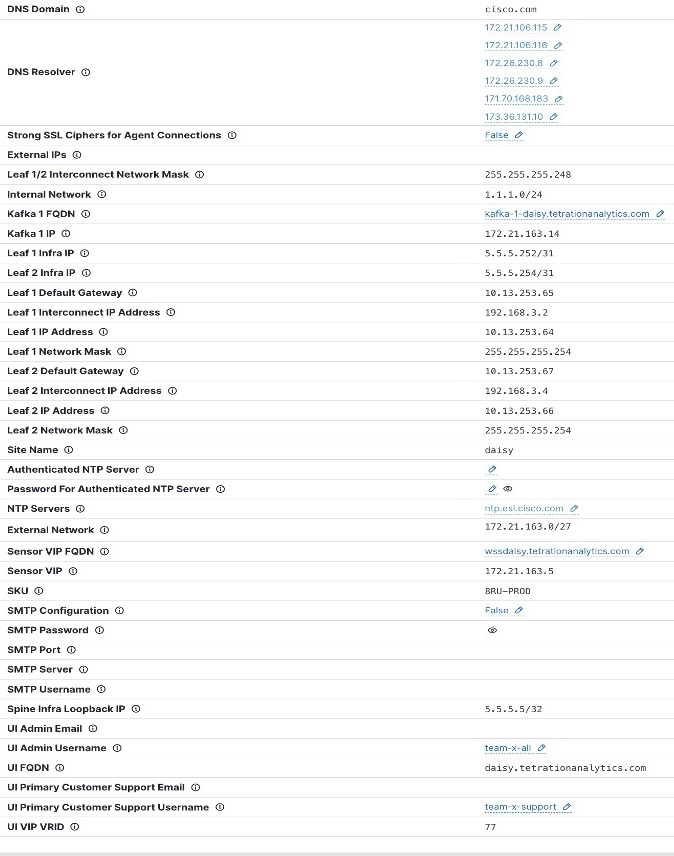
The cluster configuration provides an overview of the current settings of the Secure Workload cluster, including details about customer network, servers, administrative contacts, and more. Hover your cursor over the info icon to view the details about each field. You can modify the value of a field by clicking the pencil icon next to it.


Note


You can configure the Secure Workload cluster settings either at the cluster deploy UI setup, cluster upgrade UI setup or make changes to the deployed cluster configurations on the UI.


To view cluster configurations, from the navigation pane, choose Platform > Cluster Configuration.

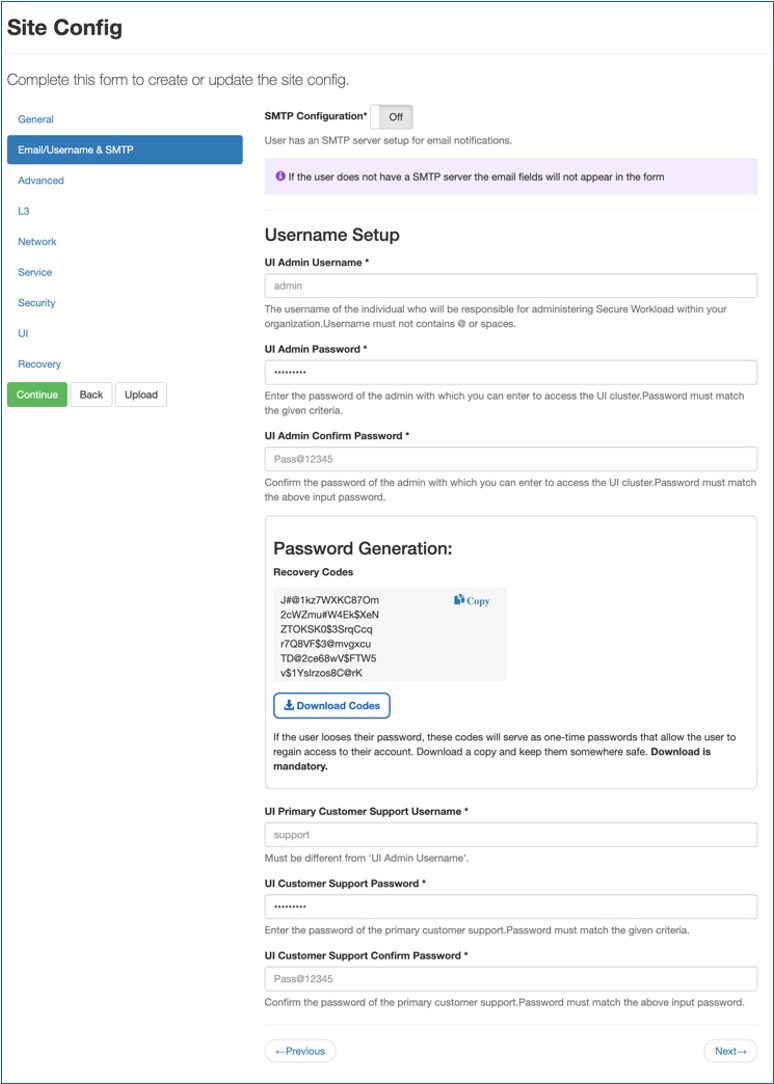
The SMTP Configuration field in the cluster configuration is used to enable or disable SMTP configuration. When toggling the SMTP configuration, a popup appears:

  • SMTP OFF: Displays the current logged-in admin user login (read-only) and mandatory downloadable recovery codes for that user. All email addresses are disabled for the system and the users.

  • SMTP ON: Displays the current logged-in admin user login (read-only), configurable Admiral alert email, and SMTP server configuration options. You will need to configure the admin email address and the SMTP server.

Figure 33. Cluster Configuration– SMTP Configuration
Strong SSL Ciphers for Agent Connections

When this option is enabled, TLS-1.0 and TLS-1.1 protocols and the following ciphers will not be accepted by the Secure Workload cluster during the SSL negotiations:

  • DHE- RSA-AES128-GCM-SHA256

  • DHE-RSA-AES256-GCM-SHA384

  • ECDHE-ECDSA-AES128-SHA

  • ECDHE-RSA- AES128-SHA

  • ECDHE-ECDSA-AES256-SHA

  • ECDHE-RSA-AES256-SHA

  • DHE-RSA-AES128-SHA256

  • DHE- RSA-AES128-SHA

  • DHE-RSA-AES256-SHA256

  • DHE-RSA-AES256-SHA

  • ECDHE-ECDSA-DES-CBC3- SHA

  • ECDHE-RSA-DES-CBC3-SHA

  • EDH-RSA-DES-CBC3-SHA

  • AES128-GCM-SHA256

  • AES256-GCM- SHA384

  • AES128-SHA256

  • AES256-SHA256

  • AES128-SHA

  • AES256-SHA

  • DES-CBC3-SHA

Use robust ciphers during the TLS handshake process and establish the following connections.

  • Connect API and UI to Secure Workload.

  • Connect all visibility and enforcement agent to Secure Workload.

Both Site Admins and Customer Support users can access this setting.


Note


  • Both Site Admins and Customer Support users can access this setting.

  • Older version of SSL libraries do not support this option.


CA Certificate Validity

By default, CA certificate have a one-year validity period. You can update the validity and expiration thresholds on the cluster configuration page.

Table 12. Cluster Validity Fields

Field

Description

Cluster CA Renewal Threshold

Defines the number of days in which the Secure Workload CA certificate needs to be renewed.

Cluster CA Validity

Defines the validity period for Secure Workload CA certificates.

External IPv6 Cluster Connectivity

Physical Cisco Secure Workload clusters can be configured to connect to both external IPv4 and IPv6 networks. IPv4 connectivity is required but IPv6 connectivity is optional. Once IPv6 connectivity has been configured, it cannot be disabled. Enabling IPv6 connectivity for external networking for the cluster can only be done during deploy or upgrade. See the Cisco Secure Workload Upgrade Guide for more information about enabling external IPv6 cluster connectivity during upgrade or the Cisco Secure Workload Hardware Deployment Guide for more information about enabling external IPv6 cluster connectivity during deployment.

Before you begin

To get agents to operate in dual stack mode (supporting both IPv4 and IPv6)

Prerequisite

  • Cluster must have IPv6 enabled.

  • Create A and AAAA records (for IPv4 and IPv6) in DNS for an FQDN and wait for the domain names to resolve.

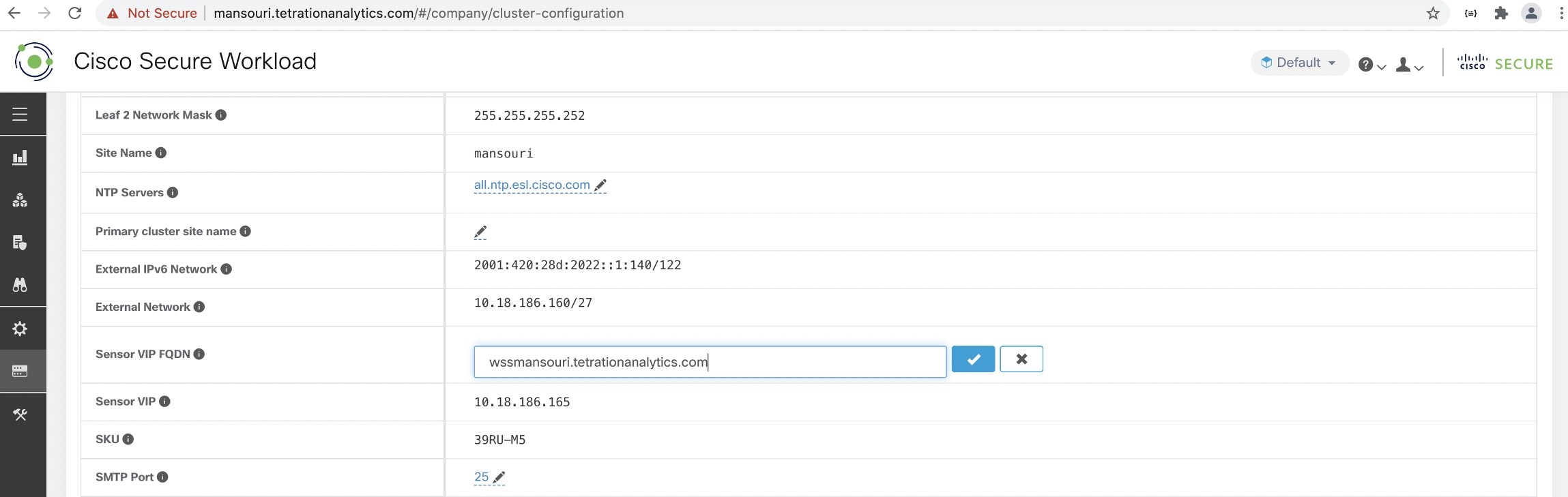
Configure “Sensor VIP FQDN” for agents to operate in dual stack mode

Procedure

Step 1

Choose Platform > Cluster Configuration from the navigation bar on the left.

Step 2

Look for the “Sensor IPv6 VIP”, “Sensor VIP” and “Sensor VIP FQDN” fields. “Sensor IPv6 VIP” and “Sensor VIP” should already be set.

Step 3

If “Sensor VIP FQDN” is not set, set it to the FQDN created above. The A and AAAA records in DNS for the FQDN must resolve before you do this.

Step 4

If “Sensor VIP FQDN” was already set, make sure there are A and AAAA records in DNS for the FQDN as set in the “Sensor VIP FQDN” field, then click into the “Sensor VIP FQDN” field and save it to the same value so it updates.

Step 5

After the field completes updating (after about 20 minutes, the status is updated automatically), agents will be able to connect to the cluster via both IPv4 and IPv6.

Step 6

Valid “Sensor VIP FQDN” can be set only once.

Note


No IPv6 enforcement support for AIX. For more information on the requirements and limitations for dual-stack mode, see the Cisco Secure Workload Upgrade Guide


NTP Authentication

Secure Workload on-premises version supports Network Time Protocol Version (NTP), version 4 and SHA-1 authentication. Configure the NTP server using the Setup user interface or use the Cluster Configuration page to deploy the appliance on the Secure Workload.

To configure NTP authentication using the Secure Workload user interface:

Procedure

Step 1

Configure the NTP server: A system running CentOS 7 provides the following configurations as a reference, and the configurations vary depending on the operating system.

  1. Ensure that the following entries are available under /etc/ntp.conf.

    
    # Key file containing the keys and key identifiers used when operating with symmetric key cryptography. 
    keys /etc/ntp/keys
    
    # Specify the key identifiers which are trusted.
    trustedkey 1
    controlkey 1
    requestkey 1
  2. Enter the server-side key under /etc/ntp/keys.

    
    # For more information about this file, see the man page ntp_auth(5).
    # id	type	key
    1 SHA1 <password> 
  3. Restart NTP server: # service ntpd restart

  4. Start the service for the NTP server:

    
    # ntpq -p
        remote       refid     st  t  when  poll  reach  delay  offset  jitter
    ==============================================================================
    <ntp.server.com> <refid>     5  u  17     64     377  0.000  0.000   0.000   

Step 2

On the Secure Workload UI, navigate to Platform > Cluster Configuration.

Step 3

In the Authenticated NTP Server field, enter the name or IP address of the NTP server.

Step 4

In the Password For Authenticated NTP Server field, enter the NTP server password.


After you configure and authenticate the NTP server, the authenticated NTP server takes precedence over any unauthenticated NTP servers that you enter in Secure Workload.
Disable Download and Registration of Unsupported Agents

As a system administrator, you have the ability to prevent agents with unsupported versions from registering with the cluster or being installed using the installer script. This is managed through a new configuration that effectively blocks new installations of agents with deprecated versions.

For instance, if you are using Secure Workload version 3.9, and the agent you are trying to download or register is on version 3.7 or earlier, the agent will fail to either download or register. This feature is designed to ensure that all agents within the cluster are running on supported versions, which can help to prevent potential compatibility issues or security vulnerabilities that might exist in older versions of the software.

Disable Unsupported Agents

To enable the Disable Unsupported Agents configuration, follow these steps:

Procedure

Step 1

Log in to the Secure Workload UI as an administrator.

Step 2

From the navigation pane, choose Platforms > Cluster Configuration.

Step 3

Change the Disable Unsupported Agents configuration field to True. By default, the configuration is disabled.


What to do next
After enabling the configuration, agents with not supported versions will not be able to register with the cluster or be installed using the installer script. This effectively blocks the installation of agents with deprecated versions, ensuring that only supported agent versions are utilized within the environment.

To continue the registration of the agent, we recommend that you download the latest software agent version.

Disable Agent Download

To prevent agents with deprecated software versions from getting installed:

Procedure

Step 1

From the navigation pane, choose Platforms > Cluster Configuration.

Step 2

Enable the Disable Agent Download configuration.


After you enable the configuration, the agent downloads successfully regardless of the software agent version.

Disable Agent Registration

To prevent registration of new agents:

Procedure

Step 1

Log in to the Secure Workload UI as an administrator.

Step 2

From the navigation pane, choose Platforms > Cluster Configuration.

Step 3

Enable the Disable Agent Registration configuration. After you enable the configuration, you cannot register any new agent on the appliance that does not match the software version.

Note


After enabling the configuration, if you attempt to download or register an agent with an unsupported version, it will fail to register on the appliance, and a warning message will be displayed on the GUI stating "Package download or registration for the old agent version is disabled." This ensures that only agents with supported versions can be registered or installed, preventing the use of deprecated agent versions within the environment.


Note


By default, the Disable Unsupported Agents, Disable Agent Download and Disable Agent Registration configurations are disabled.


Usage Analytics

Site Administrators and Customer Support users can enable or disable usage analytics. In the navigation bar, click Manage > Service Settings > Usage Analytics.

Secure Workload collects data, renders anonymously through one-way hashing before sending it to the server. Configure the Privacy settings on a per-appliance basis for an on-premises appliance and a per-tenant basis for Cisco Secure Workload SaaS. You can also enable Data collection and toggle the collection on this page.

Session Configuration

UI User Authentication idle session timeout can be configured here. This config applies to all the users of the appliance. The default idle session duration is 1 hour. The idle session duration can be set within the range of 5 minutes to 24 hours. The session timeout takes effect on a user’s authenticated session when this value is saved.

Site Admins and Customer Support users can access this setting. In the left navigation pane, click Manage > Service Settings > Session Configuration.

SSL Certificate and Key

To enable a fully verifiable HTTPS access to the Secure Workload UI, an SSL certificate specific to the U I’s domain name and the RSA private key that matches the SSL certificate’s public key can be uploaded into the cluster.

An SSL Certificate can be obtained in two ways depending on the format of the Fully Qualified Domain Name (FQDN) used to refer to the Secure Workload UI Virtual IP (VIP) address. If the Secure Workload FQDN is based on an enterprise domain name such as tetration.cisco.com, your enterprise Certificate Authority (CA) who owns the base domain issues you an SSL Certificate. Otherwise, you may use a reputable SSL Certificate vendor to issue you an SSL Certificate for your FQDN.


Note


It is important to note that although the Secure Workload UI supports Server Name Indication (SNI), subject alternative names (Sans) specified in the certificate will not be matched. For instance, if the common name (CN) of the certificate is tetration.cisco.com and the certificate includes a SAN for tetration1.cisco.com, HTTPS requests sent with an Incompatible browser to the cluster with tetration1.cisco.com as the host name will not be served with that certificate. HTTPS requests made to the cluster with a host name other than the host name specified in the CN will be served using the default, self-signed certificate that is installed on the cluster. These requests result in browser warnings.


Site Admins and Customer Support users can work with SSL Certificates. From the navigation pane, click Platform > SSL Certificate.

The Maintenance UI or set-ups, which is used for major upgrade releases and patches, has been migrated to an HTTPS URL schema. After upgrading to a Secure Workload, Release, administrators are required to upload separate certificates for the Maintenance UI.

To import the certificate and key, click the Import New Certificate and Key button.

To generate the signing request, click the Generate New Certificate Signing Request button.


Note


The first import of SSL certification and the private key should be performed through a trusted network connection to the cluster so that the private key cannot be intercepted by malicious parties who have access to the transport layer.


Enter the following information for your SSL certificate and key:

NAME can be any name for the certificate key pair. This name is for your benefit when looking at which SSL certificate is installed.

X509 Certificate field accepts SSL certificate string in Privacy Enhanced Mail (PEM) format. If your SSL certificate requires an intermediary CA bundle, concatenate the CA bundle after your cert so that the SSL certificate for your Secure Workload FQDN is in the beginning of the certificate file.

It should have the following format:

-----BEGIN CERTIFICATE-----

< Certificate for Secure Workload FQDN >

-----END CERTIFICATE-----

-----BEGIN CERTIFICATE-----

< Intermediary CA 1 content >

-----END CERTIFICATE-----

-----BEGIN CERTIFICATE-----

< Intermediary CA 2 content >

-----END CERTIFICATE-----

-----BEGIN CERTIFICATE-----

< Root CA content >

-----END CERTIFICATE-----

RSA Private Key field should be the RSA private key of the public key that is signed in the previous certificate. It should have the following format:

-----BEGIN RSA PRIVATE KEY-----

< private key data >

-----END RSA PRIVATE KEY-----


Note


RSA Private Key is required to be unencrypted. It causes a “500 Internal Server Error” if the RSA Private Key is encrypted.


After you import, verification steps are run to ensure that public key that is signed in the certificate and the private key are indeed RSA key pair. If the verification is successful, we display the SHA-1 digest (SHA-1 signature and creation time) of the certificate bundle.

Reload the browser to see that your SSL connection to the Secure Workload UI is now using the newly imported SSL certificate.

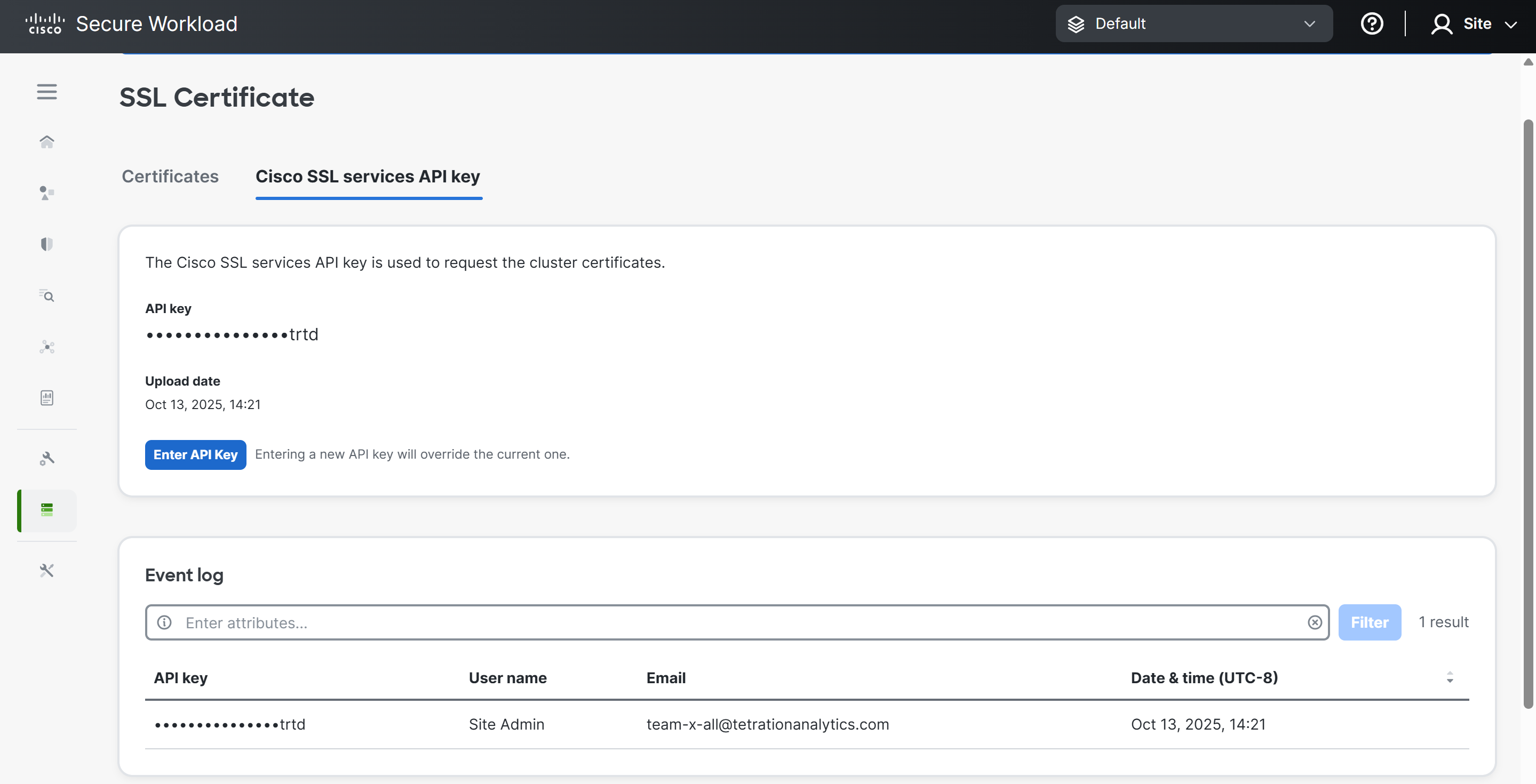
Configure the Cisco SSL Services API Key

The Cisco SSL Services API Key enables Site Admins to configure and manage the API key required to request cluster certificates and interact with Cisco SSL Services.

Follow these steps to configure the Cisco SSL Services API key:

Procedure

Step 1

From the navigation path, choose Platform > SSL Certificate > Cisco SSL Services API Key.

Step 2

Enter the API key and click Save.


Idle Session

For those who are authenticating using a local database, this section explains how failed login attempts may lock the user account:

Procedure

Step 1

Five failed login attempts using email and password result in locking the account.

Note


As a security measure against probing, no specific message indicating the lock will be provided in the login interface when trying to sign in a locked account.

Step 2

Lock out interval is set at 30 minutes. After the account is unlocked, use the correct password to log in or initiate password recovery by clicking Forgot password?

Note


Once a user is successfully signed in, one hour of inactivity logs out the user. This timeout is configured from Manage > Service Settings > Session Configuration.


Preferences

The Preferences page displays your account details and enables you to update your display preferences, change your landing page, change your password, and configure two-factor authentication.

Change Your Landing Page Preference

To change the default page on the UI when you sign in:

Procedure

Step 1

On the top-right corner of the window, click the user icon and choose User Preferences.

Step 2

Choose a landing page from the drop-down menu. Your preference is saved as the default or home page when you log in. To see the change, click the Secure Workload logo at the top-left corner of the page.


Change a Password

Procedure

Step 1

Click on the user icon in the top-right corner.

Step 2

Select User Preferences.

Step 3

In the Change Password pane, enter your current password in the Old Password field.

Step 4

Enter your new password in the Password field.

Step 5

Re-enter your new password in the Confirm Password field.

Step 6

Click Change Password to submit the change.

Note


Password must be 8–128 characters and contain at least one of the each following:

  • Lower case letters ( a b c d . . . )

  • Upper case letters ( A B C D . . . )

  • Numbers (0 1 2 3 4 5 6 7 8 9 )

  • Special characters ( ! " # $ % & ’ ( ) * + , - . / : ; < = > ? @ [ \ ] ^ _ ‘ { | } ~ ), space included


Recovery Codes
Procedure
  Command or Action Purpose

Step 1

Download the recovery codes from the User Preferences page.​

Note


Only admins have the ability to generate recovery codes. Note that if external authentication is enabled, recovery code generation is not supported.​

Step 2

Each admin user will have to download their recovery codes after login and will be provided with six recovery codes.​

Step 3

At login, enter the recovery code in the password field. Recovery codes must be used during login in conjunction with the username.

Step 4

When logging in with the username and recovery code as the password, users will be redirected to the password reset screen to set a new password.

Note


The used recovery code will no longer be valid for subsequent logins.​ We suggest users regenerate their recovery codes before exhausting all available codes.​

Recover Password

This section explains how to reset your password if you have forgotten the password.

Before you begin

To reset a password, you must have an account. Only a Site Admin has the priviledge to create new accounts.

Procedure

Step 1

Point your browser to the Cisco Secure Workload URL and click the Forgot Password link. The Forgot your password? dialog box is displayed.

Step 2

Step 3

Enter the email ID to which the password must be sent.

Step 4

Click Reset Password.

Password reset instructions are sent to your email.

Note


The password recovery procedure using two-factor authentication requires contacting Cisco Technical Assurance Center for a temporary one-time password.


Reset Password

This section explains how to reset password for users without an email ID.


Note


If SMTP is disabled, at login, the Forgot Password button will be disabled for users.


Procedure

Step 1

As a Site Admin, log in to Secure Workload, and from the navigation pane, choose Manage > User Access > Users.

Step 2

Under the Actions column, click the Pencil icon. The User Details page is displayed.

Table 13. User Details Field Descriptions

Field

Description

Email or Username

Enter the username of the user; the usernames are non-case sensitive, but should not contain @ or spaces in the username.

Note


If the SMTP configuration is switched OFF, email-based authentication will be affected as you will not be able to send the password reset instructions to the users.

Note


As a Site Admin, you can use the username to generate temporary passwords for users who want to recover them.

The maximum length of a username cannot exceed 255 characters.

First Name

Enter the user’s first name.

Last Name

Enter the user’s last name.

Scope

Root scope that is assigned to the user for multitenancy. (Available to site admins)

SSH Public Key

(Optional) Click Import to import an SSH public key or you can import a key later.

Step 3

To generate a temporary password, click Generate Password. Copy the password and share it with users who request them.

Note


To reset the password, use the username and the temporary password to login to Secure Workload. After you login, create a permanent password in the Reset password page.

Figure 34. User Details

Step 4

To secure the account, enter the new password in the Reset password page. After resetting the password, enter the username and the newly set password in the login page.

Note


New password must meet the following conditions:

  • Length of the password must be at least 8 characters.

  • Password must contain at least one upper-case letter.

  • Password must contain at least one lower-case letter.

  • Password must contain at least number.

  • Password must contain at least one of the special characters: !@#$%^*&-_+={}[/}|\?:;",'


Enable Two-Factor Authentication

This section explains how to enable two-factor authentication.

Procedure

Step 1

Click on the user icon.

Step 2

Select User Preferences.

Step 3

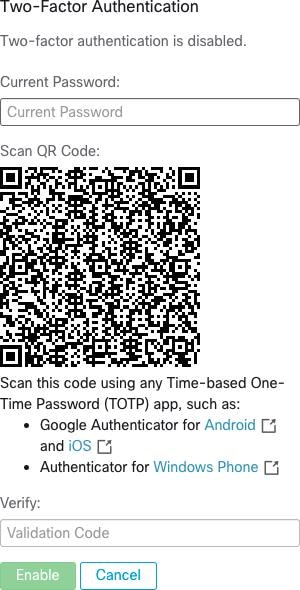
Click the Enable button in the Two-Factor Authentication pane. A new Two-Factor Authentication page is displayed.

Step 4

Enter your password.

Step 5

Scan the QR code that is displayed under the Current Password field using a time-based one-time password (TOTP) app, such as Google Authenticator (Android or iOS) or Authenticator (Windows phone).

Step 6

Enter the validation code that is shown by your chosen TOTP app.

Step 7

Click Enable.

Figure 35. Two-Factor Authentication Pane

Select the Use two-factor authentication check box when you log into the system and enter the verification code that is shown in your TOTP app to sign in.

Note


In case you need to recover the password for the two-factor authentication, contact your Site Admin or Secure Workload Customer Support.


Disabling Two-Factor Authentication

This section explains how to disable two-factor authentication.

Procedure

Step 1

Click on the user icon.

Step 2

Select User Preferences.

Step 3

Under two-factor authentication, click the Disable button. The Two-Factor Authentication pane appears.

Step 4

Enter your password.

Step 5

Click the Disable button again.

You will no longer be required to enter a two-factor verification code during login.