Secure Firewall 6100 Threat Defense Getting Started: Cloud-Delivered Firewall Management Center

PDF

Configure interfaces

Want to summarize with AI?

Log in

Overview

Learn how to configure Secure Firewall 6100 interfaces, including assigning inside and outside zones and setting IP addressing for routed deployments.

The following example configures a routed-mode inside interface with a static address and a routed-mode outside interface using DHCP. It also adds a DMZ interface for an internal web server.

Procedure

1.

Choose Devices > Device Management, and click Edit (edit icon) for the firewall.

2.

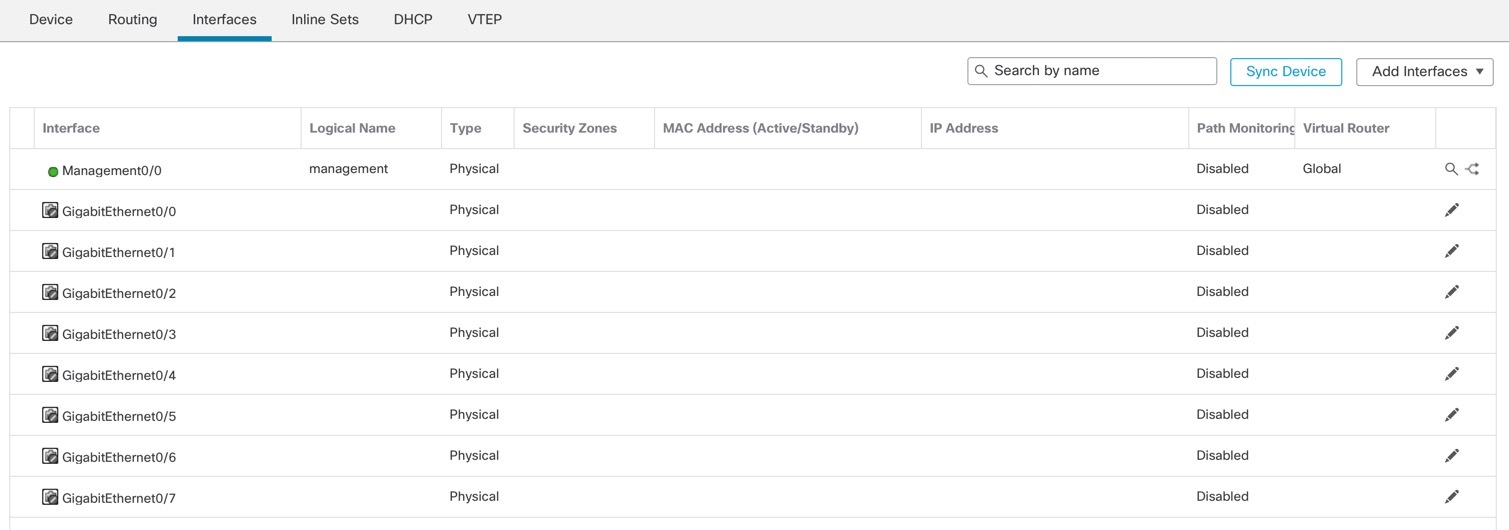
Click Interfaces.

Figure 1. Interfaces
Interfaces
3.

To create breakout ports from a 40-Gb or larger interface, click the Break icon for the interface.

If you already used the full interface in your configuration, you will have to remove the configuration before you can proceed with the breakout.

4.

Click Edit (edit icon) for the interface that you want to use for inside.

Figure 2. General Tab
General Tab
  1. From the Security Zone drop-down list, choose an existing inside security zone or add a new one by clicking New.

    For example, add a zone called inside_zone. You apply your security policy based on zones or groups. For example, configure your access control policy to enable traffic to go from the inside zone to the outside zone, but not from outside to inside.

    If the inside interface was preconfigured, the rest of these fields are optional.

  2. Enter a Name up to 48 characters in length.

    For example, name the interface inside.

  3. Check the Enabled check box.

  4. Leave the Mode set to None.

  5. Click the IPv4 and/or IPv6 tab.

    • IPv4—Choose Use Static IP from the drop-down list, and enter an IP address and subnet mask in slash notation.

      For example, enter 192.168.1.1/24

      Figure 3. IPv4 Tab
      IPv4 Tab
    • IPv6—Check the Autoconfiguration check box for stateless autoconfiguration.

      Figure 4. IPv6 Tab
      IPv6 Tab
  6. Click OK.

5.

Click Edit (edit icon) for the interface that you want to use for outside.

Figure 5. General Tab
General Tab
  1. From the Security Zone drop-down list, choose an existing outside security zone or add a new one by clicking New.

    For example, add a zone called outside_zone.

    You should not alter any other basic settings because doing so will disrupt the Firewall Management Center management connection.

  2. Click OK.

6.

Configure a DMZ interface to host a web server, for example.

  1. Click Edit (edit icon) for the interface you want to use.

  2. From the Security Zone drop-down list, choose an existing DMZ security zone or add a new one by clicking New.

    For example, add a zone called dmz_zone.

  3. Enter a Name up to 48 characters in length.

    For example, name the interface dmz.

  4. Check the Enabled check box.

  5. Leave the Mode set to None.

  6. Click the IPv4 and/or IPv6 tab and configure the IP address as desired.

  7. Click OK.

7.

Click Save.