Let’s explore a use case and learn how to deploy NetFlow and sFlow protocols to monitor and curb malicious attack on the network via a use case.
Here's a hypothetical use case illustrating a bad actor (attacker) sending malicious traffic and the network getting compromised:
-
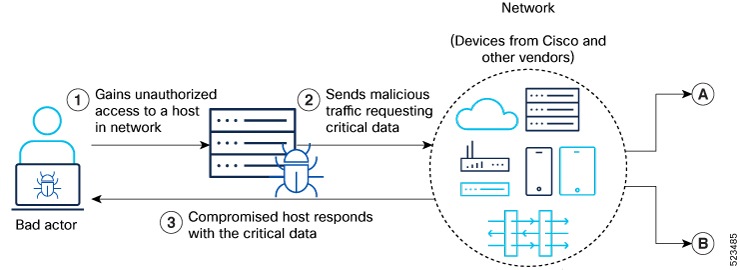
Attack entry point—An Enterprise becomes the target of a cyber attack. The attacker employs various tactics to gain unauthorized initial access to the network.
-
Generate malicious traffic— After the attacker identifies vulnerable devices as potential targets, they compromise a host and start generating malicious traffic and potentially launch DDoS attacks, to steal sensitive data, or take control of the network using these compromised machines as a platform.
-
Breach data—The malicious traffic triggers a series of attacks within the network. With access to sensitive data, the attacker attempts retrieving critical data from the compromised network.
With this context, lets explore these two scenarios:
traffic monitoring scenarios without NetFlow and sFlow
Explains the consequences of not implementing NetFlow or sFlow for network traffic monitoring in an enterprise environment.
Traffic monitoring protocols with NetFlow and sFlow
Explains how NetFlow and sFlow protocols enable proactive network traffic monitoring and threat detection.