Modernizing Cybersecurity for Federal Government
Available Languages
Bias-Free Language
The documentation set for this product strives to use bias-free language. For the purposes of this documentation set, bias-free is defined as language that does not imply discrimination based on age, disability, gender, racial identity, ethnic identity, sexual orientation, socioeconomic status, and intersectionality. Exceptions may be present in the documentation due to language that is hardcoded in the user interfaces of the product software, language used based on RFP documentation, or language that is used by a referenced third-party product. Learn more about how Cisco is using Inclusive Language.
Protecting missions, residents, and the national interest
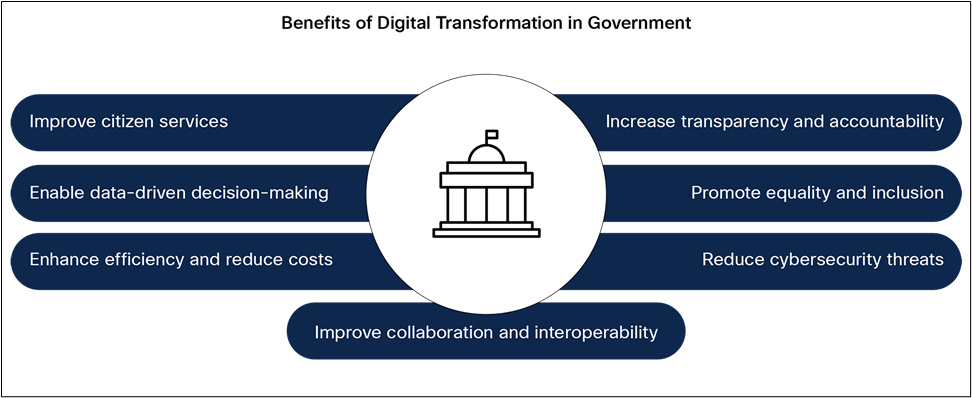
Federal missions underpin economic stability, public safety, and the security of the nation. As agencies modernize to meet evolving demands from residents and mission partners, cybersecurity has become a critical enabler of trust, resilience, and continuity.
Modernization expands connectivity across cloud, legacy systems, and partners—elevating both opportunity and cyber risk.
This solution brief is designed to help federal leaders, security practitioners, and IT teams navigate cybersecurity modernization with clarity and confidence. It highlights the key challenges shaping federal environments today and outlines practical approaches for securing missions, resident data, and national interests through Zero Trust principles, simplified security operations, and expert support. Readers will gain guidance on how to improve security during modernization, meet federal mandates, and strengthen cyber resilience—without disrupting mission delivery.
Secure mission delivery for the federal government
Federal mission delivery now extends far beyond traditional network boundaries. Agencies must operate securely across hybrid and multicloud platforms, long‑standing legacy environments, mobile workforces, and interagency partners—often all at the same time. This distributed and interconnected reality increases operational complexity and amplifies the potential impact of cyber risk on mission outcomes.
To operate effectively in this environment, security must continuously validate users, devices, applications, and workloads wherever missions operate. Zero Trust provides a foundational approach by reducing implicit trust and informing access decisions through identity, device posture, and contextual signals—helping agencies limit risk while preserving collaboration and operational agility.
Modern mission delivery also depends on visibility and speed. Advanced analytics, artificial intelligence, and automation help agencies make sense of activity across complex environments and focus limited resources where they matter most. These capabilities support mission delivery by enabling agencies to:
● Increase visibility across distributed environments
● Prioritize risk based on mission impact
● Reduce manual effort through automation
Together, these approaches help federal agencies modernize security alongside mission execution— supporting resilience, operational awareness, and continuity in an increasingly dynamic and contested digital landscape.
Navigating the compliance maze
Federal agencies operate within one of the most demanding cybersecurity and risk management environments in the world. Compliance requirements are shaped by law, executive mandates, and evolving standards—each designed to protect missions, residents, and national interests across increasingly complex environments.
As federal environments modernize, compliance has shifted from periodic assessments to an operational discipline. Agencies are expected to maintain ongoing visibility into risk, apply controls consistently across hybrid and multicloud environments, and demonstrate audit readiness as part of daily operations.
Frameworks such as the NIST Cybersecurity Framework (CSF), the Risk Management Framework (RMF) and associated NIST SP 800-53 control baselines, FISMA, and FedRAMP provide essential guidance for managing federal cyber risk. When operationalized through integrated security architectures and automation, these frameworks help agencies:
● Reduce manual compliance effort
● Improve oversight and consistency
● Support continuous monitoring
Federal compliance expectations continue to evolve alongside modernization initiatives. As efforts such as FedRAMP 20x explore more agile, risk‑informed approaches to cloud authorization, agencies are increasingly focused on capabilities that support ongoing assessment and real‑time visibility—rather than point‑in‑time compliance alone.
Together, these shifts reflect a broader transformation in how compliance supports secure modernization and mission readiness.

Traditional perimeter‑based security models were built for static environments with clear boundaries. In today’s federal landscape—spanning cloud platforms, legacy systems, mobile users, and interagency partners—those assumptions no longer hold. Implicit trust based on network location increases risk and limits visibility across distributed environments.
Zero Trust addresses this challenge by replacing assumed access with continuous verification. Access decisions are informed by identity, device posture, application context, and observed behavior—helping agencies reduce risk while enabling the access and collaboration required to support mission operations.
Core principles of Zero Trust
When applied consistently, Zero Trust helps agencies strengthen security posture by focusing on a few foundational principles:
● Verify explicitly using identity, device, and context
● Apply least‑privilege access to limit exposure
● Assume breach and design for rapid detection
These principles allow agencies to apply security controls more precisely without introducing unnecessary friction or operational delays.
From policy to operational model
Zero Trust is most effective when it extends beyond policy statements and becomes an operational model. Automation and analytics play a critical role by continuously evaluating activity, adapting controls, and supporting timely response across complex environments.
By combining Zero Trust principles with integrated security capabilities, federal agencies can:
● Improve visibility across users and systems
● Strengthen access decisions with shared context
● Support consistent enforcement as environments evolve
Federal agencies approach Zero Trust through established government guidance, with implementation shaped primarily by the CISA Zero Trust Maturity Model and the DoD Zero Trust Strategy frameworks. While these models differ in structure and emphasis, both reinforce core Zero Trust principles that support secure mission delivery across complex federal environments.
Zero Trust implementation models: CISA and DoD perspectives
Zero Trust across the federal government
While Zero Trust principles are consistent across the federal government, implementation approaches vary by mission, operating environment, and oversight authority. Two primary models guide federal adoption today:
● CISA Zero Trust Maturity Model, broadly applicable across civilian agencies
● DoD Zero Trust Strategy and Reference Architecture, tailored to defense and national security missions
Where NIST fits in federal Zero Trust
In addition to CISA and DoD guidance, NIST provides foundational Zero Trust architecture concepts that inform both models. NIST Zero Trust guidance focuses on describing core components, trust evaluation, and policy decision points, serving as a technical reference that complements—rather than competes with—federal implementation models.
For federal agencies, NIST Zero Trust concepts:
● Inform architecture and control design
● Support alignment with NIST risk management frameworks
● Provide common terminology across technology domains
CISA and DoD guidance build on this foundation by translating Zero Trust concepts into government‑ specific adoption and operational models.
Implementing Zero Trust in practice
Federal agencies are not required to choose between Zero Trust models. In practice, many organizations align broadly to CISA’s maturity model for enterprise adoption, apply DoD‑style rigor to mission‑critical or high‑risk systems, and leverage NIST guidance to inform architecture and control decisions. This approach enables agencies to apply Zero Trust consistently while adapting implementation to mission, risk, and operational context.
Table 1. Federal Zero Trust implementation models
| Aspect |
CISA Zero Trust Maturity Model |
DoD Zero Trust Strategy |
| Primary Audience |
Civilian federal agencies |
Department of Defense and defense partners |
| Purpose |
Provide a common adoption framework and |
Define a prescriptive strategy aligned to |
| Structure |
Maturity‑based model organized |
Uses seven pillars, adding visibility, analytics, and |
| Scope |
Broad applicability across diverse civilian environments |
Highly distributed, operational, and tactical environments |
| Identity Focus |
Strong emphasis on identity as the |
Identity integrated with operational and |
| Data Protection |
Central element across maturity stages |
Tightly integrated with mission systems and |
| Operational Model |
Incremental adoption and |
Operational enforcement aligned to mission execution |
Federal agencies face persistent cyber risks driven by sophisticated adversaries and operational complexity. Key challenges include:
Nation-state and advanced persistent threats
● Highly resourced adversaries targeting mission systems
● Long dwell attacks evading traditional controls
● Focus on espionage, disruption, strategic influence
Supply chain and third-party risk
● Expanding attack surface via software suppliers
● Inherited vulnerabilities from vendors and providers
● Limited visibility into third party security posture
Identity and credential abuse
● Stolen or compromised credentials drive breaches
● Over privileged access across users and devices
● Gaps between identity, device, access controls
Hybrid and legacy environment complexity
● Modern cloud coexists with legacy systems
● Inconsistent security controls across environments
● Limited visibility across hybrid infrastructures
Security operations overload and staffing constraints
● High alert volumes across disconnected tools
● Manual investigation and response processes
● Limited staffing with growing operational demands
AI risk and governance
● Growing reliance on AI across mission systems
● Limited visibility into AI decision logic
● Data quality, bias, and integrity concerns
Federal environments support mission‑critical systems and services that operate across identity infrastructures, networks, endpoints, cloud platforms, and applications—often spanning agencies, partners, and enclaves simultaneously. Securing these environments requires more than deploying individual security tools; it requires integrated security capabilities that provide shared visibility, contextual intelligence, and coordinated protection at scale.
By embedding visibility, analytics, and enforcement into shared operational processes, integrated security architectures reduce compliance overhead while supporting continuous monitoring, audit readiness, and mission assurance. This approach enables security to function as an ongoing operational discipline rather than a point‑in‑time control activity
Integrated security starts with a platform approach. Cisco and Splunk together provide the foundation for connecting security signals, applying shared intelligence, and enabling coordinated action across complex federal environments—allowing security to operate as a system rather than a collection of disconnected controls.
Cisco provides the security controls and enforcement points that protect users, devices, networks, applications, and data wherever federal missions operate. Splunk provides the analytics and operational intelligence that correlate activity across domains and over time. Together, they enable a unified security model that supports Zero Trust principles, continuous compliance, and resilient mission operations.

From intelligence to coordinated action
Insight alone is not sufficient. Integrated Security by Design closes the loop by enabling coordinated action across enforcement points.
By combining Cisco’s security controls with Splunk’s analytics and automation capabilities, agencies can apply policies consistently across users, devices, networks, and applications. When risk is identified, actions can be taken automatically or through guided response—reducing response time and minimizing manual effort while maintaining policy alignment.
This coordinated model strengthens Zero Trust enforcement by ensuring access decisions and protections are informed by real‑time, cross‑domain context, rather than static assumptions.
The value of an integrated platform
Integrated Security supports agencies by enabling:
● Unified visibility across identity, network, endpoint, cloud, and application environments
● Faster, more effective response through correlated analytics and shared context
● Consistent Zero Trust enforcement across users, devices, and workloads
● Reduced operational complexity and scalable security operations across hybrid environments
Because Cisco and Splunk operate as a connected platform, security teams can spend less time navigating between tools and more time supporting secure, reliable service delivery for the missions they serve.
Foundation for mission-ready security
An integrated security architecture provides the foundation for mission‑ready security solutions. By connecting controls, analytics, and response into a cohesive system, agencies can strengthen Zero Trust adoption, support compliance requirements, and maintain resilience as environments and threats continue to evolve.
Cisco Security Reference Architecture
Cisco’s approach is guided by the Cisco Security Reference Architecture, a high‑level, outcomes‑ driven framework for aligning security capabilities across identity, network, endpoint, cloud, and application domains. This reference architecture helps ensure security investments operate cohesively as a system—supporting Zero Trust principles, prioritized risk management, and coordinated response without prescribing implementations.
Mission-ready security solutions
Cisco and Splunk deliver an integrated security portfolio designed to support federal cybersecurity modernization across complex, hybrid environments. Together, these capabilities provide visibility, analytics, and automation to help agencies reduce risk, strengthen Zero Trust enforcement, and support federal security requirements at scale.
Cisco Security Cloud
At the core of Cisco’s security approach is Cisco Security Cloud, a unified, open platform that brings together identity, network, cloud, and security operations capabilities. Cisco Security Cloud enables consistent policy, shared telemetry, and coordinated enforcement across distributed environments—allowing security to operate as a cohesive system rather than disconnected tools.
By integrating security controls with analytics and automation, Cisco Security Cloud helps federal agencies improve visibility, reduce operational complexity, and respond more effectively to evolving threats, while supporting modernization across hybrid and multicloud architectures.
Cisco Security Cloud supports mission‑ready security by enabling:
● Unified visibility across environments
● Consistent Zero Trust enforcement
● Faster, analytics‑driven response
● Simplified security operations
Cisco Security Cloud for Government
Federal environments operating under FedRAMP High and other U.S. government requirements demand more than individual product authorizations. Agencies need a unified platform that supports secure access, consistent operations, and audit‑ready compliance across highly regulated environments.
Cisco Security Cloud for Government is a unified, open platform purpose‑built for government use. It provides secure access and connectivity across users, devices, applications, and workloads—supporting federal missions wherever they operate. As the government‑ specific instantiation of Cisco Security Cloud, it integrates Cisco’s FedRAMP‑authorized security services while applying
Designed for highly-regulated federal environments
The Cisco Security Cloud ecosystem is architected to meet the rigorous security requirements of highly regulated federal environments. Through Cisco Security Cloud for Government, agencies can maintain a consistent security posture and operational control across diverse, mission‑critical workloads.
Cisco Security Cloud for Government enables agencies to:
● Apply consistent security policies across FedRAMP High‑authorized services
● Centralize visibility and monitoring for audit and compliance activities
● Support continuous monitoring and operational readiness
● Reduce operational complexity while maintaining strict authorization boundaries
Integrated compliance and operations
By leveraging Cisco Security Cloud for Government, agencies can extend centralized management and monitoring capabilities to their FedRAMP High environments. This approach supports operational efficiency while maintaining clear separation of authorization scopes and shared responsibility
Key outcomes include:
● Improved audit readiness through shared visibility
● Consistent policy enforcement across sensitive environments
● Greater operational confidence for high‑impact federal workloads
A detailed list of FedRAMP‑authorized Cisco security solutions and their respective impact levels is provided later in this Solution Brief.
Cisco delivers a comprehensive, integrated security portfolio designed to support federal cybersecurity modernization across complex, hybrid environments. Built to operate as a cohesive system rather than isolated tools, the Cisco Security portfolio enables agencies to apply consistent Zero Trust principles, strengthen visibility, and reduce operational complexity as missions, threats, and environments evolve.
The following sections highlight how Cisco’s security capabilities are organized to support federal needs, including:
● Network, cloud, and application security to protect highly distributed infrastructures
● Identity, access, and user security to support Zero Trust‑aligned access decisions
● Threat detection, response, and analytics to accelerate investigation and response
● Integrated security suites that simplify deployment and operational consistency
Together, these capabilities provide agencies with the building blocks needed to operationalize Zero Trust, support compliance, and maintain resilience—while allowing security to scale as missions and requirements change.
Network, cloud, and application security
Federal agencies operate highly distributed environments spanning on-premises infrastructure, cloud platforms, and shared applications across mission systems. Cisco's network, cloud, and application security capabilities provide consistent protection and visibility to support resilient mission delivery across hybrid environments.
Cisco Secure Firewall
Provides advanced threat prevention, intrusion detection, and policy enforcement across on premises, cloud, and hybrid environments with unified management and AI driven detection.
Cisco Hybrid Mesh Firewall
Delivers consistent security enforcement and centralized policy management across distributed environments, simplifying segmentation and threat protection at scale.
Security in Cisco Cloud Control
Delivers AI-driven, centralized policy management across Cisco and third-party firewalls, helping simplify operations and enhance security posture.
Cisco Identity Services Engine (ISE)
Provides centralized identity and access control by enforcing policy decisions based on user identity, device posture, and contextual signals. ISE supports Zero Trust‑aligned access enforcement across wired, wireless, and remote access environments.
Cisco Multicloud Defense
Enables centralized security policy enforcement and visibility across AWS, Azure, and GCP environments, supporting consistent controls in multicloud architectures.
Cisco Umbrella
A cloud‑delivered security service that provides DNS‑layer protection, secure web gateway, firewall, and cloud access security functionality. Umbrella helps block malicious destinations early in the attack chain and supports consistent policy enforcement for users across distributed federal environments.
Cisco AI Defense
Helps agencies address risks associated with the use of artificial intelligence by monitoring, protecting, and governing AI‑driven applications and workflows. By providing visibility into AI usage and enforcing policy controls, AI Defense supports responsible adoption and operational oversight of AI technologies in federal environments.
Cisco Secure Workload
Provides deep visibility and zero trust microsegmentation for applications across data center and cloud environments, reducing attack surfaces and limiting lateral movement.
Cisco Hypershield
Provides distributed, kernel‑level enforcement using eBPF technology to deliver high‑performance, context‑aware segmentation and protection across modern, highly dynamic environments.
Cisco Web Application and API Protection (WAAP)
Protects web applications and APIs from threats such as DDoS attacks, API abuse, and automated attacks across hybrid and multicloud deployments.
Cisco Secure DDoS Protection
Helps mitigate denial‑of‑service attacks that target network and application availability, supporting resilient mission operations across hybrid environments.
Identity, access, and user security
Federal agencies rely on identity‑centric security to support missions across distributed environments. Cisco’s identity, access, and user security capabilities help verify users and device posture, reduce credential‑based risk, and support Zero Trust‑aligned access decisions.
Cisco Duo
Provides phishing resistant multi-factor authentication and device trust to ensure only verified users and healthy devices can access federal systems and applications. Duo supports adaptive, risk-based access decisions aligned to Zero Trust principles.
Cisco Secure Access (SSE)
A cloud-delivered secure access service that combines Zero Trust Network Access (ZTNA), secure web gateway, CASB, and firewall as a service capabilities to protect users, data, and applications regardless of location.
Cisco Secure Client
Delivers unified secure connectivity, posture assessment, and Zero Trust access for users across any device or location, supporting federated work environments and mission continuity.
Cisco Secure Endpoint
Provides advanced Endpoint Detection and Response (EDR) capabilities to detect, investigate, and remediate malware and advanced threats in real time.
Cisco Secure Email Threat Defense (ETD)
Helps protect users from phishing, credential theft, and account‑based attacks that commonly target email as an initial access vector. By detecting malicious email activity and reducing identity compromise, ETD supports stronger user trust signals and helps limit the risk of unauthorized access in federal environments.
Threat detection, response, and analytics
Detecting and responding to threats at scale requires context across disparate security domains. Cisco and Splunk provide capabilities that help agencies correlate activity, prioritize potential threats based on impact, and support more efficient investigation and response across complex federal environments.
Cisco XDR
Correlates telemetry across endpoint, network, cloud, email, and identity domains to accelerate detection, investigation, and response using automation and AI driven analytics.
Cisco Secure Network Analytics (SNA)
Delivers agentless network visibility and behavioral analytics to detect threats across on premises and cloud environments, including encrypted traffic.
Cisco Secure Malware Analytics
Provides advanced malware analysis by detonating suspicious files in a controlled environment to observe behavior and indicators of compromise. These insights help security teams better understand threats and support investigation and response activities.
Cisco Telemetry Broker
enables agencies to collect, normalize, and distribute network telemetry across security and analytics tools. By improving access to high‑quality data, Telemetry Broker helps support visibility, analytics, and informed decision‑making across complex environments.
Cisco Security Analytics and Logging
Centralizes security telemetry and log management to support investigations, compliance reporting, and analytics driven operations.
Splunk SOAR
Automates security workflows and incident response through playbooks and orchestration, reducing response times and analyst workloads.
Splunk Enterprise Security (ES)
Splunk’s SIEM solution, providing AI‑powered analytics to support detection, investigation, and response across complex environments. ES correlates data from infrastructure, applications, and security tools to improve visibility and support informed security operations at scale.
Splunk User Behavior Analytics (UBA)
Uses machine learning to identify insider threats, compromised accounts, and abnormal behavioral patterns across users and entities.
Visibility, intelligence, and operational insight
Effective cybersecurity depends on visibility beyond individual tools or environments. Cisco’s visibility and intelligence capabilities help agencies gain insight across networks, cloud services, and external dependencies, improving situational awareness and supporting faster, more informed decision making.
Cisco Talos Threat Intelligence
Talos Threat Intelligence provides real time global threat intelligence that informs detection, prevention, and response across Cisco security technologies.
ThousandEyes
ThousandEyes delivers end to end visibility across networks and cloud services, helping agencies distinguish between performance issues and security incidents affecting mission delivery.
Cisco Security Suites
Cisco security capabilities are also available through integrated deployment bundles that simplify adoption and operations.
Cisco Breach Protection Suite
Provides threat detection, investigation, and response across endpoints, network, email, identity, and cloud environments using AI‑assisted analytics and shared telemetry. By correlating signals across domains, the suite helps agencies prioritize threats and support more efficient incident response.
Cisco User Protection Suite
Combines identity protection, secure access, and endpoint defenses to help reduce credential‑based risk and unauthorized access. The suite supports adaptive access decisions aligned with Zero Trust principles across distributed environments.
Cisco User and Breach Protection Suite
Combines identity protection and advanced threat detection into a single integrated offering. By correlating telemetry across users, endpoints, networks, and cloud environments, the suite supports unified visibility and more coordinated response while reducing operational complexity.
Cisco Cloud Protection Suite
Provides integrated security controls to protect applications and data across hybrid and multicloud environments. The suite supports segmentation, gateway‑based protection, and consistent policy enforcement to reduce attack surfaces and limit unauthorized access.
By simplifying security operations across distributed environments, the suite helps maintain visibility and apply Zero Trust–aligned controls consistently
FedRAMP‑certified cloud services and authorization boundaries
FedRAMP certification confirms federal security requirements, while Agency Authorization (ATO) governs operational use. Cisco offers a broad portfolio of FedRAMP‑certified Class C (Moderate) and Class D (High) security solutions supporting mission‑critical workloads and sensitive federal data.
Many of these offerings operate within the Cisco Security Cloud for Government ecosystem, providing centralized management, visibility, and policy enforcement while maintaining clear authorization boundaries.
Table 2. Cisco and Splunk FedRAMP-certified cloud services
| Cisco Product |
FedRAMP Certification |
Description |
| Cisco Meraki for Government |
Class C (Moderate) |
Cloud-managed networking platform with secure wireless, switching, firewalls, and SD-WAN. |
| Cisco Duo Federal |
Class C (Moderate) |
MFA compliant with FIPS 140-2 and NIST SP 800-63-3. Supports AAL2 and AAL3 authenticators including biometric and hardware tokens. |
| Cisco SD-WAN for Government |
Class C (Moderate) |
Secure, application-aware networking optimized for cloud integration. |
| Cisco Cloudlock for Government |
Class C (Moderate) |
Cloud-native CASB securing identities, data, and applications with machine learning analytics. |
| Cisco ThousandEyes for Government |
Class C (Moderate) |
Network performance visibility and diagnostics. |
| Splunk Cloud Platform |
Class C (Moderate) |
Real-time operational insights for non-sensitive environments. |
| Splunk Observability Cloud |
Class C (Moderate) |
Proactive monitoring and optimization of infrastructure and applications |
| Cisco AppDynamics GovAPM |
Class C (Moderate) |
Real-time application performance monitoring for secure operations. |
| Splunk Cloud Platform |
Class D (High) |
Robust analytics and monitoring for critical government operations. |
| Security in Cisco Cloud Control for Government1 |
Class D (High) |
Centralized policy management across distributed environments. |
| Cisco Secure Access for Government1 |
Class D (High) |
Unified management with Zero Trust Network Access (ZTNA) and AI-driven threat intelligence. |
| Cisco Umbrella for Government1 |
Class D (High) |
DNS-layer security, Secure Web Gateway (SWG), Cloud Delivered Firewall (CDFW), CASB, and Data Loss Prevention (DLP). |
| Cisco Secure Firewall for Government1 |
Class D (High) |
Advanced threat protection and firewall capabilities tailored for federal environments. |
| Cisco Multicloud Defense for Government1 |
Class D (High) |
Centralized security policy enforcement and visibility across AWS, Azure, and GCP environments |
| Cisco Security Analytics and Logging for Government1 |
Class D (High) |
Secure, centralized logging and diagnostic insights to improve infrastructure visibility and support. |
| Cisco Secure Email Threat Defense for Government1 |
Class D (High) |
Cloud-native email security solution provides real-time inline scanning and remediation of email threats. |
For the most current information on Cisco and Splunk FedRAMP authorizations, agencies should refer to the FedRAMP Marketplace.
Cisco Services: Turning strategy into action
Cisco® Services empower government agencies to bridge the critical gap between high-level cybersecurity strategy and resilient, day-to-day operations. Our unified services and support portfolio strengthens the entire security lifecycle—delivering everything from rigorous risk assessment and secure architectural design to decisive, real-time threat response.
By combining deep public sector expertise with AI‑driven intelligence from Cisco IQ™, Cisco Services help agencies better understand their environments, prioritize actions, and continuously improve security outcomes across complex, regulated infrastructures.
Advisory and Assessment Services
These services help agencies evaluate their current security posture, identify gaps and risks, and define actionable roadmaps aligned to mission and regulatory drivers.
● Zero Trust Advisory
Helps agencies assess current Zero Trust maturity and define a practical, CISA‑aligned roadmap. The engagement identifies strengths, gaps, and dependencies across identity, devices, applications, and networks and delivers prioritized recommendations to support incremental, enforceable adoption.
● Advanced Persistent Threat Resiliency Assessment
Evaluates defensive readiness against sophisticated adversaries using threat‑informed analysis. This assessment identifies architectural weaknesses, policy gaps, and exposure pathways, translating technical findings into prioritized actions that strengthen resilience and reduce attack surface.
● AI Security Trust and Assurance Program
Provides visibility into AI usage, including shadow AI, unmanaged models, and undocumented pipelines. Cisco experts assess security controls, data flows, and risk posture, delivering a clear, data‑driven roadmap to support secure, trusted, and scalable AI adoption.
Plan, Design, and Implement Services
These services provide hands‑on expertise to design and implement security capabilities that align to Zero Trust and resiliency objectives across hybrid environments.
● Application Microsegmentation Service
Helps agencies design and implement application‑level segmentation policies to protect critical workloads on‑premises and in the cloud. This service reduces lateral movement, limits blast radius during incidents, and supports consistent enforcement without disrupting operations.
Incident Response Services
These services help agencies prepare for, respond to, and recover from cyber incidents—combining readiness activities, real‑time intelligence, and expert‑led response to minimize impact and restore operations quickly.
● Talos Incident Response
Rapid, expert support during active cyber incidents. Cisco Talos Incident Response provides 24x7x365 access to experienced responders who assist with triage, investigation, containment, and remediation— working alongside agency teams and across shared environments when incidents span multiple organizations.
● Talos Proactive Services
Structured services designed to assess, plan, and test incident response readiness. These services include readiness assessments, tabletop exercises, threat hunting, logging reviews, and tailored incident response playbooks to help agencies strengthen preparedness before incidents occur.
● Talos Threat Intelligence
Real‑time threat analysis and reputation data to help agencies stay ahead of emerging threats. Cisco Talos intelligence combines large‑scale telemetry with open‑source and proprietary research to support faster detection, investigation, and response across security operations.
● Talos Vulnerability Research
Continuous discovery and responsible disclosure of software and operating system vulnerabilities. Talos researchers provide early protection against zero‑day threats while fixes are developed, strengthening overall security and resilience
Flexible engagement models
Cisco Services are available through flexible engagement models, including subscription‑based services for ongoing needs and project‑based engagements for targeted initiatives. This flexibility allows agencies to align service delivery with your mission priorities, budgets, and acquisition requirements—while maintaining ownership of architecture decisions and compliance outcomes.
To engage Cisco Services and learn more about available offerings, agencies can work with their Cisco account team or an authorized Cisco partner.
Upskill and uplevel: Cisco certifications for government
Cisco Services for government modernization includes valuable learning and certification opportunities through Cisco Learning Credits (CLCs). These prepaid training vouchers, often bundled with product purchases, enable you to enhance your teams’ skills and maximize the value of Cisco solutions. CLCs can be used for instructor-led courses, private training, digital learning, certification prep, exam vouchers, and even attendance at Cisco Live events.
Cisco University, now known as Cisco U., offers a comprehensive digital learning experience tailored to your individual goals. It provides a rich library of technology and certification training, including practice exams and simulators. You can leverage Cisco U. to access a wide range of courses on cybersecurity, networking, programming, and more, ensuring your staff stays current with the latest technological advancements.
By utilizing CLCs and Cisco U. you can efficiently upskill your workforce, accelerate digital transformation efforts, and maintain compliance with evolving security standards. Check out this Cisco Blog on Cisco U
Getting started with Cisco
Federal cybersecurity modernization is an ongoing effort that must adapt to evolving missions, technologies, and threats—while maintaining compliance and operational continuity. By prioritizing mission‑critical systems and highest‑risk areas, agencies can make steady progress through incremental modernization. Cisco solutions and services are designed to support this approach, helping agencies strengthen security capabilities while maintaining ownership of operational and compliance decisions.
Next steps
To begin or advance cybersecurity modernization efforts, federal agencies can engage Cisco to assess current capabilities, identify priority areas, and align solutions to mission and operational requirements. Cisco supports incremental modernization approaches that allow security to evolve alongside agency missions.
Federal Enterprise Agreements
Cisco Security Enterprise Agreements (EAs) help federal agencies simplify how security technologies and services are acquired, managed, and scaled over time. Through a single, co‑terminated agreement, agencies gain predictable access to Cisco security software and select Cisco Services, reducing procurement complexity while improving visibility across deployments.
Built‑in flexibility and Cisco’s True Forward model allow agencies to grow or adjust security capabilities as requirements evolve—without retroactive penalties— supporting long‑term modernization while maintaining budget predictability and operational control.
Resources
● Cisco Solutions for Federal Government
● Cisco Modernizing Government Cybersecurity
Cisco partners
Cisco works with a broad ecosystem of authorized federal partners to support agencies across planning, deployment, and ongoing operations. To find a qualified government partner, visit the Cisco Partner Locator on our website.