Describes ISIS link group features, offering instructions for configuring link group profiles and associating interfaces with link groups to improve network resilience and control.
A ISIS link group is a routing feature that
-
enables you to define a group of links for metric management
-
adjusts the ISIS metric for remaining active links when the number of active links drops below a configured minimum, and
-
restores the original metric when the link group is reestablished.
Additional details about ISIS link groups
The ISIS link group feature lets you optimize network routing by associating a set of links as a group. When the number of active IS-IS adjacencies within the group falls below the minimum threshold, a metric offset is applied to the remaining links. This dynamic adjustment influences route selection, helping traffic avoid degraded paths. Once links are restored to the threshold, ISIS removes the offset and returns metrics to their original values.
ISIS link group metric adjustment
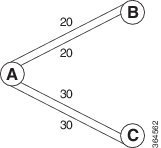
Router A connects to both Router B and Router C. Between A and B, there are two layer 3 links with an ISIS metric of 20 each; between A and C, there are links with a metric of 30. Normally, traffic prefers the lower metric path (A→B). If one link between A and B fails and ISIS link groups are not configured, traffic still goes through B. With ISIS link group settings—using an offset of 20 and minimum-members of 2—when a link fails the metric rises to 40 (original 20 + offset 20), and traffic reroutes through C. Similar logic can apply for the path between A and C.