Overview
This section provides examples of how CSM handles policies that exceed the bandwidth pool size or bandwidth alarm threshold set on the CSM Configuration page
CSM discovers and updates the available and reservable bandwidth in the network. It maintains an accounting of all bandwidth reservations provided for CS SR-TE policies to ensure that the total reserved bandwidth on all interfaces remains at or below the network-wide resource pool (bandwidth pool size). When the bandwidth exceeds either the configured pool or the threshold, the system responds by:
-
generating threshold-crossing event notifications for visibility and operational response,
-
denying the policy establishment or bandwidth increase until resources become available,
-
repeatedly retrying path computations at regular intervals (for example, every 30 minutes) until a solution is found or the policy is disabled.
Example: Bandwidth utilization surpasses defined threshold
In this example, we assume the reserved bandwidth settings are as follows:
-
Link CS Bandwidth Pool Size: 10%
-
Link CS Bandwidth Minimum Threshold: 10%
In this example, the bandwidth pool size for the 10 Gbps ethernet interfaces is 1Gbps and the alarm threshold is set at 100 Mbps (10% of pool size).
-
A circuit-style SR-TE policy from node 5501-02 to node 5501-01 (r02 - r01) is created with a bandwidth of 100 Mbps.
Figure 1. CS-SR policy 10 mbps up 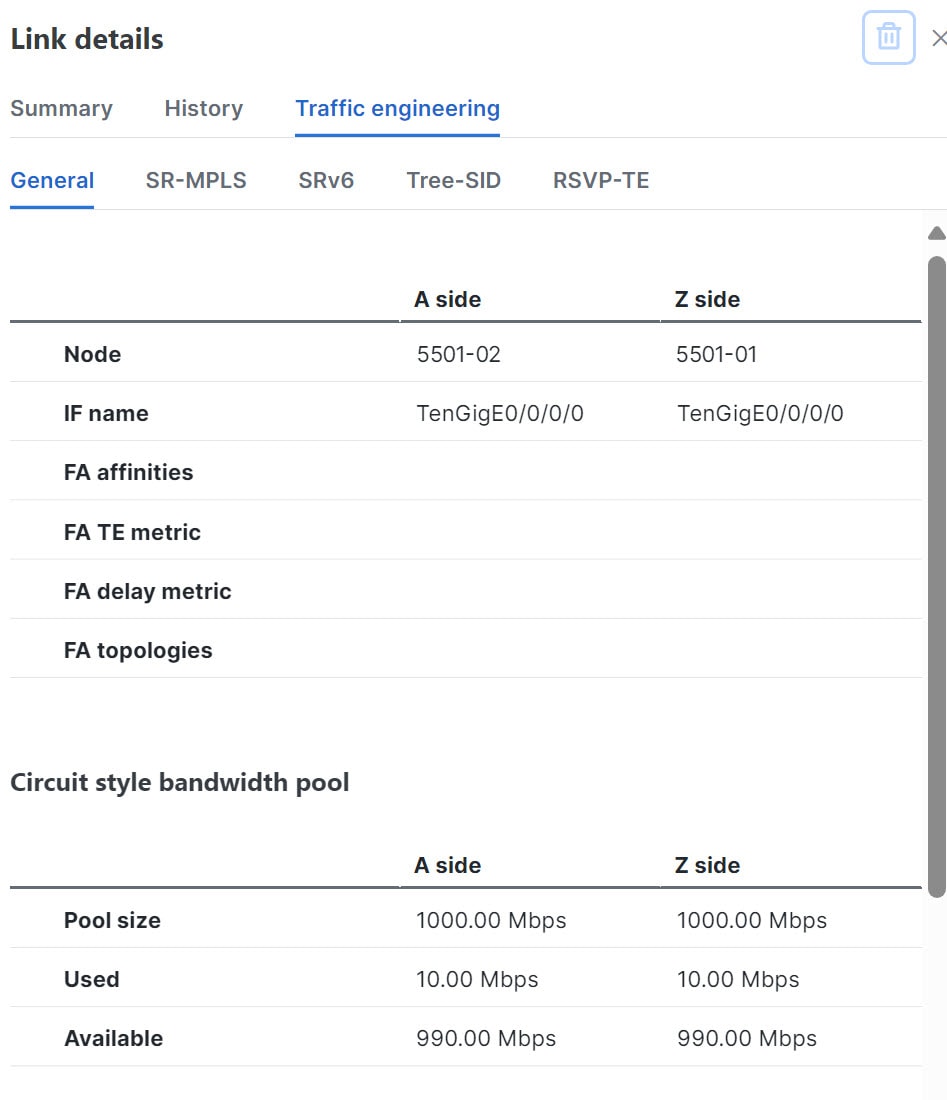
-
Later, the requested bandwidth configured for the policy is increased to 500 Mbps. CSM determines the additional bandwidth along the existing path is available and reserves it.
Figure 2. CS-SR policy 500 mbps up 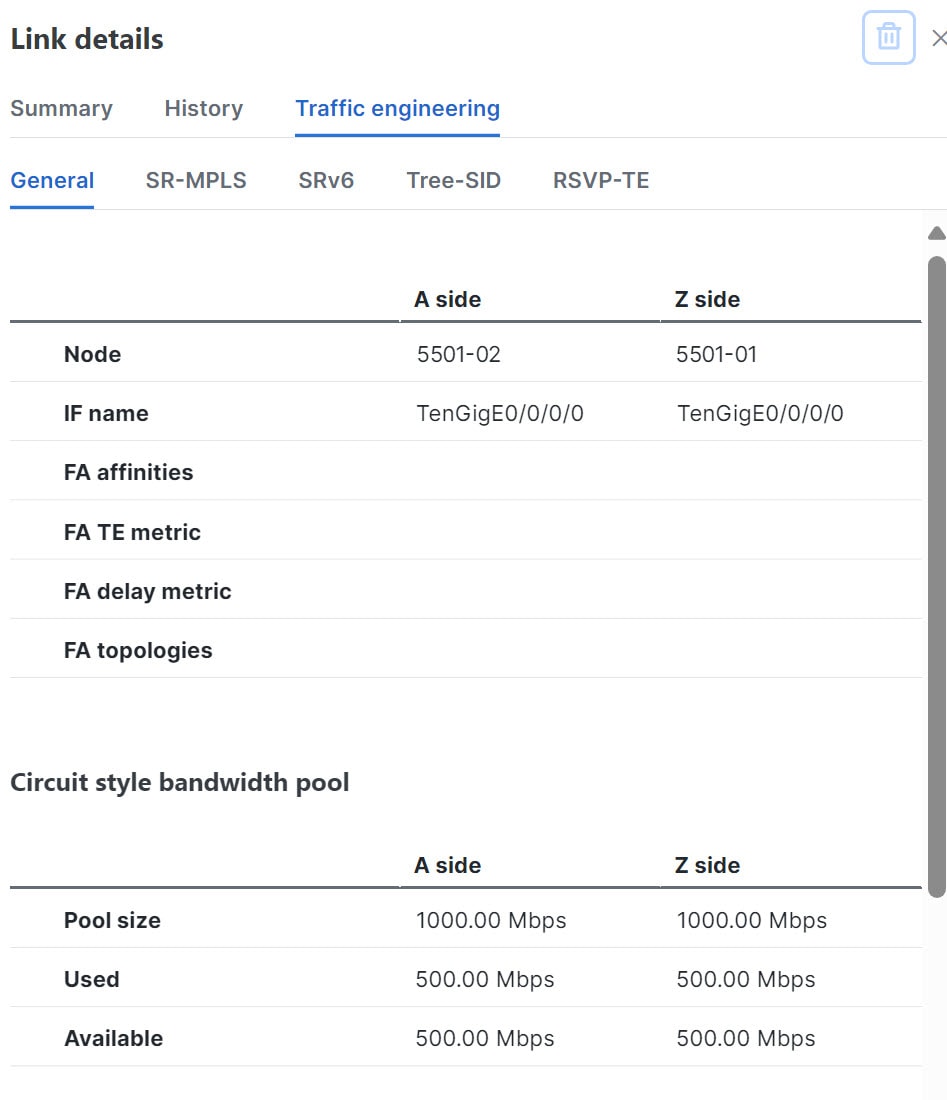
-
Since the bandwidth utilization (500 Mbps) with the updated policy is above the configured pool utilization threshold (100 Mbps), an event is triggered.
Figure 3. Threshold alerts

Example: Bandwidth pool size and utilization exceeded
In this example, we assume the reserved bandwidth settings are as follows:
-
Link CS Bandwidth Pool Size: 10%
-
Link CS Bandwidth Minimum Threshold: 90%
In this example, the bandwidth pool size for the 10 Gbps ethernet interfaces is 1Gbs and the alarm threshold is set for 900 Mbps.
-
An existing circuit-style SR-TE policy from node 5501-02 to node 5501-01 (r02 - r01) uses a bandwidth of 500 Mbps.
-
Later, a new policy requiring a bandwidth of 750 Mbps with a path from node 5501-02 to node 5501-01 to 5501-2 (r02 - r01- r2) is requested. Since the existing policy and this new policy together exceed the bandwidth pool size, and alarm threshold of 1 Gbps (750 Mbps + 500 Mbps = 1250 Mbps), the following behaviors occur:
-
The new CS-SR policy r02 - r01 - r2 has been created, but remains operationally down because CSM cannot compute a path for the new policy. CSM will try again every 30 minutes to find a path that meets the bandwidth requirements.
Figure 4. CS-SR policy exceeds bandwidth pool size 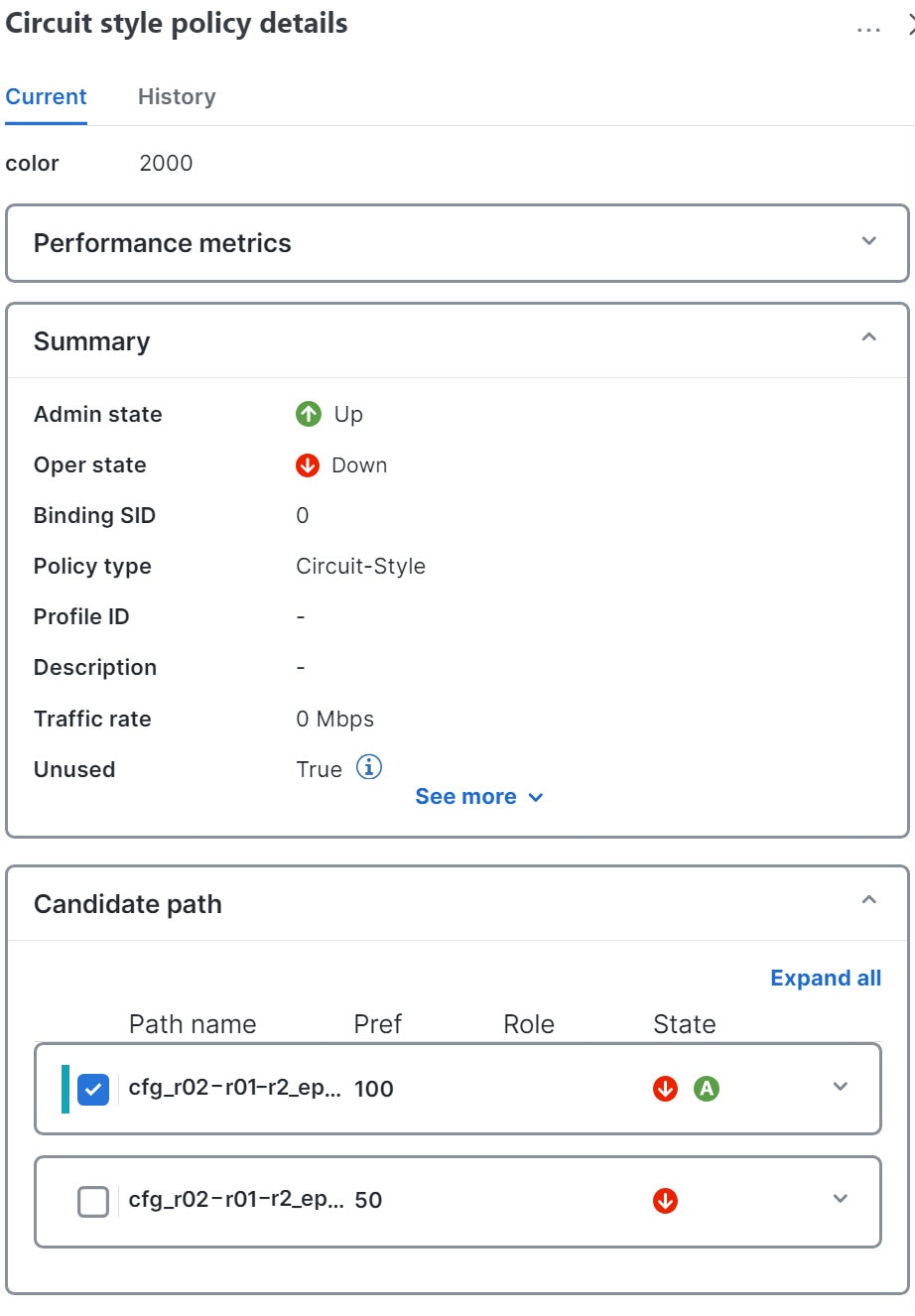
-
Alerts are triggered.
Figure 5. Threshold alerts

-
-
Later, the circuit-style SR-TE policy r02 - r01- r2 is updated and only requires 10 Mbps. The following behaviors occur:
-
Since the total bandwidth required for the two policies (10 Mbps + 500 Mbps = 510 Mbps) now requires less than the bandwidth pool size (1Gbps), circuit-style SR-TE policy r02 - r01 - r2 receives a path computed by CSM and becomes operationally up.
Figure 6. Updated CS-SR policy operational 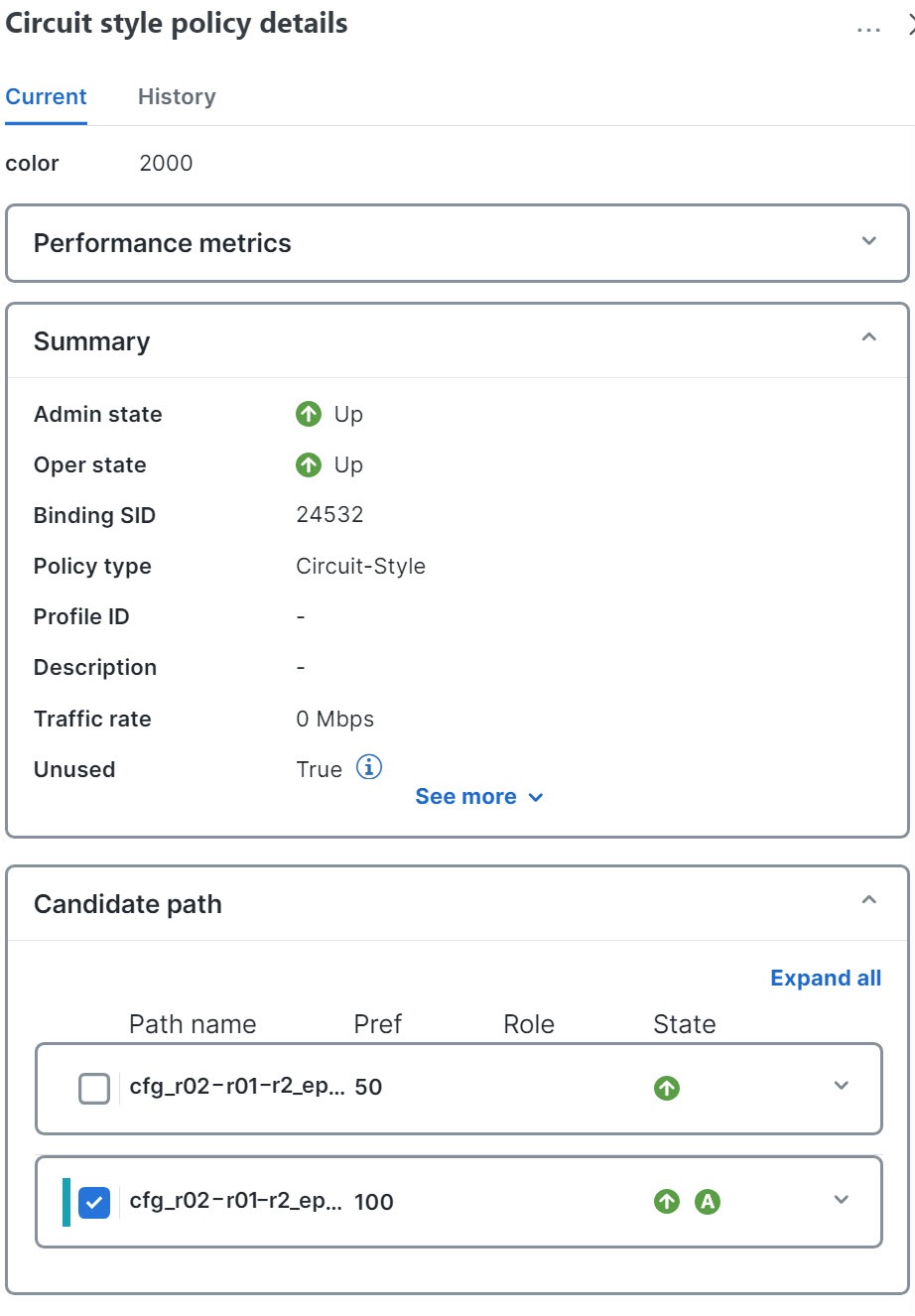
-
Since the second circuit-style SR-TE policy with the reduced bandwidth is now provided a path by CSM , alerts are cleared.
Figure 7. Cleared alerts

-