Underlay Considerations
Unicast Underlay:
The primary purpose of the underlay in the VXLAN EVPN fabric is to advertise the reachability of Virtual Tunnel End Points (VTEPs) and BGP peering addresses. The primary criterion for choosing an underlay protocol is fast convergence in the event of node failures. Other criteria are:
-
Simplicity of configuration.
-
Ability to delay the introduction of a node into the network on boot up.
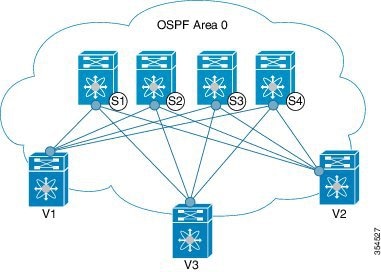
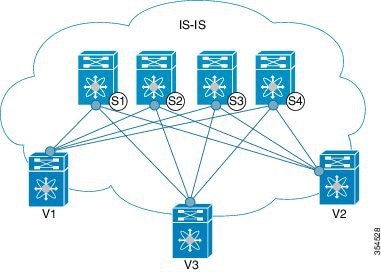
This document details the two primary protocols supported and tested by Cisco, IS-IS and OSPF. It will also illustrate the use of the eBGP protocol as an underlay for the VXLAN EVPN fabric.
Underlay and Overlay Packet Flow and Deployment Considerations
From an underlay/overlay perspective, the packet flow from a server to another over the Virtual Extensible LAN (VXLAN) fabric as mentioned below:
-
The server sends traffic to the source VXLAN tunnel endpoint (VTEP). The VTEP performs Layer-2 or Layer-3 communication based on the destination MAC and derives the nexthop (destination VTEP).

Note
When a packet is bridged, the target end host’s MAC address is stamped in the DMAC field of the inner frame. When a packet is routed, the default gateway’s MAC address is stamped in the DMAC field of the inner frame.
-
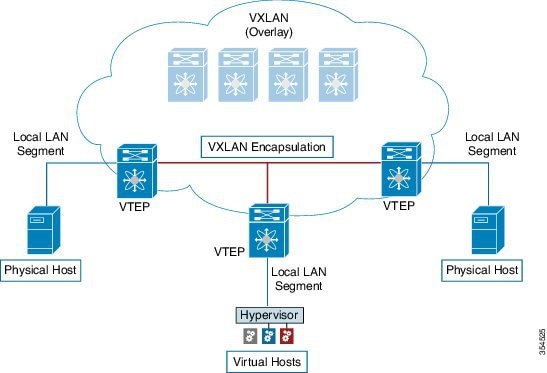
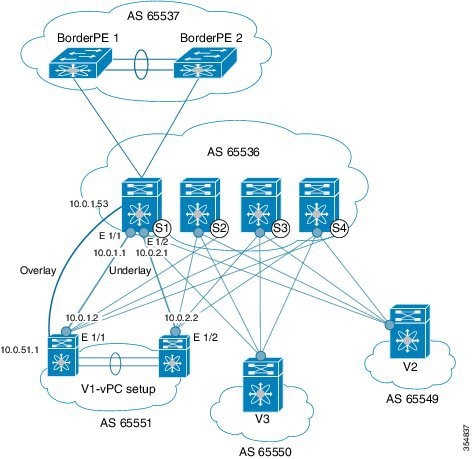
The VTEP encapsulates the traffic (frames) into VXLAN packets (overlay function – see Figure 1) and signals the underlay IP network.
-
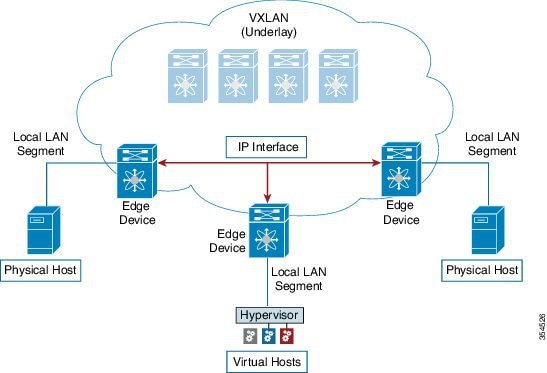
Based on the underlay routing protocol, the packet is sent from the source VTEP to destination VTEP through the IP network (underlay function – see Underlay Overview figure).
-
The destination VTEP removes the VXLAN encapsulation (overlay function) and sends traffic to the intended server.
The VTEPs are a part of the underlay network as well since VTEPs need to be reachable to each other to send VXLAN encapsulated traffic across the IP underlay network.
The Overlay Overview and Underlay Overview images (below) depict the broad difference between an overlay and underlay. Since the focus is on the VTEPs, the spine switches are only depicted in the background. Note that, in real time, the packet flow from VTEP to VTEP traverses through the spine switches.
Deployment considerations for an underlay IP network in a VXLAN EVPN Programmable Fabric
The deployment considerations for an underlay IP network in a VXLAN EVPN Programmable Fabric are given below:
-
Maximum transmission unit (MTU) – Due to VXLAN encapsulation, the MTU requirement is larger and we must avoid potential fragmentation.
-
An MTU of 9216 bytes on each interface on the path between the VTEPs accommodates maximum server MTU + VXLAN overhead. Most data center server NICs support up to 9000 bytes. So, no fragmentation is needed for VXLAN traffic.
-
The VXLAN IP fabric underlay supports the IPv4 address family.
-
-
Unicast routing - Any unicast routing protocol can be used for the VXLAN IP underlay. You can implement OSPF, IS-IS, or eBGP to route between the VTEPs.
Note
As a best practice, use a simple IGP (OSPF or IS-IS) for underlay reachability between VTEPs with iBGP for overlay information exchange.
-
IP addressing – Point-to-point (P2P) or IP unnumbered links. For each point-to-point link, as example between the leaf switch nodes and spine switch nodes, typically a /30 IP mask should be assigned. Optionally a /31 mask or IP unnumbered links can be assigned. The IP unnumbered approach is leaner from an addressing perspective and consumes fewer IP addresses. The IP unnumbered option for the OSPF or IS-IS protocol underlay will minimize the use of IP addresses.
/31 network - An OSPF or IS-IS point-to-point numbered network is only between two switch (interfaces), and there is no need for a broadcast or network address. So, a /31 network suffices for this network. Neighbors on this network establish adjacency and there is no designated router (DR) for the network.
Note
IP Unnumbered for VXLAN underlay is supported starting with Cisco NX-OS Release 7.0(3)I7(2). Only a single unnumbered link between the same devices (for example, spine - leaf) is supported. If multiple physical links are connecting the same leaf and spine, you must use the single L3 port-channel with unnumbered link.
-
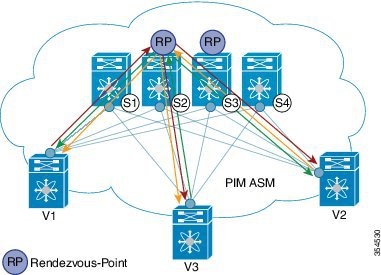
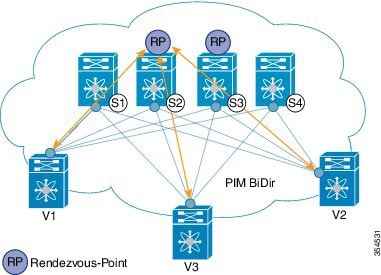
Multicast protocol for multi-destination (BUM) traffic – Though VXLAN has the BGP EVPN control plane, the VXLAN fabric still requires a technology for Broadcast/Unknown unicast/Multicast (BUM) traffic to be forwarded.
-
PIM Bidir is supported on Cisco Nexus 9300-EX/FX/FX2 platform switches.
-
vPC configuration — This is documented in Configuring vPCs of Cisco Nexus 9000 Series NX-OS Interfaces Configuration Guide.
 Feedback