Installing the Chassis

Safety

Before you install, operate, or service the switch, refer to the Regulatory, Compliance, and Safety Information for the Cisco Nexus 9000 Series content for important Safety Information.


Warning


Statement 1071— Warning Definition

IMPORTANT SAFETY INSTRUCTIONS

Before you work on any equipment, be aware of the hazards involved with electrical circuitry and be familiar with standard practices for preventing accidents. Read the installation instructions before using, installing, or connecting the system to the power source. Use the statement number provided at the end of each warning statement to locate its translation in the translated safety warnings for this device.

SAVE THESE INSTRUCTIONS


Warning


Statement 1089—Instructed and Skilled Person Definitions

An instructed person is someone who has been instructed and trained by a skilled person and takes the necessary precautions when working with equipment.

A skilled person or qualified personnel is someone who has training or experience in the equipment technology and understands potential hazards when working with equipment.

There are no serviceable parts inside. To avoid risk of electric shock, do not open.


Warning


Statement 1074—Comply with Local and National Electrical Codes

To reduce risk of electric shock or fire, installation of the equipment must comply with local and national electrical codes.


Note


Statement 407—Japanese Safety Instruction

You are strongly advised to read the safety instruction before using the product.

https://www.cisco.com/web/JP/techdoc/pldoc/pldoc.html

When installing the product, use the provided or designated connection cables/power cables/AC adapters.

〈製品使用 における 安全上 注意〉

www.cisco.com/web/JP/techdoc/index.html

続ケーブル 、電源 コードセット AC アダプタ バッテリなどの 部品 、必 添付品 または

指定品 をご 使用 ください 。添付品 指定品以外 をご 使用 になると 故障 動作不良、火災

原因 となります また 、電源 コードセットは 弊社 指定 する 製品以外 機器 には 使用

できないためご注意ください。

Warning


Statement 1017—Restricted Area

This unit is intended for installation in restricted access areas. Only skilled, instructed, or qualified personnel can access a restricted access area.


Warning


Statement 1091—Installation by an Instructed Person

Only an instructed person or skilled person should be allowed to install, replace, or service this equipment. See statement 1089 for the definition of an instructed or skilled person.

There are no serviceable parts inside. To avoid risk of electric shock, do not open.


Warning


Statement 1028—More Than One Power Supply

This unit might have more than one power supply connection. To reduce risk of electric shock, remove all connections to de-energize the unit.


Warning


Statement 1003— Power Disconnection

To reduce risk of electric shock or personal injury, disconnect power before removing or replacing components or performing upgrades.


Warning


Statement 1046—Installing or Replacing the Unit

To reduce risk of electric shock, when installing or replacing the unit, the ground connection must always be made first and disconnected last.

If your unit has modules, secure them with the provided screws.


Warning


Statement 1022—Disconnect Device

To reduce the risk of electric shock and fire, a readily accessible disconnect device must be incorporated in the fixed wiring.


Warning


Statement 1033—Safety Extra-Low Voltage (SELV)—IEC 60950/ES1–IEC 62368 DC Power Supply

To reduce the risk of electric shock, connect the unit only to a DC power source that complies with the SELV requirements in the IEC 60950-based safety standards or the ES1 requirements in the IEC 62368-based safety standards.


Warning


Statement 1024—Ground Conductor

This equipment must be grounded. To reduce the risk of electric shock, never defeat the ground conductor or operate the equipment in the absence of a suitably installed ground conductor. Contact the appropriate electrical inspection authority or an electrician if you are uncertain that suitable grounding is available.


Warning


Statement 1032—Lifting the Chassis

To prevent personal injury or damage to the chassis, never attempt to lift or tilt the chassis using the handles on modules, such as power supplies, fans, or cards. These types of handles are not designed to support the weight of the unit.


Warning


Statement 1006—Chassis Warning for Rack-Mounting and Servicing

To prevent bodily injury when mounting or servicing this unit in a rack, you must take special precautions to ensure that the system remains stable. The following guidelines are provided to ensure your safety:

  • This unit should be mounted at the bottom of the rack if it is the only unit in the rack.

  • When mounting this unit in a partially filled rack, load the rack from the bottom to the top with the heaviest component at the bottom of the rack.

  • If the rack is provided with stabilizing devices, install the stabilizers before mounting or servicing the unit in the rack.


Caution


To prevent loss of input power, ensure the total maximum loads on the circuits supplying power to the switch are within the current ratings for the wiring and breakers.


Note


For AC and HVAC/HVDC input application, please refer to the statement below:


Warning


Statement 1005— Circuit Breaker

This product relies on the building's installation for short-circuit (overcurrent) protection. Ensure that the protective devices is rated not greater than 20A (North America), 16A (Europe), and 13A (UK).


Note


For LVDC input application, please refer to the statement below:


Warning


Statement 1005— Circuit Breaker

This product relies on the building installation for short-circuit (overcurrent) protection. Ensure that the protective devices are rated not greater than 70A (North America), 63A (Rest of World).


Warning


Statement 1056—Unterminated Fiber Cable

Invisible laser radiation may be emitted from the end of the unterminated fiber cable or connector. Do not view directly with optical instruments. Viewing the laser output with certain optical instruments, for example, eye loupes, magnifiers, and microscopes, within a distance of 100 mm, may pose an eye hazard.


Warning


Statement 1255—Laser Compliance Statement

Pluggable optical modules comply with IEC 60825-1 Ed. 3 and 21 CFR 1040.10 and 1040.11 with or without exception for conformance with IEC 60825-1 Ed. 3 as described in Laser Notice No. 56, dated May 8, 2019.


Installation Options with Rack-Mount Kits

The rack-mount kit enables you to install the switch into racks of varying depths. Position the switch with easy access to either the port connections or the fan and power supply modules.

Install the switch using the N9K-C9300-RMK rack mount kit for four post racks that you can order from Cisco.

The rack or cabinet that you use must meet the requirements listed the in General requirements for cabinets and racks section.


Note


You are responsible for verifying that your rack and rack-mount hardware comply with the guidelines that are described in this document.


Install a rack

Before you begin

Before you install the switch, you must install a standard four-post, 19-inch EIA data center rack (or a cabinet that contains such a rack) that meets the requirements listed in Overview of racks .

Follow these steps to install a rack.

Procedure


Step 1

Bolt the rack to the concrete subfloor before moving the chassis onto it.

Step 2

If the rack has bonded construction, connect it to the earth ground. This action enables you to easily ground the switch and its components and to ground your electrostatic discharge (ESD) wrist strap to prevent damaging discharges when you handle ungrounded components before installing them.

Step 3

Include one or two power sources at the rack. For AC power, provide a power receptacle.

Step 4

Include one or two power sources at the rack. For DC power, provide a circuit breaker with terminals for connecting power cables.

Note


If you are not using power redundancy or are using n+1 redundancy, you need only one power source. If you are using n + n redundancy, you need two power sources.


Unpack and inspect a new switch

Before you install a new chassis, unpack and inspect it to be sure that you have all the items that you ordered. Verify that the switch was not damaged during shipment. If anything is damaged or missing, contact your customer representative immediately.


Caution


When you handle the chassis or its components, follow ESD protocol at all times to prevent ESD damage. This protocol includes but is not limited to wearing an ESD wrist strap that you connect to the earth ground.


Tip


Do not discard the shipping container when you unpack the switch. Flatten the shipping cartons and store them. If you need to move or ship the system in the future, you will need this container.


Before you begin

Follow these steps to unpack and inspect a new switch.

Procedure


Step 1

Compare the shipment to the equipment list that is provided by your customer service representative. Verify that you have received all of the ordered items.

The shipment should include:

  • Switch chassis, which includes these installed components:

    • Two power supplies (any combination of these, with the airflow direction being the same as for the fan modules):

      • 1400-W AC power supply

        • Port-side exhaust AC power supply with blue coloring (NXA-PAC-1400W-PE)

        • Port-side intake AC power supply with burgundy coloring (NXA-PAC-1400W-PI)

      • 2000-W DC power supply

        • Port-side intake DC power supply with burgundy coloring (NXA-PDC-2KW-PI)

    • Three fan modules (all fan and power supply modules must have the same airflow direction)

      • Port-side exhaust airflow with blue coloring (NXASFAN-160CFM2PE)

      • Port-side intake airflow with burgundy coloring (NXASFAN-160CFM2PI)

  • Switch accessory kit

Step 2

Check the contents of the box for damage.

Step 3

If you notice any discrepancies or damage, send this information to your customer service representative by email:

  • Invoice number of the shipper (see the packing slip)

  • Model and serial number of the missing or damaged unit

  • Description of the problem and how it affects the installation


Planning How to Position the Chassis in the Rack

The switch is designed so that you can have coolant air flow through the switch in one of two directions:

  • Enter the port side and exhaust out the power supply side (port-side intake airflow)

  • Enter the power supply side and exhaust out the port side (port-side exhaust airflow)

For port-side intake airflow, the switch must have port-side intake fan modules and AC or DC power supply modules. Both the fan modules and the power supplies have red coloring.

For port-side exhaust airflow, the switch must have port-side exhaust fan and AC or DC power supply modules. Both the fan modules and the power supplies have blue coloring.

Plan the positioning of the switch so that its ports are located close to ports on connected devices or so that the fan and power supply modules are conveniently located in a maintenance aisle. Order the modules that move coolant air in the appropriate direction from the cold aisle to the hot aisle.


Note


All fan and power supply modules in the same switch must operate with the same direction of airflow. The air intake portion of the switch must be located in a cold aisle.


Install the switch using the NXK-ACC-RMK2-2RU rack-mount kit

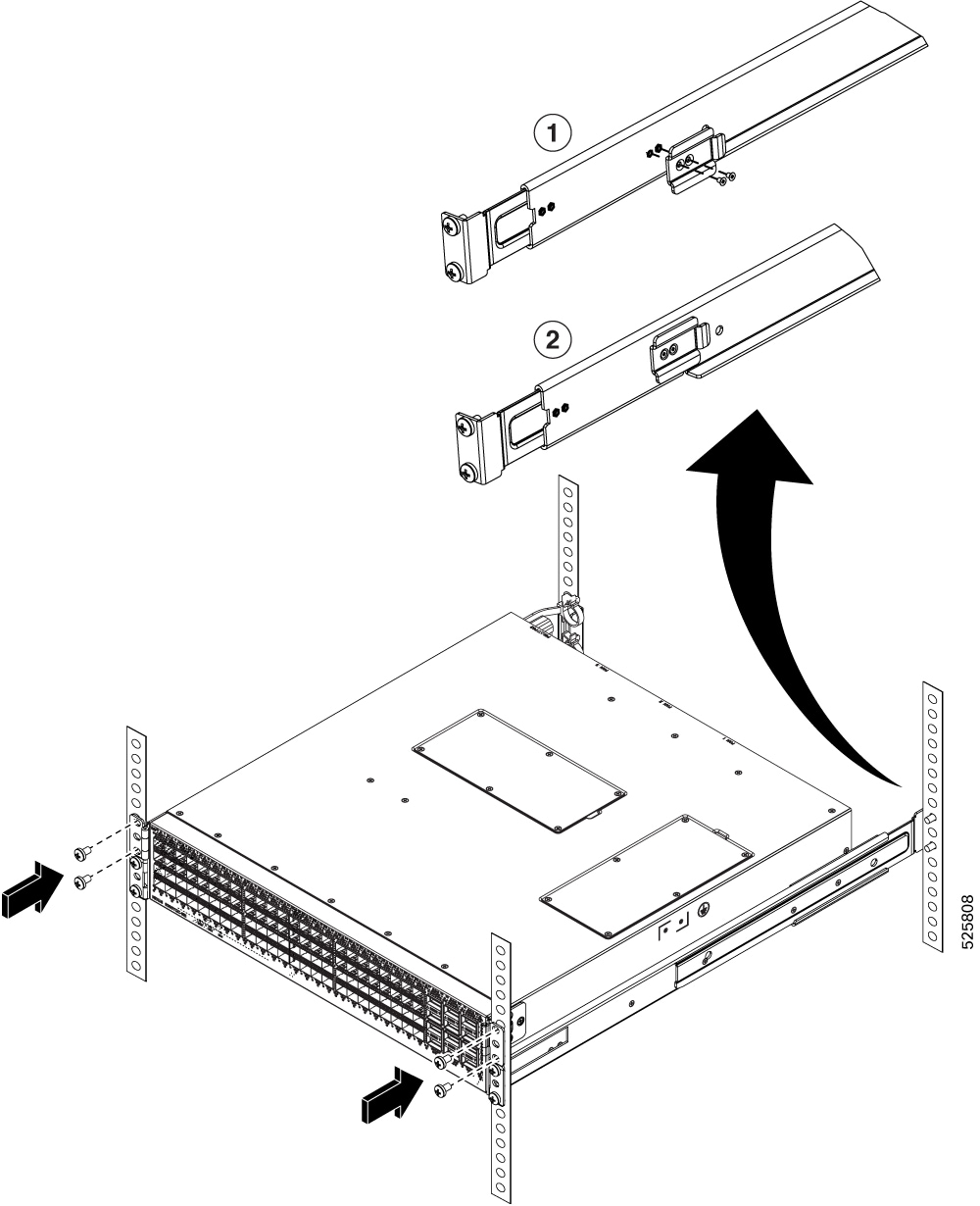
To install the switch, attach mounting brackets to the rack, install slider rails on the rear of the rack, slide the switch onto the slider rails, install the retainer brackets, and secure the switch to the rack with the retainer clips. Typically, the front of the rack is the side easiest to access for maintenance.


Note


You supply the eight 10-32 or 12-24 screws required to mount the slider rails and switch to the rack.

Before you begin

  • Inspect the switch shipment to ensure that you have everything ordered.

  • Verify that the switch rack-mount kit includes these parts:

    • Rack-mount brackets (2)

    • Rack-mount front-mount brackets (2)

    • Rack-mount slider rails (2)

    • Rack-mount retainer clips (2)

    • Phillips countersink screws (12)

    • Flat head screws M4 (6)

    • Flat head screws M3 (4)

  • The rack is installed and secured to its location.

Procedure


Step 1

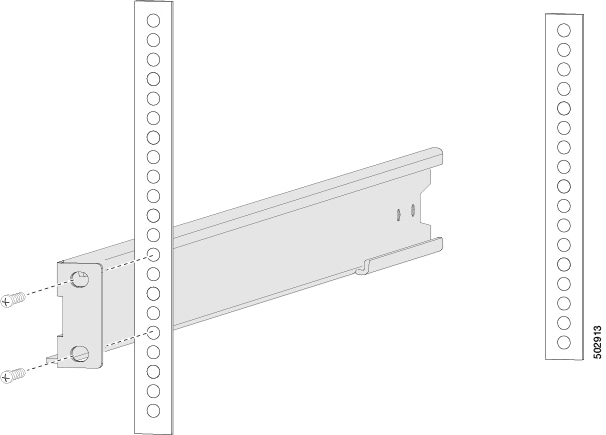
Install two rack-mount brackets to the rack.

  1. Determine which end of the chassis goes in the cold aisle:

    • If the switch has port-side intake modules (fan modules with burgundy coloring), position the front-mount brackets so that the switch ports will be in the cold aisle.

    • If the switch has port-side exhaust modules (fan modules with blue coloring), position the front-mount brackets so that the switch fan and power supply modules will be in the cold aisle.

  2. Position a front-mount bracket so that it aligns to the desired position in the rack and secure the bracket with 12-24 screws or 10-32 screws, depending on the rack thread type (see the figure). Tighten 12-24 screws to 30 in-lb (3.39 N·m) of torque. Tighten 10-32 screws to 20 in-lb (2.26 N·m) of torque.

  3. Repeat Step 1 for the other front rack-mount bracket on the other side of the rack and be sure to position that bracket horizontally to the same level as the first bracket.

Step 2

If you are not installing the chassis into a grounded rack, attach a customer-supplied grounding wire to the chassis as explained in Ground the chassis . If you are installing the chassis into a grounded rack, skip this step.

Step 3

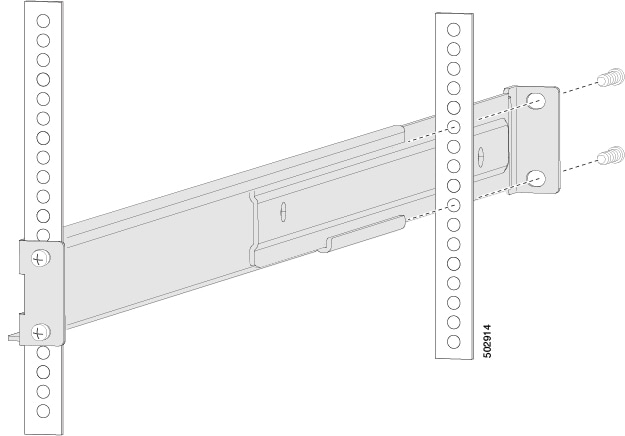
Install the slider rails on the rack or cabinet.

  1. Determine which two posts of the rack or cabinet you should use for the slider rails. Of the four vertical posts in the rack or cabinet, two will be used for the front mount brackets attached to the easiest accessed end of the chassis. The other two posts will have the slider rails.

  2. Position a slider rail at the desired level on the back side of the rack and slide it into the front-mount bracket already installed. Secure with 12-24 screws or 10-32 screws, depending on the rack thread type (see the figure). Tighten 12-24 screws to 30 in-lb (3.39 N·m) of torque. Tighten 10-32 screws to 20 in-lb (2.26 N·m) of torque.

  3. Repeat Step 3 to attach the other slider rail to the other side of the rack.

    Make sure that the slider rails are at the same level. Use a level tool, tape measure, or carefully count the screw holes in the vertical mounting rails.

Step 4

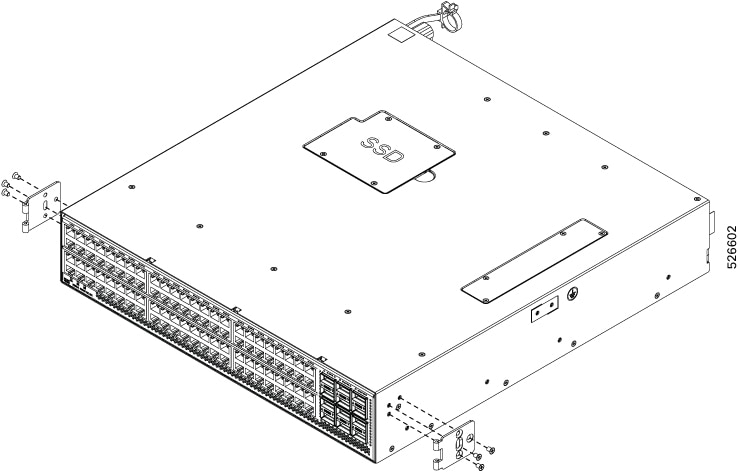
Insert the switch into the rack and attach it.

  1. Align the four holes in one side of front mount brackets to three holes on the left or right side of the chassis (see the figure).

  2. Use three M4 x 6 mm screws to attach the bracket to the chassis. Tighten each screw to 11 to 15 in-lb (1.2 to 1.7 N·m).

  3. Repeat Steps 4 to attach the second front mount bracket to the other side of the chassis.

Step 5

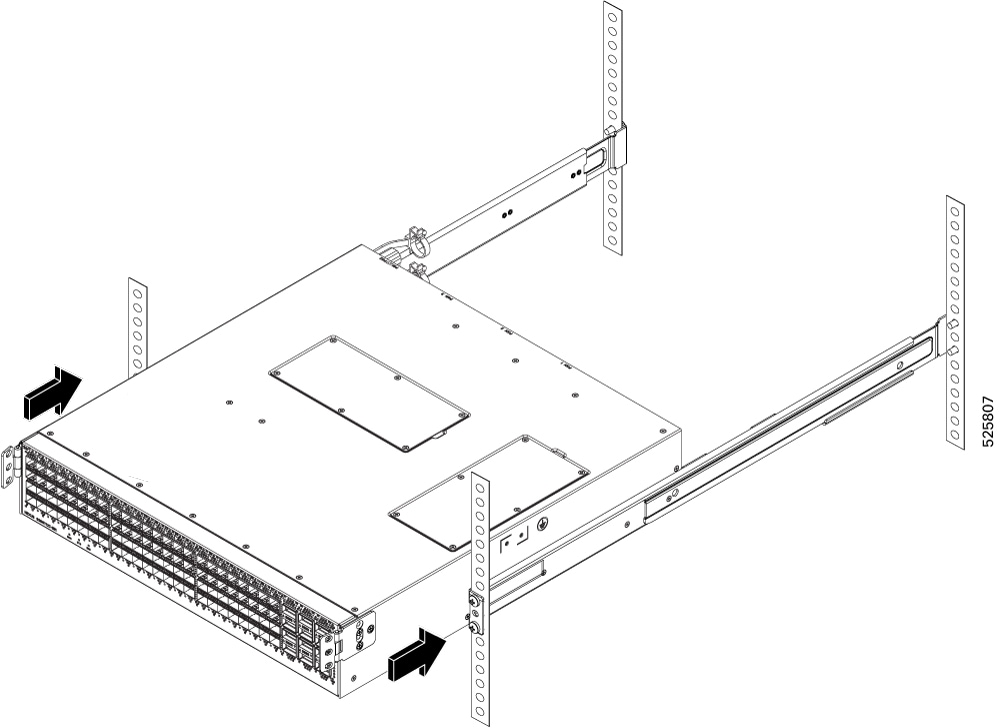
Insert the switch into the rack and attach it.

  1. Holding the switch with both hands, position the switch onto the rack-mount brackets and carefully slide the chassis into the rack (see the figure).

Step 6

Rotate one front mount bracket to align with the rack (see the figure).

  1. Tighten the 10-32 screws to 20 in-lb (2.26 N·m) or tighten the 12-24 screws to 30 in-lb (3.39 N·m).

  2. Repeat Step 6 to attach the other front mount bracket on other side of the chassis.

Step 7

Insert the retainer clip to hold the chassis in place.

  1. Align the retainer clip to the inside of the back of the slider rail. Make sure to hook the flange to the cutout on the bracket and align the screw holes (see the figure).

  2. Attach the screws to secure the retainer clip (see the figure).

  3. Repeat Step 7 to attach the other retainer clip on the other side of the chassis.

Step 8

If you attached a grounding wire to the chassis grounding pad, connect the other end of the wire to the facility ground.


Ground the chassis

The switch chassis is automatically grounded when you properly install the switch in a grounded rack with metal-to-metal connections between the switch and rack.


Note


Provide an electrical conducting path between the product chassis and the metal surface of the enclosure or rack in which it is mounted or to a grounding conductor. To ensure electrical continuity, use thread-forming type mounting screws that remove any paint or non-conductive coatings and establish a metal-to-metal contact. Remove any paint or other non-conductive coatings on the surfaces between the mounting hardware and the enclosure or rack. Clean the surfaces and apply an antioxidant before installation.


Ground the rack if using LVDC power supplies. If using AC or HVDC power supplies, the power cord for the AC power supplies provides grounding for the chassis. For supplemental grounding or bonding, attach a customer-supplied grounding cable to the chassis ground pad.

Ground the chassis. If you are using a 2-post rack, attach a customer-supplied grounding cable. Attach the cable to the chassis grounding pad and the facility ground. If you are using a 4-post rack, ensure that your chassis is grounded through the rack mount system or the power cable (AC or HVDC).


Warning


Statement 1024— Ground Conductor

This equipment must be grounded. To reduce the risk of electric shock, never defeat the ground conductor or operate the equipment in the absence of a suitably installed ground conductor. Contact the appropriate electrical inspection authority or an electrician if you are uncertain that suitable grounding is available.


Warning


Statement 1046— Installing or Replacing the Unit

To reduce risk of electric shock, when installing or replacing the unit, the ground connection must always be made first and disconnected last.


Before you begin

Before you can ground the chassis, verify the earth ground contact has a solid connection to the data center building.

Procedure


Step 1

Use a wire-stripping tool to remove approximately 0.75 inch (19 mm) of the covering from the end of the grounding wire. We recommend 6-AWG wire for the U.S. installations.

Step 2

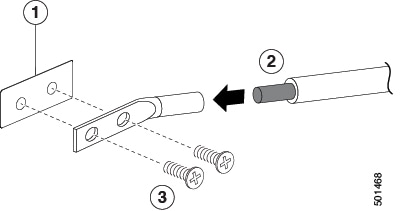
Insert the stripped end of the grounding wire into the open end of the grounding lug. Use a crimping tool to crimp the lug to the wire. See the figure. Verify that the ground wire is securely attached to the grounding lug by attempting to pull the wire out of the crimped lug (tug test).

1

Chassis grounding pad

3

2 M4 screws are used to secure the grounding lug to the chassis

2

Grounding cable, with 0.75 in. (19 mm) of insulation that is stripped from one end, which is inserted into the grounding lug and crimped in place

Step 3

Secure the grounding lug to the chassis grounding pad with two M4 screws, see figure 1. Tighten the screws to 11 to 15 in-lb (1.24 to 1.69 N m) of torque.

Step 4

Prepare the other end of the grounding wire and connect it to the facility ground.


Start the switch

Start the switch by connecting it to its dedicated power source. If you need n + n redundancy, connect each power supply in a switch to a different power source.


Note


This equipment is designed to boot up in less than 30 minutes, dependent on its neighboring devices being fully up and running.


Before you begin

  • The switch must be installed and secured to a rack or cabinet.

  • The switch must be adequately grounded.

  • The rack must be close enough to the dedicated power source so that you can connect the switch to the power source by using the designated power cables.

  • You have the designated power cables for the power supplies that you are connecting to the dedicated power sources.


    Note


    Depending on the outlet receptacle on your AC power distribution unit, you might need an optional jumper power cord to connect the switch to your outlet receptacle.


  • The switch is not connected to the network (this includes any management or interface connections).

  • The fan and power supply modules are fully secured in their chassis slots.

Procedure


Step 1

(Optional) For any AC power supply, do this:

  1. Using the recommended AC power cable for your country or region, connect one end to the AC power supply.

  2. Connect the other end of the power cable to the AC power source.

Step 2

(Optional) For any LV DC power supply, do this:

  1. Turn off the circuit breaker for the power source.

  2. When using an LV DC power supply that does not use a lug, connect the supplied wiring harness to the source. Or connect the user-supplied wires to the LV DC power source.

  3. When using an LV DC power supply that does not use a lug, connect the attached plug of the supplied wiring harness to the power supply. Or attach the lugs of the user supplied wires to the power supply.

  4. If there is a safety cover for the power source terminals, place and secure it over the terminals.

  5. Turn on the power at the circuit breaker for the DC power source.

Step 3

Verify that the power supply LED is on and green.

Step 4

Listen for the fans; they should begin operating when the power supply is powered.

Step 5

After the switch boots, verify that these LEDs are lit:

  • On the fan modules, the Status (STA or STS) LED is green.

    If a fan module Status LED is not green, try reinstalling the fan module.

  • After initialization, the switch chassis Status (labeled as STA or STS) LED is green.

Step 6

Verify that the system software has booted and the switch has initialized without error messages.

A setup utility automatically launches the first time that you access the switch and guides you through the basic configuration. For instructions on how to configure the switch and check module connectivity, see the appropriate Cisco Nexus 9000 Series Configuration Guides .