Overview
Describes small network deployments in Cisco ISE that use a minimal Cisco ISE footprint. This provides centralized policy management and access control with lower complexity, making them suitable for smaller sites with limited users, devices, and authentication load.
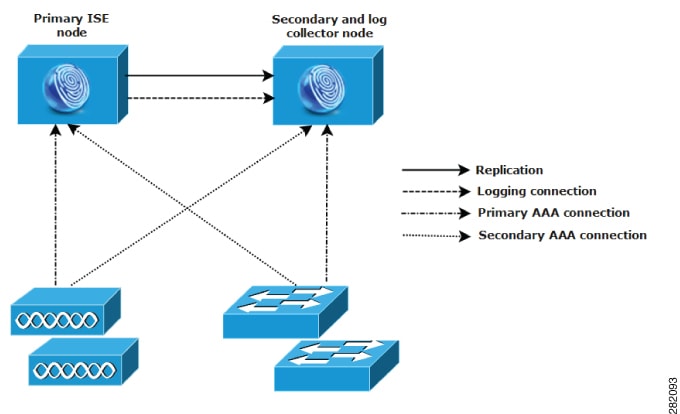
The smallest Cisco ISE deployment consists of two Cisco ISE nodes with one Cisco ISE node functioning as the primary node.
The primary node manages all configuration, authentication, and policy tasks for your network. The secondary node acts as a backup. If connectivity is lost between the primary node and network appliances, network resources, or RADIUS, the secondary node supports the primary node and keeps the network running.
Centralized authentication, authorization, and accounting (AAA) operations between clients and the primary node are performed using the RADIUS protocol. Cisco ISE synchronizes all content from the primary node to the secondary node. In a small network deployment, you can configure both nodes on all RADIUS clients by using this model or a similar approach.

If you want to add more devices, network resources, users, or AAA clients, switch from the small deployment model to a split or distributed deployment model.