Outlines CFM integration with EVPN, highlighting feature benefits, supported services, restrictions, and configuration of E-LAN and E-Line topologies, including multiple deployment scenarios and domain-level examples for comprehensive service assurance.
CFM on EVPN feature highlights and benefits
CFM on EVPN provides essential capabilities to monitor and maintain the health and connectivity of EVPN services. The key highlights and benefits include:
-
Fault detection and isolation—enables rapid detection of connectivity faults within EVPN domains, helping to isolate and pinpoint issues quickly to minimize service disruption.
-
Proactive monitoring—supports continuous monitoring of EVPN service health through periodic continuity checks, ensuring early identification of potential problems.
-
Service assurance—verifies the operational status of EVPN instances, CFM helps maintain high service availability and reliability.
-
Standardized protocols—uses IEEE 802.1ag and ITU-T Y.1731 standards, ensuring interoperability across multi-vendor environments.
-
Scalability—designed to scale with large EVPN deployments, supporting multiple maintenance domains and endpoints.
-
Simplified troubleshooting—provides detailed fault management tools such as loopback and linktrace messages, which assist network operators in diagnosing and resolving issues efficiently.
-
Integration with EVPN— is tightly integrated with EVPN control plane mechanisms, enabling seamless operation and management within EVPN architectures.
Supported offload types and timer values
Continuity Check Messages (CCMs) are heartbeat messages exchanged periodically among all Maintenance End Points (MEPs) within a service. Each MEP sends multicast CCMs and receives CCMs from all other MEPs, enabling peer discovery and connectivity verification. The offload type is determined by where CCMs are processed.
Currently, only the Non-offload type is supported, where CCMs are generated and processed by the CPU. For a CFM session on a bundle interface or similar, CCM timers must be set to one second or greater.
CCM timers define the intervals at which CCMs are sent and received. If CCMs are not received within the configured interval, the CFM MEP is considered down. The supported CCM timer values for the Non-offload type are:
This table details the supported CCM times values for non-offload and hardware offload types:
|
Offload type |
CCM timer value |
|---|---|
|
Non-offload |
1 second |
|
10 seconds |
|
|
1 minute |
|
|
10 minutes |
|
|
1 second, applicable to these routers:
|
Restrictions for CFM on EVPN
To ensure accurate CFM operation on EVPN, observe these restrictions:
-
Loopback and linktrace results may show artifacts such as multiple or varying responses for the same instance.
-
Do not configure CFM on interfaces with untagged encapsulation for EVPN pseudowire, as this is unsupported by Cisco IOS XR software.
Supported services for CFM on EVPN
CFM on EVPN support these service types:
-
EVPN E-LAN—CFM plays a crucial role in EVPN E-LAN services by enabling service providers and enterprises to maintain high availability and ensure the reliability of their distributed Ethernet services.
-
EVPN E-Line—CFM facilitates monitoring and maintaining the health of point-to-point Ethernet services over packet-switched networks, which is essential for service providers managing EVPN E-Line services.
CFM on EVPN is supported only on single-homed devices.
CFM on EVPN E-LAN single-homing
CFM on EVPN E-LAN single-homing is a network monitoring feature that
-
operates on networks running E-LAN services with single-homed devices
-
monitors the health and performance of E-LAN services, and
-
provides high-speed Layer 2 services with enhanced resiliency.
How CFM on EVPN E-LAN single-homing works
Summary
The key components involved in the CFM on EVPN E-LAN single-homing process are:
-
Single-homed device: Connects to the EVPN E-LAN service and participates in connectivity monitoring.
-
CFM: Monitors and verifies connectivity within the EVPN E-LAN domain.
-
EVPN E-LAN domain: The network environment where devices communicate and connectivity is managed.
The CFM on EVPN E-LAN single-homing process enables continuous connectivity monitoring by the single-homed device within the EVPN E-LAN domain, and detects faults through continuity checks and alerts administrators to ensure network stability and simplify troubleshooting.
Workflow
These stages describe how CFM on EVPN E-LAN single-homing works.
-
The single-homed device connects to the EVPN E-LAN service.
-
CFM is enabled on the device to monitor connectivity within the EVPN E-LAN domain.
-
CFM initiates continuity checks between the single-homed device and other devices in the EVPN E-LAN.
-
CFM detects any connectivity faults and generates alarms or notifications.
-
Network administrators use CFM results to troubleshoot and resolve connectivity issues.
Result
This process ensures continuous monitoring and fault detection in single-homed EVPN E-LAN environments, improving network stability and simplifying troubleshooting.
Configure CFM on EVPN E-LAN full mesh topology
Enable and verify CFM on EVPN E-LAN full mesh topology to monitor network continuity and detect faults.
Use this task to configure CFM continuity checks, MEP cross-checks, and interface settings on Cisco routers participating in an EVPN E-LAN full mesh topology.
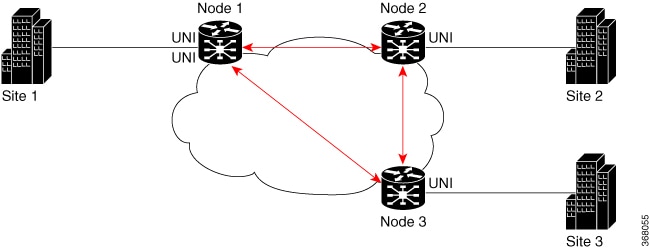
Procedure
CFM is enabled on all nodes in the EVPN E-LAN full mesh topology, providing continuous connectivity monitoring and fault detection.
Configure CFM on EVPN E-LAN hub and spoke topology
Configure CFM on an EVPN E-LAN hub and spoke topology with SLA profiles to monitor connectivity between the hub and spoke nodes.
This task extends the full mesh CFM configuration by adding SLA operation profiles on the hub node to ensure continuous network service monitoring.
Before you begin
Complete the full mesh CFM configuration steps on all nodes.
Procedure
SLA profiles are configured on the hub node, enabling continuous service-level monitoring between the hub and spoke nodes.
Configure CFM for different domain types and bridge domains
Configure Ethernet CFM continuity checks and MEP cross-checks for various domain levels, multiple MEPs, and multiple services across different EVPN bridge domains.
Use these examples to configure CFM in complex EVPN environments with multiple bridge domains, domain levels, and services.
Before you begin
Ensure you have the necessary domain, service, bridge group, and bridge domain information.
Procedure
Follow these steps for each of these scenarios.
Scenario 1: Up MEPs with the same domain and level
Procedure
Scenario 2: Multiple Up MEPs on AC interfaces in the same bridge domain
Procedure
Scenario 3: Multiple services for different EVPN bridge domains
Procedure
Scenario 4: Different EVPN bridge domains on different domain levels
Procedure
CFM on EVPN E-Line single-homing
A CFM on EVPN E-Line single-homing is a network monitoring solution that
-
operates on networks using EVPN E-Line single-homed devices
-
monitors E-Line services providing high-speed Layer 2 connectivity, and
-
ensures high resiliency for the Layer 2 services.
CFM up MEP is supported only on single-homing Layer 2 main and subinterfaces.
How CFM on EVPN E-Line single-homing works
Summary
The key components involved in the CFM on EVPN E-Line single-homing process are:
-
Cisco routers (Nodes 1, 2, and 3): These routers form the network topology and are interconnected.
-
CFM: Provides fault detection and monitoring capabilities within the EVPN E-Line service.
-
EVPN E-Line service: A point-to-point Ethernet VPN service that supports single-homing configurations.
CFM on EVPN E-Line single-homing enables routers to exchange monitoring messages over a full mesh to detect faults and ensure continuous service integrity. This process supports rapid fault detection and high availability in single-homed EVPN E-Line deployments.
Workflow
These stages describe how CFM on EVPN E-Line single-homing works.
-
Cisco routers (Nodes 1, 2, and 3) establish full mesh connectivity to support CFM operations within the EVPN E-Line topology.
-
CFM messages are exchanged between the routers to monitor connectivity and detect faults.
-
Faults detected by CFM trigger notifications and enable rapid troubleshooting within the EVPN E-Line single-homing environment.
-
Routers maintain continuous monitoring to ensure service integrity and performance.
Result
This process enables robust fault management and monitoring for EVPN E-Line single-homing deployments, ensuring high availability and rapid fault detection in the network.
Configure CFM on EVPN E-Line single-homing
Enable and validate CFM to monitor service continuity and endpoint liveliness for EVPN E-Line service.
Use this task to configure CFM service continuity checks, Maintenance End Point (MEP) cross-checks, and enable CFM on interfaces for EVPN E-Line single-homing deployments.
Procedure
CFM is configured on EVPN E-Line, providing continuous service monitoring and fault detection through MEP cross-checks and continuity checks, ensuring network reliability and rapid troubleshooting.