Get Started With Fleet Upgrade

This document covers the following topics:

About Fleet Upgrade

Cisco Crosswork Workflow Manager (CWM) Solutions is a collection of pre-built use cases that offers customers a convenient and efficient way to manage, configure and upgrade their devices. It provides out-the-box use cases that are easy to deploy and ready to use, allowing users to quickly onboard their devices for management.

CWM Solutions Fleet Upgrade lets users manage, distribute, and commit software images and image upgrades to multiple devices at the same time, including to third-party devices.

Fleet Upgrade is automated, customizable, extensible, provides strong error checking, and supports devices from Cisco and other vendors.

To get started using Fleet Upgrade, see the next topic, Onboard devices.

Installing Fleet Upgrade

This version of Crosswork Workflow Manager Solutions (CWM-S) Fleet Upgrade is part of the Cisco Crosswork Network Controller Premier tier. You must install the Premier tier package as a CAPP (CCrosswork APPlication) on a cluster deployment of Cisco Crosswork Network Controller. Your cluster deployment must be supported by Crosswork Data Gateway, Cisco Network Services Orchestrator (NSO), Workflow Automation, and an adequate number of server node resources.

Crosswork Network Controller cluster deployment and installation of the supporting products is explained in the Cisco Crosswork Network Controller 7.1 Installation Guide. To install Fleet Upgrade from the Premier-tier CAPP:

  1. Download and unzip the latest version of the Cisco Crosswork Network Controller Premier Package, a tar.gz file available to customers from Cisco Software Download.

  2. Follow the steps given in Install Crosswork Applications.

  3. When you are finished, follow the instructions in Deploy NSO Function Pack Bundles to deploy the NSO FP bundles contained in the same download file.

Onboard devices

Before you can test devices for compliance with software image standards, or upgrade them, the devices must be part of your Cisco Crosswork managed inventory.

The Cisco Crosswork Network Controller 7.1 Administrator Guide chapter Onboard Devices contains complete instructions on how to add devices to your managed inventory, using a wide variety of methods. Two of the mostly commonly used are:

Once you have populated your managed device database, it is also a good idea to export it as a CSV file backup. For help with this task, see the topic Export Device Information to a CSV File.

Populate the image repository

Before you use Fleet Upgrade to standardize, test conformance, and upgrade the images installed on your network devices, you must first populate the local software image repository with the images you need. Follow these steps to populate the repository using Fleet Upgrade (you can also use CNC's Device Management > Software Management > Images functions to add and upload software images to the repository).

Before you begin

CWM Solutions provides a local software image repository that you can use to set up policies that establish your software-image standards. You can then use the same repository to test whether your devices are in conformance with those standards, and deploy software images and upgrades to your managed devices. You can browse, choose and automatically download SMUs to the repository directly from Cisco.com, using your Cisco customer login. You can also upload software images to the repository.

Fleet Upgrade image repository downloading is not yet available for Cisco ISO network operating system files, or the network OS files offered by supported third parties. For this reason, Cisco recommends that you download network OS files, so that they are ready for upload to the Fleet Upgrade repository when you follow the steps in this topic.


Note


To reduce your internet visibility, you can configure Fleet Upgrade to download SMUs from Cisco.com using a proxy server. For details, see Download software upgrades using a proxy server.

When installed with Crosswork Network Controller, the Fleet Upgrade image repository is the same as, and has the same contents as, the Crosswork Network Controller software image repository. All the software image management features you are used to using with CNC are available to you, in addition to the automated image upgrade workflow that Fleet Upgrade provides.


Procedure


Step 1

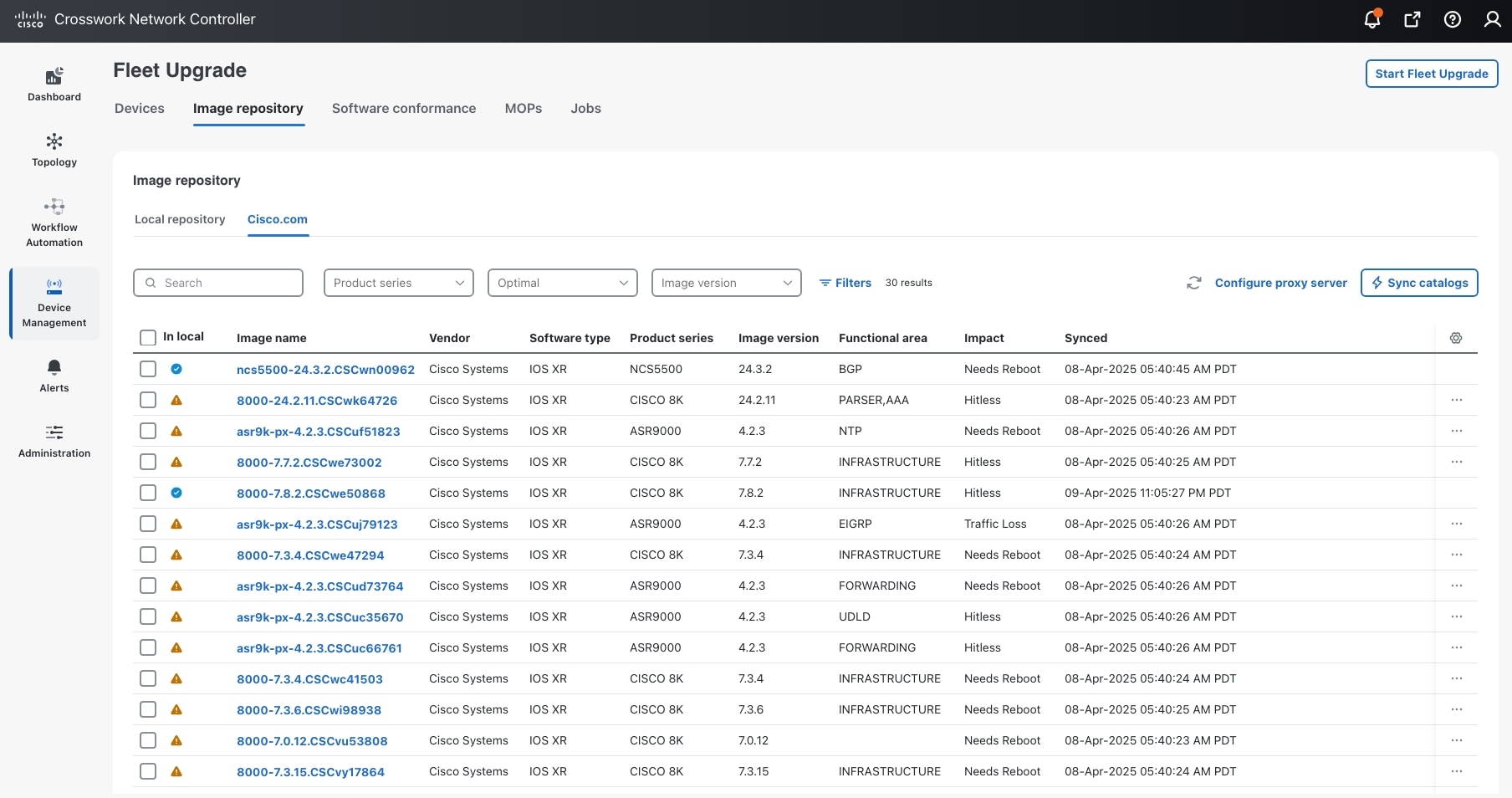
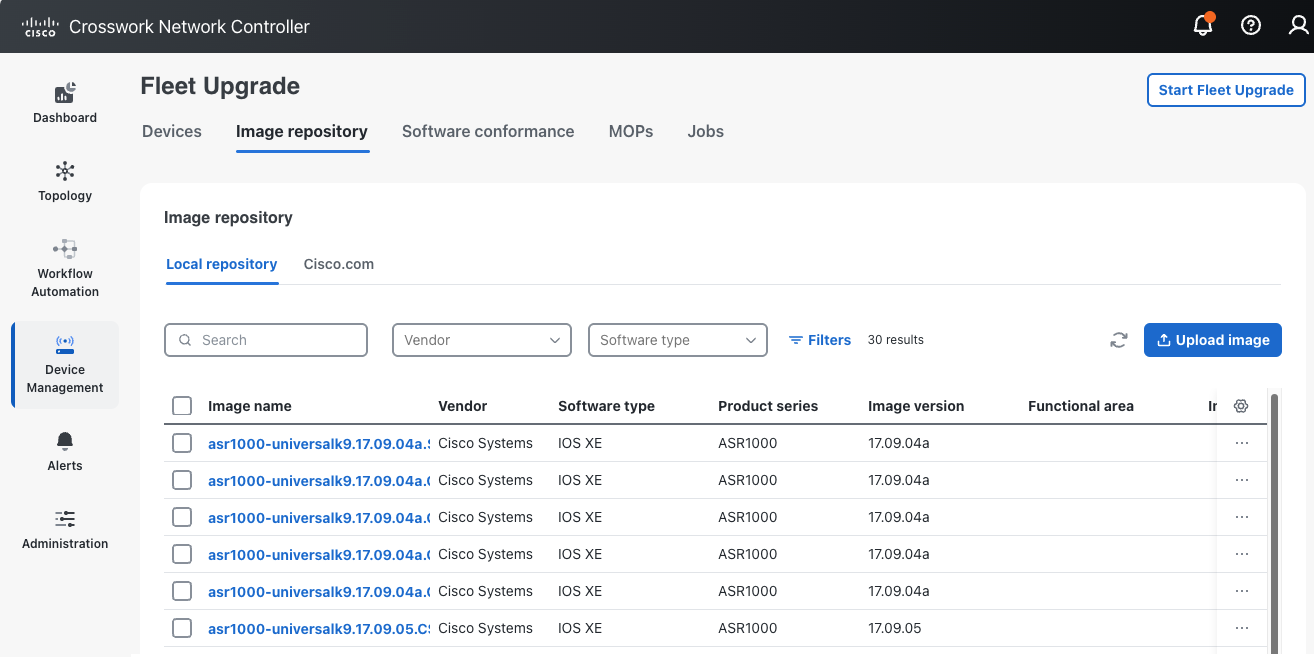
From the main menu, choose Device Management > Fleet Upgrade > Image Repository. The Fleet Upgrade window's Image repository tab displays the list of ISOs and SMUs loaded to the local image repository.

Image Repository tab

Step 2

There are two ways to load images into the local repository:

  • If you want to load Cisco SMUs, go to Step 3.

  • If you want to load Cisco or third-party network OS software images you have previously downloaded, go to Step 4.

Step 3

To load Cisco SMUs:

  1. Click the Cisco.com tab. The window's Image repository section now displays the catalog of all SMUs available from the Cisco.com software image download site.

    SMU Catalog

    Tip


    Cisco releases many new SMUs each quarter. Use the Filters button to limit the display to the SMUs of interest to you. If you don't see the ones you want, or the timestamps shown under Synced are more than three months old, click Sync catalogs to update the list.

  2. Choose one or more of the SMUs you want to download by clicking the checkboxes shown next to each SMU image's name in the far left column.

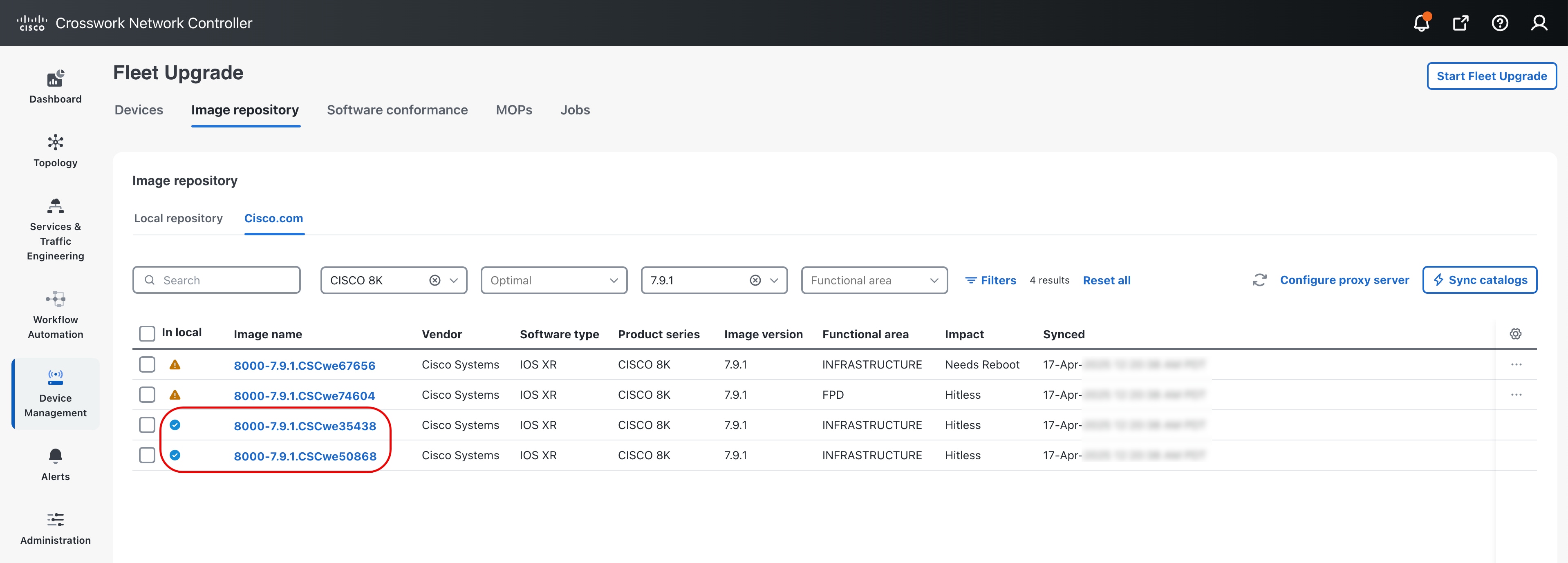
    A blue check mark shown next to the SMU image's name under the In local column (circled in the image below) indicates that the image is already in the local repository. You need not select it and try to download it again.

    Images already in repository
  3. To begin the download, click the More icon () in the far right column in the same row as any of the SMUs you chose.

  4. Choose Download to local. You will be shown a list of the SMUs you chose and a device activation code. Click Authenticate to download, and log in with the activation code. Record the activation code and follow the instructions on your device for the next steps.

Step 4

To load Cisco or third-party network OS software images you have previously downloaded:

  1. Click Upload image.

  2. Complete the fields on the Upload Image window as shown in the following table (the Vendor and Image File Name values are required):

    In this field...

    Enter or choose:

    Vendor *

    Cisco or Juniper.

    Software Type *

    If Vendor is Cisco, IOS XR or IOS XE. If Vendor is Juniper, MX 960.

    Product Series *

    A supported Product Series for the chosen Vendor and Software Type (for example, "CAT2000" for Cisco IOS XE).

    Functional area (optional)

    A description of the OS functional area affected by the upgrade (such as: "ACL" or "Infrastructure").

    Impact (optional)

    A description of the operational impact of the upgrade installation (such as: "Requires reboot" or "Hitless")

    Choose image file *

    The path and filename of (or click Browse to choose) the software image file to be uploaded

  3. When you are finished, click Upload image.


What to do next

Follow the steps in Create image policies.

Create image policies

Software image policies are a critical part of the Fleet Upgrade workflow. Whenever you create a software image policy, you choose one or more software image versions stored in your local repository, making them part of that image policy. Choosing them establishes those images as the standards that are supposed to be installed on your devices. As different types of devices run different types of software images, you'll need to establish image policies for each type of device. Whenever you run a Fleet Upgrade conformance report against a particular type of device, you will also need to pick the appropriate image policy for that device type. The Fleet Upgrade workflow will then check the software actually installed on those devices against the standard image established in the policy. If the installed and standard image versions don't match, then the device is non-conformant.

Note that Fleet Upgrade will rate as conformant only those devices that have all the chosen target images and image versions in the image policy installed at the time you run the conformance report. If you run a conformance report against a device that does not have one or more of the policy's images or versions installed, the report will rate that device as non-conformant.

Before you begin

Ensure you have downloaded one or more SMUs and network OS software images to the image repository, as explained in Populate the image repository.

Procedure


Step 1

From the main menu, choose Device Management > Fleet Upgrade > Software conformance > Image policies.

Step 2

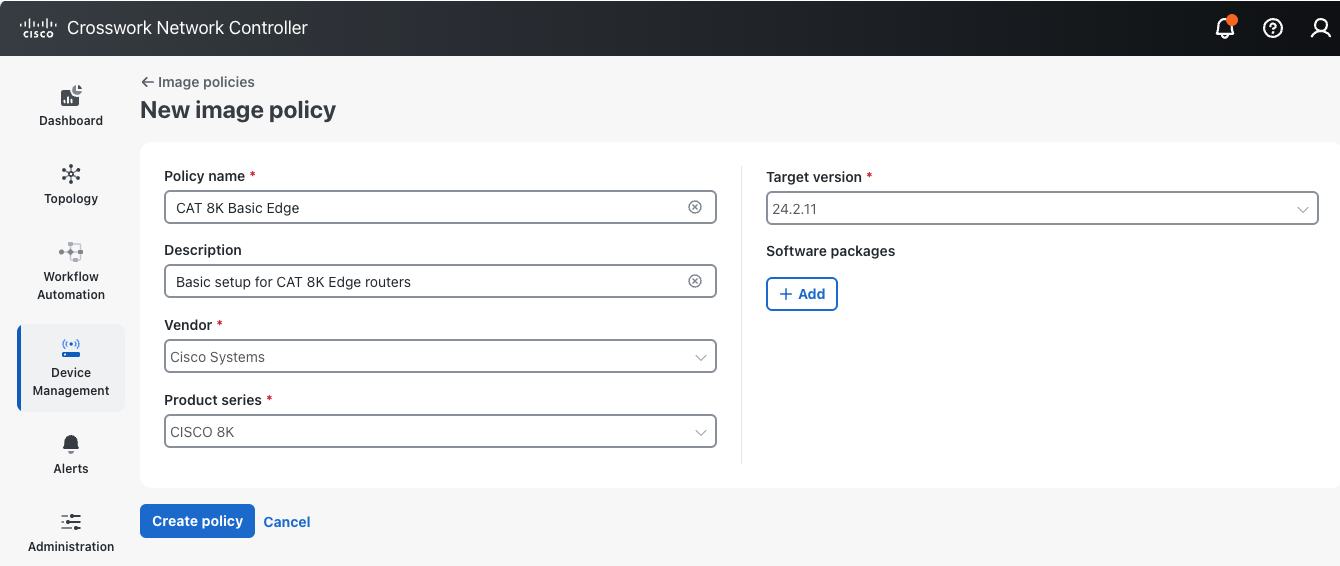
Click + Add image policy to display the New image policy window.

New Image Policy Window

Step 3

Complete the first five fields in the New image policy window as shown in the following table:

In this field...

Enter or choose...

Policy name

A unique name for the image policy, such as ASR1KSMU.

Description

An optional description of the policy's purpose, such as Standard minimum SMU level for all Cisco ASR 1000 routers.

Vendor

The name of the software vendor, such Cisco Systems.

Product series

The network device product series, such as the Cisco ASR1000.

Target version

The target version of the product series, such as 17.09.04a for the Cisco ASR1000 (supported target versions are pre-selected for you based on the target version).

Step 4

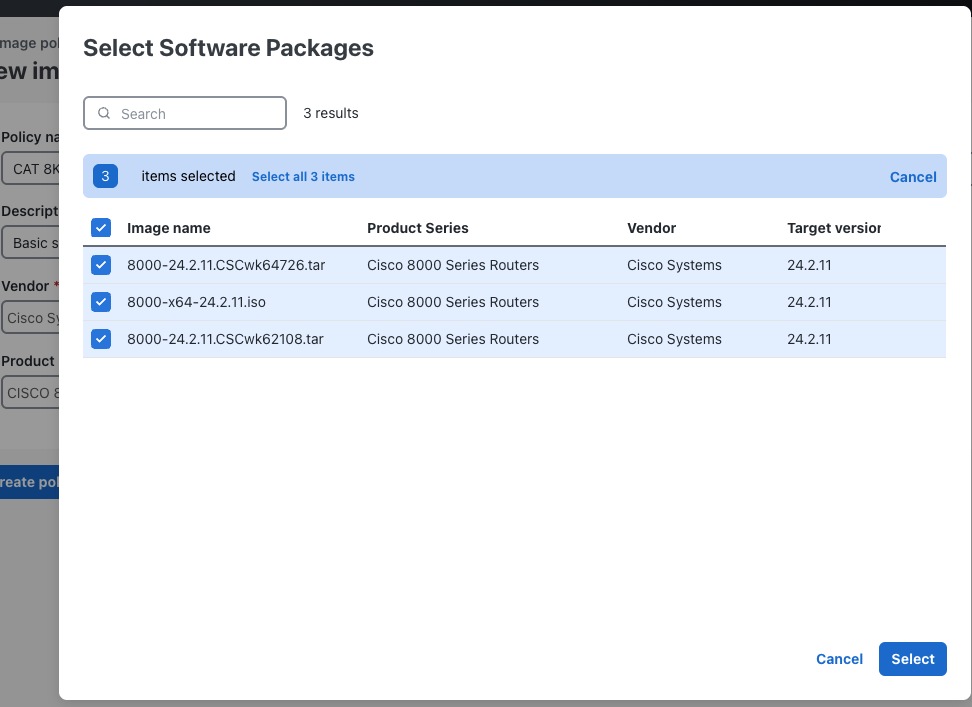
In the Software packages field, click the + Add button. The Select Software Packages window lists all the software images downloaded to your local repository that can be installed on the network device product series you specified.

Step 5

Click the check box next to the Image name of each software image you want to make part of this image policy.

Select Softtware Packages

Step 6

When you are finished selecting software images, click Select. You can continue revising your entries as needed, or click + Add again to change your software image selections. When you are finished, click Create policy to save the new policy.


What to do next

Follow the steps in Run a policy conformance report.

Run a policy conformance report

Use the policy conformance report to determine when you need to perform a Fleet Upgrade on one or more of your network devices.

You can create Fleet Upgrade conformance reports to check software image conformance for any device type and any combination of software images and versions. The core of the report is the software image policy you choose. The software image policy specifies the standard software images your devices should have installed on them. In addition, you can choose to run Fleet Upgrade conformance reports against devices on demand, at a future date or time you choose, or at regular recurring intervals. Each time the report runs, it will compare the software image installed on the devices with the software images specified in the image policy. The report will identify as "conformant" every device with all the policy's images installed. The report will flag as "non-conformant" any devices missing one or more of the policy images.


Tip


You may find that the image policy that forms the basis of the conformance report you ran is out of date or otherwise incorrect. If that's the case, you can easily edit the policy and then run the report again. To edit an existing image policy, select Device Management > Fleet Upgrade > Software Conformance > Image policies to display the list of image policies. Scroll or use Search to find the policy you want, then click the More (…) menu at the far right in the same row as the report you want and select Edit report.


Before you begin

Ensure you have created one or more software image policies, as explained in Create image policies.

Procedure


Step 1

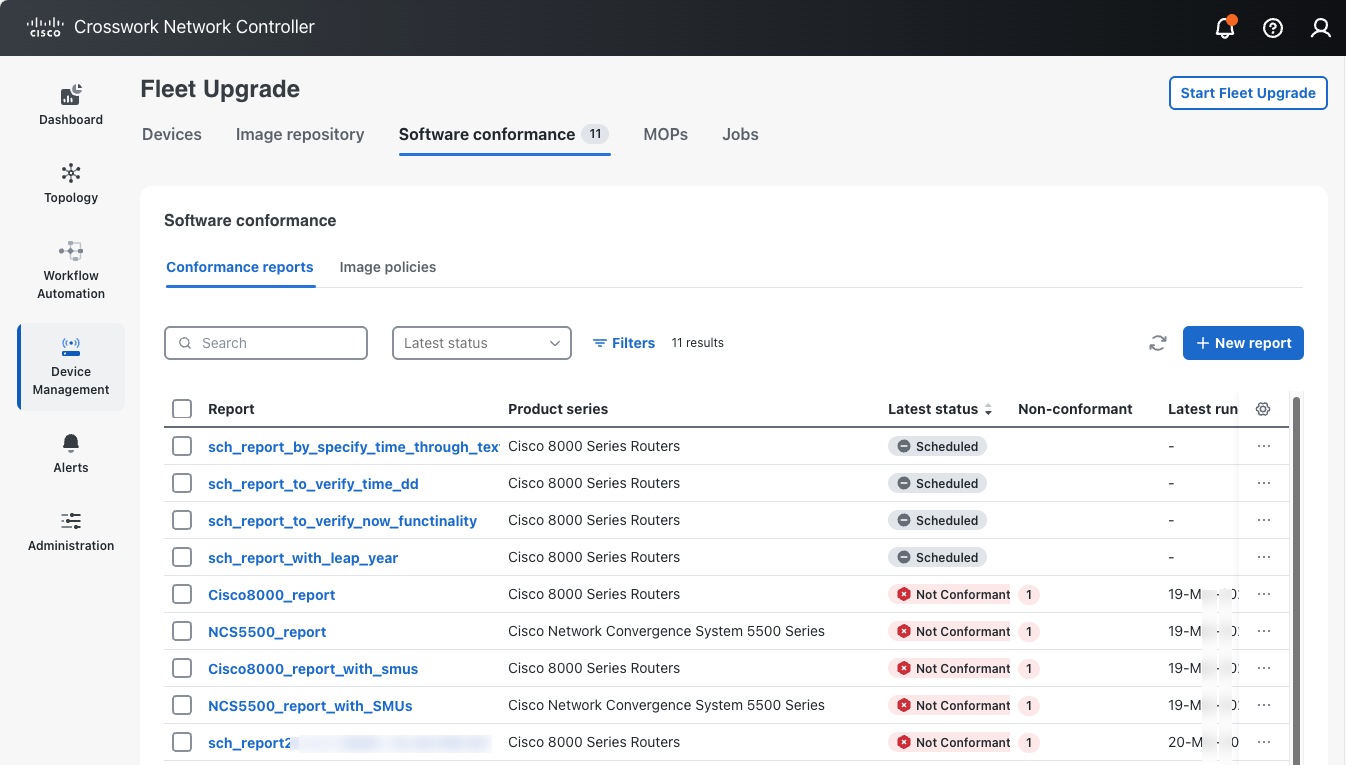
From the main menu, select Device Management > Fleet Upgrade > Software conformance > Conformance reports. The Conformance reports tab displays the status of all completed software conformance reports, as shown in the figure below.

Conformance reports tab

Step 2

Click + New report.

Step 3

Complete the first five fields in the New image policy window as shown in the following table:

In this field...

Enter or select...

Report name

A unique name for the conformance report, such as ASR1KStandard.

Select image policy

An optional description of the policy's purpose, such as Cisco ASR 1000 edge router SMU status.

Current version

The device software version number, such as 24.2.2.

Run schedule

One of the following:

  • Run now.

  • Schedule for specific data and time. If you select this option, you must also specify a Time and Date.

  • Run recurring report. If you select this option, you must also specify an Interval between runs, or the Days of the week or Days of the month you want the recurring report to run on.

Step 4

When you are finished, click Create Report to save the new report. If you selected Run now, you will also run the new report.

Clicking Create Report will return you to the Conformance reports tab, where you can review the status of any report you have already run.


What to do next

If you're still viewing the results of a report and you see non-conforming devices, consider running a Fleet Upgrade using the steps in Run a Fleet Upgrade job.

If your conformance report failed, investigate by following the steps in Monitor conformance report results.

Monitor conformance report results

Use the Conformance reports tab to monitor the results of a conformance report, including any failures that occur. The status details for failures will help you diagnose the cause and correct it.

Procedure


Step 1

From the main menu, choose Device Management > Fleet Upgrade > Software Conformance > Conformance reports.

Step 2

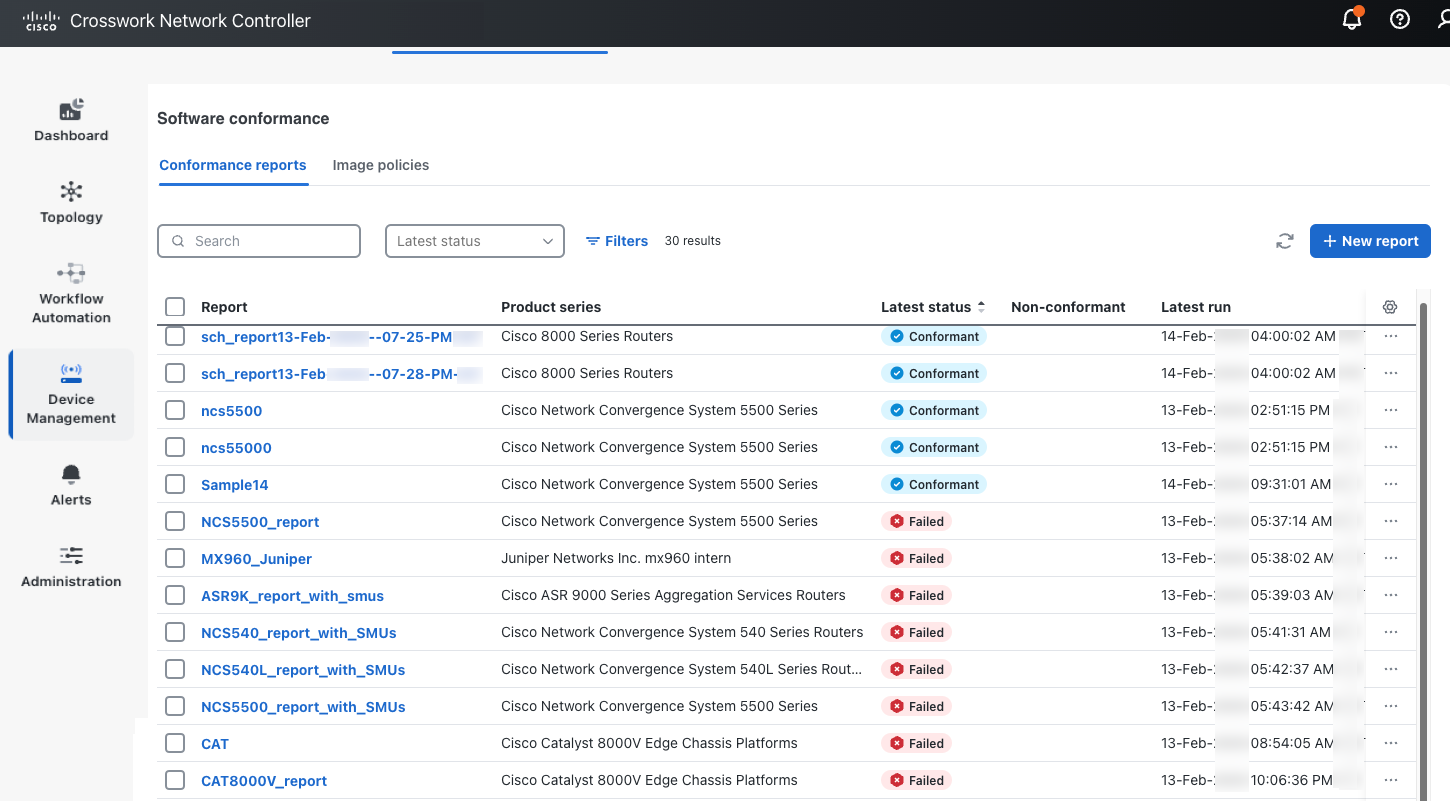
Click the Latest status column header to sort the column alphabetically. Reports with "Conformant" and "Failed" results will be sorted like those shown in the following figure.

Conformance reports, latest status

Step 3

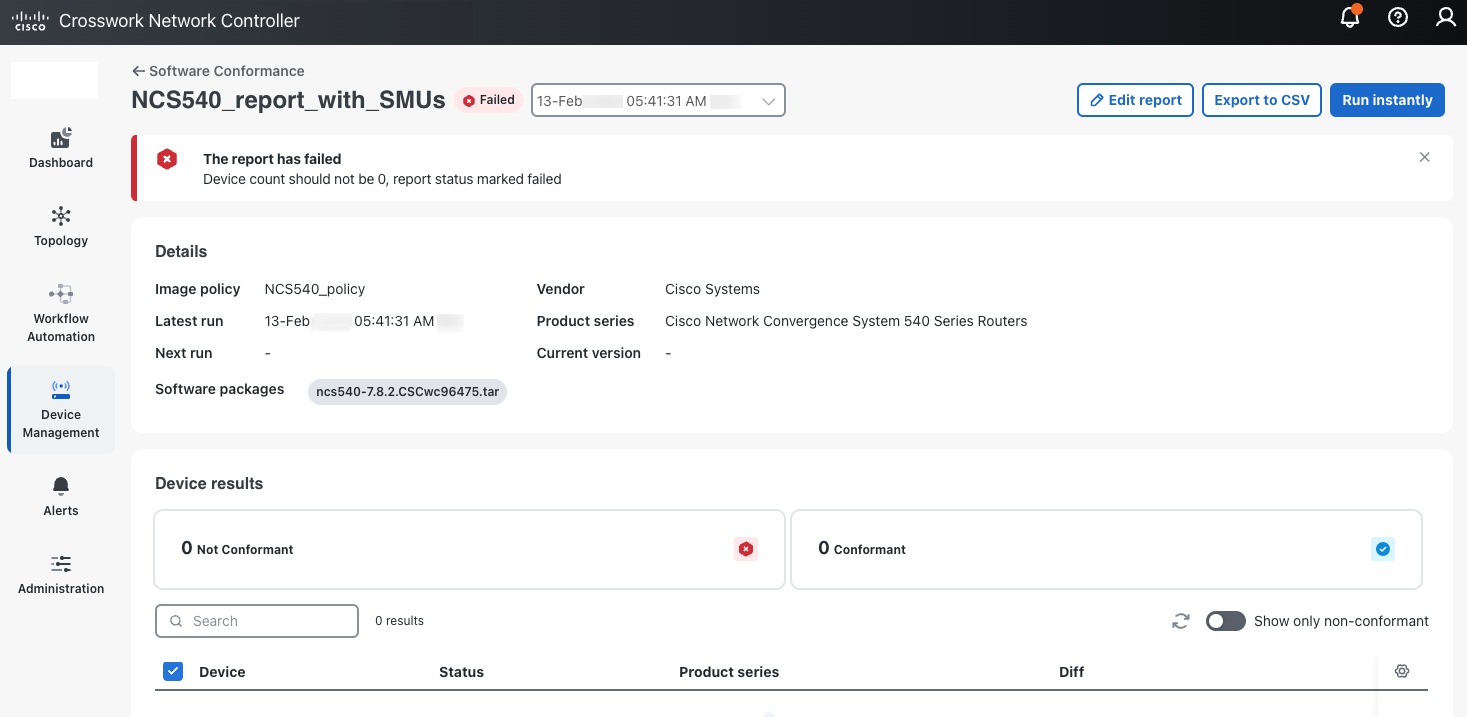
For any report that failed: Click the Report name. Crosswork displays a detail screen like the one shown below, giving the reason for the report failure. In this example, no existing devices were specified, so there was nothing against which to compare the software image policy. You can easily correct this by ensuring that the next run includes devices.

Details for a failed report

Tip


For any software conformance report whose details you're viewing:

  • Click on the date field to see details for other runs of the same report.

  • Click Edit report to change the report settings and re-run or re-schedule it.

  • Click Export to CSV to save the report as a CSV file in your default downloads directory.

  • Click Run instantly to re-run the report immediately with the same settings as before.

Step 4

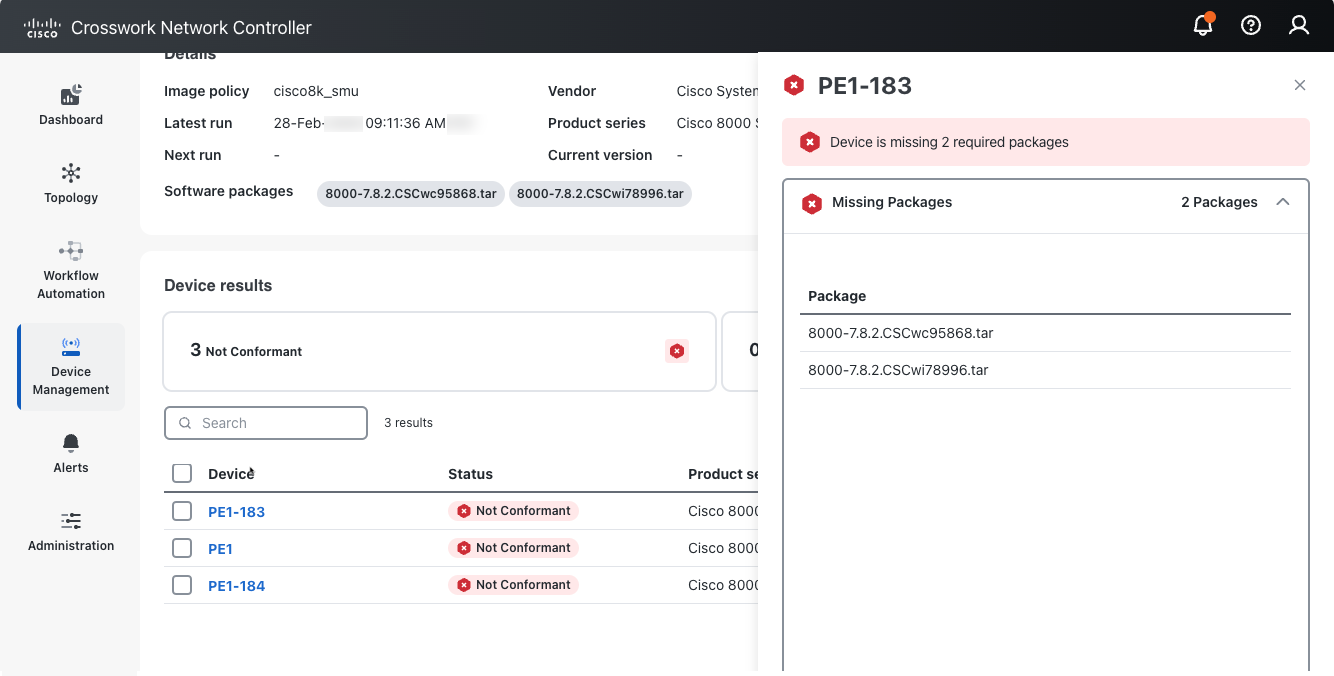
For any report showing non-conformant devices: Click the Report name. Crosswork displays a detail screen like the one shown below, listing the non-conformant devices. If needed, click the Device name to see details for each non-conforming device. In this example, the first of the three devices was missing both of the required software packages.

Any non-conforming device will also be identified as non-conformant on the Fleet Upgrade > Devices page.

Details for non-conforming devices

Run a Fleet Upgrade job

Fleet Upgrade uses Methods Of Procedure (MOPs) to perform automated device upgrades. The term "MOP" as used in Fleet Upgrade refers to a set of pre-programmed actions that are performed in sequenced phases. Each Action in the MOP is selected and (where needed) customized to deliver a complete, successful upgrade for the combination of software image and device for which it is intended. Fleet Upgrade provides default MOPs for the devices and software it supports, as well as facilities for creating custom versions of the default MOPs, and entirely new MOPs with mixtures of default and new Actions. At runtime, you have the opportunity to select which MOP your Fleet Upgrade job will use, as well as customizing other variables (such as the job name and the execution schedule). For more on these topics, see Use the default MOPs and Create custom MOPs.

Before you begin

The easiest way to run a Fleet Upgrade is, first, to run a conformance report, as explained in Run a policy conformance report, and then select the non-conforming device and click Start Fleet Upgrade. Running the conformance report first not only ensures that the Fleet Upgrade is really needed, it also lets you launch the upgrade automatically.

The steps below assume that you will want to launch a Fleet Upgrade from the Software conformance > Conformance report window. But you can also launch an upgrade by clicking the Start Fleet Upgrade button on any of the other Fleet Upgrade windows where it appears: Devices, Image repository > Local repository, Image repository > Cisco.comSoftware conformance > Image policies, MOPs, and Jobs,

Procedure


Step 1

Choose Device Management > Fleet Upgrade > Software conformance to display the Conformance reports list. The list should show a Report with one or more devices with a Latest status that is Not Conformant.

Step 2

Click the selection checkbox shown next to the name of the Report. Click Start Fleet Upgrade. The New Software Update window displays a list of all the devices that were checked for conformance. The non-conformant devices are already selected for you.

Step 3

For each additional device you want Fleet Upgrade to update, click the check box shown next to the device Host name. Or click the check box shown next to the Host name column title to select all of them.

You can select a maximum of 50 devices to be upgraded in the same Fleet Upgrade job.

Step 4

Click Next to display the Select software image window. If the software image policy you used to create the conformance report specified a target version and software packages, the list of software packages to be installed on the devices will be pre-selected for you.

Step 5

If the image policy did not specify packages, or you want to install more packages, click +Add, then click the check box shown next to each package's Image name. Then click Select to display the list of all packages to be installed.

Step 6

Click Next to display the Select MOP window.

Step 7

Click the Select MOP drop down list to select the MOP you want to use to install the chosen software packages on the selected devices.

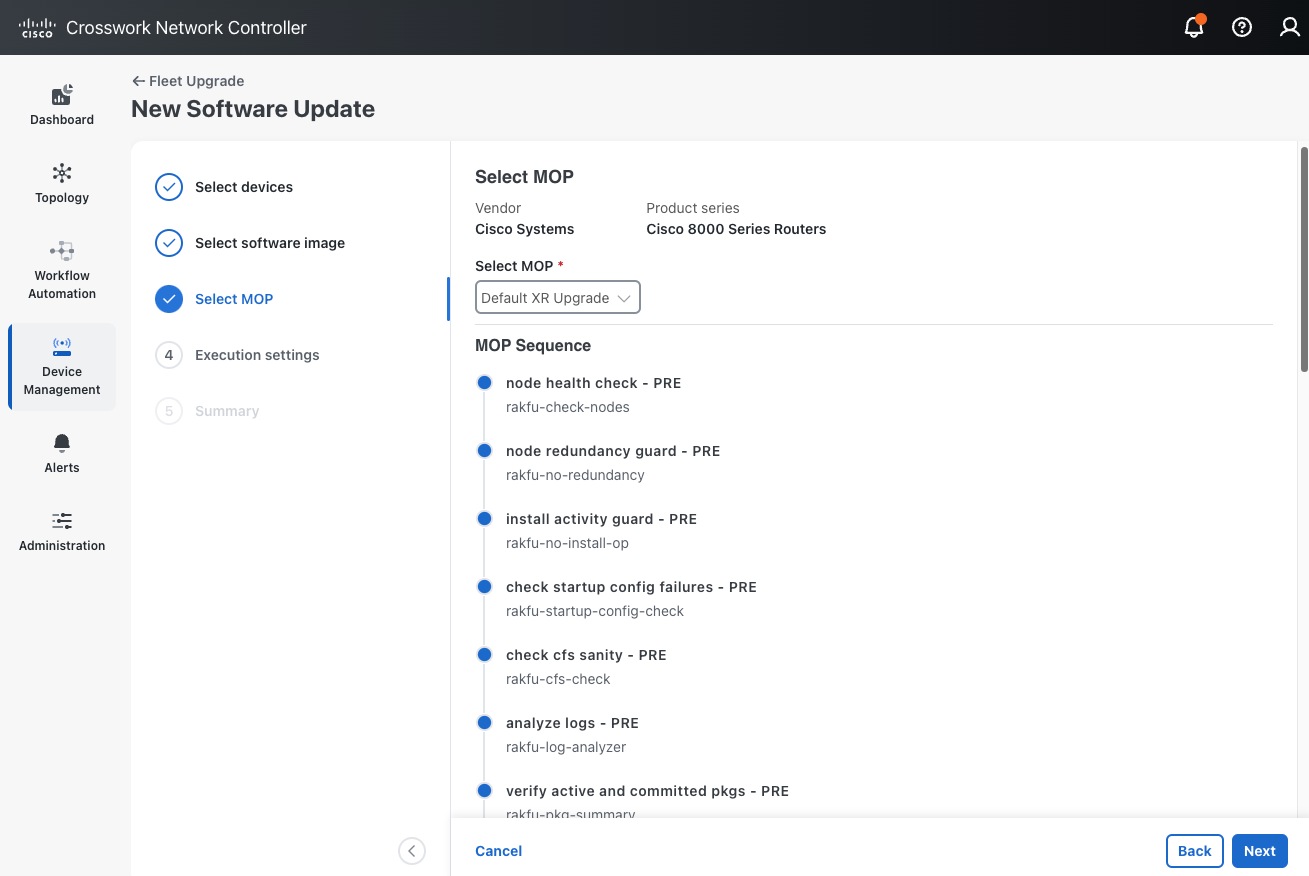
The drop down list will always display one or more MOPs pre-selected for the type of device series you are trying to upgrade. Unless you have a special purpose in mind, use the pre-defined MOPs supplied with Fleet Upgrade, such as the Default XR Upgrade MOP shown in the following figure.

Default XR Upgrade MOP

Step 8

Click Next to display the Execution settings window.

Step 9

Complete the fields in the Execution settings window as shown in the following table:

In this field...

Enter or select...

Job name

A unique name for the job, such as ASR1KStandard.

Job tags

An optional, comma-separated list of search tags to help you find the job in the job listing, ASR1000, ASRUpdates.

Parallel upgrades

Specify the number of device upgrades to be executed at the same time, in parallel. Defaults to 1. For help with setting this and the Acceptable failures value, see Use Parallel Upgrades with Acceptable Failures.

Acceptable failures

Specify the number of installation failures to be allowed before further upgrades are canceled. Defaults to 1.

Execution time

Specify one of the following:

  • Run now. CMW Solutions will begin executing the upgrade as soon as you click Submit.

  • Schedule for specific data and time. If you select this option, you must also specify a Time and Date.

Step 10

Click Next to display the Summary window.

Step 11

When you are finished, make sure the confirmation checkbox is selected. Then click Submit to save the new update job and either schedule or (if you selected Run now) run it.


What to do next

Follow the steps in Monitor Fleet Upgrade job results.

Monitor Fleet Upgrade job results

Use the Fleet Upgrade Jobs page to monitor the results of a Fleet Upgrade job run, including any failures that occur. The status details for failures will help you diagnose their cause.

Procedure


Step 1

Choose Device Management > Fleet Upgrade > Jobs to display the list of upgrade jobs and their status.

Step 2

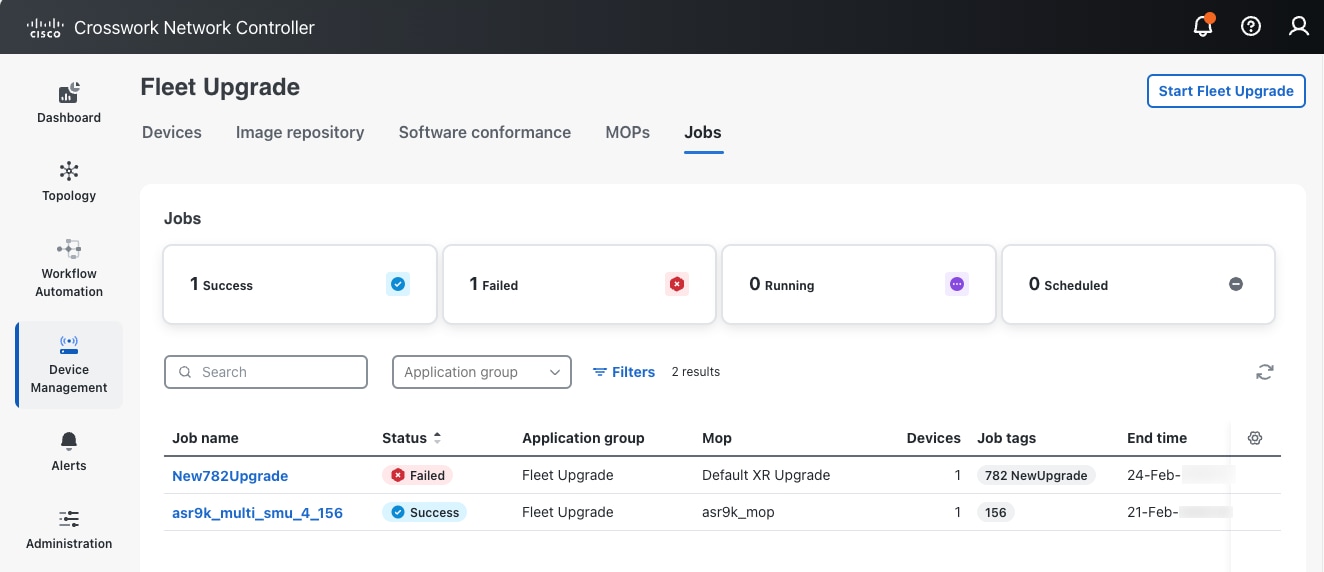
Click the Status column header to sort the column alphabetically. Upgrade jobs will be sorted like those shown in the following figure.

Job Status

Step 3

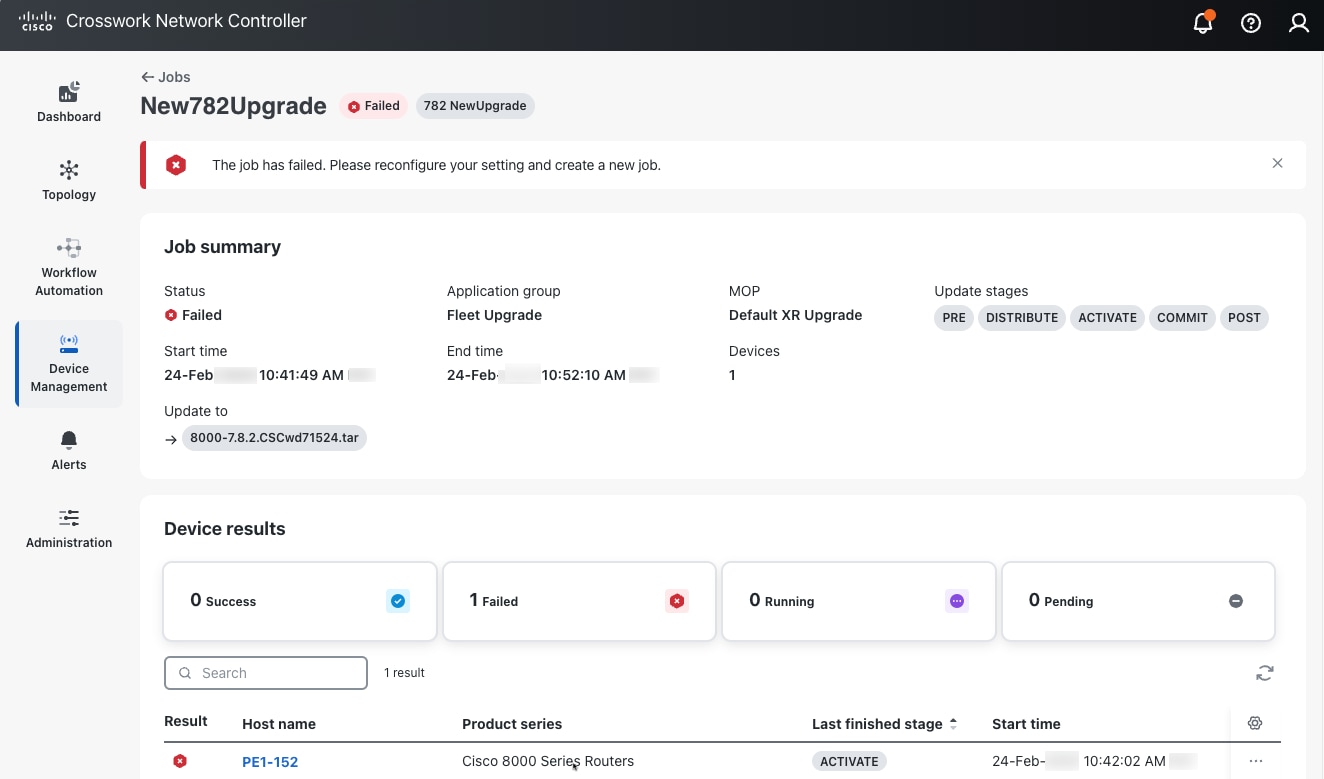
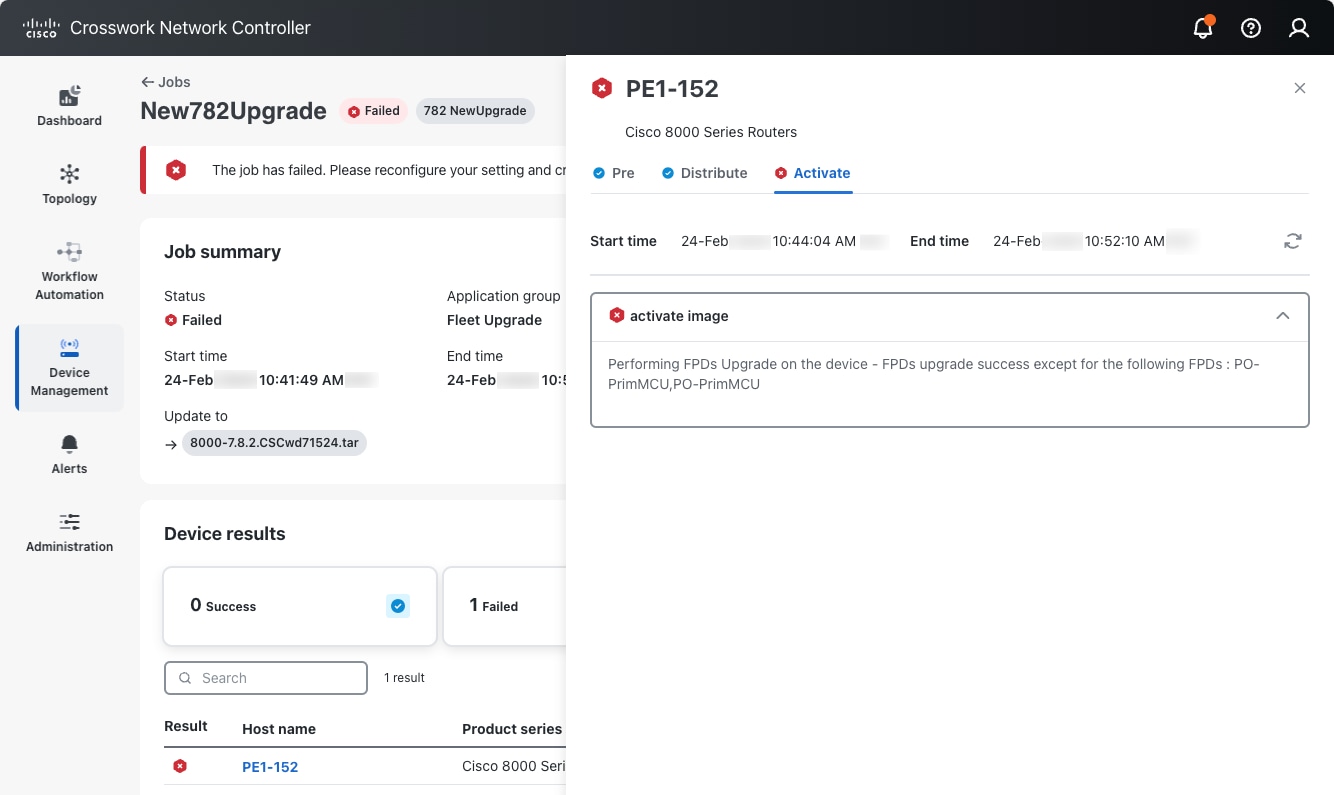
Click the Job name for a job that failed. CNC displays a Job Summary page like the one shown below. Under Device results, the page lists the Host name of the device where the update failed and the Last finished stage where the failure occurred.

Job Summary page

Step 4

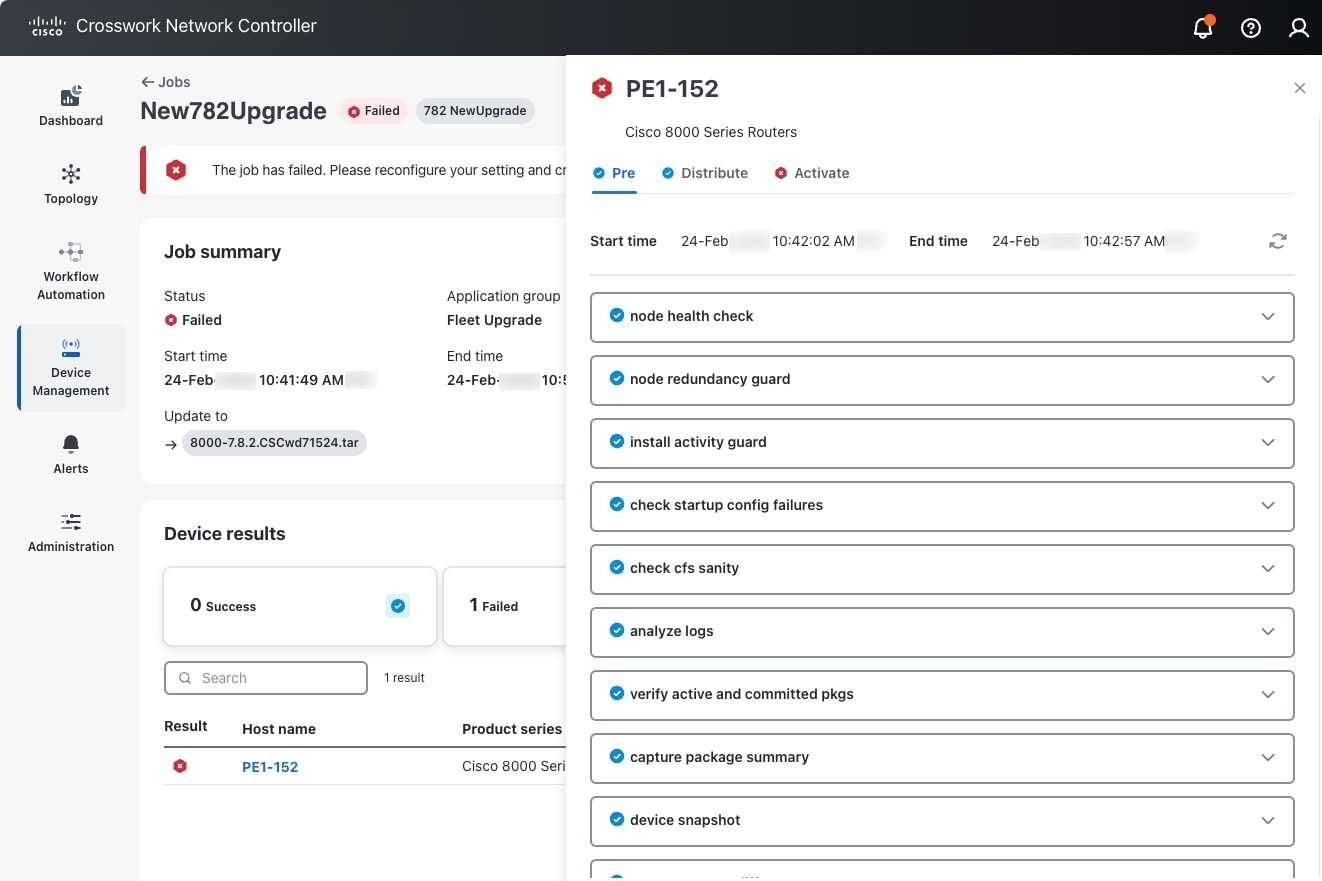
Click the Host name to display a pop up screen with tabs representing the stages of the upgrade, and for each stage, the actions performed during that stage. As we can see in the following example, all the actions performed during the Pre-check stage passed.

Pre check stage success

Step 5

Click the tab for the stage where the upgrade failed (in this example, the failure occurred during the Activate stage), and expand the action where the failure occurred. In this example, the image activation action succeeded for all but two of the Field Programmable Devices (FPDs) in this release.

Activate-stage failure