EIGRP protocol
EIGRP is a routing protocol that
-
uses the same distance vector algorithm and distance information as IGRP,
-
improves convergence properties and operating efficiency, and
-
provides increased network width compared to RIP and IGRP.
Convergence technology and network width
The convergence technology employs the Diffusing Update Algorithm (DUAL). DUAL guarantees loop-free operation at every instant during a route computation. It also allows devices involved in a topology change to synchronize simultaneously. Routers that are not affected by topology changes are not involved in recomputations.
IP EIGRP provides increased network width. With RIP, the largest possible width of your network is 15 hops. The EIGRP metric is large enough to support thousands of hops, so the transport-layer hop counter is the only barrier to expanding the network. EIGRP increments the transport control field only when an IP packet has traversed 15 routers and the next hop to the destination was learned through EIGRP. When a RIP route is used as the next hop to the destination, the transport control field is incremented as usual.
EIGRP IPv6
EIGRP IPv6 is a routing protocol, which
-
runs on interfaces without requiring a global IPv6 address,
-
is configured directly on the interfaces where it operates, and
-
supports stub routing on switches running Network Essentials.
Router ID requirements for EIGRP IPv6
EIGRP IPv6 instance requires an implicit or explicit router ID before it can run.
-
An implicit router ID is derived from a local IPv6 address, ensuring any IPv6 node always has an available router ID.
-
EIGRP IPv6 may operate in a network with only IPv6 nodes. In this scenario, a router ID might not be available.
For information on how to configure EIGRP for IPv6, see the Configuring EIGRP for IPv6 section.
For more information on EIGRP for IPv6, see the Cisco IOS IPv6 Configuration Library on Cisco.com.
EIGRP features
EIGRP provides these features:
-
Fast convergence.
-
Incremental updates when the state of a destination changes, instead of sending the entire contents of the routing table, minimizing the bandwidth required for EIGRP packets.
-
Less CPU usage because full update packets need not be processed each time that they are received.
-
Protocol-independent neighbor discovery mechanism to learn about neighboring routers.
-
Variable-length subnet masks (VLSMs).
-
Arbitrary route summarization.
-
EIGRP scales to large networks.
EIGRP components
EIGRP component details
EIGRP has these four basic components:
-
Neighbor discovery and recovery: Routers use this process to dynamically learn of other routers on their directly attached networks. Routers must also discover when their neighbors become unreachable or inoperative. Neighbor discovery and recovery is achieved with low overhead by periodically sending small hello packets. As long as hello packets are received, the Cisco IOS software can learn that a neighbor is alive and functioning. When this status is determined, the neighboring routers can exchange routing information.
-
Reliable transport protocol:Reliable transport protocol is responsible for guaranteed, ordered delivery of EIGRP packets to all neighbors. This protocol supports intermixed transmission of multicast and unicast packets. Some EIGRP packets must be sent reliably, and others do not. For efficiency, reliability is provided only when necessary. On a multiaccess network with multicast capabilities, such as Ethernet, it is unnecessary to send hello packets reliably to each neighbor individually. Instead, EIGRP sends a single multicast hello and indicates in the packet that acknowledgment is not needed. Other packet types, such as updates, require acknowledgment, which is shown in the packet. The reliable transport protocol can send multicast packets quickly when unacknowledged packets are pending. This approach helps ensure that convergence time remains low when link speeds vary.
-
DUAL finite state machine:The DUAL finite state machine embodies the decision process for all route computations. It tracks every route advertised by all neighbors. DUAL uses distance information, also called a metric, to select efficient, loop-free paths. It selects the routes to be placed into the routing table based on feasible successors. A successor is a neighboring router used for packet forwarding and has a least-cost path to a destination that cannot form a routing loop. When there are no feasible successors but neighbors do advertise the destination, DUAL must perform a recomputation. During this process, a new successor is determined. The time needed to recompute a route affects the convergence time. Recomputation is processor-intensive, so it is beneficial to avoid it unless necessary. When the topology changes, DUAL tests for feasible successors. If feasible successors exist, DUAL uses them to avoid unnecessary recomputation.
-
Protocol-dependent modules:Protocol-dependent modules are responsible for network layer protocol-specific tasks. For example, the IP EIGRP module sends and receives EIGRP packets encapsulated in IP. It also parses EIGRP packets and informs DUAL of new information received. EIGRP requests DUAL to make routing decisions, and the results are stored in the IP routing table. EIGRP is also responsible for redistributing routes learned from other IP routing protocols.
EIGRP stub routing
An EIGRP stub routing feature is a network routing mechanism that
-
improves network stability
-
reduces resource utilization, and
-
simplifies the stub device configuration.
Hub-and-spoke network topologies
Stub routing is commonly used in hub-and-spoke network topologies. In a hub-and-spoke network, one or more end (stub) networks are connected to a remote device (the spoke) that is connected to one or more distribution devices (the hub).
The remote device is adjacent to one or more distribution devices. The only route for IP traffic to reach the remote device is through a distribution device. This configuration is commonly used in WAN topologies, where the distribution device is directly connected to a WAN and can serve many remote devices.
In a hub-and-spoke topology, the remote device must forward all nonlocal traffic to a distribution device, so it becomes unnecessary for the remote device to have a complete routing table. Generally, the distribution device need not send anything more than a default route to the remote device.
When using the EIGRP stub routing feature, you need to configure the distribution and remote devices to use EIGRP and configure only the remote device as a stub. Only specified routes are propagated from the remote (stub) device. The stub device responds to all queries for summaries, connected routes, redistributed static routes, external routes, and internal routes with the message inaccessible. A device that is configured as a stub will send a special peer information packet to all neighboring devices to report its status as a stub device.
Any neighbor that receives a packet informing it of the stub status will not query the stub device for any routes, and a device that has a stub peer will not query that peer. The stub device will depend on the distribution device to send proper updates to all peers.
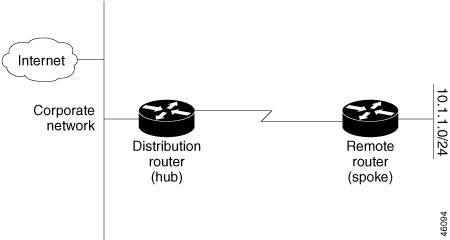
The stub routing feature by itself does not prevent routes from being advertised to the remote device. In this scenario, the remote device can access the corporate network and the Internet only through the distribution device. Having a complete route table on the remote device would serve no functional purpose because the path to the corporate network and the Internet would always be through the distribution device. The large route table would only reduce the amount of memory that is required by the remote device. Bandwidth and memory can be conserved by summarizing and filtering routes in the distribution device. The remote device need not receive routes that have been learned from other networks because the remote device must send all nonlocal traffic, regardless of the destination, to the distribution device. If a true stub network is desired, the distribution device should be configured to send only a default route to the remote device. The EIGRP stub routing feature does not automatically enable summarization on distribution devices. In most cases, the network administrator will need to configure summarization on distribution devices.
 Note |
When configuring the distribution device to send only a default route to the remote device, you must use the IPclassless command on the remote device. By default, the IPclassless command is enabled in all Cisco images that support the EIGRP stub routing feature. |
Without the EIGRP stub routing feature, even after routes that are sent from the distribution device to the remote device have been filtered or summarized, a problem might occur. If a route is lost somewhere in the corporate network, EIGRP could send a query to the distribution device, which in turn would send a query to the remote device, even if routes are being summarized. If a communication problem occurs over the WAN link between the distribution device and the remote device, the EIGRP stuck in active (SIA) condition might occur, leading to instability in the network. The EIGRP stub routing feature allows a network administrator to prevent queries from being sent to the remote device.
EIGRP stub routing
An EIGRP stub routing feature is a network routing mechanism that
-
improves network stability,
-
reduces resource utilization, and
-
simplifies the stub device configuration.
Stub routing is commonly used in hub-and-spoke network topologies. In a hub-and-spoke network, one or more end (stub) networks are connected to a remote device (the spoke) that is connected to one or more distribution devices (the hub).
The remote device is adjacent to one or more distribution devices. The only route for IP traffic to reach the remote device is through a distribution device. This type of configuration is commonly used in WAN topologies, where the distribution device is directly connected to a WAN. The distribution device can be connected to many remote devices, which is often the case.
In a hub-and-spoke topology, the remote device must forward all nonlocal traffic to a distribution device, so it becomes unnecessary for the remote device to have a complete routing table. Generally, the distribution device need not send anything more than a default route to the remote device.
When using the EIGRP stub routing feature, you need to configure the distribution and remote devices to use EIGRP and configure only the remote device as a stub. Only specified routes are propagated from the remote (stub) device. The stub device responds to all queries for summaries, connected routes, redistributed static routes, external routes, and internal routes with the message “inaccessible.” A device that is configured as a stub will send a special peer information packet to all neighboring devices to report its status as a stub device.
Any neighbor that receives a packet informing it of the stub status will not query the stub device for any routes, and a device that has a stub peer will not query that peer. The stub device will depend on the distribution device to send proper updates to all peers.
The stub routing feature by itself does not prevent routes from being advertised to the remote device. In this example, the remote device can access the corporate network and the Internet only through the distribution device. Having a complete route table on the remote device would serve no functional purpose because the path to the corporate network and the Internet would always be through the distribution device. The large route table would only reduce the amount of memory that is required by the remote device. Bandwidth and memory can be conserved by summarizing and filtering routes in the distribution device. The remote device need not receive routes that have been learned from other networks because the remote device must send all nonlocal traffic, regardless of the destination, to the distribution device. If a true stub network is desired, the distribution device should be configured to send only a default route to the remote device. The EIGRP stub routing feature does not automatically enable summarization on distribution devices. In most cases, the network administrator will need to configure summarization on distribution devices.
Note |
When configuring the distribution device to send only a default route to the remote device, you must use the IPclassless command on the remote device. By default, the IPclassless command is enabled in all Cisco images that support the EIGRP stub routing feature. |
Without the EIGRP stub routing feature, even after routes that are sent from the distribution device to the remote device have been filtered or summarized, a problem might occur. If a route is lost somewhere in the corporate network, EIGRP could send a query to the distribution device, which in turn would send a query to the remote device, even if routes are being summarized. If there is a communication problem (over the WAN link) between the distribution device and the remote device, an EIGRP stuck in active (SIA) condition could occur and cause instability elsewhere in the network. The EIGRP stub routing feature allows a network administrator to prevent queries from being sent to the remote device.
 Feedback