Network Address Translation
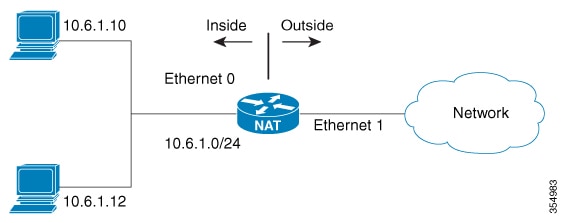
Network Address Translation (NAT) is designed for IP address conservation. It enables private IP networks that use unregistered IP addresses to connect to the Internet. NAT operates on a device, usually connecting two networks together, and translates the private (not globally unique) addresses in the internal network into global routable addresses. It does so before packets are forwarded onto another network.
NAT can be configured to advertise only one address for the entire network to the outside world. This ability provides more security by effectively hiding the entire internal network behind that one address. NAT offers the dual functions of security and address conservation and is typically implemented in remote-access environments.
NAT is also used at the enterprise edge to allow internal users access to the Internet and to allow Internet access to internal devices such as mail servers.
 Note |
Layer 3 Network Address Translation requires the Network Advantage license. For the latest license requirements, see the Cisco IE3500 Rugged Series Data Sheet. |
Finding Feature Information
Your software release may not support all the features described in this document. For the latest caveats and feature information, see Bug Search Tool and the release notes for your platform and software release. To find information about the features, and to see a list of the releases in which each feature is supported, see the feature information table at the end of this chapter.
Use the Cisco Feature Navigator to find information about platform support and Cisco software image support. To access the Cisco Feature Navigator, go to https://cfnng.cisco.com/. An account on Cisco.com is not required.
 Feedback