Navigating Neocloud Solution Brief
Available Languages
Bias-Free Language
The documentation set for this product strives to use bias-free language. For the purposes of this documentation set, bias-free is defined as language that does not imply discrimination based on age, disability, gender, racial identity, ethnic identity, sexual orientation, socioeconomic status, and intersectionality. Exceptions may be present in the documentation due to language that is hardcoded in the user interfaces of the product software, language used based on RFP documentation, or language that is used by a referenced third-party product. Learn more about how Cisco is using Inclusive Language.
Security Risks and Compliance in the AI Era
As artificial intelligence moves from experimental labs to the core of global enterprise strategy, the infrastructure supporting it must evolve. This solution brief, Navigating Neocloud, explores the emergence of specialized, AI-first cloud providers and the unique security landscape they create. We journey from the architectural differences between Neoclouds and Hyperscalers to the specific risks inherent in highspeed Graphic Processing Unit (GPU) fabrics.
By introducing the ClusterMAX™ benchmark and detailing how Cisco's integrated security portfolio aids in achieving compliance, we provide a roadmap for organizations to achieve performance without compromising on the security, intellectual property protection, or regulatory compliance required.
This brief explores the architectural shift toward specialized GPU providers, identifies the unique risks to AI intellectual property, and demonstrates how Cisco’s security portfolio enables high-performance compliance with ClusterMAX, SOC2, ISO 27001, and Cybersecurity Maturity Model Certification (CMMC)
Traditional cloud providers were built for the era of the website and the database. But the explosion of Generative AI has created a new, insatiable demand: massive, raw, parallel processing power. To meet this need, a new breed of service provider has emerged– the Neocloud.
Why Neoclouds are Emerging
The first Neoclouds didn’t start in traditional data centers. They often emerged from high-performance niches like 3D rendering farms or specialized cryptomining operations. As Large Language Models (LLMs) went mainstream, these providers pivoted their infrastructure to offer what Hyperscalers couldn’t: immediate, at-scale access to dense clusters of highthroughput networks optimized specifically for the “heavy lifting” of AI training and inference.
Why Now?
The shift to Neocloud is driven by three primary market forces:
● GPU Scarcity: While traditional cloud struggle with supply chain constraints, Neocloud specializes in securing and deploying the latest GPU hardware (like H100s and A100s) as their primary business.
● Architecture Bottlenecks: Standard virtualized cloud networks are designed for general traffic, creating “bottlenecks” that slow down the massive data transfers required between GPUs and AI training.
● The Cost of Scale: For organizations training frontier models, the overhead and egress fees of general-purpose clouds can become prohibitively expensive compared to the streamlined, performance-focused pricing of a Neocloud.
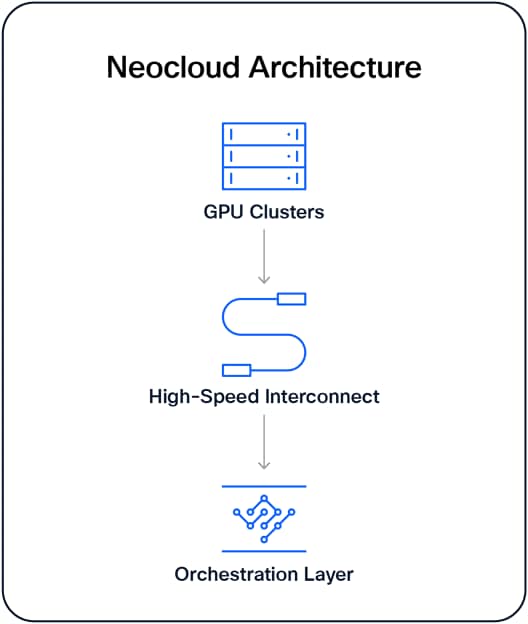
The Neocloud Advantage
Neoclouds offer a “supercomputer-as-a-service” experience that provides several distinct advantages:
● Bare-Metal Performance: By removing the “virtualization tax,” Neoclouds allow AI models to run directly on the hardware, maximizing every clock cycle of the GPU.
● Ultra-Low Latency Fabrics: Neoclouds utilize high-bandwidth, low-latency fabrics to ensure thousands of GPUs can communicate at the speeds required for intensive model training and inference.
● Dense Clustering: Unlike general clouds that spread resources across a data center, Neoclouds provide high-density clusters (like ClusterMAX) where GPUs are physically and logically optimized for massive parallel workloads.
Architecture Matters: Neoclouds vs. General-Purpose Clouds
Not all clouds are created equal. While Hyperscalers built the modern internet, the massive compute requirements of Generative AI have exposed limitations of general-purpose architecture. Choosing the right platform depends on whether you need a "swiss army knife" or a "precision instrument".
The Hyperscaler Gap
Hyperscalers (AWS, Azure, GCP) dominate general-purpose cloud services but prioritize breadth over AI optimization.
● Optimization: They support broad workloads; Neoclouds are purpose-built for AI.
● Provisioning: GPU access can take weeks at scale; Neoclouds offer near-instant availability.
● Networking: Hyperscalers often rely on standard Ethernet; Neoclouds deploy high-speed, high-throughput networks optimized for advanced GPU workloads.
The Traditional Cloud Limit
Standard cloud providers focus on virtualizing CPU and memory for web apps and storage.
● Performance: Traditional clouds rely on virtualization layers; Neoclouds deliver bare-metal GPU performance with specialized cooling and orchestration.
● Use Cases: Traditional clouds power SaaS and enterprise apps; Neoclouds enable massive-scale AI training, inference, and scientific computing.
Table 1. Neocloud vs. Hyperscaler vs. Regular Cloud Provider
| Feature/Aspect |
Neocloud |
Hyperscaler (AWS, Azure, GCP) |
Regular Cloud |
| Primary Focus |
AI / HPC Workloads |
General Purpose / SaaS |
Web Apps / Storage |
| Compute Type |
Bare-metal GPU |
Virtualized GPU / CPU |
Virtualized CPU |
| Networking |
High-speed, highthroughput network |
Standard Ethernet |
Standard Ethernet |
| Security |
Minimal Security
For advanced security,
contact Cisco to tailor a solution. |
Standard L3/L4 |
Standard L3/L4 |
| GPU Availability |
Instant / High Density |
Restricted / Shared |
Limited to None |
| Performance Tax |
Zero (Bare-Metal) |
High (Virtualization) |
High (Virtualization) |
The Shared Responsibility Model
In the Neocloud world, the “shared responsibility model” looks different than it does in traditional cloud environments. Because Neoclouds provide high-performance, bare-metal access to GPUs, the customer inherits a much larger security footprint.
Understanding this boundary is critical: The provider secures the infrastructure, but you must secure the innovation.
The Neocloud Boundary
● The Provider’s Responsibility: They are responsible for “security OF the cloud.” This includes physical data center security, power, cooling, and the health of the physical GPU hardware and the underlying network fabric.
● The Customer’s (Your) Responsibility: You are responsible for “security IN the cloud.” Because you have direct access to the hardware, you own the security of the operating system, the GPU drivers, the data, and—most importantly—the AI Model Weights and Intellectual Property.
How Cisco Fills the Gap
Cisco’s security portfolio is designed to help you manage your side of the shared responsibility model without sacrificing the performance you came to Neocloud for.
● You own the Workload: Cisco Secure Workload provides the visibility and microsegmentation the provider doesn’t.
● You own the Traffic: Cisco Hypershield and Secure Firewall protect the data flows that the provider simply carries.
● You own the Access: Cisco Duo and Identity Services Engine (ISE) ensure that only authorized researchers and admins can touch your expensive GPU clusters.
The New Frontier of Threat: Unique Risks in Neocloud
While Neoclouds offer unparalleled performance, their specialized architecture creates a different kind of attack surface. Traditional security tools often suffer from “blind spots” in these high-speed, bare-metal environments.
The Isolation Challenge: Lateral Movement
In dense GPU clusters, the high-speed backend fabric is designed for performance, not necessarily for security.
● Cross-Tenant Leakage: Without robust microsegmentation, there is a risk of traffic “leaking” between customers sharing the same physical cluster.
● Silent Lateral Movement: Attackers can move between GPU nodes across the high-speed fabric, often undetected by traditional OS-level monitoring.
Infrastructure Blind Spots: Fabric Persistence
Because Neoclouds provide “close to the metal” access, the underlying hardware components become primary targets.
● Vulnerable Nodes & Drivers: Unpatched GPU drivers or firmware can become persistent entry points for exploits that survive even if a container is deleted.
● Orchestration Vulnerabilities: Insecure Kubernetes configurations or unpatched images can lead to cluster-wide compromises, giving attackers access to the raw compute power.
Identity and API Vulnerability: The Management Plane
Neoclouds are heavily driven by APIs and management consoles to orchestrate massive AI jobs.
● Over-Privileged Access: API keys and service accounts often have excessive permissions, allowing a single compromised credential to take over an entire GPU fleet.
● Console Abuse: Unauthorized access to management planes can lead to “Job Abuse,” where attackers hijack your expensive compute for their own purposes (like crypto-mining or unauthorized model training).
The “Crown Jewel” Threat: Model & Data Integrity
In the AI era, your most valuable asset is your model. Neoclouds introduce specific risks to this Intellectual Property.
● Model Theft & Exfiltration: High-speed fabrics allow for the rapid, silent exfiltration of proprietary model weights and training data.
● Adversarial Manipulation: If the infrastructure is tampered with, training data can be “poisoned,” or model inference can be manipulated, leading to unreliable AI outputs.
The Compliance Hurdle
Many Neocloud environments lack the native logging and auditability required for regulated industries.
● Audit Gaps: Difficulty in hosting financial, healthcare, or public sector workloads due to a lack of controls aligned with SOC2, ISO 27001, or CMMC.
ClusterMAX: Benchmarking the AI Cloud
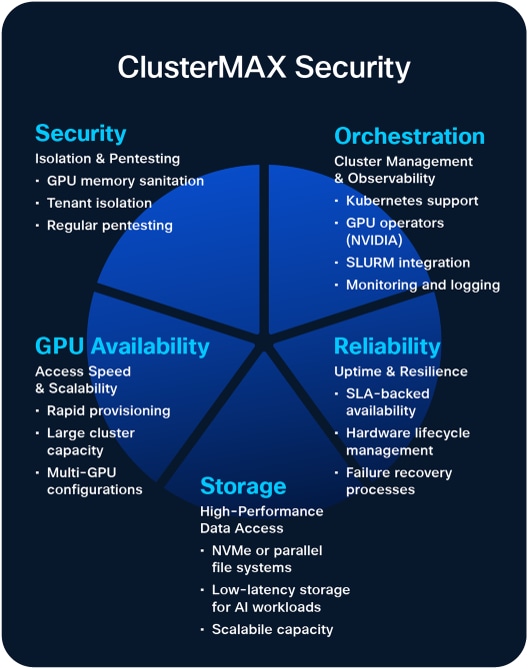
As Neocloud adoption accelerates, organizations need a standardized way to evaluate providers for security, reliability, and operational maturity. ClusterMAX, developed by SemiAnalysis, has emerged as the industry benchmark for GPU cloud environments, rating providers across five critical dimensions:
● Security – Isolation guarantees, GPU sanitization, pentesting rigor.
● Orchestration – Kubernetes support, GPU operators, SLURM, observability.
● Reliability – Uptime, failure resilience, hardware lifecycle management.
● Storage – High-performance storage integration for AI workloads.
● GPU Availability – Access speed and cluster scalability.
The 5 Pillars of ClusterMAX Security
To achieve a top-tier rating, a Neocloud provider must meet five rigorous security requirements that address the unique risks of AI infrastructure:
● Tenant Isolation: Secure segmentation and backend network separation.
● Node Hardening: Enforced patching for GPU nodes, drivers, and firmware.
● Identity Control: Per-tenant RBAC for management planes and GPUs.
● Deep Observability: Telemetry for East-West traffic and job behaviors.
● Auditability: Compliance-aligned logging (SOC2, ISO, CMMC)
Why Benchmarking Matters
ClusterMAX helps organizations move beyond “marketing promises” to objective validation:
● Objective Comparison: Compare providers using a standardized scoring system.
● Risk Reduction: Select providers with proven isolation and sanitization protocols.
● Compliance Readiness: Ensure the underlying infrastructure can support regulated AI customers (Financial, Healthcare, Public Sector).
The Cisco Unified Defense for Neocloud
As AI workloads redefine the boundaries of compute, traditional security models must evolve to protect the specialized, high-performance architecture of the Neocloud. Cisco’s unified defense for Neocloud provides a performance-first, integrated security framework designed specifically for GPU-accelerated environments. Rather than treating security as a bolt-on, this architecture embeds protection across four critical layers: the Management Plane, Perimeter Layer, Fabric Layer, and Workload Layer.
By unifying identity, infrastructure, and deep observability, Cisco ensures that security never becomes a bottleneck for AI innovation. Backed by the global intelligence of Cisco Talos, this layered approach mitigates unique risks such as cross-tenant lateral movement and model integrity attacks. Whether enforcing Zero Trust access for administrators or providing eBPF-powered isolation for massive GPU clusters, Cisco delivers the technical controls and auditable evidence required to pass stringent compliance benchmarks like ISO 27001, SOC 2, and CMMC—all without compromising the ultra-low latency that production-grade AI demands.
● Cisco Secure Firewall
Cisco Secure Firewall delivers high-performance macrosegmentation and advanced threat defense. It provides “virtual patching” for vulnerable systems and inspects encrypted traffic without introducing performance-killing latency, leveraging the Encrypted Visibility Engine (EVE) to detect threats in encrypted traffic without full decryption.
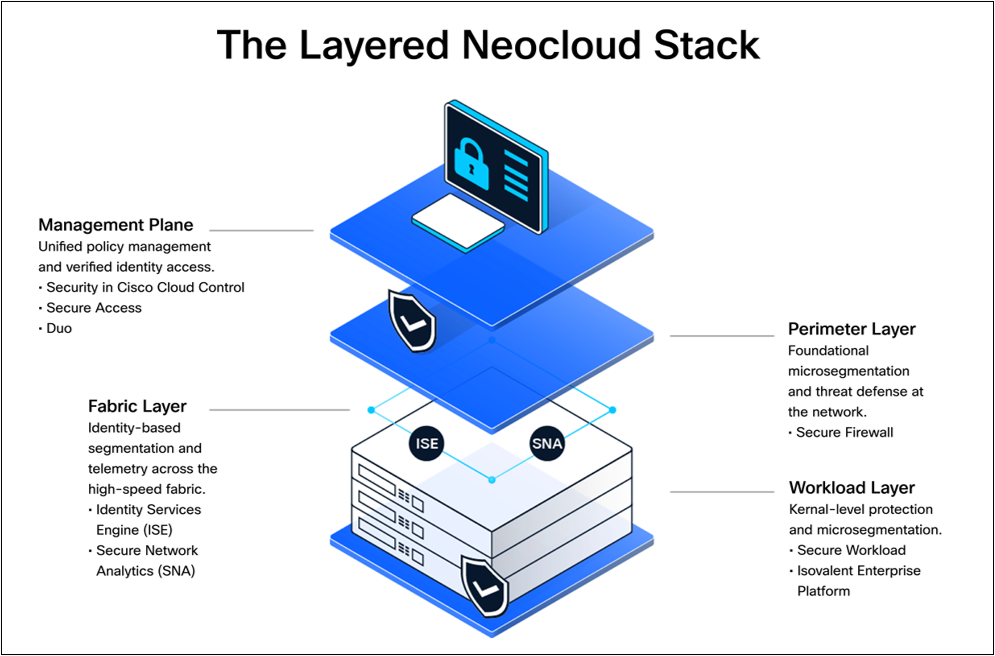
● Cisco Secure Workload
Cisco Secure Workload automates microsegmentation and least-privilege access across multicloud environments. It provides deep visibility into application behavior to secure EastWest traffic and prevent lateral movement within dense GPU clusters.
● Isovalent Enterprise Platform
Isovalent Enterprise Platform offers scalable, high-performance networking and security tailored for dynamic cloud-native infrastructure. It enhances visibility and threat defense across hybrid and multicloud deployments, providing identity-based security, zero-trust networking, and efficient observability for Kubernetes and cloud environments without compromising performance
● Security in Cisco Cloud Control
Security in Cisco Cloud Control is a unified management platform that centralizes visibility and policy enforcement. It unifies threat response and ensures a consistent security posture across all Neocloud infrastructure.
● Secure Access
Cisco Secure Access is a comprehensive Zero Trust Network Access (ZTNA) solution that secures access across applications and environments for any user, device, and location. It consolidates multiple security functions such as Zero Trust Network Access, Secure Web Gateway, Cloud Access Security Broker, cloud firewall, DNS-layer security, and more into a single cloud-managed service. This solution simplifies user experience, enhances security with granular access controls, and streamlines IT operations with a unified management console. It is designed to protect hybrid workforces and supports secure access to SaaS, private apps, and the internet regardless of user location or device.
● Cisco Secure DDoS Protection
Cisco Secure DDoS Protection provides automated, real-time mitigation of volumetric and application-layer attacks at the network edge. It ensures the continuous availability of GPU infrastructure and management APIs, preventing costly service disruptions during intensive AI training and inference cycles.
● Cisco Identity Services Engine (ISE)
Cisco ISE delivers centralized, identity-based access control and policy enforcement across the physical and virtual infrastructure. It ensures that only authorized administrators and compliant devices can access critical hardware, providing the foundational visibility and control needed to meet stringent enterprise security and audit requirements.
● Cisco Duo
Cisco Duo enforces strong identity verification and device health checks across all administrative and developer access points. It secures the Neocloud management plane against credential based attacks, ensuring that only trusted users and compliant devices can manage high-value GPU resources and AI APIs.
● Cisco Secure Network Analytics (SNA)
Cisco SNA uses machine learning and telemetry to detect “silent” threats like data exfiltration and lateral movement. It identifies hidden threats in encrypted traffic without requiring decryption, maintaining both security and privacy.
Cisco’s unified framework helps meet ClusterMAX standards by integrating protection across the network fabric, workloads, and management plane. These ten solutions provide a foundational, layered defense that secures AI infrastructure at scale, ensuring your Neocloud remains high-performing, secure, and compliant.
Mapping Security to Compliance
For organizations operating in regulated industries, performance is only half the equation; compliance is the other. As AI moves from the lab to production, Neocloud environments must prove they can protect sensitive data under the world’s most rigorous regulatory frameworks.
Cisco’s security architecture is designed not just to defend, but to provide the granular evidence and enforcement required to meet these global standards. The following sections map our seven core security solutions to the specific requirements of SOC 2, ISO 27001, and CMMC, providing a blueprint for building a compliant and trusted AI infrastructure.
SOC2: Establishing Trust in the AI Cloud
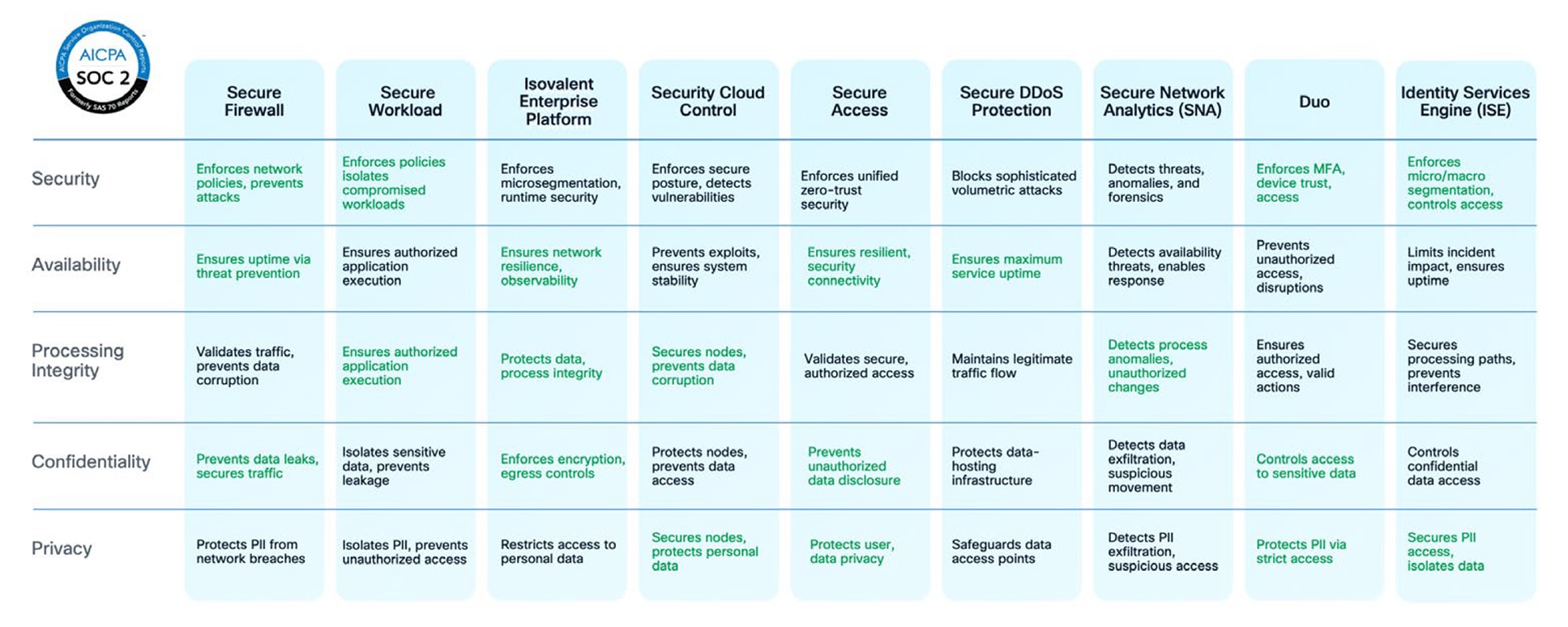
SOC2 is the industry benchmark for demonstrating that a service organization has the necessary controls to protect customer data. In a Neocloud environment, the ClusterMAX™ requirements for Multi-Tenant Isolation and Deep Observability are the technical bedrocks of the SOC 2 "Security" and "Confidentiality" criteria.
By implementing Cisco’s layered defense, organizations can prove to auditors that East-West traffic is strictly isolated and that every GPU job is monitored for abnormal behavior. This mapping illustrates how Cisco provides the granular auditability and protection required to host sensitive AI workloads while meeting all five Trust Services Criteria.
Table 2. SOC2 Compliance for Neocloud
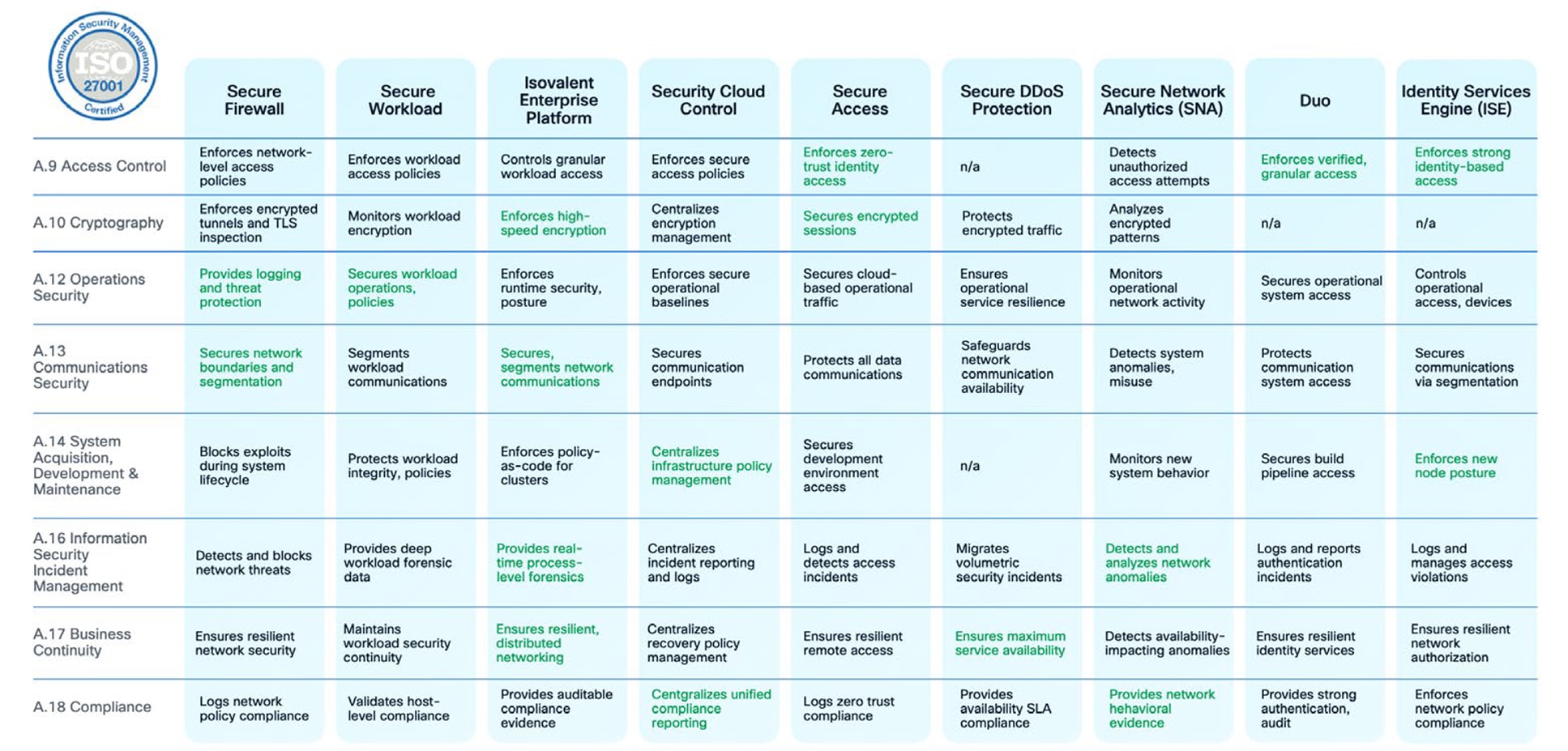
ISO 27001: Global Standards for Information Security
ISO 27001 provides a globally recognized, risk-based framework for managing information security. The ClusterMAX pillars of Infrastructure Hardening and Node Lifecycle Management align directly with ISO 27001’s focus on operational security and system integrity. Cisco solutions support these requirements by automating “virtual patching” and enforcing identity based access across the GPU fabric. This table demonstrates how Cisco’s architecture maps to key Annex A controls, ensuring that high-performance GPU clusters are operated within a mature, internationally standardized security management system that prioritizes both performance and risk mitigation.
Table 3. ISO 27001 Compliance for Neocloud
CMMC: Securing the Defense Industrial Base
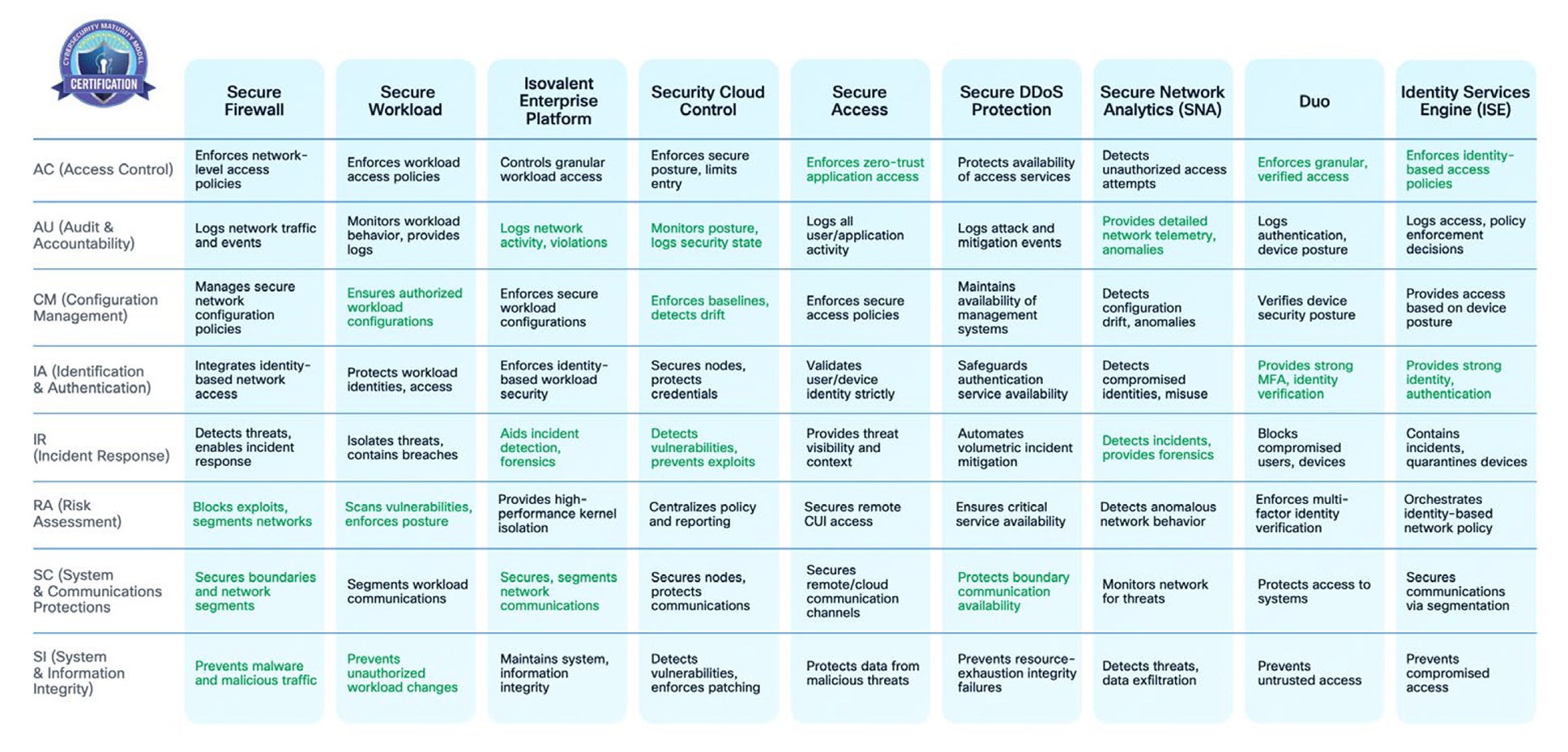
For organizations handling Controlled Unclassified Information (CUI) within the federal supply chain, CMMC compliance is a non-negotiable requirement. In a Neocloud, the GPU fabric itself must act as a hardened enclave. The ClusterMAX requirements for Secure Backend Networks and Per-Tenant RBAC are essential for meeting CMMC domains like Access Control and System & Communication Protection.
Cisco’s security portfolio ensures that federal AI initiatives are protected by the same level of rigor required for traditional defense systems. This table highlights how our solutions provide the continuous monitoring and incident response capabilities necessary to maintain CMMC eligibility and secure the nation’s most sensitive AI innovations.
Table 4. CMMC Compliance for Neocloud
Building a Trusted AI Infrastructure
The shift to Neocloud represents more than just a change in hardware; it is a fundamental shift in how we build and scale intelligence. As AI models become the most valuable intellectual property on earth, the infrastructure that hosts them must be as resilient as it is powerful.
By aligning with the ClusterMAX standard and leveraging Cisco’s security portfolio, organizations can move past the “security tax” and embrace a future where performance and protection are inextricably linked. Whether you are training frontier models or deploying real-time inference, the goal remains the same: to innovate with the confidence that your data, your models, and your reputation are secure.
Ready to Secure Your AI Future?
Navigating the complexities of Neocloud security and global compliance doesn’t have to be a solo journey. Cisco is ready to help you architect a secure, high-performance foundation for your AI initiatives.
Take the Next Step:
● Work with our experts to identify gaps in your current GPU cloud architecture.
● Get a deep dive into the configurations for the Cisco AI-security suite.
● Contact your Cisco Account Team to discuss how we can help you meet CyberMAX standards and achieve your compliance goals.
For more information, please refer to the following:
● Explore fundamentals of AI Security
● See why Cisco is the critical infrastructure for the AI era
● Secure your AI transformation and power your cyber defenses