Overview
This topic explains the ULB deployment architecture, including key components, workflows, requirements, and expected outcomes for technical implementation and operations.
The following diagram illustrates a typical deployment model of ULB.
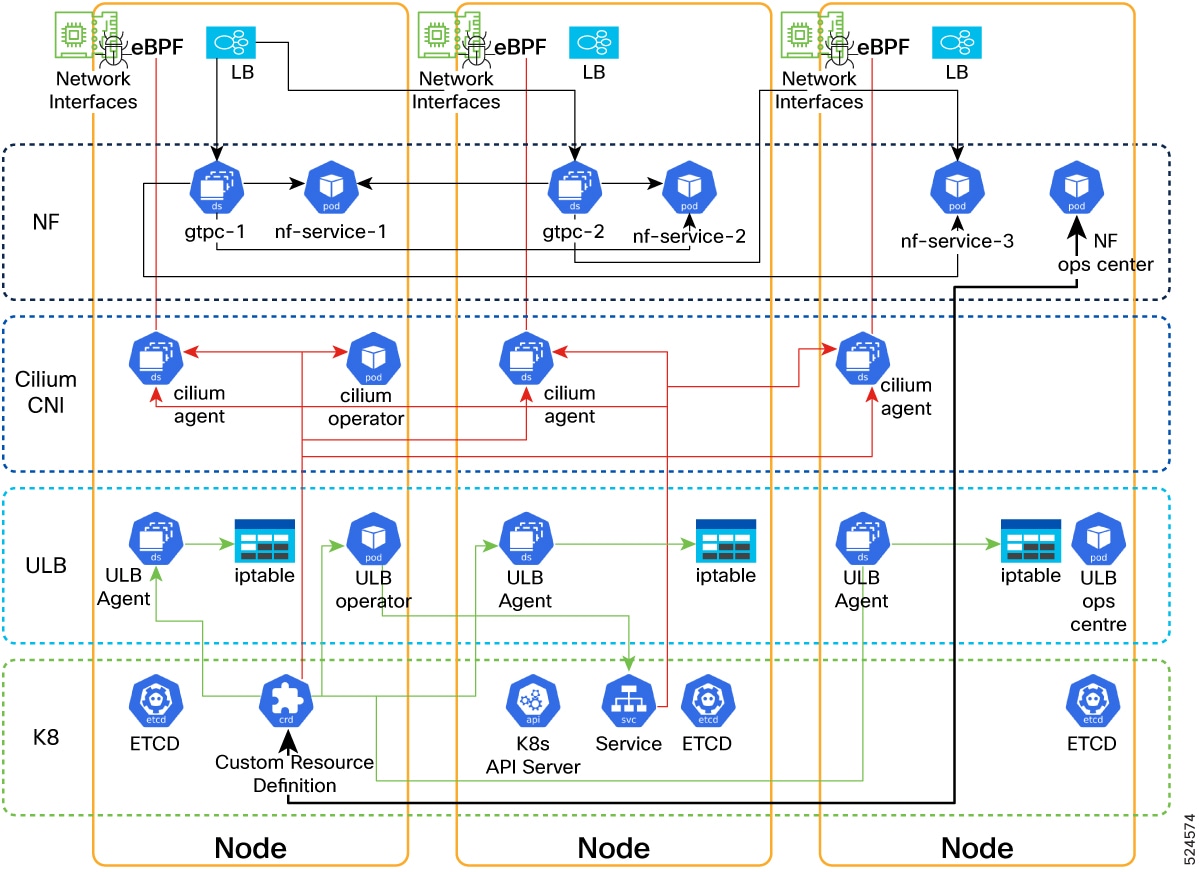
ULB can be deployed both on-premises and cloud platform, providing a unified load-balancing abstraction that simplifies application usage and integration.
-
On-Premise:
-
The service integrates with on-premise environments featuring leaf-spine network architecture, leveraging BGP and BFD protocols for robust route advertisement and rapid path failure detection.
-
-
Cloud:
-
For public cloud deployments, the service publishes routes with equal priority to facilitate faster convergence during failure events and maintains balanced traffic distribution across worker nodes.
-
Deployment of ULB on the cloud platform is not qualified in this release. Contact your Cisco account representative for more information.
Key components of ULB
Explains the key components of ULB, highlighting their roles, requirements, and operational considerations. It covers the main ULB components that run as pods in the Kubernetes cluster.