Licensing Requirements
See the Cisco NX-OS Licensing Guide and Cisco NX-OS Licensing Options Guide for Cisco NX-OS licensing recommendations and instructions to obtain and apply licenses.
The documentation set for this product strives to use bias-free language. For the purposes of this documentation set, bias-free is defined as language that does not imply discrimination based on age, disability, gender, racial identity, ethnic identity, sexual orientation, socioeconomic status, and intersectionality. Exceptions may be present in the documentation due to language that is hardcoded in the user interfaces of the product software, language used based on RFP documentation, or language that is used by a referenced third-party product. Learn more about how Cisco is using Inclusive Language.
This chapter contains information about Cisco's IP fabric for media solution.
See the Cisco NX-OS Licensing Guide and Cisco NX-OS Licensing Options Guide for Cisco NX-OS licensing recommendations and instructions to obtain and apply licenses.
Today, the broadcast industry uses a serial digital interface (SDI) router and SDI cables to transport video and audio traffic. The SDI cables can carry only a single unidirectional signal. As a result, many cables, frequently stretched over long distances, are required, making it difficult and time-consuming to expand or change an SDI-based infrastructure.
Cisco’s IP fabric for media solution helps transition from an SDI router to an IP-based infrastructure. In an IP-based infrastructure, a single cable can carry multiple bidirectional traffic flows and can support different flow sizes without requiring changes to the physical infrastructure.
The IP fabric for media solution consists of a flexible spine and leaf architecture or a single modular switch topology. The solution uses Cisco Nexus 9000 Series switches with the Cisco non-blocking multicast (NBM) algorithm (an intelligent traffic management algorithm) and with or without the Cisco Data Center Network Manager (DCNM) Media Controller. Using open APIs, the Cisco DCNM Media Controller can integrate with various broadcast controllers. The solution provides a highly reliable (zero drop multicast), highly visible, highly secure, and highly available network.
Cisco’s IP fabric for media solution supports the following types of deployments:
Spine-leaf topology—Flexible architecture for large-scale deployments that are typically seen in an IP studio.
Single modular switch—Architecture suitable for fixed deployments, with the controller providing features such as flow visibility, security, and monitoring.
Cisco's IP fabric for media solution supports a spine-leaf topology that consists of multiple spine and leaf switches. The topology supports any combination of leaf switches, including using just one type of leaf switch.
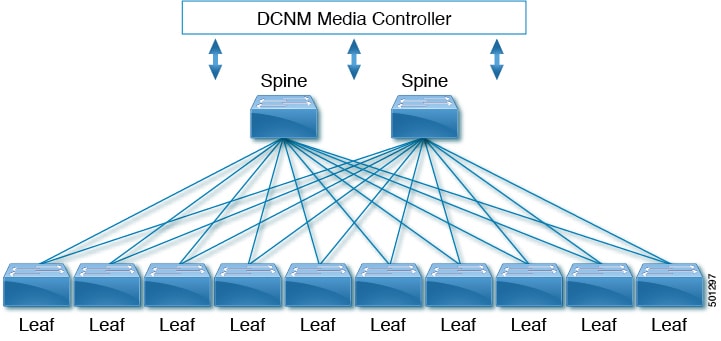
Media sources and receivers connect to the leaf switches, and receivers initiate IGMP join requests to the leaf switches in order to receive the media traffic.
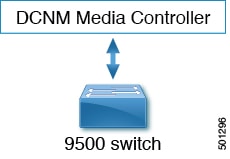
Cisco's IP fabric for media solution supports a single modular switch topology that consists of one Cisco Nexus 9500 Series switch.
The following Cisco Nexus 9000 Series switches are used to transport video and audio traffic through the IP fabric:
|
Cisco Nexus 9000 Series Switch |
Number and Size of Ports |
Role in Topology |
||
|---|---|---|---|---|
|
Cisco Nexus 9236C switch |
36 x 40/100-Gbps ports |
Spine or leaf in spine-leaf topology |
||
|
Cisco Nexus 9272Q switch |
72 x 40-Gbps ports |
Spine or leaf in spine-leaf topology |
||
|
Cisco Nexus 92160YC-X switch |
48 x 1/10/25-Gbps ports |
Leaf in spine-leaf topology |
||
|
Cisco Nexus 9336C-FX2 switch |
36 x 40/100-Gbps ports |
Spine or leaf in spine-leaf topology |
||
|
Cisco Nexus 9348GC-FXP switch |
48 x 100-Mbps/1-Gbps ports |
Leaf in spine-leaf topology |
||
|
Cisco Nexus 9364C switch |
64 x 40/100-Gbps ports |
Spine in spine-leaf topology |
||
|
Cisco Nexus 93108TC-EX switch |
48 x 1/10-Gbps ports |
Leaf in spine-leaf topology |
||
|
Cisco Nexus 93108TC-FX switch |
48 x 10-Gbps ports |
Leaf in spine-leaf topology |
||
|
Cisco Nexus 93180LC-EX switch |
32 x 40/100-Gbps ports |
Leaf in spine-leaf topology |
||
|
Cisco Nexus 93180YC-EX switch |
48 x 1/10/25-Gbps ports |
Leaf in spine-leaf topology |
||
|
Cisco Nexus 93180YC-FX switch |
48 x 10/25-Gbps ports |
Leaf in spine-leaf topology |
||
|
Cisco Nexus 93240YC-FX2 switch |
12 x 40/100-Gbps ports |
Spine or leaf in spine-leaf topology |
||
|
Cisco Nexus 9504 or 9508 switch with the following line cards:
|
36 x 40/100-Gbps ports (for N9K-X9636C-R line cards) 32 x 40/100-Gbps ports (for N9K-X9636C-RX line cards) 36 x 40-Gbps ports (for N9K-X9636Q-R line cards) |
Spine in spine-leaf topology or single modular switch |
*For the latest breakout and optics support, see https://www.cisco.com/c/en/us/support/interfaces-modules/transceiver-modules/products-device-support-tables-list.html.
Through open APIs, the Cisco DCNM Media Controller seamlessly integrates with the broadcast controller and provides a similar operator workflow with all the benefits of an IP-based infrastructure. The DCNM Media Controller features an intuitive GUI that enables you to configure your IP fabric using predefined templates that are designed for media networks.
The DCNM Media Controller enables you to do the following:
Configure secure generic or multicast-specific policies for individual hosts and allow or deny hosts based on their role.
Configure secure multicast-specific policies for multiple hosts and flows.
View the traffic flow and bandwidth utilization to identify problem areas (such as link failures or oversubscriptions) in your fabric.
Use flow analytics to measure and store bit rates and to display the details for individual traffic flows.
View an audit log of actions that are performed on the fabric.
Cisco's IP fabric for media solution supports deterministic failure handling.
During a link or switch failure, the affected flows are moved to alternate links, provided sufficient bandwidth is available. With SMPTE 2022-7, redundancy is built on the endpoints, which ensures that the link or switch failure does not affect production traffic.
Cisco's IP fabric for media solution provides the following benefits:
Replaces specialized hardware (SDI routers) with a general-purpose switching infrastructure.
Supports various types and sizes of broadcasting equipment endpoints with port speeds up to 100 Gbps.
Supports the latest video technologies, including 4K and 8K ultra HD.
Scales horizontally. When you need more capacity, you can add a leaf switch to support more endpoints.
Provides a deterministic network with zero packet loss, ultra low latency, and minimal jitter.
Capable of synchronizing all media sources and receivers.
Provides deterministic failure handling that sends traffic to the receiver when a link fails between a leaf and the spine.
Supports the coexistence of live and file-based traffic flows for postproduction work.
Offers increased network security.
Provides a non-blocking network design to prevent the oversubscription of links.
Requires no changes to the existing operator workflow.
|
Related Topic |
Document Title |
|---|---|
|
Cisco DCNM Media Controller |
Cisco DCNM Installation Guide for Media Controller Deployment, Release 11.0(1) |
|
Cisco NX-OS release information |
Cisco Nexus 9000 Series NX-OS IP Fabric for Media Release Notes |
|
Cisco NX-OS software upgrades |
Cisco Nexus 9000 Series NX-OS Software Upgrade and Downgrade Guide |
|
IGMP snooping and PIM |
Cisco Nexus 9000 Series NX-OS Multicast Routing Configuration Guide |
|
IP fabric for media scalability numbers |
|
|
NX-API REST |
Cisco Nexus 3000 and 9000 Series NX-API REST SDK User Guide and API Reference |
|
OSPF |
Cisco Nexus 9000 Series NX-OS Unicast Routing Configuration Guide |
|
PTP |
Cisco Nexus 9000 Series NX-OS System Management Configuration Guide |
|
QoS |
Cisco Nexus 9000 Series NX-OS Quality of Service Configuration Guide |
|
TCAM carving |
|
|
VLANs |
Cisco Nexus 9000 Series NX-OS Layer 2 Switching Configuration Guide |
 Feedback