Contents

Configuring Ethernet Interfaces

This section describes the configuration of the Ethernet interfaces on a Cisco Nexus 5000 Series switch. It contains the following sections:

Information About Ethernet Interfaces

The Ethernet ports can operate as standard Ethernet interfaces connected to servers or to a LAN.

The Ethernet interfaces also support Fibre Channel over Ethernet (FCoE). FCoE allows the physical Ethernet link to carry both Ethernet and Fibre Channel traffic.

On a Cisco Nexus 5000 Series switch, the Ethernet interfaces are enabled by default.

About the Interface Command

You can enable the various capabilities of the Ethernet interfaces on a per-interface basis using the interface command. When you enter the interface command, you specify the following information:

  • Interface type—All physical Ethernet interfaces use the ethernet keyword.

  • Slot number

    • Slot 1 includes all the fixed ports.

    • Slot 2 includes the ports on the upper expansion module (if populated).

    • Slot 3 includes the ports on the lower expansion module (if populated).

  • Port number

    • Port number within the group.

The interface numbering convention is extended to support use with a Cisco Nexus 2000 Series Fabric Extender as follows:

switch(config)# interface ethernet [chassis/]slot/port

  • Chassis ID is an optional entry to address the ports of a connected Fabric Extender. The chassis ID is configured on a physical Ethernet or EtherChannel interface on the switch to identify the Fabric Extender discovered via the interface. The chassis ID ranges from 100 to 199.

About the Unidirectional Link Detection Parameter

UDLD Overview

The Cisco-proprietary Unidirectional Link Detection (UDLD) protocol allows ports that are connected through fiber optics or copper (for example, Category 5 cabling) Ethernet cables to monitor the physical configuration of the cables and detect when a unidirectional link exists. When the switch detects a unidirectional link, UDLD shuts down the affected LAN port and alerts the user. Unidirectional links can cause a variety of problems, including spanning tree topology loops.

UDLD is a Layer 2 protocol that works with the Layer 1 protocols to determine the physical status of a link. At Layer 1, autonegotiation takes care of physical signaling and fault detection. UDLD performs tasks that autonegotiation cannot perform, such as detecting the identities of neighbors and shutting down misconnected LAN ports. When you enable both autonegotiation and UDLD, Layer 1 and Layer 2 detections work together to prevent physical and logical unidirectional connections and the malfunctioning of other protocols.

A unidirectional link occurs whenever traffic transmitted by the local device over a link is received by the neighbor but traffic transmitted from the neighbor is not received by the local device. If one of the fiber strands in a pair is disconnected, as long as autonegotiation is active, the link does not stay up. In this case, the logical link is undetermined, and UDLD does not take any action. If both fibers are working normally at Layer 1, then UDLD at Layer 2 determines whether those fibers are connected correctly and whether traffic is flowing bidirectionally between the correct neighbors. This check cannot be performed by autonegotiation, because autonegotiation operates at Layer 1.

A Cisco Nexus 5000 Series switch periodically transmits UDLD frames to neighbor devices on LAN ports with UDLD enabled. If the frames are echoed back within a specific time frame and they lack a specific acknowledgment (echo), the link is flagged as unidirectional and the LAN port is shut down. Devices on both ends of the link must support UDLD in order for the protocol to successfully identify and disable unidirectional links.


Note


By default, UDLD is locally disabled on copper LAN ports to avoid sending unnecessary control traffic on this type of media.


The following figure shows an example of a unidirectional link condition. Device B successfully receives traffic from Device A on the port. However, Device A does not receive traffic from Device B on the same port. UDLD detects the problem and disables the port.
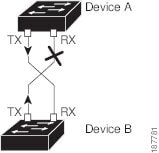
Figure 1. Unidirectional Link

Default UDLD Configuration

The following table shows the default UDLD configuration.

Table 1  UDLD Default Configuration

Feature

Default Value

UDLD global enable state

Globally disabled

UDLD aggressive mode

Disabled

UDLD per-port enable state for fiber-optic media

Enabled on all Ethernet fiber-optic LAN ports

UDLD per-port enable state for twisted-pair (copper) media

Disabled on all Ethernet 10/100 and 1000BASE-TX LAN ports

Related Information
Configuring the UDLD Mode

UDLD Aggressive and Nonaggressive Modes

UDLD aggressive mode is disabled by default. You can configure UDLD aggressive mode only on point-to-point links between network devices that support UDLD aggressive mode. If UDLD aggressive mode is enabled, when a port on a bidirectional link that has a UDLD neighbor relationship established stops receiving UDLD frames, UDLD tries to reestablish the connection with the neighbor. After eight failed retries, the port is disabled.

To prevent spanning tree loops, nonaggressive UDLD with the default interval of 15 seconds is fast enough to shut down a unidirectional link before a blocking port transitions to the forwarding state (with default spanning tree parameters).

When you enable the UDLD aggressive mode, the following occurs:

  • One side of a link has a port stuck (both transmission and receive)

  • One side of a link remains up while the other side of the link is down

In these cases, the UDLD aggressive mode disables one of the ports on the link, which prevents traffic from being discarded.

About Interface Speed

A Cisco Nexus 5000 Series switch has a number of fixed 10-Gigabit ports, each equipped with SFP+ interface adapters. The Cisco Nexus 5010 switch has 20 fixed ports, the first 8 of which are switchable 1-Gigabit and 10-Gigabit ports. The Cisco Nexus 5020 switch has 40 fixed ports, the first 16 of which are switchable 1-Gigabit and 10-Gigabit ports.

About the Cisco Discovery Protocol

The Cisco Discovery Protocol (CDP) is a device discovery protocol that runs over Layer 2 (the data link layer) on all Cisco-manufactured devices (routers, bridges, access servers, and switches) and allows network management applications to discover Cisco devices that are neighbors of already known devices. With CDP, network management applications can learn the device type and the Simple Network Management Protocol (SNMP) agent address of neighboring devices running lower-layer, transparent protocols. This feature enables applications to send SNMP queries to neighboring devices.

CDP runs on all media that support Subnetwork Access Protocol (SNAP). Because CDP runs over the data-link layer only, two systems that support different network-layer protocols can learn about each other.

Each CDP-configured device sends periodic messages to a multicast address, advertising at least one address at which it can receive SNMP messages. The advertisements also contain time-to-live, or holdtime information, which is the length of time a receiving device holds CDP information before discarding it. Each device also listens to the messages sent by other devices to learn about neighboring devices.

The switch supports both CDP Version 1 and Version 2.

Default CDP Configuration

The following table shows the default CDP configuration.

Table 2  Default CDP Configuration

Feature

Default Setting

CDP interface state

Enabled

CDP timer (packet update frequency)

60 seconds

CDP holdtime (before discarding)

180 seconds

CDP Version-2 advertisements

Enabled

About the Debounce Timer Parameters

The port debounce time is the amount of time that an interface waits to notify the supervisor of a link going down. During this time, the interface waits to see if the link comes back up. The wait period is a time when traffic is stopped.

You can enable the debounce timer for each interface and specify the delay time in milliseconds.


Caution


When you enable the port debounce timer the link up and link down detections are delayed, resulting in a loss of traffic during the debounce period. This situation might affect the convergence and reconvergence of some protocols.


About MTU Configuration

The Cisco Nexus 5000 Series switch is a Layer 2 device. This means it does not fragment frames. As a result, the switch cannot have two ports in the same Layer 2 domain with different maximum transmission units (MTUs). A per-physical Ethernet interface MTU is not supported. Instead, the MTU is set according to the QoS classes. You modify the MTU by setting Class and Policy maps.


Note


When you show the interface settings, a default MTU of 1500 is displayed for physical Ethernet interfaces and a receive data field size of 2112 is displayed for Fibre Channel interfaces.


Configuring Ethernet Interfaces

Configuring the UDLD Mode

You can configure normal or aggressive unidirectional link detection (UDLD) modes for Ethernet interfaces on devices configured to run UDLD. Before you can enable a UDLD mode for an interface, you must make sure that UDLD is already enabled on the device that includes the interface. UDLD must also be enabled on the other linked interface and its device.

To use the normal UDLD mode, you must configure one of the ports for normal mode and configure the other port for the normal or aggressive mode. To use the aggressive UDLD mode, you must configure both ports for the aggressive mode.


Note


Before you begin, UDLD must be enabled for the other linked port and its device.


To configure the UDLD mode, perform this task:

SUMMARY STEPS

    1.    switch# configure terminal

    2.    switch(config)# feature udld

    3.    switch(config)# no feature udld

    4.    switch(config)# show udld global

    5.    switch(config)# interface type slot/port

    6.    switch(config-if)# udld {enable | disable | aggressive}

    7.    switch(config-if)# show udld interface


DETAILED STEPS
     Command or ActionPurpose
    Step 1 switch# configure terminal
     

    Enters configuration mode.

     
    Step 2 switch(config)# feature udld
     

    Enables UDLD for the device.

     
    Step 3 switch(config)# no feature udld
     

    Disables UDLD for the device.

     
    Step 4 switch(config)# show udld global
     

    Displays the UDLD status for the device.

     
    Step 5 switch(config)# interface type slot/port
     

    Specifies an interface to configure, and enters interface configuration mode.

     
    Step 6 switch(config-if)# udld {enable | disable | aggressive}
     

    Enables the normal UDLD mode, disables UDLD, or enables the aggressive UDLD mode.

     
    Step 7 switch(config-if)# show udld interface
     

    Displays the UDLD status for the interface.


    This example shows how to enable the UDLD for the switch:

     switch# configure terminal
    
     switch(config)# feature udld


    This example shows how to enable the normal UDLD mode for an Ethernet port:

     switch# configure terminal
    
     switch(config)# interface ethernet 1/4
    
     switch(config-if)# udld enable


    This example shows how to enable the aggressive UDLD mode for an Ethernet port:

     switch# configure terminal
    
     switch(config)# interface ethernet 1/4
    
     switch(config-if)# udld aggressive


    This example shows how to disable UDLD for an Ethernet port:

     switch# configure terminal
    
     switch(config)# interface ethernet 1/4
    
     switch(config-if)# udld disable


    This example shows how to disable UDLD for the switch:

     switch# configure terminal
    
     switch(config)# no feature udld


    Configuring Interface Speed

    The first 8 ports of a Cisco Nexus 5010 switch and the first 16 ports of a Cisco Nexus 5020 switch are switchable 1-Gigabit and 10-Gigabit ports. The default interface speed is 10-Gigabit. To configure these ports for 1-Gigabit Ethernet, insert a 1-Gigabit Ethernet SFP transceiver into the applicable port and then set its speed with the speed command.

    To configure a 1-Gigabit Ethernet port, perform this task:

    SUMMARY STEPS

      1.    switch# configure terminal

      2.    switch(config)# interface type slot/port

      3.    switch(config-if)# speed speed


    DETAILED STEPS
       Command or ActionPurpose
      Step 1 switch# configure terminal
       

      Enters configuration mode.

       
      Step 2 switch(config)# interface type slot/port
       

      Enters interface configuration mode for the specified interface. This interface must have a 1-Gigabit Ethernet SFP transceiver inserted into it.

       
      Step 3 switch(config-if)# speed speed
       

      Sets the speed on the interface.


      The following example shows how to set the speed for a 1-Gigabit Ethernet port:

      switch# configure terminal
      
      switch(config)# interface ethernet 1/4
      
      switch(config-if)# speed 1000


      This command can only be applied to a physical Ethernet interface.


      Note


      If the interface and transceiver speed is mismatched, the SFP validation failed message is displayed when you enter the show interface ethernet slot/port command. For example, if you insert a 1-Gigabit SFP transceiver into a port without configuring the speed 1000 command, you will get this error. By default, all ports are 10 Gigabits.


      Configuring the Cisco Discovery Protocol

      Configuring the CDP Characteristics

      You can configure the frequency of Cisco Discovery Protocol (CDP) updates, the amount of time to hold the information before discarding it, and whether or not to send Version-2 advertisements.

      To configure CDP characteristics for an interface, perform this task:

      SUMMARY STEPS

        1.    switch# configure terminal

        2.    (Optional) switch(config)# [no] cdp advertise {v1 | v2 }

        3.    (Optional) switch(config)# [no] cdp format device-id {mac-address | serial-number | system-name}

        4.    (Optional) switch(config)# [no] cdp holdtime seconds

        5.    (Optional) switch(config)# [no] cdp timer seconds


      DETAILED STEPS
         Command or ActionPurpose
        Step 1 switch# configure terminal
         

        Enters configuration mode.

         
        Step 2 switch(config)# [no] cdp advertise {v1 | v2 }
         
        (Optional)

        Configures the version to use to send CDP advertisements. Version-2 is the default state.

        Use the no form of the command to return to its default setting.

         
        Step 3 switch(config)# [no] cdp format device-id {mac-address | serial-number | system-name}
         
        (Optional)

        Configures the format of the CDP device ID. The default is the system name, which can be expressed as a fully qualified domain name.

        Use the no form of the command to return to its default setting.

         
        Step 4 switch(config)# [no] cdp holdtime seconds
         
        (Optional)

        Specifies the amount of time a receiving device should hold the information sent by your device before discarding it. The range is 10 to 255 seconds; the default is 180 seconds.

        Use the no form of the command to return to its default setting.

         
        Step 5 switch(config)# [no] cdp timer seconds
         
        (Optional)

        Sets the transmission frequency of CDP updates in seconds. The range is 5 to 254; the default is 60 seconds.

        Use the no form of the command to return to its default setting.


        This example shows how to configure CDP characteristics:

        switch# configure terminal
        
        switch(config)# cdp timer 50
        
        switch(config)# cdp holdtime 120
        
        switch(config)# cdp advertise v2


        Enabling or Disabling CDP

        You can enable or disable CDP for Ethernet interfaces. This protocol works only when you have it enabled on both interfaces on the same link.

        To enable or disable CDP for an interface, perform this task:

        SUMMARY STEPS

          1.    switch# configure terminal

          2.    switch(config)# interface type slot/port

          3.    switch(config-if)# cdp enable

          4.    switch(config-if)# no cdp enable


        DETAILED STEPS
           Command or ActionPurpose
          Step 1 switch# configure terminal
           

          Enters configuration mode.

           
          Step 2 switch(config)# interface type slot/port
           

          Enters interface configuration mode for the specified interface.

           
          Step 3 switch(config-if)# cdp enable
           

          Enables CDP for the interface.

          To work correctly, this parameter must be enabled for both interfaces on the same link.

           
          Step 4 switch(config-if)# no cdp enable
           

          Disables CDP for the interface.


          The following example shows how to enable CDP for an Ethernet port:

          switch# configure terminal
          
          switch(config)# interface ethernet 1/4
          
          switch(config-if)# cdp enable


          This command can only be applied to a physical Ethernet interface.

          Configuring the Debounce Timer

          You can enable the debounce timer for Ethernet ports by specifying a debounce time (in milliseconds) or disable the timer by specifying a debounce time of 0.

          You can show the debounce times for all of the Ethernet ports by using the show interface debounce command.

          To enable or disable the debounce timer, perform this task:

          SUMMARY STEPS

            1.    switch# configure terminal

            2.    switch(config)# interface type slot/port

            3.    switch(config-if)# link debounce time milliseconds


          DETAILED STEPS
             Command or ActionPurpose
            Step 1 switch# configure terminal
             

            Enters configuration mode.

             
            Step 2 switch(config)# interface type slot/port
             

            Enters interface configuration mode for the specified interface.

             
            Step 3 switch(config-if)# link debounce time milliseconds
             

            Enables the debounce timer for the amount of time (1 to 5000 milliseconds) specified.

            Disables the debounce timer if you specify 0 milliseconds.


            This example shows how to enable the debounce timer and set the debounce time to 1000 milliseconds for an Ethernet interface:

            switch# configure terminal
            
            switch(config)# interface ethernet 1/4
            
            switch(config-if)# link debounce time 1000


            This example shows how to disable the debounce timer for an Ethernet interface:

            switch# configure terminal
            
            switch(config)# interface ethernet 1/4
            
            switch(config-if)# link debounce time 0


            This command can only be applied to a physical Ethernet interface.

            Configuring the Description Parameter

            To provide textual interface descriptions for the Ethernet ports, perform this task:

            SUMMARY STEPS

              1.    switch# configure terminal

              2.    switch(config)# interface type slot/port

              3.    switch(config-if)# description test


            DETAILED STEPS
               Command or ActionPurpose
              Step 1 switch# configure terminal
               

              Enters configuration mode.

               
              Step 2 switch(config)# interface type slot/port
               

              Enters interface configuration mode for the specified interface.

               
              Step 3 switch(config-if)# description test
               

              Specifies the description for the interface.


              This example shows how to set the interface description to "Server 3 Interface."

              switch# configure terminal
              
              switch(config)# interface ethernet 1/3
              
              switch(config-if)# description Server 3 Interface


              Disabling and Restarting Ethernet Interfaces

              You can shut down and restart an Ethernet interface. This action disables all of the interface functions and marks the interface as being down on all monitoring displays. This information is communicated to other network servers through all dynamic routing protocols. When shut down, the interface is not included in any routing updates.

              To disable an interface, perform this task:

              SUMMARY STEPS

                1.    switch# configure terminal

                2.    switch(config)# interface type slot/port

                3.    switch(config-if)# shutdown

                4.    switch(config-if)# no shutdown


              DETAILED STEPS
                 Command or ActionPurpose
                Step 1 switch# configure terminal
                 

                Enters configuration mode.

                 
                Step 2 switch(config)# interface type slot/port
                 

                Enters interface configuration mode for the specified interface.

                 
                Step 3 switch(config-if)# shutdown
                 

                Disables the interface.

                 
                Step 4 switch(config-if)# no shutdown
                 

                Restarts the interface.


                The following example shows how to disable an Ethernet port:

                switch# configure terminal
                
                switch(config)# interface ethernet 1/4
                
                switch(config-if)# shutdown


                The following example shows how to restart an Ethernet interface:

                switch# configure terminal
                
                switch(config)# interface ethernet 1/4
                
                switch(config-if)# no shutdown


                Displaying Interface Information

                To view configuration information about the defined interfaces, perform one of these tasks:

                Command

                Purpose

                switch# show interface type slot/port

                Displays the detailed configuration of the specified interface.

                switch# show interface type slot/port capabilities

                Displays detailed information about the capabilities of the specified interface. This option is only available for physical interfaces

                switch# show interface type slot/port transceiver

                Displays detailed information about the transceiver connected to the specified interface. This option is only available for physical interfaces.

                switch# show interface brief

                Displays the status of all interfaces.

                switch# show interface debounce

                Displays the debounce status of all interfaces.

                switch# show interface flowcontrol

                Displays the detailed listing of the flow control settings on all interfaces.

                The show interface command is invoked from EXEC mode and displays the interface configurations. Without any arguments, this command displays the information for all the configured interfaces in the switch.

                The following example shows how to display the physical Ethernet interface:

                switch# show interface ethernet 1/1
                Ethernet1/1 is up
                  Hardware is 1000/10000 Ethernet, address is 000d.eca3.5f08 (bia 000d.eca3.5f08)
                  MTU 1500 bytes, BW 10000000 Kbit, DLY 10 usec,
                     reliability 255/255, txload 190/255, rxload 192/255
                  Encapsulation ARPA
                  Port mode is trunk
                  full-duplex, 10 Gb/s, media type is 1/10g
                  Input flow-control is off, output flow-control is off
                  Auto-mdix is turned on
                  Rate mode is dedicated
                  Switchport monitor is off
                  Last clearing of "show interface" counters never
                  5 minute input rate 942201806 bytes/sec, 14721892 packets/sec
                  5 minute output rate 935840313 bytes/sec, 14622492 packets/sec
                  Rx
                    129141483840 input packets 0 unicast packets 129141483847 multicast packets
                    0 broadcast packets 0 jumbo packets 0 storm suppression packets
                    8265054965824 bytes
                    0 No buffer 0 runt 0 Overrun
                    0 crc 0 Ignored 0 Bad etype drop
                    0 Bad proto drop
                  Tx
                    119038487241 output packets 119038487245 multicast packets
                    0 broadcast packets 0 jumbo packets
                    7618463256471 bytes
                    0 output CRC 0 ecc
                    0 underrun 0 if down drop     0 output error 0 collision 0 deferred
                    0 late collision 0 lost carrier 0 no carrier
                    0 babble
                    0 Rx pause 8031547972 Tx pause 0 reset
                 

                The following example shows how to display the physical Ethernet capabilities:

                switch# show interface ethernet 1/1 capabilities
                Ethernet1/1
                  Model:                 734510033
                  Type:                  10Gbase-(unknown)
                  Speed:                 1000,10000
                  Duplex:                full
                  Trunk encap. type:     802.1Q
                  Channel:               yes
                  Broadcast suppression: percentage(0-100)
                  Flowcontrol:           rx-(off/on),tx-(off/on)
                  Rate mode:             none
                  QOS scheduling:        rx-(6q1t),tx-(1p6q0t)
                  CoS rewrite:           no
                  ToS rewrite:           no
                  SPAN:                  yes
                  UDLD:                  yes
                  Link Debounce:         yes
                  Link Debounce Time:    yes
                  MDIX:                  no
                  FEX Fabric:            yes
                 

                The following example shows how to display the physical Ethernet transceiver:

                switch# show interface ethernet 1/1 transceiver
                Ethernet1/1
                    sfp is present
                    name is CISCO-EXCELIGHT
                    part number is SPP5101SR-C1
                    revision is A
                    serial number is ECL120901AV
                    nominal bitrate is 10300 MBits/sec
                    Link length supported for 50/125mm fiber is 82 m(s)
                    Link length supported for 62.5/125mm fiber is 26 m(s)
                    cisco id is --
                    cisco extended id number is 4
                 

                The following example shows how to display a brief interface status (some of the output has been removed for brevity):

                switch# show interface brief
                 
                --------------------------------------------------------------------------------
                Ethernet      VLAN   Type Mode   Status  Reason                   Speed     Port
                Interface                                                                   Ch #
                --------------------------------------------------------------------------------
                Eth1/1        200    eth  trunk  up      none                        10G(D) --
                Eth1/2        1      eth  trunk  up      none                        10G(D) --
                Eth1/3        300    eth  access down    SFP not inserted            10G(D) --
                Eth1/4        300    eth  access down    SFP not inserted            10G(D) --
                Eth1/5        300    eth  access down    Link not connected         1000(D) --
                Eth1/6        20     eth  access down    Link not connected          10G(D) --
                Eth1/7        300    eth  access down    SFP not inserted            10G(D) --
                ...
                 

                The following example shows how to display the link debounce status (some of the output has been removed for brevity):

                switch# show interface debounce
                 
                --------------------------------------------------------------------------------
                Port          Debounce time   Value(ms)
                --------------------------------------------------------------------------------
                ...
                Eth1/1        enable               100
                Eth1/2        enable               100
                Eth1/3        enable               100
                ...
                 

                The following example shows how to display the CDP neighbors:

                switch# show cdp neighbors
                Capability Codes: R - Router, T - Trans-Bridge, B - Source-Route-Bridge
                                  S - Switch, H - Host, I - IGMP, r - Repeater,
                                  V - VoIP-Phone, D - Remotely-Managed-Device,
                                  s - Supports-STP-Dispute
                 
                 
                Device ID              Local Intrfce   Hldtme  Capability  Platform      Port ID
                 
                d13-dist-1               mgmt0           148     S I      WS-C2960-24TC  Fas0/9
                n5k(FLC12080012)         Eth1/5          8       S I s    N5K-C5020P-BA  Eth1/5
                 

                Note


                From Cisco NX-OS Release 4.0(1a)N1(1), the default value of the device ID field for CDP advertisement has been changed from the chassis serial number to the hostname and serial number, as in the example above.


                Default Physical Ethernet Settings

                The following table lists the default settings for all physical Ethernet interfaces:

                Parameter

                Default Setting

                Debounce

                Enable, 100 milliseconds

                Duplex

                Auto (full-duplex)

                Encapsulation

                ARPA

                MTU1

                1500 bytes

                Port Mode

                Access

                Speed

                Auto (10000)

                1 MTU cannot be changed per-physical Ethernet interface. You modify MTU by selecting maps of QoS classes.

                Configuring Ethernet Interfaces

                Configuring Ethernet Interfaces

                This section describes the configuration of the Ethernet interfaces on a Cisco Nexus 5000 Series switch. It contains the following sections:

                Information About Ethernet Interfaces

                The Ethernet ports can operate as standard Ethernet interfaces connected to servers or to a LAN.

                The Ethernet interfaces also support Fibre Channel over Ethernet (FCoE). FCoE allows the physical Ethernet link to carry both Ethernet and Fibre Channel traffic.

                On a Cisco Nexus 5000 Series switch, the Ethernet interfaces are enabled by default.

                About the Interface Command

                You can enable the various capabilities of the Ethernet interfaces on a per-interface basis using the interface command. When you enter the interface command, you specify the following information:

                • Interface type—All physical Ethernet interfaces use the ethernet keyword.

                • Slot number

                  • Slot 1 includes all the fixed ports.

                  • Slot 2 includes the ports on the upper expansion module (if populated).

                  • Slot 3 includes the ports on the lower expansion module (if populated).

                • Port number

                  • Port number within the group.

                The interface numbering convention is extended to support use with a Cisco Nexus 2000 Series Fabric Extender as follows:

                switch(config)# interface ethernet [chassis/]slot/port

                • Chassis ID is an optional entry to address the ports of a connected Fabric Extender. The chassis ID is configured on a physical Ethernet or EtherChannel interface on the switch to identify the Fabric Extender discovered via the interface. The chassis ID ranges from 100 to 199.

                About the Unidirectional Link Detection Parameter

                UDLD Overview

                The Cisco-proprietary Unidirectional Link Detection (UDLD) protocol allows ports that are connected through fiber optics or copper (for example, Category 5 cabling) Ethernet cables to monitor the physical configuration of the cables and detect when a unidirectional link exists. When the switch detects a unidirectional link, UDLD shuts down the affected LAN port and alerts the user. Unidirectional links can cause a variety of problems, including spanning tree topology loops.

                UDLD is a Layer 2 protocol that works with the Layer 1 protocols to determine the physical status of a link. At Layer 1, autonegotiation takes care of physical signaling and fault detection. UDLD performs tasks that autonegotiation cannot perform, such as detecting the identities of neighbors and shutting down misconnected LAN ports. When you enable both autonegotiation and UDLD, Layer 1 and Layer 2 detections work together to prevent physical and logical unidirectional connections and the malfunctioning of other protocols.

                A unidirectional link occurs whenever traffic transmitted by the local device over a link is received by the neighbor but traffic transmitted from the neighbor is not received by the local device. If one of the fiber strands in a pair is disconnected, as long as autonegotiation is active, the link does not stay up. In this case, the logical link is undetermined, and UDLD does not take any action. If both fibers are working normally at Layer 1, then UDLD at Layer 2 determines whether those fibers are connected correctly and whether traffic is flowing bidirectionally between the correct neighbors. This check cannot be performed by autonegotiation, because autonegotiation operates at Layer 1.

                A Cisco Nexus 5000 Series switch periodically transmits UDLD frames to neighbor devices on LAN ports with UDLD enabled. If the frames are echoed back within a specific time frame and they lack a specific acknowledgment (echo), the link is flagged as unidirectional and the LAN port is shut down. Devices on both ends of the link must support UDLD in order for the protocol to successfully identify and disable unidirectional links.


                Note


                By default, UDLD is locally disabled on copper LAN ports to avoid sending unnecessary control traffic on this type of media.


                The following figure shows an example of a unidirectional link condition. Device B successfully receives traffic from Device A on the port. However, Device A does not receive traffic from Device B on the same port. UDLD detects the problem and disables the port.

                Figure 1. Unidirectional Link

                Default UDLD Configuration

                The following table shows the default UDLD configuration.

                Table 1  UDLD Default Configuration

                Feature

                Default Value

                UDLD global enable state

                Globally disabled

                UDLD aggressive mode

                Disabled

                UDLD per-port enable state for fiber-optic media

                Enabled on all Ethernet fiber-optic LAN ports

                UDLD per-port enable state for twisted-pair (copper) media

                Disabled on all Ethernet 10/100 and 1000BASE-TX LAN ports

                Related Information

                UDLD Aggressive and Nonaggressive Modes

                UDLD aggressive mode is disabled by default. You can configure UDLD aggressive mode only on point-to-point links between network devices that support UDLD aggressive mode. If UDLD aggressive mode is enabled, when a port on a bidirectional link that has a UDLD neighbor relationship established stops receiving UDLD frames, UDLD tries to reestablish the connection with the neighbor. After eight failed retries, the port is disabled.

                To prevent spanning tree loops, nonaggressive UDLD with the default interval of 15 seconds is fast enough to shut down a unidirectional link before a blocking port transitions to the forwarding state (with default spanning tree parameters).

                When you enable the UDLD aggressive mode, the following occurs:

                • One side of a link has a port stuck (both transmission and receive)

                • One side of a link remains up while the other side of the link is down

                In these cases, the UDLD aggressive mode disables one of the ports on the link, which prevents traffic from being discarded.

                About Interface Speed

                A Cisco Nexus 5000 Series switch has a number of fixed 10-Gigabit ports, each equipped with SFP+ interface adapters. The Cisco Nexus 5010 switch has 20 fixed ports, the first 8 of which are switchable 1-Gigabit and 10-Gigabit ports. The Cisco Nexus 5020 switch has 40 fixed ports, the first 16 of which are switchable 1-Gigabit and 10-Gigabit ports.

                About the Cisco Discovery Protocol

                The Cisco Discovery Protocol (CDP) is a device discovery protocol that runs over Layer 2 (the data link layer) on all Cisco-manufactured devices (routers, bridges, access servers, and switches) and allows network management applications to discover Cisco devices that are neighbors of already known devices. With CDP, network management applications can learn the device type and the Simple Network Management Protocol (SNMP) agent address of neighboring devices running lower-layer, transparent protocols. This feature enables applications to send SNMP queries to neighboring devices.

                CDP runs on all media that support Subnetwork Access Protocol (SNAP). Because CDP runs over the data-link layer only, two systems that support different network-layer protocols can learn about each other.

                Each CDP-configured device sends periodic messages to a multicast address, advertising at least one address at which it can receive SNMP messages. The advertisements also contain time-to-live, or holdtime information, which is the length of time a receiving device holds CDP information before discarding it. Each device also listens to the messages sent by other devices to learn about neighboring devices.

                The switch supports both CDP Version 1 and Version 2.

                Default CDP Configuration

                The following table shows the default CDP configuration.

                Table 2  Default CDP Configuration

                Feature

                Default Setting

                CDP interface state

                Enabled

                CDP timer (packet update frequency)

                60 seconds

                CDP holdtime (before discarding)

                180 seconds

                CDP Version-2 advertisements

                Enabled

                About the Debounce Timer Parameters

                The port debounce time is the amount of time that an interface waits to notify the supervisor of a link going down. During this time, the interface waits to see if the link comes back up. The wait period is a time when traffic is stopped.

                You can enable the debounce timer for each interface and specify the delay time in milliseconds.


                Caution


                When you enable the port debounce timer the link up and link down detections are delayed, resulting in a loss of traffic during the debounce period. This situation might affect the convergence and reconvergence of some protocols.


                About MTU Configuration

                The Cisco Nexus 5000 Series switch is a Layer 2 device. This means it does not fragment frames. As a result, the switch cannot have two ports in the same Layer 2 domain with different maximum transmission units (MTUs). A per-physical Ethernet interface MTU is not supported. Instead, the MTU is set according to the QoS classes. You modify the MTU by setting Class and Policy maps.


                Note


                When you show the interface settings, a default MTU of 1500 is displayed for physical Ethernet interfaces and a receive data field size of 2112 is displayed for Fibre Channel interfaces.


                Configuring Ethernet Interfaces

                Configuring the UDLD Mode

                You can configure normal or aggressive unidirectional link detection (UDLD) modes for Ethernet interfaces on devices configured to run UDLD. Before you can enable a UDLD mode for an interface, you must make sure that UDLD is already enabled on the device that includes the interface. UDLD must also be enabled on the other linked interface and its device.

                To use the normal UDLD mode, you must configure one of the ports for normal mode and configure the other port for the normal or aggressive mode. To use the aggressive UDLD mode, you must configure both ports for the aggressive mode.


                Note


                Before you begin, UDLD must be enabled for the other linked port and its device.


                To configure the UDLD mode, perform this task:

                SUMMARY STEPS

                  1.    switch# configure terminal

                  2.    switch(config)# feature udld

                  3.    switch(config)# no feature udld

                  4.    switch(config)# show udld global

                  5.    switch(config)# interface type slot/port

                  6.    switch(config-if)# udld {enable | disable | aggressive}

                  7.    switch(config-if)# show udld interface


                DETAILED STEPS
                   Command or ActionPurpose
                  Step 1 switch# configure terminal
                   

                  Enters configuration mode.

                   
                  Step 2 switch(config)# feature udld
                   

                  Enables UDLD for the device.

                   
                  Step 3 switch(config)# no feature udld
                   

                  Disables UDLD for the device.

                   
                  Step 4 switch(config)# show udld global
                   

                  Displays the UDLD status for the device.

                   
                  Step 5 switch(config)# interface type slot/port
                   

                  Specifies an interface to configure, and enters interface configuration mode.

                   
                  Step 6 switch(config-if)# udld {enable | disable | aggressive}
                   

                  Enables the normal UDLD mode, disables UDLD, or enables the aggressive UDLD mode.

                   
                  Step 7 switch(config-if)# show udld interface
                   

                  Displays the UDLD status for the interface.


                  This example shows how to enable the UDLD for the switch:

                   switch# configure terminal
                  
                   switch(config)# feature udld


                  This example shows how to enable the normal UDLD mode for an Ethernet port:

                   switch# configure terminal
                  
                   switch(config)# interface ethernet 1/4
                  
                   switch(config-if)# udld enable


                  This example shows how to enable the aggressive UDLD mode for an Ethernet port:

                   switch# configure terminal
                  
                   switch(config)# interface ethernet 1/4
                  
                   switch(config-if)# udld aggressive


                  This example shows how to disable UDLD for an Ethernet port:

                   switch# configure terminal
                  
                   switch(config)# interface ethernet 1/4
                  
                   switch(config-if)# udld disable


                  This example shows how to disable UDLD for the switch:

                   switch# configure terminal
                  
                   switch(config)# no feature udld


                  Configuring Interface Speed

                  The first 8 ports of a Cisco Nexus 5010 switch and the first 16 ports of a Cisco Nexus 5020 switch are switchable 1-Gigabit and 10-Gigabit ports. The default interface speed is 10-Gigabit. To configure these ports for 1-Gigabit Ethernet, insert a 1-Gigabit Ethernet SFP transceiver into the applicable port and then set its speed with the speed command.

                  To configure a 1-Gigabit Ethernet port, perform this task:

                  SUMMARY STEPS

                    1.    switch# configure terminal

                    2.    switch(config)# interface type slot/port

                    3.    switch(config-if)# speed speed


                  DETAILED STEPS
                     Command or ActionPurpose
                    Step 1 switch# configure terminal
                     

                    Enters configuration mode.

                     
                    Step 2 switch(config)# interface type slot/port
                     

                    Enters interface configuration mode for the specified interface. This interface must have a 1-Gigabit Ethernet SFP transceiver inserted into it.

                     
                    Step 3 switch(config-if)# speed speed
                     

                    Sets the speed on the interface.


                    The following example shows how to set the speed for a 1-Gigabit Ethernet port:

                    switch# configure terminal
                    
                    switch(config)# interface ethernet 1/4
                    
                    switch(config-if)# speed 1000


                    This command can only be applied to a physical Ethernet interface.


                    Note


                    If the interface and transceiver speed is mismatched, the SFP validation failed message is displayed when you enter the show interface ethernet slot/port command. For example, if you insert a 1-Gigabit SFP transceiver into a port without configuring the speed 1000 command, you will get this error. By default, all ports are 10 Gigabits.


                    Configuring the Cisco Discovery Protocol

                    Configuring the CDP Characteristics

                    You can configure the frequency of Cisco Discovery Protocol (CDP) updates, the amount of time to hold the information before discarding it, and whether or not to send Version-2 advertisements.

                    To configure CDP characteristics for an interface, perform this task:

                    SUMMARY STEPS

                      1.    switch# configure terminal

                      2.    (Optional) switch(config)# [no] cdp advertise {v1 | v2 }

                      3.    (Optional) switch(config)# [no] cdp format device-id {mac-address | serial-number | system-name}

                      4.    (Optional) switch(config)# [no] cdp holdtime seconds

                      5.    (Optional) switch(config)# [no] cdp timer seconds


                    DETAILED STEPS
                       Command or ActionPurpose
                      Step 1 switch# configure terminal
                       

                      Enters configuration mode.

                       
                      Step 2 switch(config)# [no] cdp advertise {v1 | v2 }
                       
                      (Optional)

                      Configures the version to use to send CDP advertisements. Version-2 is the default state.

                      Use the no form of the command to return to its default setting.

                       
                      Step 3 switch(config)# [no] cdp format device-id {mac-address | serial-number | system-name}
                       
                      (Optional)

                      Configures the format of the CDP device ID. The default is the system name, which can be expressed as a fully qualified domain name.

                      Use the no form of the command to return to its default setting.

                       
                      Step 4 switch(config)# [no] cdp holdtime seconds
                       
                      (Optional)

                      Specifies the amount of time a receiving device should hold the information sent by your device before discarding it. The range is 10 to 255 seconds; the default is 180 seconds.

                      Use the no form of the command to return to its default setting.

                       
                      Step 5 switch(config)# [no] cdp timer seconds
                       
                      (Optional)

                      Sets the transmission frequency of CDP updates in seconds. The range is 5 to 254; the default is 60 seconds.

                      Use the no form of the command to return to its default setting.


                      This example shows how to configure CDP characteristics:

                      switch# configure terminal
                      
                      switch(config)# cdp timer 50
                      
                      switch(config)# cdp holdtime 120
                      
                      switch(config)# cdp advertise v2


                      Enabling or Disabling CDP

                      You can enable or disable CDP for Ethernet interfaces. This protocol works only when you have it enabled on both interfaces on the same link.

                      To enable or disable CDP for an interface, perform this task:

                      SUMMARY STEPS

                        1.    switch# configure terminal

                        2.    switch(config)# interface type slot/port

                        3.    switch(config-if)# cdp enable

                        4.    switch(config-if)# no cdp enable


                      DETAILED STEPS
                         Command or ActionPurpose
                        Step 1 switch# configure terminal
                         

                        Enters configuration mode.

                         
                        Step 2 switch(config)# interface type slot/port
                         

                        Enters interface configuration mode for the specified interface.

                         
                        Step 3 switch(config-if)# cdp enable
                         

                        Enables CDP for the interface.

                        To work correctly, this parameter must be enabled for both interfaces on the same link.

                         
                        Step 4 switch(config-if)# no cdp enable
                         

                        Disables CDP for the interface.


                        The following example shows how to enable CDP for an Ethernet port:

                        switch# configure terminal
                        
                        switch(config)# interface ethernet 1/4
                        
                        switch(config-if)# cdp enable


                        This command can only be applied to a physical Ethernet interface.

                        Configuring the Debounce Timer

                        You can enable the debounce timer for Ethernet ports by specifying a debounce time (in milliseconds) or disable the timer by specifying a debounce time of 0.

                        You can show the debounce times for all of the Ethernet ports by using the show interface debounce command.

                        To enable or disable the debounce timer, perform this task:

                        SUMMARY STEPS

                          1.    switch# configure terminal

                          2.    switch(config)# interface type slot/port

                          3.    switch(config-if)# link debounce time milliseconds


                        DETAILED STEPS
                           Command or ActionPurpose
                          Step 1 switch# configure terminal
                           

                          Enters configuration mode.

                           
                          Step 2 switch(config)# interface type slot/port
                           

                          Enters interface configuration mode for the specified interface.

                           
                          Step 3 switch(config-if)# link debounce time milliseconds
                           

                          Enables the debounce timer for the amount of time (1 to 5000 milliseconds) specified.

                          Disables the debounce timer if you specify 0 milliseconds.


                          This example shows how to enable the debounce timer and set the debounce time to 1000 milliseconds for an Ethernet interface:

                          switch# configure terminal
                          
                          switch(config)# interface ethernet 1/4
                          
                          switch(config-if)# link debounce time 1000


                          This example shows how to disable the debounce timer for an Ethernet interface:

                          switch# configure terminal
                          
                          switch(config)# interface ethernet 1/4
                          
                          switch(config-if)# link debounce time 0


                          This command can only be applied to a physical Ethernet interface.

                          Configuring the Description Parameter

                          To provide textual interface descriptions for the Ethernet ports, perform this task:

                          SUMMARY STEPS

                            1.    switch# configure terminal

                            2.    switch(config)# interface type slot/port

                            3.    switch(config-if)# description test


                          DETAILED STEPS
                             Command or ActionPurpose
                            Step 1 switch# configure terminal
                             

                            Enters configuration mode.

                             
                            Step 2 switch(config)# interface type slot/port
                             

                            Enters interface configuration mode for the specified interface.

                             
                            Step 3 switch(config-if)# description test
                             

                            Specifies the description for the interface.


                            This example shows how to set the interface description to "Server 3 Interface."

                            switch# configure terminal
                            
                            switch(config)# interface ethernet 1/3
                            
                            switch(config-if)# description Server 3 Interface


                            Disabling and Restarting Ethernet Interfaces

                            You can shut down and restart an Ethernet interface. This action disables all of the interface functions and marks the interface as being down on all monitoring displays. This information is communicated to other network servers through all dynamic routing protocols. When shut down, the interface is not included in any routing updates.

                            To disable an interface, perform this task:

                            SUMMARY STEPS

                              1.    switch# configure terminal

                              2.    switch(config)# interface type slot/port

                              3.    switch(config-if)# shutdown

                              4.    switch(config-if)# no shutdown


                            DETAILED STEPS
                               Command or ActionPurpose
                              Step 1 switch# configure terminal
                               

                              Enters configuration mode.

                               
                              Step 2 switch(config)# interface type slot/port
                               

                              Enters interface configuration mode for the specified interface.

                               
                              Step 3 switch(config-if)# shutdown
                               

                              Disables the interface.

                               
                              Step 4 switch(config-if)# no shutdown
                               

                              Restarts the interface.


                              The following example shows how to disable an Ethernet port:

                              switch# configure terminal
                              
                              switch(config)# interface ethernet 1/4
                              
                              switch(config-if)# shutdown


                              The following example shows how to restart an Ethernet interface:

                              switch# configure terminal
                              
                              switch(config)# interface ethernet 1/4
                              
                              switch(config-if)# no shutdown


                              Displaying Interface Information

                              To view configuration information about the defined interfaces, perform one of these tasks:

                              Command

                              Purpose

                              switch# show interface type slot/port

                              Displays the detailed configuration of the specified interface.

                              switch# show interface type slot/port capabilities

                              Displays detailed information about the capabilities of the specified interface. This option is only available for physical interfaces

                              switch# show interface type slot/port transceiver

                              Displays detailed information about the transceiver connected to the specified interface. This option is only available for physical interfaces.

                              switch# show interface brief

                              Displays the status of all interfaces.

                              switch# show interface debounce

                              Displays the debounce status of all interfaces.

                              switch# show interface flowcontrol

                              Displays the detailed listing of the flow control settings on all interfaces.

                              The show interface command is invoked from EXEC mode and displays the interface configurations. Without any arguments, this command displays the information for all the configured interfaces in the switch.

                              The following example shows how to display the physical Ethernet interface:

                              switch# show interface ethernet 1/1
                              Ethernet1/1 is up
                                Hardware is 1000/10000 Ethernet, address is 000d.eca3.5f08 (bia 000d.eca3.5f08)
                                MTU 1500 bytes, BW 10000000 Kbit, DLY 10 usec,
                                   reliability 255/255, txload 190/255, rxload 192/255
                                Encapsulation ARPA
                                Port mode is trunk
                                full-duplex, 10 Gb/s, media type is 1/10g
                                Input flow-control is off, output flow-control is off
                                Auto-mdix is turned on
                                Rate mode is dedicated
                                Switchport monitor is off
                                Last clearing of "show interface" counters never
                                5 minute input rate 942201806 bytes/sec, 14721892 packets/sec
                                5 minute output rate 935840313 bytes/sec, 14622492 packets/sec
                                Rx
                                  129141483840 input packets 0 unicast packets 129141483847 multicast packets
                                  0 broadcast packets 0 jumbo packets 0 storm suppression packets
                                  8265054965824 bytes
                                  0 No buffer 0 runt 0 Overrun
                                  0 crc 0 Ignored 0 Bad etype drop
                                  0 Bad proto drop
                                Tx
                                  119038487241 output packets 119038487245 multicast packets
                                  0 broadcast packets 0 jumbo packets
                                  7618463256471 bytes
                                  0 output CRC 0 ecc
                                  0 underrun 0 if down drop     0 output error 0 collision 0 deferred
                                  0 late collision 0 lost carrier 0 no carrier
                                  0 babble
                                  0 Rx pause 8031547972 Tx pause 0 reset
                               

                              The following example shows how to display the physical Ethernet capabilities:

                              switch# show interface ethernet 1/1 capabilities
                              Ethernet1/1
                                Model:                 734510033
                                Type:                  10Gbase-(unknown)
                                Speed:                 1000,10000
                                Duplex:                full
                                Trunk encap. type:     802.1Q
                                Channel:               yes
                                Broadcast suppression: percentage(0-100)
                                Flowcontrol:           rx-(off/on),tx-(off/on)
                                Rate mode:             none
                                QOS scheduling:        rx-(6q1t),tx-(1p6q0t)
                                CoS rewrite:           no
                                ToS rewrite:           no
                                SPAN:                  yes
                                UDLD:                  yes
                                Link Debounce:         yes
                                Link Debounce Time:    yes
                                MDIX:                  no
                                FEX Fabric:            yes
                               

                              The following example shows how to display the physical Ethernet transceiver:

                              switch# show interface ethernet 1/1 transceiver
                              Ethernet1/1
                                  sfp is present
                                  name is CISCO-EXCELIGHT
                                  part number is SPP5101SR-C1
                                  revision is A
                                  serial number is ECL120901AV
                                  nominal bitrate is 10300 MBits/sec
                                  Link length supported for 50/125mm fiber is 82 m(s)
                                  Link length supported for 62.5/125mm fiber is 26 m(s)
                                  cisco id is --
                                  cisco extended id number is 4
                               

                              The following example shows how to display a brief interface status (some of the output has been removed for brevity):

                              switch# show interface brief
                               
                              --------------------------------------------------------------------------------
                              Ethernet      VLAN   Type Mode   Status  Reason                   Speed     Port
                              Interface                                                                   Ch #
                              --------------------------------------------------------------------------------
                              Eth1/1        200    eth  trunk  up      none                        10G(D) --
                              Eth1/2        1      eth  trunk  up      none                        10G(D) --
                              Eth1/3        300    eth  access down    SFP not inserted            10G(D) --
                              Eth1/4        300    eth  access down    SFP not inserted            10G(D) --
                              Eth1/5        300    eth  access down    Link not connected         1000(D) --
                              Eth1/6        20     eth  access down    Link not connected          10G(D) --
                              Eth1/7        300    eth  access down    SFP not inserted            10G(D) --
                              ...
                               

                              The following example shows how to display the link debounce status (some of the output has been removed for brevity):

                              switch# show interface debounce
                               
                              --------------------------------------------------------------------------------
                              Port          Debounce time   Value(ms)
                              --------------------------------------------------------------------------------
                              ...
                              Eth1/1        enable               100
                              Eth1/2        enable               100
                              Eth1/3        enable               100
                              ...
                               

                              The following example shows how to display the CDP neighbors:

                              switch# show cdp neighbors
                              Capability Codes: R - Router, T - Trans-Bridge, B - Source-Route-Bridge
                                                S - Switch, H - Host, I - IGMP, r - Repeater,
                                                V - VoIP-Phone, D - Remotely-Managed-Device,
                                                s - Supports-STP-Dispute
                               
                               
                              Device ID              Local Intrfce   Hldtme  Capability  Platform      Port ID
                               
                              d13-dist-1               mgmt0           148     S I      WS-C2960-24TC  Fas0/9
                              n5k(FLC12080012)         Eth1/5          8       S I s    N5K-C5020P-BA  Eth1/5
                               

                              Note


                              From Cisco NX-OS Release 4.0(1a)N1(1), the default value of the device ID field for CDP advertisement has been changed from the chassis serial number to the hostname and serial number, as in the example above.


                              Default Physical Ethernet Settings

                              The following table lists the default settings for all physical Ethernet interfaces:

                              Parameter

                              Default Setting

                              Debounce

                              Enable, 100 milliseconds

                              Duplex

                              Auto (full-duplex)

                              Encapsulation

                              ARPA

                              MTU1

                              1500 bytes

                              Port Mode

                              Access

                              Speed

                              Auto (10000)

                              1 MTU cannot be changed per-physical Ethernet interface. You modify MTU by selecting maps of QoS classes.