EVPN IRB
|
Feature Name |
Release Information |
Feature Description |
|
EVPN IRB over MPLS core |
Release 3.7.2 |
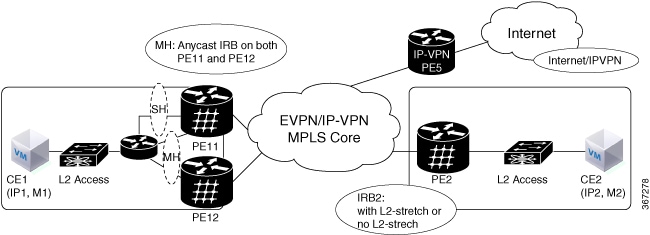
EVPN IRB enhances network flexibility by enabling seamless Layer 3 connectivity between hosts on different subnets over an MPLS or IP network. This feature allows Layer 3 forwarding among hosts across IP subnets, maintains EVPN’s multi-homing capabilities, and supports communication between EVPN hosts or subnets and IP VPNs, making it easier to connect and manage diverse network environments. |
The EVPN IRB feature is a component that
-
enables L3 forwarding among hosts across different IP subnets,
-
while maintaining the multi-homing capabilities of EVPN.
-
Additionally, it allows EVPN hosts or subnets to communicate with IP VPNs, enhancing network flexibility and connectivity.
EVPN IRB components
To implement EVPN IRB, the network uses these key components to ensure effective traffic management and routing:
-
BGP (Border Gateway Protocol): It advertises subnet and host routes to the EVPN core using route-type 5 and route-type 2 messages.
-
EVPN: It manages ethernet segment configurations and handles host route advertisements and failover scenarios.
-
L2RIB (Layer 2 Routing Information Base): It handles MAC or IP mobility, resolves routes, computes the best routes, and handles duplicate host detection.
-
BVI MA (Bridge Virtual Interface Manager): It manages IRB interfaces and supports routing by advertising the BVI's subnet and MAC addresses.
-
L2FIB (Layer 2 Forwarding Information Base): It ensures correct forwarding based on MAC addresses.
EVPN IRB environments
The EVPN IRB supports these environments:
-
Single-homing interface: Customer Edge (CE) devices connect directly to a single Physical Edge (PE) router.
-
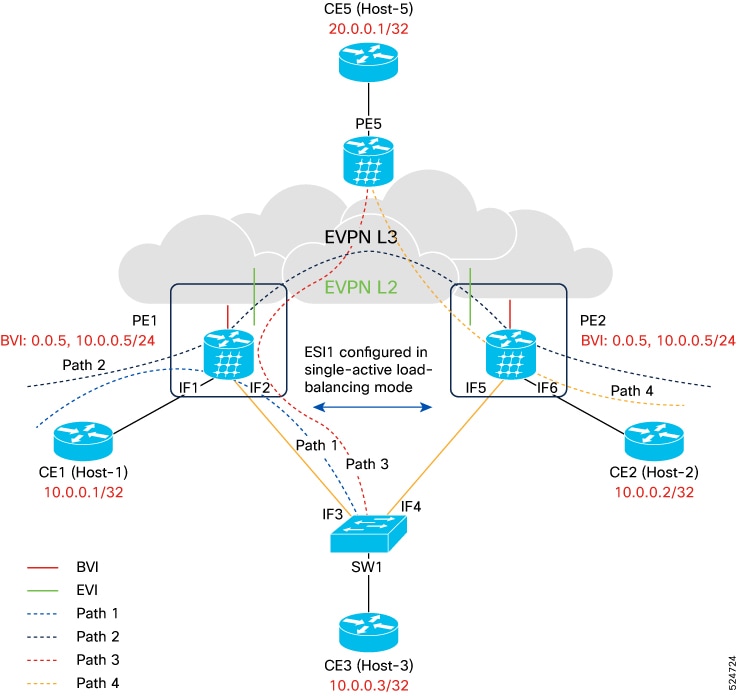
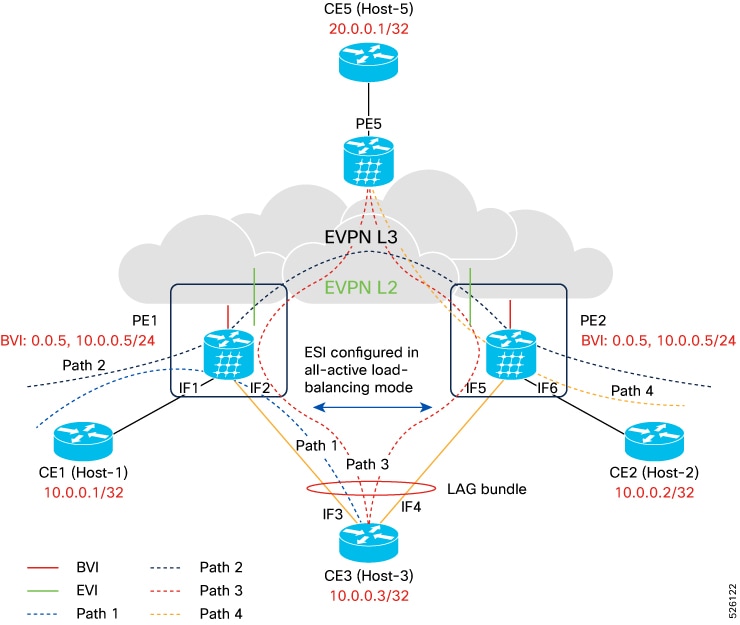
Multi-homing interface: CE device connect to multiple PE routers through dual links, a Link Aggregation Group (LAG), or a switch.
-
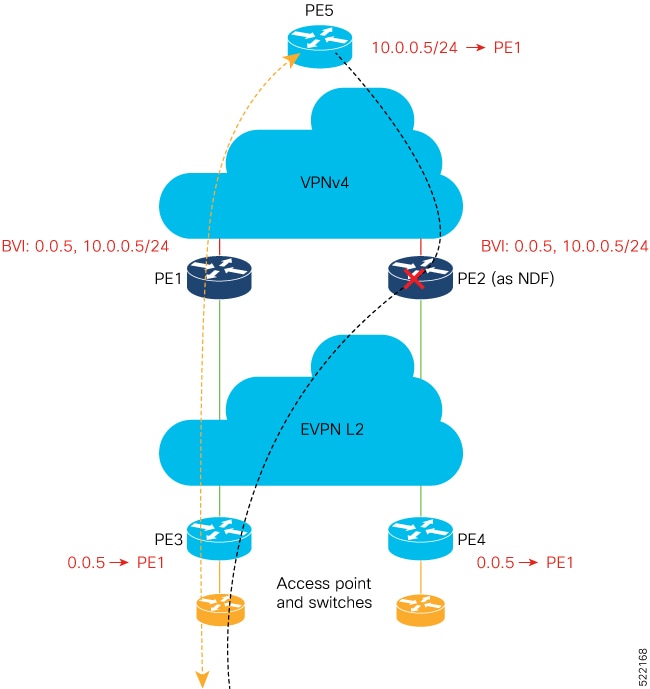
Anycast gateway or Bridge Virtual Interface (BVI): BVI interfaces use the same IP and MAC addresses on all PE routers, enabling devices in the network to reach the gateway using the same address, regardless of which router is the designated forwarder.
EVPN-IRB core and access options
EVPN-IRB supports these core and access options:
-
Core options:
-
Host routing: Enable or disable host routing to manage subnet and host route advertisements.
-
VRF: Integrate with VRF for seamless route management.
-
-
Access options:
-
Switch devices: Supports switch devices with or without LAG.
-
Y-cable configurations: Use Y-cable configurations for redundancy.
-
Mixed environments connections: Operate in mixed environments with single-homing, single-active multi-homing, and all-active multi-homing connections.
-
Limitations and restrictions for EVPN IRB
These are the limitations and restrictions for EVPN IRB:
-
SRv6 EVPN-IRB do not support Single-Flow-Active (SFA) load balalcing mode.

 Feedback