Covers dial-in telemetry sessions where a collector connects to the router to subscribe to telemetry data.
A model-driven telemetry session is a network monitoring mechanism that
-
streams configuration and operational data from Cisco IOS XR routers in real time,
-
uses a subscription-based model to deliver structured data to remote collectors, and
-
enables proactive monitoring, troubleshooting, and automation for resilient network operations.
How model-driven telemetry sessions work and their benefits
Describes how model-driven telemetry sessions stream configuration and operational data from Cisco IOS XR routers in real time, using a subscription-based model to deliver structured data to remote collectors for proactive monitoring, troubleshooting, and automation.
Streaming telemetry introduces a new paradigm for monitoring network health by providing a mechanism to efficiently stream configuration and operational data of interest from Cisco IOS XR routers. This streamed data is transmitted in a structured format to remote management stations for monitoring and troubleshooting purposes.
With telemetry data, you can create a data lake. By analyzing this data, you can proactively monitor your network, track CPU and memory utilization, identify patterns, troubleshoot your network in a predictive manner, and devise strategies to create a resilient network using automation.
Telemetry operates on a subscription model, where you subscribe to data of interest using sensor paths. Sensor paths describe OpenConfig data models or native Cisco data models. You can access the OpenConfig and Native data models for telemetry from GitHub, a software development platform that provides hosting services for version control.
You can choose who initiates the subscription by establishing a telemetry session between the router and the receiver. The session is established using either a dial-out mode or dial-in mode, as described in the Scale-Up Your Network Monitoring Strategy Using Telemetry article.
Watch this video to discover the power of real-time network management using model-driven telemetry.
This article describes the dial-in mode, where a receiver dials in to the router to establish a telemetry session. In this mode, the receiver subscribes dynamically to one or more sensor paths specified in a subscription. The router streams telemetry data through the same session established by the receiver. The dial-in mode of subscriptions is dynamic and terminates when the receiver cancels the subscription or when the session ends.
The following image shows a high-level overview of the dial-in mode:
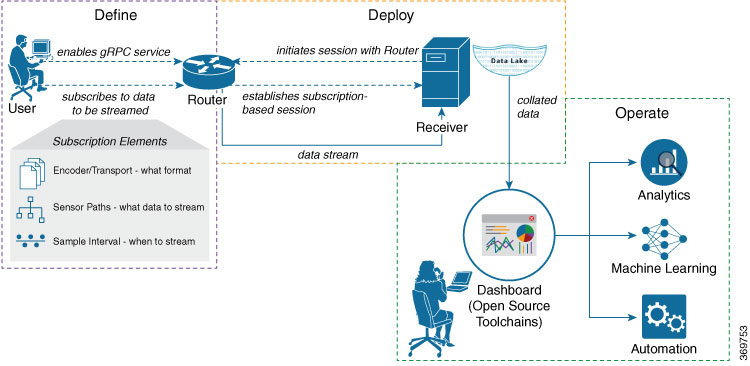
This article also provides a use case that illustrates simultaneous monitoring of various network parameters, showing how streaming telemetry data helps you gain better visibility of the network and make informed decisions to stabilize it.
You can programmatically configure a dial-in telemetry session using the openconfig-telemetry.yang OpenConfig data model. To get started with using data models, see the Programmability Configuration Guide.
Example of model-driven telemetry session
For instance, a network operator can use model-driven telemetry sessions to monitor CPU and memory utilization across multiple routers in real time, enabling proactive troubleshooting and automation strategies for network resilience.
Monitor Network Parameters Using Telemetry Data for Proactive Analysis
Describes how to monitor network parameters using telemetry data for proactive analysis, including prerequisites, workflow, and step-by-step configuration and verification.