Cisco Catalyst Center ITSM Integration Guide, Release 3.1.x
Bias-Free Language
The documentation set for this product strives to use bias-free language. For the purposes of this documentation set, bias-free is defined as language that does not imply discrimination based on age, disability, gender, racial identity, ethnic identity, sexual orientation, socioeconomic status, and intersectionality. Exceptions may be present in the documentation due to language that is hardcoded in the user interfaces of the product software, language used based on RFP documentation, or language that is used by a referenced third-party product. Learn more about how Cisco is using Inclusive Language.
Catalyst Center integration with a generic REST endpoint
This table describes how to configure Catalyst Center integration with a generic REST endpoint. You may wish to publish Network and Automation events to a generic REST endpoint
outside a configuration management database. This can improve performance, security, or event response.
Table 1. Catalyst Center to generic REST endpoint integration procedure
Step
Description
Step 1
Install or upgrade to the latest Catalyst Center release.
In the configuration slide-in pane, click Destination to receive events.
Step 4
To send the data to a different staging table in ServiceNow, select Generic REST Endpoint in ServiceNow as the destination to receive events.
Determine the generic REST endpoint, which serves as the destination URI for publishing Network and Automation events.
Step 5
Configure network event settings in Event Settings.
The Catalyst Center platform and ITSM integration allows you to select from a list of events specific to the configured bundles, to create and modify
the severity of events, incidents, or problems to match business priorities.
Configure the integration settings. From the main menu, choose System > Settings > System Configuration > Integration Settings. Enter your callback URL hostname or IP address.
Step 7
Access the generic REST endpoint in ITSM and review the network event data that has been posted using the REST APIs in this
procedure. Then review and manipulate this data according to your business or network needs.
Configure network events
You can subscribe to specific events that may occur in your network. After you subscribe, you receive a notification whenever
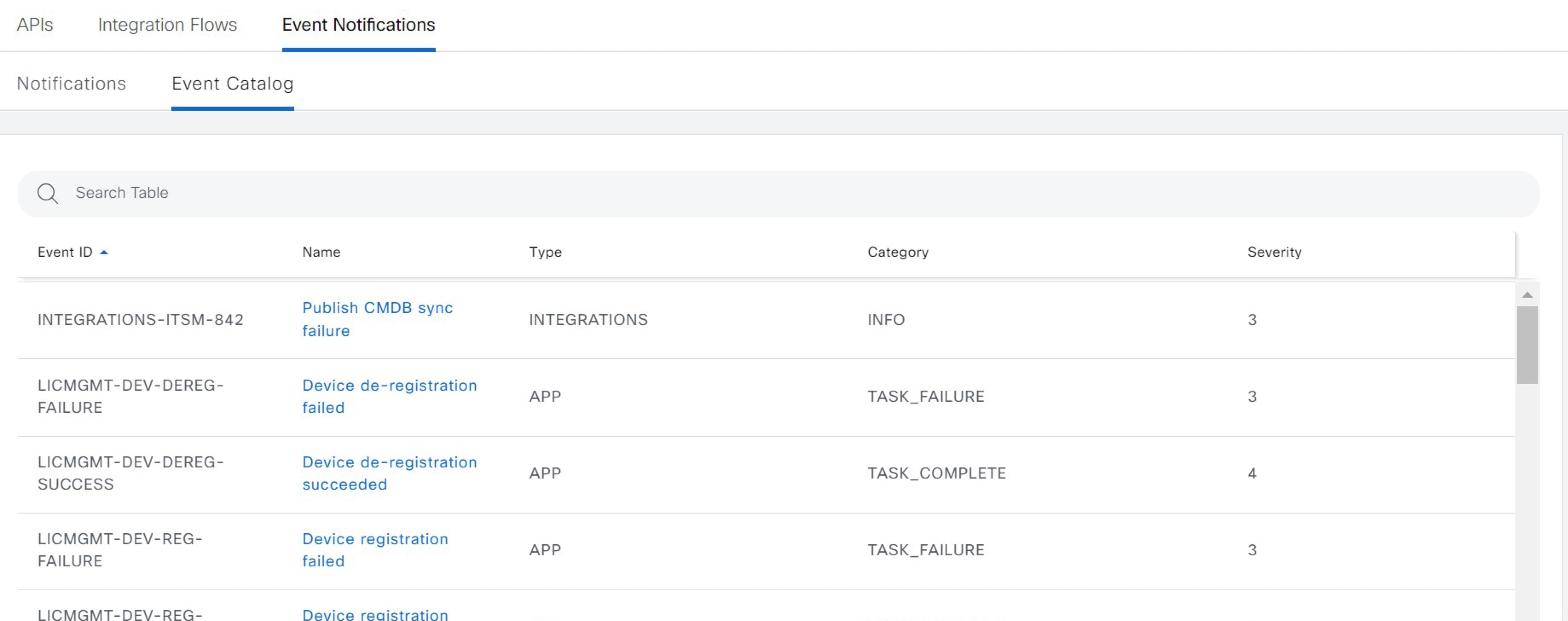
the network event occurs. You subscribe to an event using the Event Notifications window in the Catalyst Center platform GUI.
Figure 1. Catalyst Center platform Events window
Before you begin
To subscribe to network events, you must configure the required destination to deliver event notifications from the Catalyst Center platform. To access the Destinations window, click the menu icon and chooseSystem > Settings > External Services > Destinations.
You must have the appropriate permissions to perform the tasks in this procedure. For information about role-based access
control for the Catalyst Center platform, see the Cisco Catalyst Center Platform User Guide.
Procedure
Step 1
From the main menu, choose Platform > Developer Toolkit > Event Notifications.
The Event Notifications window opens.
Step 2
Click the Notifications tab to view the notification tiles.
Each notification is represented by a tile and contains a link to view notification details. From the CHANNELS area in the
left pane, click the radio button next to the notification channels to view the existing tiles with the selected channel.
Step 3
Follow the steps in the Create a New Notification wizard to create a new notification.
Click Let's Do It to go directly to the workflow.
Step 4
In the Select Site and Events window, select a site from the drop-down list and select the Network event or events that support the required notification
channel.
Step 5
Click Next.
The Select Channels window opens.
Step 6
In the Select Channels window, select the notification channel.
Click Next to configure the values in the corresponding Settings window.
Step 7
Click Next.
The Name and Description window opens.
Step 8
Click Next.
The Summary window opens.
Step 9
In the Summary window, review the configuration settings.
To make any changes, click Edit.
Step 10
Click Finish.
The Done! Your new notification is complete window appears.
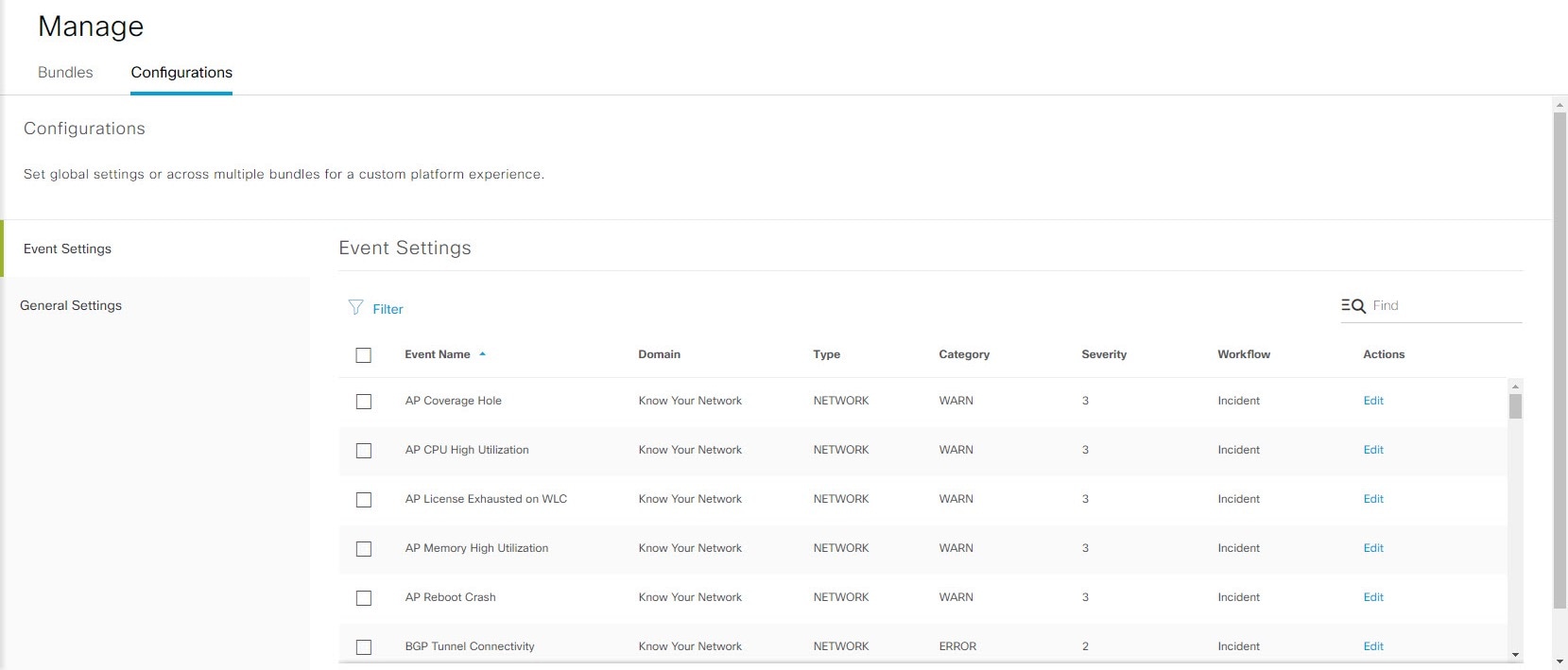
Using the Catalyst Center platform and ITSM integration, you can select from a list of possible issues to create or modify the severity of events, incidents,
or problems in ServiceNow to match your business priorities. You perform these tasks in the Events Settings window.
Note
For this release, you configure only network assurance events in Event Settings; SWIM events are not available for configuration.
Important
The Event Settings window and its functionality are applicable only to configure events for an ITSM integration and not for events that are
configured to other destinations. To configure events to a webhook or other destination, click the link at the top of the
columns. Use the Event Notifications window to configure events for an email, webhook, or SNMP trap.
Figure 2. Events Settings window
Before you begin
You must have the appropriate permissions to do the tasks as described in this procedure. For information about role-based
access control for the Catalyst Center platform, see the Cisco Catalyst Center Platform User Guide.
Procedure
Step 1
From the main menu, choose Platform > Manage > Configurations.
A Configurations window that contains an Events Settings section opens.
Step 2
Review the information presented in the Event Settings section:
Event Name: Name of the Catalyst Center event.
Domain: Domain of the Catalyst Center event.
Type: Network, App, System, Security, or Integrations.
Category: Error, Warn, Info, Alert, Task Progress, or Task Complete.
Severity: 1 to 5.
Note
Severity 1 is the most important or critical priority. You can edit the severity level of each event.
Workflow: Incident, Problem, Event, or RFC (Request for Change).
Actions: Edit.
To change what is displayed in the table, click the Filter icon or enter a keyword in the Find field. For example, to view all network notifications, enter Network in the Find field. To view all severity 1 notifications, enter 1 in the Find field.
Step 3
To edit an event, click Edit in the Actions column.
To change a setting, click the down-arrow and then select a value from the available options.
Step 4
Click the box next to the event name to enable notifications.
You must select the events in the Event Settings section to configure events for an ITSM integration. This enables notifications through Catalyst Center when the event occurs in the future.
Step 5
Click Save.
Catalyst Center integration with ServiceNow without the Cisco Catalyst app
This table describes how to configure Catalyst Center integration with ServiceNow without using the Cisco Catalyst app. Configure the integration for network events, SWIM events, or both types of events based on your requirements.
Note
You can also use the Basic ITSM (ServiceNow) CMDB synchronization bundle with this workflow. If you use this bundle, be sure to select Post device inventory details to a staging table as the destination type. The other destination type (Synchronize device inventory directly with CMDB) requires the Cisco Catalyst app. Additionally, the Post device inventory details to a staging table destination type only sends data to the REST API endpoint. Create a script to take any further action on the data.
Table 2. Catalyst Center-to-ServiceNow integration without the Cisco Catalyst App procedure
Step
Description
Step 1
Install or upgrade to the latest Catalyst Center release.
For information about configuring user profiles and setting up the MID Server, see the "Scope Certified Application (Cisco
Catalyst) - Installation and Configuration" guide available on the ServiceNow Store website.
This bundle enables Change Management between the two systems (Catalyst Center and ServiceNow). Enable change Management and Incident or Problem Management workflows based on the automation or assurance
use cases that you want to log tickets in ServiceNow.
Step 4
Configure network event settings in Event Settings.
The Catalyst Center platform and ITSM integration allows the user to select from a list of possible issues to create and modify the severity of events,
incidents, or problems in ServiceNow to match business priorities.
Step 5
Configure the Automation events for ITSM (ServiceNow) bundle.
The Automation Events for ITSM (ServiceNow) bundle retrieves events relating to software image updates required for compliance,
security or any other operational triggers from Catalyst Center. SWIM event notifications are sent from Catalyst Center to ServiceNow when they occur, not on a polling and notify schedule.
Access your ServiceNow instance and review the network and SWIM event data that has been posted using the REST APIs in this
procedure. Review and manipulate this data in ServiceNow per your business or network needs.
Configure the network issue monitor and enrichment for ITSM (ServiceNow) bundle
Use this procedure to monitor network assurance and maintenance issues and to publish event details to a ServiceNow platform.
Note
Closed loop automation is supported for assurance events between Catalyst Center and the ServiceNow system. It is not supported
for other event types.
Closed loop automation is supported only for the REST API endpoint configured in the Network Issue Monitor and Enrichment
for ITSM (ServiceNow) bundle. The Event Management and Generic REST API endpoints in this bundle do not support automatic
ticket creation or resolution for assurance events. However, updates about resolved or ignored assurance events are sent to
these endpoints.
When an assurance event or issue is ignored or resolved in Catalyst Center, the system sends an update to ServiceNow regardless
of which endpoint is configured in the Automation Events for ITSM (ServiceNow) Bundle.
To publish event data to the Event table in ServiceNow, install the Event Management plug-in in your ServiceNow instance. Otherwise, you can configure the bundle
to send the data to a REST API endpoint in the Cisco Catalyst app.
Before you begin
You must have the appropriate permissions to complete the steps described in this procedure. For information about role-based
access control for the Catalyst Center platform, see the Cisco Catalyst Center Platform User Guide.
Procedure
Step 1
From the main menu, choose Platform > Manage > Bundles.
Review the displayed bundles and their current status.
Step 2
Click the Network Issue Monitor and Enrichment for ITSM (ServiceNow) bundle link or icon (a colored square with an initial) for additional information about the bundle.
Additional information may include the following:
General information: Vendor, version, platform, tags displayed under the square icon.
Information: Tab that displays general information (purpose of bundle and how bundle works in the network), sample schemas, configuration
notes, and other data about the bundle.
Contents: Tab that accesses the APIs and integration flows that make up the bundle, or provides information about the integration
flows that make up the bundle.
Release Notes: Tab that displays latest release information about the bundle, including its version.
Step 3
Click each tab to review the information about the bundle.
Step 4
Click the Enable button to enable the bundle.
An Information field appears in the window.
Step 5
In the Information field, click the Enable button to confirm enabling the bundle.
When you click the Enable button to confirm, the system displays a success message.
Step 6
In the success message, click OK.
Step 7
Click the Configure button to configure the settings at the bundle level.
A configuration slide-in pane appears.
Step 8
In the configuration slide-in pane, click ServiceNow Access Settings to configure a ServiceNow Connection instance.
Step 9
Click the radio button to configure either an existing ServiceNow Connection instance or create a new instance.
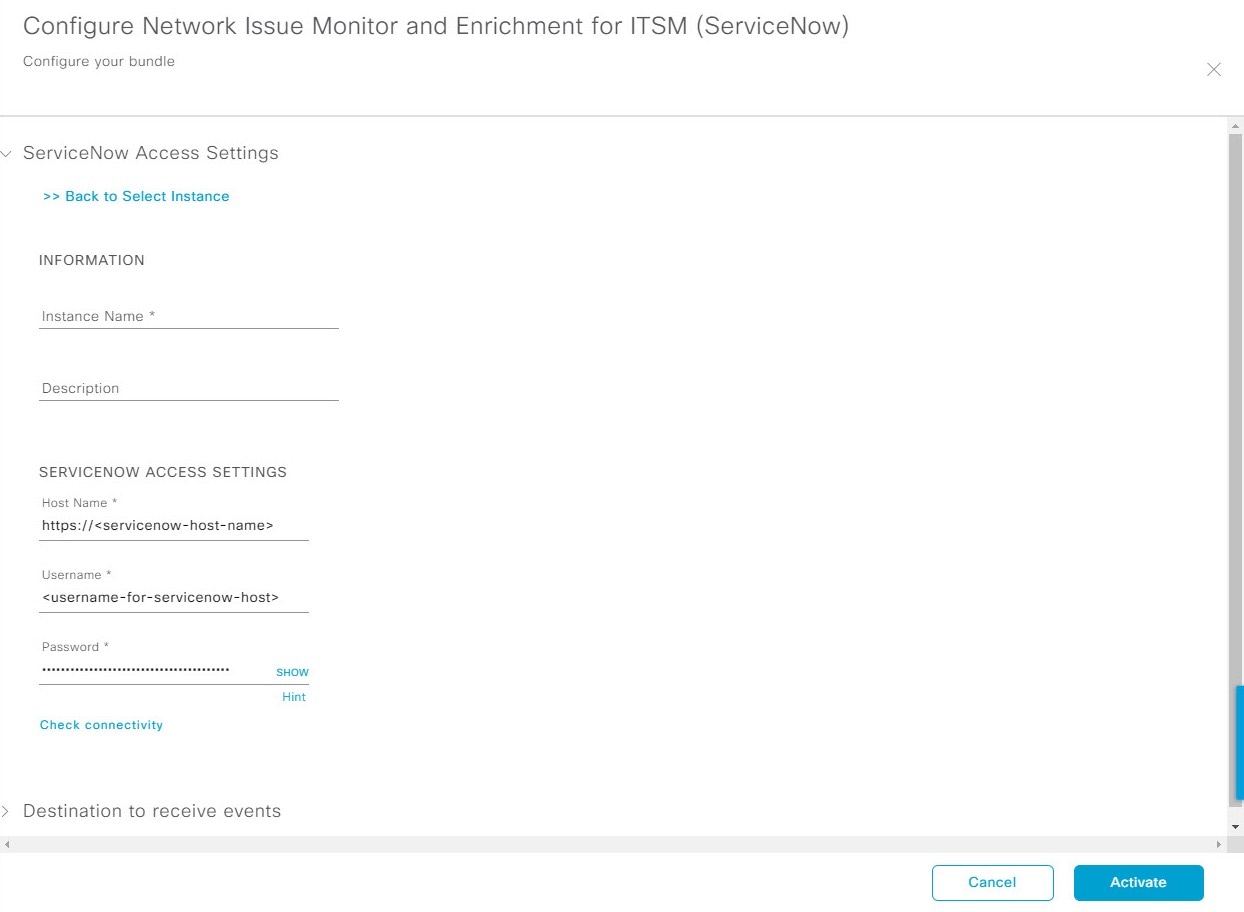
Figure 3. Example of ServiceNow instance configuration fields
For configuring an existing ServiceNow Connection instance, select it from the drop-down menu in the window and click Activate.
Step 10
For configuring a new ServiceNow Connection instance, enter this additional information:
Instance Name: Name of the instance.
Description: Description of the instance.
Host name: Hostname for the ServiceNow system.
Username: Username required to access the ServiceNow system.
Password: Password required to access the ServiceNow system.
Step 11
Click Check Connectivity to test whether you can connect to the server where the endpoint is located.
After you successfully test connectivity to the server, configure Destination to receive events.
Step 12
In the configuration slide-in pane, click Destination to receive events to configure a Destination Connection instance.
Step 13
Click the radio button to configure either an existing Destination Connection instance or configure a new instance.
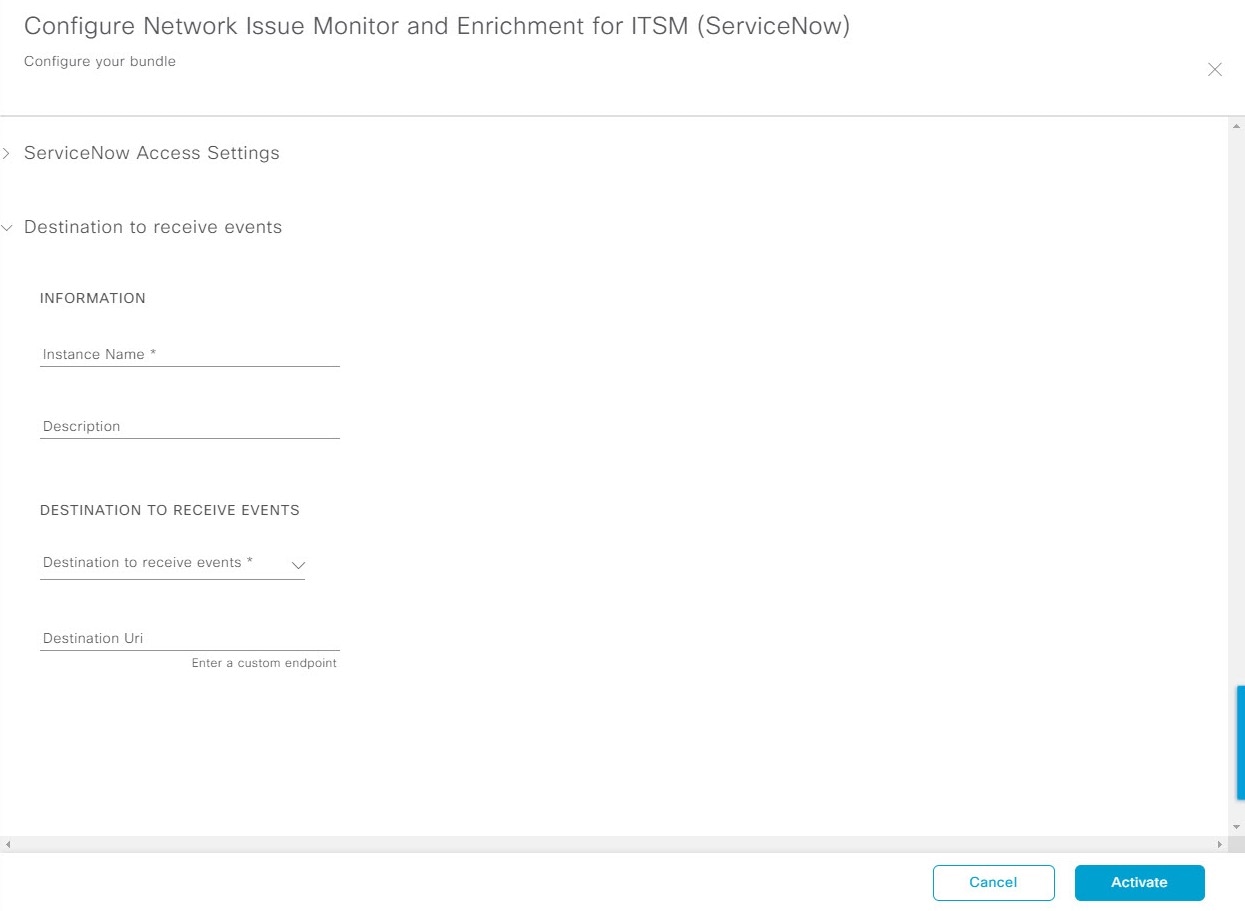
Figure 4. Example of Destination to receive events configuration fields
For configuring an existing Destination Connection instance, select it from the drop-down menu in the window and click Activate.
Step 14
For configuring a new Destination instance, this additional information must be entered:
Instance Name: Name of the instance.
Description: Description of the instance.
Destination to receive events: Select one of these options:
Event Management: When setting up Catalyst Center integration with ServiceNow without using the Cisco Catalyst app, select the Event Management option. The Event Management option also requires that you have the Event Management plug-in configured within the ServiceNow instance.
REST API Endpoint: The REST API Endpoint option can be used with the Cisco Catalyst app. With this option, data is sent to a REST API endpoint within the Cisco Catalyst app.
Note
When a network event or issue is ignored or resolved in Catalyst Center, an event status update is sent to the Cisco Catalyst app in ServiceNow, and the ticket created for the event in ServiceNow is closed automatically.
Generic REST Endpoint in ServiceNow: With this option, you can send the data to a different staging table in ServiceNow.
Note
Use this destination type to send data to a REST API endpoint outside the Cisco Catalyst app. Ensure that the created staging table/import set table has a field called u_event_details. The event details from Catalyst Center are mapped to this field. With the Generic REST Endpoint in ServiceNow destination type, after data transfer, you must write custom code to use the data from the staging table and create tickets
in ServiceNow.
Destination URI: Enter a destination URI (Uniform Resource Indicator) for the Generic REST Endpoint in ServiceNow option. This field is mandatory for this option.
After entering this information, proceed to the next step.
Step 15
Click Activate to save your changes and activate the bundle or click Cancel to cancel the configuration and close the slide-in pane.
The changes made to the bundle take effect immediately, and the bundle status changes from ENABLED to ACTIVE.
Configure event settings
The Catalyst Center platform and ITSM integration lets you select from a list of possible issues to create and modify the severity of events, incidents,
or problems in ServiceNow to align with your business priorities. You perform these tasks in the Events Settings window.
Note
For this release, there are no SWIM events to configure in Event Settings. You can configure only network assurance events.
Important
The Event Settings window and its functionality is only applicable to events for an ITSM (ServiceNow) integration and not to events configured
for other destinations. To configure events for a webhook or other destination, click the link at the top of the columns to
access the Events window. Use the Events window to configure events for an email, webhook, or SNMP trap notifications.
Figure 5. Events Settings window
Before you begin
You must have the appropriate permissions to perform the tasks as described in this procedure. For information about role-based
access control for the Catalyst Center platform, see the Cisco Catalyst Center Platform User Guide.
Procedure
Step 1
From the main menu, choose Platform > Manage > Configurations.
A Configurations window opens with an Events Settings section.
Step 2
Review the Event Settings section, which contains this information:
Severity: P1 (Severity 1) through P5 (Severity 5).
Note
Assign Severity 1 to the most important or critical priority.
Workflow: Incident, Problem, Event, or RFC (Request for Change).
Actions: Edit.
You can adjust what is displayed in the table by clicking the Filter icon and using the filter, or by typing a keyword in the Find field. For example, to display all access point notifications, type AP in the Find field. To view all network notifications, type Network in the Find field. To view all severity notifications, type 1 in the Find field.
Step 3
Click Edit in the Actions column to edit an event.
To select a setting, click the downward pointing angle and adjust the value. For example, click Network to change the event type to App. This changes the event type from a network type to an application type. Click Severity and adjust the value to 1 from 5. This raises the severity level from 5 to 1.
Step 4
Click the box next to the event name to enable notifications.
This enables notifications through Catalyst Center when the event occurs in the future.
Step 5
Click Save.
Configure the automation events for ITSM (ServiceNow) bundle
Follow this procedure to monitor and publish events that require device provisioning activities, software image updates for
compliance, security, or other operational triggers to a ServiceNow system.
Note
You can publish the event data to the Event table in ServiceNow if you have the Event Management plug-in in your ServiceNow instance. If not, you can configure the bundle
to send the data to a REST API endpoint in the Cisco Catalyst app.
Enable ITSM in Catalyst Center to control device provisioning activities and group-based policy changes through a ServiceNow approval process. You do not
need to enable ITSM for software image updates, because SWIM ignores Visibility and Control of Configurations settings. For
more information about enabling ITSM approval, see the Configure System Settings chapter in the Cisco Catalyst Center Administrator Guide.
Before you begin
You must have the appropriate permissions to complete the steps described in this procedure. For information about role-based
access control for the Catalyst Center platform, see the Cisco Catalyst Center Platform User Guide.
Procedure
Step 1
From the main menu, choose Platform > Manage > Bundles.
Review the displayed bundles and their status.
Step 2
Click the Automation Events for ITSM (ServiceNow) bundle link or icon (a colored square with an initial) to access more information
about the bundle.
Additional information may include:
General information: Vendor, version, platform, tags displayed under the square icon.
Information: Tab that displays general information (purpose of bundle and how bundle works in the network), sample schemas, configuration
notes, and other data about the bundle.
Contents: Tab that accesses the APIs and integration flows that make up the bundle, or provides information about the integration
flows that make up the bundle.
Release Notes: Tab that displays latest release information about the bundle, including its version.
Step 3
Click each tab to review the information about the bundle.
Step 4
Click Enable to enable the bundle.
An Information field appears in the window.
Step 5
Click Enable in the Information field to confirm enabling the bundle.
After clicking Enable to confirm, a success message appears.
Step 6
Click OK in the success message.
Step 7
Click Configure to configure settings at the bundle level.
A configuration slide-in pane appears.
Step 8
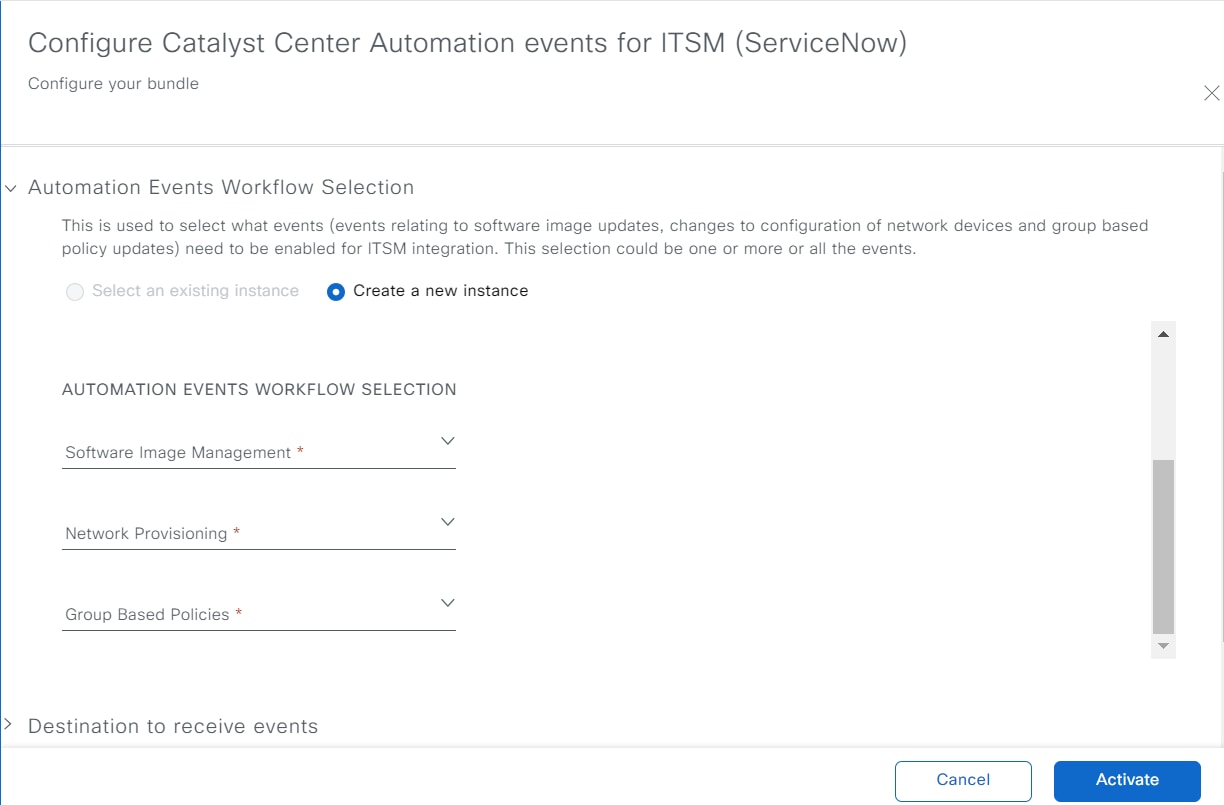
In the configuration slide-in pane, click Automation Events Workflow Selection to select events relating to software image updates, changes to configuration of network devices and group based policy updates
that require ITSM integration. You can select one, several, or all available events.
Step 9
Click the radio button to configure an existing ServiceNow Connection instance or configure a new instance.
Figure 6. Example of Automation Events Workflow Selection configuration fields
To configure an existing ServiceNow Connection instance, select it from the drop-down list and click Activate.
Step 10
To configure a new ServiceNow Connection instance, enter this additional information:
Instance Name: Name of the instance.
Description: Descriptive text of the instance.
Software Image Management: Select true from the drop-down list to enable ITSM integration of events relating to software image updates.
Network Provisioning: Select true from the drop-down list to enable ITSM integration of events relating to configuration changes of network devices.
Group Based Policies: Select true from the drop-down list to enable ITSM integration of events relating to group based policy updates.
Step 11
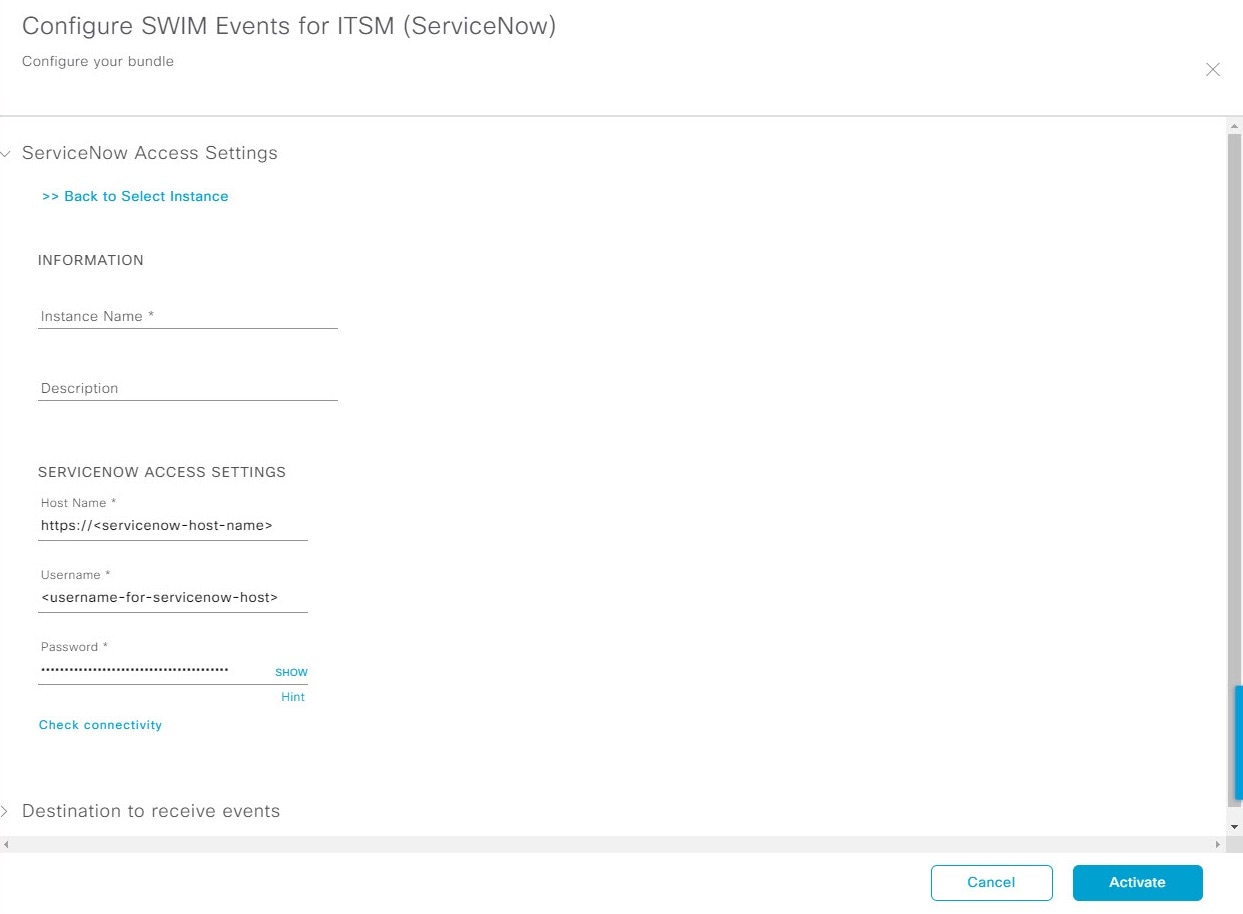
In the configuration slide-in pane, click ServiceNow Access Settings to configure a ServiceNow Connection instance.
Step 12
Click the radio button to configure either an existing ServiceNow Connection instance or configure a new instance.
Figure 7. Example of ServiceNow instance configuration fields
To configure an existing ServiceNow Connection instance, select it from the drop-down list in the window and click Activate.
Step 13
To configure a new ServiceNow Connection instance, you must enter this additional information:
Instance Name: Name of the instance.
Description: Descriptive text of the instance.
Host name: Hostname for the ServiceNow system.
Username: Username required to access the ServiceNow system.
Password: Password required to access the ServiceNow system.
Step 14
Click Check Connectivity to test whether you can connect to the server where the endpoint is located.
Activate the bundle after successfully testing connectivity to the server.
Step 15
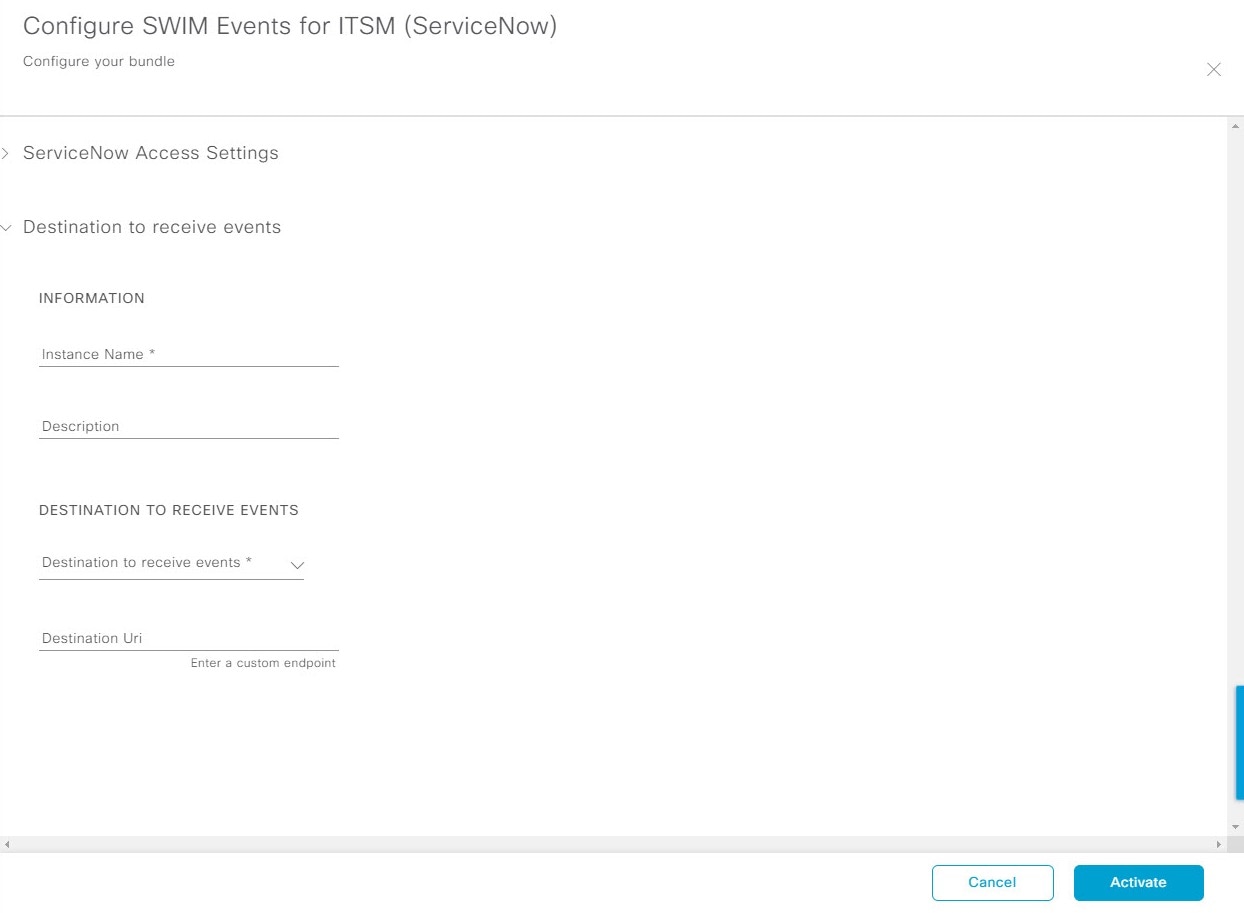
In the configuration slide-in pane, click Destination to receive events to configure a Destination Connection instance.
Step 16
Click the radio button to configure either an existing Destination Connection instance or configure a new instance.
Figure 8. Example of Destination to receive events configuration fields
To configure an existing Destination Connection instance, select it from the drop-down menu in the window and click Activate.
Step 17
To configure a new Destination instance, you must enter this additional information:
Instance Name: Name of the instance.
Description: Descriptive text of the instance.
Destination to receive events: Select one of these options:
Event Management: When setting up Catalyst Center integration with ServiceNow without using the Cisco Catalyst app, select the Event Management option. The Event Management option requires that you have the Event Management plug-in that is configured within the ServiceNow instance.
REST API Endpoint: You can use the REST API Endpoint option with the Cisco Catalyst app. Data is sent to a REST API endpoint within the Cisco Catalyst app with the REST API Endpoint option.
Generic REST Endpoint in ServiceNow: For the Generic REST Endpoint in ServiceNow option, you can send the data to a different staging table in ServiceNow.
Note
Use this destination type to send data to a REST API endpoint outside the Cisco Catalyst app. Ensure that the created staging table/import set table has a field called u_event_details. The event details from Cisco Catalyst are mapped to this field. With the Generic REST Endpoint in ServiceNow destination type, after data transfer, you must write custom code to use the data from the staging table and create tickets
in ServiceNow.
Destination URI: Enter a destination Uniform Resource Indicator (URI) for the Generic REST Endpoint in ServiceNow option. This field is mandatory for this option.
After entering this information, proceed to the next step.
Step 18
Click Activate to save your changes and activate the bundle, or click Cancel to cancel the configuration and close the slide-in pane.
Note
Click Activate to apply changes to the bundle immediately. The status of the bundle changes from ENABLED to ACTIVE.
Catalyst Center integration with ServiceNow using the Cisco Catalyst app
Catalyst Center supports an application (Catalyst Center) that facilitates integration with ServiceNow. This application (app) is designed to work with ServiceNow without its Event
Management plug-in.
Install the Cisco Catalyst app (version 2.3.1) within the ServiceNow instance. Ensure that the app does these tasks:
Schedules the basic one-way synchronization of Catalyst Center discovered devices into the ServiceNow Configuration Management Database (CMDB) using Catalyst Center inventory as a source of truth. The Cisco Catalyst app supports CMDB synchronization from Catalyst Center to ServiceNow.
Automatically triggers problem, incident, and change workflows for network events published by Catalyst Center.
Enriches Incident tickets with network details from Catalyst Center The Cisco Catalyst app makes REST API calls into Catalyst Center. This API call helps in fetching client or user enrichment information based on either the client MAC address or the network
user ID.
Supports integration of the Catalyst Center platform with ServiceNow for an automated way to create change request (CR) tickets in ServiceNow for network events.
This table describes the procedure for configuring Catalyst Center integration with ServiceNow using the Cisco Catalyst app. Follow the procedure to configure integration for network events, SWIM events, or both event types depending upon the
functionality that you require.
Table 3. Catalyst Center-to-ServiceNow integration with Cisco Catalyst app procedure
Step
Description
Step 1
Install or upgrade to the latest Catalyst Center release.
Synchronizing the network device inventory with the ServiceNow CMDB is a prerequisite to enable the auto-generation of ITSM
tickets. Therefore, the CMDB Sync must be enabled first (if it is not already done outside of Catalyst Center). Check with your ServiceNow administrator to see whether the CMDB Sync is being done elsewhere.
This bundle enables data to be sent from Catalyst Center to create any type of workflow in ServiceNow. Change Management and Incident/Problem Management workflows should be enabled
based on the automation or assurance use cases that you want to log tickets to in ServiceNow.
Step 7
Configure network event settings in Event Settings.
The Catalyst Center platform and ITSM integration allows the user to select from a list of possible issues to create and modify the severity of events,
incidents, or problems in ServiceNow to match business priorities.
Step 8
Configure the Automation Events for ITSM (ServiceNow) bundle.
Access your ServiceNow instance and review the network and SWIM event data that has been posted using the Catalyst Center REST APIs in this procedure. Begin to review and use this data per your business or network needs.
Requirements
Review these networking and systems requirements to ensure they are met for the Catalyst Center-to-ServiceNow integration:
Networking:
Configure the Cisco Catalyst app with the IP address and access information of the Catalyst Center installation used in this integration.
Note
Contact your Catalyst Center administrator to obtain this information.
Ensure HTTPS network access exists between Catalyst Center and ServiceNow.
Note
Contact your network administrator to establish this connection.
Management, Instrumentation, and Discovery (MID) server:
The MID server is running and accessible from the ServiceNow instance.
The Catalyst Center platform is accessible from the MID server.
The Catalyst Center platform REST APIs are allowed from the MID server.
Note
The MID server is used to proxy the REST requests from the ServiceNow instance.
The Catalyst Center platform is enabled in Catalyst Center.
Configure and activate the required bundle or bundles in the Catalyst Center platform. For more information, see the procedures in the next section.
Note
These bundles have the required APIs that integrate with the Cisco Catalyst app in ServiceNow.
Configure the basic ITSM (ServiceNow) CMDB synchronization bundle
Perform this procedure to either trigger or schedule a synchronization between the Catalyst Center devices and your ServiceNow CMDB system. If devices have not been synchronized between Catalyst Center and the ServiceNow CMDB system, you must activate this bundle before activating any other bundles.
Note
The Catalyst Center CMDB synchronization cannot detect multiple instances of Catalyst Center:
To identify the attributes that were synchronized from a particular Catalyst Center instance, each attribute is tagged with a Catalyst Center IP address.
ServiceNow can now identify which Catalyst Center instance the attribute came from. An extra attribute for the Configuration Item (CI) has been added to retain the Catalyst Center IP address or hostname information.
Before you begin
Ensure that you have ServiceNow running on a system that you will integrate with Catalyst Center platform.
Run a successful Discovery job in Catalyst Center. You can check whether a Discovery job is successful in Device Inventory. From the main menu, choose Provision > Inventory to view the results.
You must have the appropriate permissions to perform the tasks as described in this procedure. For more information about
role-based access control for the Catalyst Center platform, see the Cisco Catalyst Center Platform User Guide.
Procedure
Step 1
From the main menu, choose Platform > Manage > Bundles.
Review the bundles and their current status that appear on the screen.
Step 2
Click the Basic ITSM (ServiceNow) CMDB synchronization bundle link or icon (a colored square with an initial) for additional information about the bundle.
Additional information provided may include:
General information: Vendor, version, platform, tags displayed under the square icon.
Information: Tab that displays general information (purpose of bundle and how bundle works in the network), sample schemas, configuration
notes, and other data about the bundle.
Contents: Tab that accesses the integration flows and APIs that make up the bundle.
Release Notes: Tab that displays latest release information about the bundle, including its version.
Step 3
Click the Contents tab.
Step 4
Click the Integration Flows header.
An integration flow or list of integration flows appears underneath the header.
Step 5
Click Enable to activate the integration flow links.
An Information field appears in the window.
Step 6
In the Information field, click Enable to confirm enabling the bundle.
After clicking Enable to confirm, a success message appears.
Step 7
Click Okay in the success message.
Step 8
Click the integration flow link to perform these tasks:
Review the Description, Tags, How to Use this Flow, and scheduler.
Click Run Now (to run the scheduler now), Run Later (to schedule for a later time), or Recurring (to set up a recurring schedule).
For Run Later, you need to select a date, time, and time zone. For Recurring, you need to set a repeating interval (daily or weekly), an interval duration (minutes or hours), and a start and end date.
Click Schedule to enable the scheduler.
Important
Configure and enable an integration flow schedule, only after you have finished configuring the bundle. To configure and enable
an integration flow schedule, return to this view and click Schedule. You can also click the View Flows link in the Configure Basic ITSM (ServiceNow) CMDB synchronizationslide-in pane. Alternatively, click the menu icon and choosePlatform > Developer Toolkit > Integration Flows > Schedule to Publish Inventory Details-ServiceNow Connector.
Step 9
Click the X icon to return to the previous bundle window.
Step 10
Click the Configure button to configure at the bundle level.
A configuration slide-in pane appears. Review the CMDB synchronization information.
Step 11
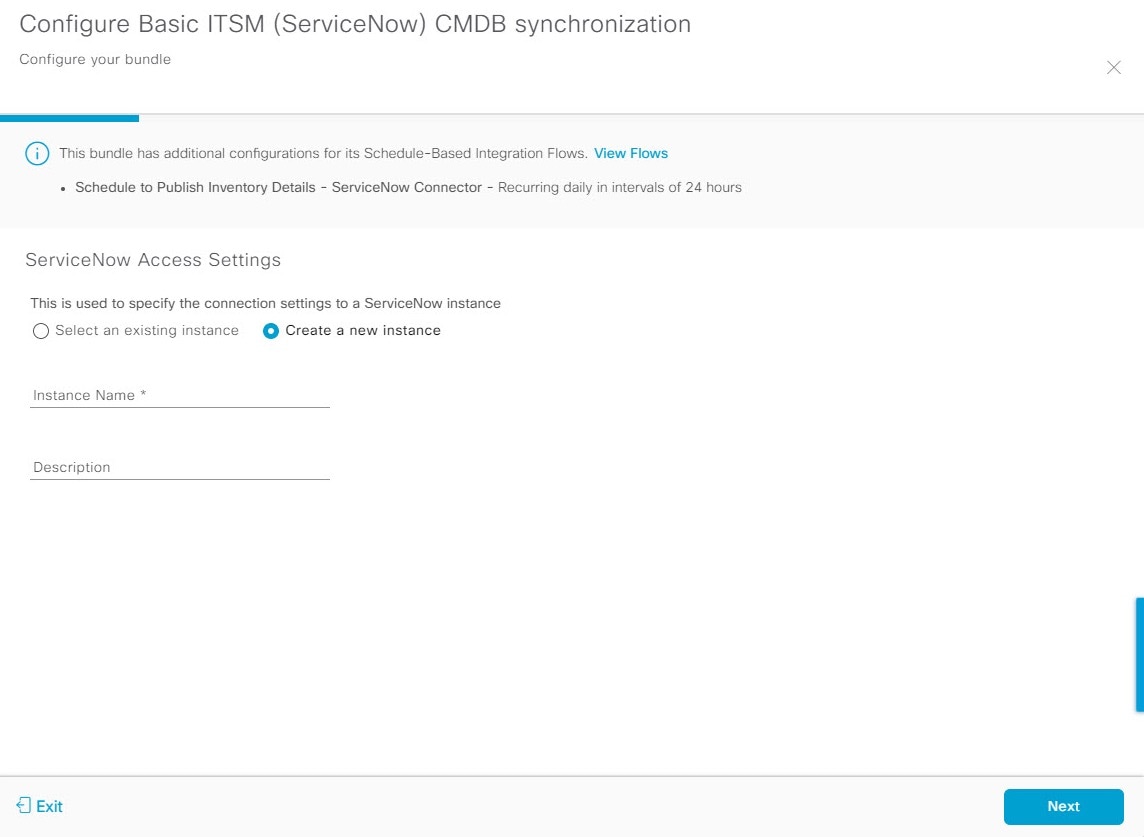
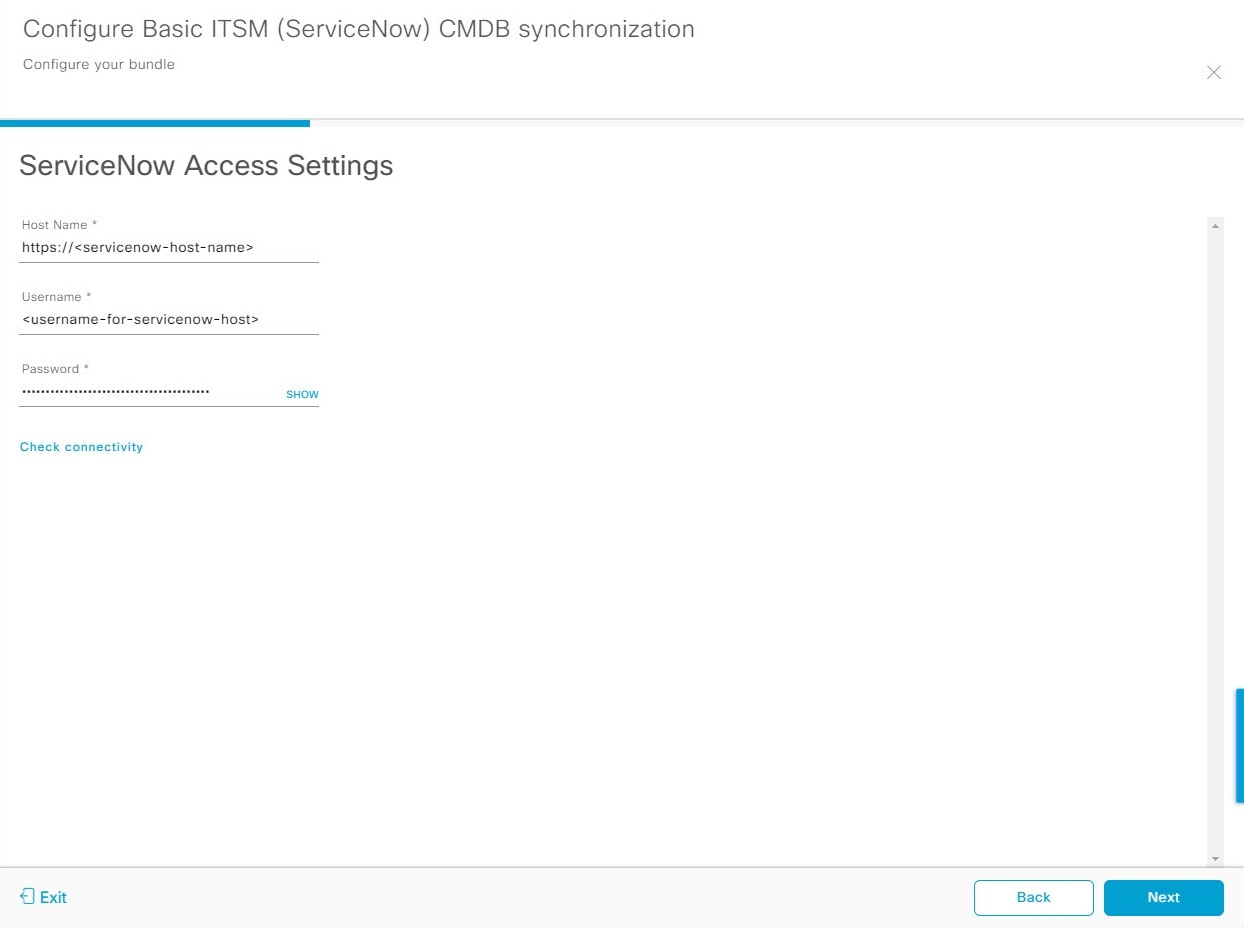
Click the radio button to configure either an existing ServiceNow access setting or a new one for the CMDB synchronization.
Figure 9. ServiceNow Access Settings
For configuring an existing setting, select it from the drop-down menu in the window and click Next.
Step 12
For configuring a new access setting, this instance information must be entered.
Instance Name: Name of the instance.
Description: Descriptive text of the instance.
Click Next.
Step 13
For configuring a new access setting, these additional settings information must be entered.
Figure 10. ServiceNow Access Settings
Hostname: Hostname or IP address of the ServiceNow server.
Username: Username for access to the ServiceNow server.
Password: Password for access to the ServiceNow server.
Click Check Connectivity to check access to the ServiceNow server.
Click Next.
Step 14
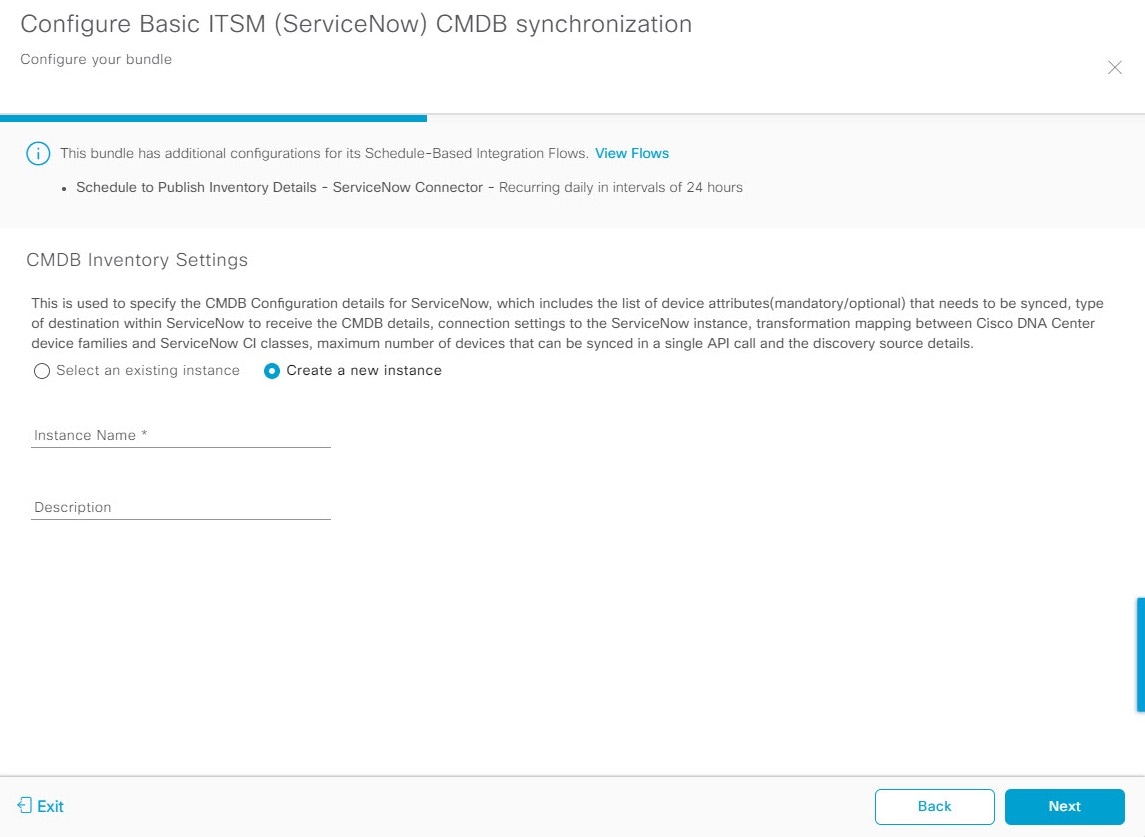
Click the radio button to configure either an existing instance or configure a new instance for the CMDB inventory settings.
Figure 11. CMDB Inventory Settings
For configuring an existing instance, select it from the drop-down menu in the window and click Configure.
Step 15
For configuring a new instance, this additional information must be entered.
Instance Name: Name of the instance.
Description: Descriptive text of the instance.
Click Next.
Step 16
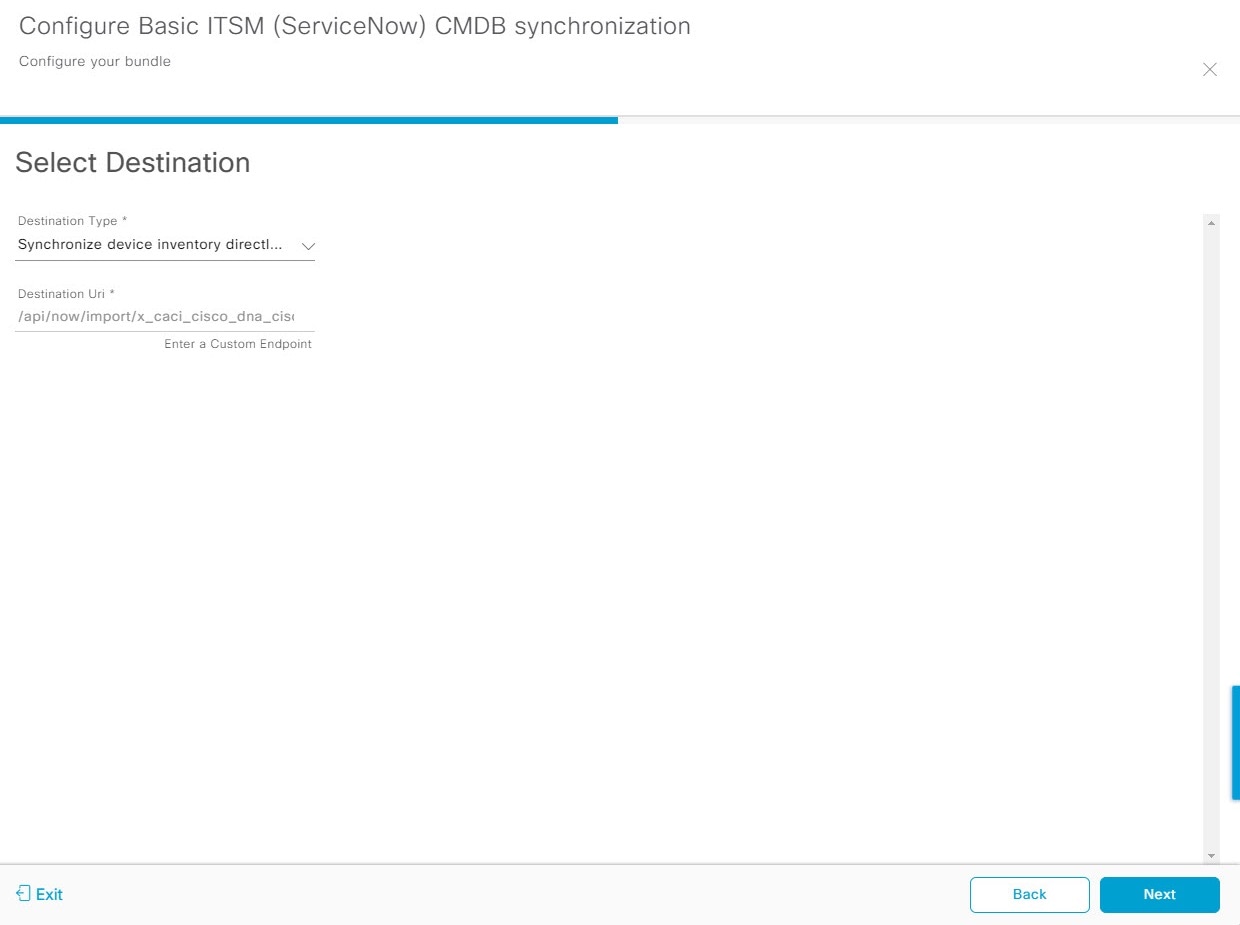
In the Select Destination window, enter this information:
Destination Type: There are two destination type options to select from:
Synchronize device inventory directly with CMDB
Post device inventory details to a staging table
Note
Use the Synchronize device inventory directly with CMDB destination type to send data to a REST API endpoint within the Cisco Catalyst app. You should use this destination type, if you are using the Cisco Catalyst app and do not have your own customized ServiceNow instance. Use the other destination type (Post device inventory details to a staging table) to send data to a REST API endpoint outside of the Cisco Catalyst app. Ensure that the created staging table has a field called u_inventory_details. The inventory details from the Cisco Catalyst app are mapped to this field. With the Post device inventory details to a staging table destination type, after data transfer, you must write custom code to move the data from the staging table and map it to the
ServiceNow CMDB.
Destination URI: Uniform Resource Identifier of the ServiceNow server (CMDB) or staging table.
Figure 12. Select Destination window
Click Next.
Step 17
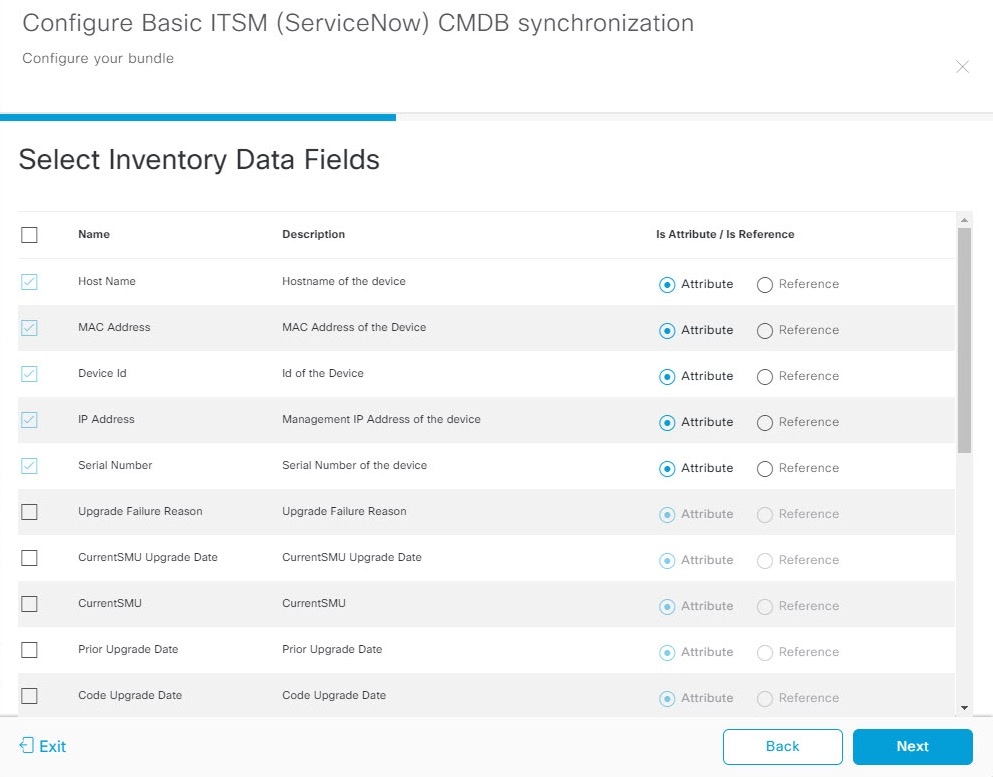
In the Select Inventory Data Fields window, select the data fields to by synchronized.
Note
Inventory data fields are Cisco created data types that can be designated as an attribute or reference to be synchronized
into a CMDB or staging table.
To select all inventory data fields for synchronization, click the top check box in the Select Inventory Data Fields. If you want to synchronize only specific fields, review each one and select the appropriate check boxes.
Figure 13. Select Inventory Data Fields window
The Select Inventory Data Fields window consists of these columns:
Name: Name of the inventory data field.
Description: Brief description of the inventory data field.
Is Attribute/Is Reference: Whether the inventory data field is an attribute or a reference. A reference data field is used to create a relationship
between two tables in a database. This is used for querying purposes. An attribute data field is used to add more data to
a table in a database.
Step 18
For the data fields selected to be synchronized in the preceding step, review their designation as either attribute or reference.
To change a data field's default designation, just click the desired data field designation (Attribute or Reference).
The integration supports only 'location', 'building', and 'part number' as reference fields.
After selecting the data fields to be synchronized and whether the data field is an attribute or reference, click Next.
Step 19
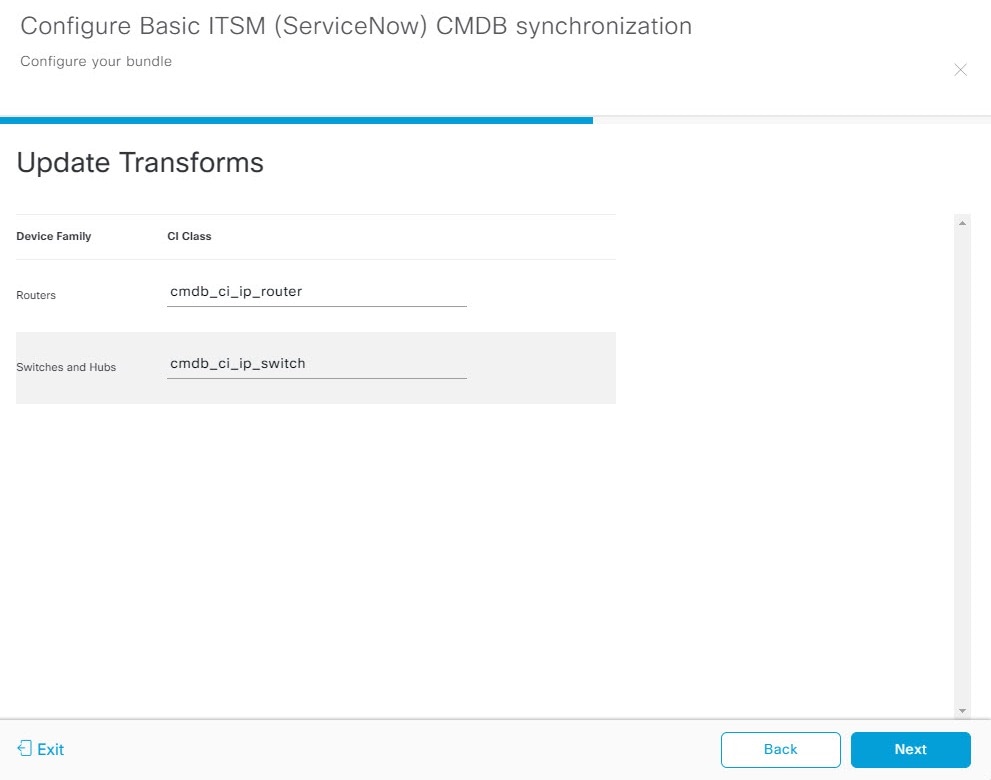
In the Update Transforms window, either accept or update the ServiceNow transformation mapping between Catalyst Center device families and ServiceNow CI classes.
Figure 14. Update Transforms window
Device families are the Catalyst Center device classifications (for example, Unified AP, Routers, Wireless Controller, Switches, and Hubs), where the inventory attributes/references
mapping to ServiceNow is already available in the existing Cisco Catalyst application in ServiceNow. The type and number of device families vary, depending on the different Cisco devices in the user's
network.
Note
Catalyst Center platform is able to automatically retrieve all of the device families in the user's Catalyst Center network and display them in this GUI window.
CI classes are the database tables for ServiceNow (for example, cmdb_ci_wap_network, cmdb_ci_ip_router, and cmdb_ci_ip_switch).
The CI Class column in the GUI window is used to map the CI classes to their respective device families.
This table displays the Catalyst Center default CI classes for each device family. The default CI classes can be modified by the user. In case of other device families
not listed below, Cisco will not have any default values specified in the CI Class column. The ServiceNow application user must either manually create the corresponding CI Classes and attribute or reference
mappings, or use a pre-existing CI class as a parent CI class. Ensure that the pre-existing or newly created class is inherited
from the Network Gear (cmdb_ci_netgear) class.
Table 4. Default Device Family to CI Class Mapping List
Device Family
Corresponding CI Class
Unified AP
cmdb_ci_wap_network
Wireless Controller
x_caci_cisco_dna_wireless_lan_controller
Routers
cmdb_ci_ip_router
Switches and Hubs
cmdb_ci_ip_switch
Meraki Access Point
cmdb_ci_wap_network
Meraki Cameras
cmdb_ci_netgear
Meraki Dashboard
cmdb_ci_netgear
Meraki Security Appliances
cmdb_ci_netgear
Meraki Switches
cmdb_ci_ip_switch
After accepting or updating the information in this window, click Next.
Note
After configuring the bundle and setting up the schedule, if a new device (device family) is discovered and it lacks a CI
class mapping in the Update Transform window, you must reconfigure the bundle to include a CI class mapping. This ensures that all devices are properly synced
to the CMDB CI tables as expected.
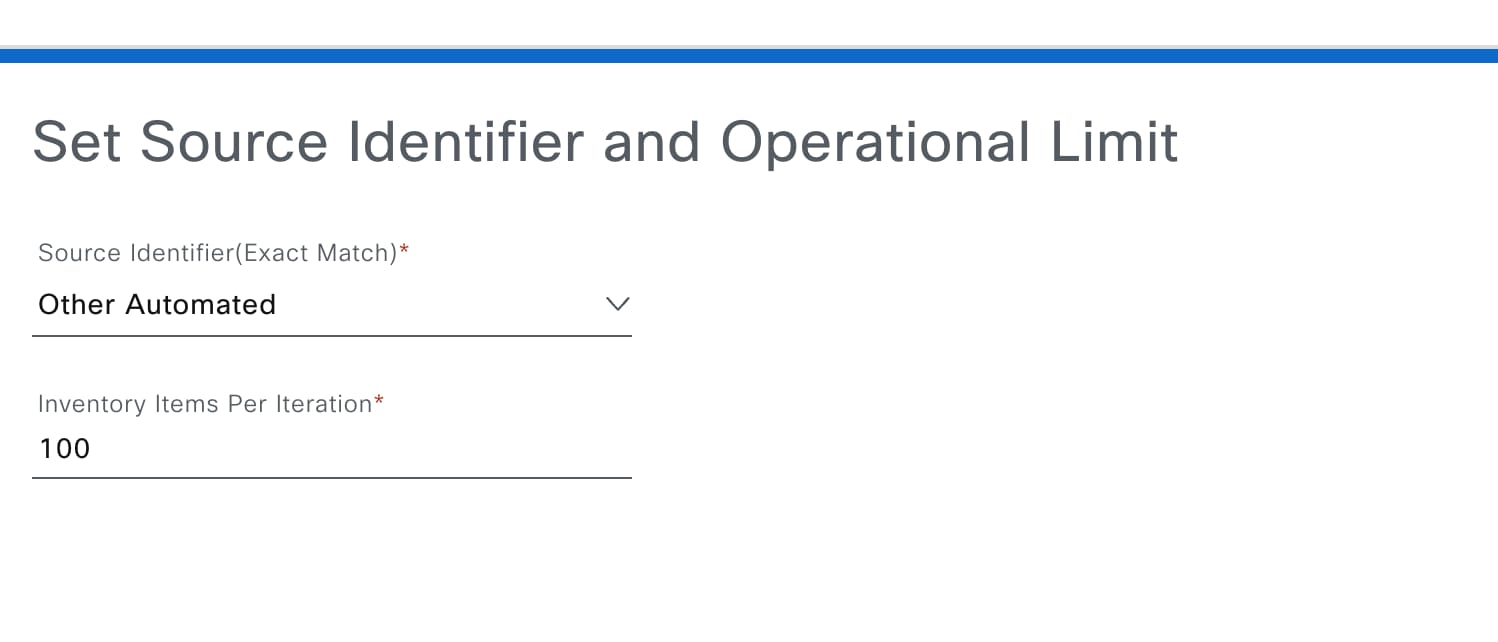
Step 20
In the Set Source Identifier and Operational Limit window, configure the data source and maximum limit.
Figure 15. Set Source Identifier and Operational Limit window
Configure these values:
Source Identifier (Exact Match): Enter the same value as previously selected or keep the value at its default, Other Automated.
Synchronize device inventory directly with CMDB
Post device inventory details to a staging table
Note
Other Automated is a preconfigured value for the discovery source attribute in an OOB ServiceNow instance. This is the value that indicates
the data source from where the ServiceNow CI was discovered. As a default, one of the existing preconfigured values is used
for the integration.
We recommend that you create your own discovery source, so as to uniquely identify the source from where the devices were
fetched to synchronize into the ServiceNow instance. The steps to create a new discovery source are described in the ServiceNow
App 'Installation and Configuration guide'.
Inventory Items Per Iteration: Maximum number of devices that can be synchronized in an iteration (single API call). We recommend that you set the limit
to 100 devices.
After entering the information, click Next.
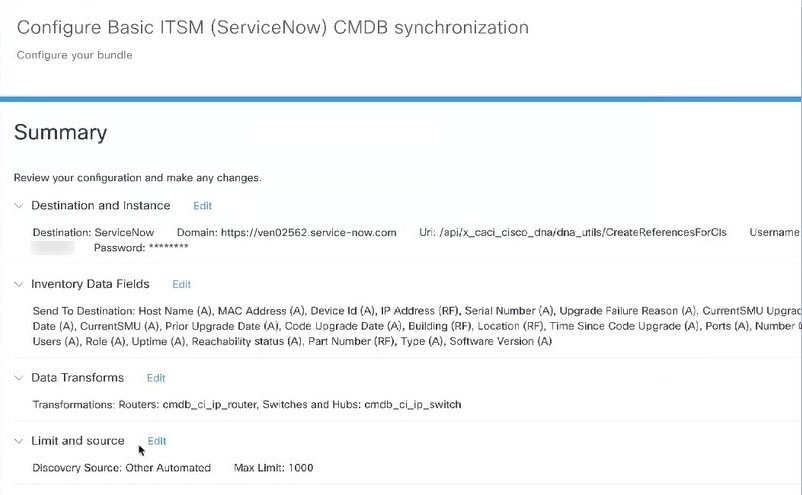
Step 21
In the Summary window, review the configuration summary.
Figure 16. Summary window
After reviewing the information, click Configure.
For a successful configuration, you will receive a Done! Bundle Configured message.
What to do next
Configure the Integration Flow for this bundle (Schedule to Publish Inventory Details - ServiceNow Connector), using one of the methods described in Step 8.
You can also test the CMDB synchronization by doing these tasks:
From the main menu, choose Platform > Runtime Dashboard > CMDB Synchronization Summary. Click Refresh to update the GUI view. Review the inventory device synchronization status to ServiceNow.
From the main menu, choose Platform > Runtime Dashboard > Event Summary. Click Refresh to refresh the GUI view. Click the individual events in the window to view the event data and access links to ServiceNow.
Go to ServiceNow and search for a synchronized device. Check the Configuration and Other Attributes tabs for synchronized data in that device's record.
Configure the network issue monitor and enrichment for ITSM (ServiceNow) bundle
Use this procedure to monitor network assurance and maintenance issues and to publish event details to a ServiceNow platform.
Note
Closed loop automation is supported for assurance events between Catalyst Center and the ServiceNow system. It is not supported
for other event types.
Closed loop automation is supported only for the REST API endpoint configured in the Network Issue Monitor and Enrichment
for ITSM (ServiceNow) bundle. The Event Management and Generic REST API endpoints in this bundle do not support automatic
ticket creation or resolution for assurance events. However, updates about resolved or ignored assurance events are sent to
these endpoints.
When an assurance event or issue is ignored or resolved in Catalyst Center, the system sends an update to ServiceNow regardless
of which endpoint is configured in the Automation Events for ITSM (ServiceNow) Bundle.
To publish event data to the Event table in ServiceNow, install the Event Management plug-in in your ServiceNow instance. Otherwise, you can configure the bundle
to send the data to a REST API endpoint in the Cisco Catalyst app.
Before you begin
You must have the appropriate permissions to complete the steps described in this procedure. For information about role-based
access control for the Catalyst Center platform, see the Cisco Catalyst Center Platform User Guide.
Procedure
Step 1
From the main menu, choose Platform > Manage > Bundles.
Review the displayed bundles and their current status.
Step 2
Click the Network Issue Monitor and Enrichment for ITSM (ServiceNow) bundle link or icon (a colored square with an initial) for additional information about the bundle.
Additional information may include the following:
General information: Vendor, version, platform, tags displayed under the square icon.
Information: Tab that displays general information (purpose of bundle and how bundle works in the network), sample schemas, configuration
notes, and other data about the bundle.
Contents: Tab that accesses the APIs and integration flows that make up the bundle, or provides information about the integration
flows that make up the bundle.
Release Notes: Tab that displays latest release information about the bundle, including its version.
Step 3
Click each tab to review the information about the bundle.
Step 4
Click the Enable button to enable the bundle.
An Information field appears in the window.
Step 5
In the Information field, click the Enable button to confirm enabling the bundle.
When you click the Enable button to confirm, the system displays a success message.
Step 6
In the success message, click OK.
Step 7
Click the Configure button to configure the settings at the bundle level.
A configuration slide-in pane appears.
Step 8
In the configuration slide-in pane, click ServiceNow Access Settings to configure a ServiceNow Connection instance.
Step 9
Click the radio button to configure either an existing ServiceNow Connection instance or create a new instance.
Figure 17. Example of ServiceNow instance configuration fields
For configuring an existing ServiceNow Connection instance, select it from the drop-down menu in the window and click Activate.
Step 10
For configuring a new ServiceNow Connection instance, enter this additional information:
Instance Name: Name of the instance.
Description: Description of the instance.
Host name: Hostname for the ServiceNow system.
Username: Username required to access the ServiceNow system.
Password: Password required to access the ServiceNow system.
Step 11
Click Check Connectivity to test whether you can connect to the server where the endpoint is located.
After you successfully test connectivity to the server, configure Destination to receive events.
Step 12
In the configuration slide-in pane, click Destination to receive events to configure a Destination Connection instance.
Step 13
Click the radio button to configure either an existing Destination Connection instance or configure a new instance.
Figure 18. Example of Destination to receive events configuration fields
For configuring an existing Destination Connection instance, select it from the drop-down menu in the window and click Activate.
Step 14
For configuring a new Destination instance, this additional information must be entered:
Instance Name: Name of the instance.
Description: Description of the instance.
Destination to receive events: Select one of these options:
Event Management: When setting up Catalyst Center integration with ServiceNow without using the Cisco Catalyst app, select the Event Management option. The Event Management option also requires that you have the Event Management plug-in configured within the ServiceNow instance.
REST API Endpoint: The REST API Endpoint option can be used with the Cisco Catalyst app. With this option, data is sent to a REST API endpoint within the Cisco Catalyst app.
Note
When a network event or issue is ignored or resolved in Catalyst Center, an event status update is sent to the Cisco Catalyst app in ServiceNow, and the ticket created for the event in ServiceNow is closed automatically.
Generic REST Endpoint in ServiceNow: With this option, you can send the data to a different staging table in ServiceNow.
Note
Use this destination type to send data to a REST API endpoint outside the Cisco Catalyst app. Ensure that the created staging table/import set table has a field called u_event_details. The event details from Catalyst Center are mapped to this field. With the Generic REST Endpoint in ServiceNow destination type, after data transfer, you must write custom code to use the data from the staging table and create tickets
in ServiceNow.
Destination URI: Enter a destination URI (Uniform Resource Indicator) for the Generic REST Endpoint in ServiceNow option. This field is mandatory for this option.
After entering this information, proceed to the next step.
Step 15
Click Activate to save your changes and activate the bundle or click Cancel to cancel the configuration and close the slide-in pane.
The changes made to the bundle take effect immediately, and the bundle status changes from ENABLED to ACTIVE.
Configure event settings
The Catalyst Center platform and ITSM integration allows you to select from a list of possible issues. You can create and modify the severity of events,
incidents, or problems in ServiceNow to match your business priorities. You do these tasks in the Events Settings window.
Note
For this release, there are no SWIM events to configure in Event Settings. You can configure only network assurance events.
Important
The Event Settings window and its functionality are only applicable to events for an ITSM (ServiceNow) integration and not for events configured
to other destinations. For events configured to a webhook or other destination, click the link at th top of the columns to
access the Events window. Use the Events window to configure events for an email, webhook, or SNMP trap.
Figure 19. Events Settings window
Before you begin
You must have the appropriate permissions to complete the tasks as described in this procedure. For information about role-based
access control for the Catalyst Center platform, see the Cisco Catalyst Center Platform User Guide.
Procedure
Step 1
From the main menu, choose Platform > Manage > Configurations.
A Configurations window opens that contains an Events Settings section.
Severity: P1 (Severity 1) through P5 (Severity 5).
Note
Assign Severity 1 to the events with most important or critical priority.
Workflow: Incident, Problem, Event, or RFC (Request for Change).
Actions: Edit.
You can adjust what is displayed in the table by clicking the Filter icon and using the filter, or by typing a keyword in the Find field. For example, to display all access point notifications, type AP in the Find field. To view all network notifications, type Network in the Find field. To view all severity notifications, type 1 in the Find field.
Step 3
Click Edit in the Actions column to edit an event.
Select a setting by clicking the downward pointing angle and adjust the value. For example, click Network and adjust to App. This changes the event type from a network type to an application type. Click Severity and adjust to 1 from 5. This raises the severity level from 5 to 1.
Step 4
Click the box next to the event name to enable notifications.
This enables notifications through Catalyst Center when the event occurs.
Step 5
Click Save.
Configure the automation events for ITSM (ServiceNow) bundle
Follow this procedure to monitor and publish events that require device provisioning activities, software image updates for
compliance, security, or other operational triggers to a ServiceNow system.
Note
You can publish the event data to the Event table in ServiceNow if you have the Event Management plug-in in your ServiceNow instance. If not, you can configure the bundle
to send the data to a REST API endpoint in the Cisco Catalyst app.
Enable ITSM in Catalyst Center to control device provisioning activities and group-based policy changes through a ServiceNow approval process. You do not
need to enable ITSM for software image updates, because SWIM ignores Visibility and Control of Configurations settings. For
more information about enabling ITSM approval, see the Configure System Settings chapter in the Cisco Catalyst Center Administrator Guide.
Before you begin
You must have the appropriate permissions to complete the steps described in this procedure. For information about role-based
access control for the Catalyst Center platform, see the Cisco Catalyst Center Platform User Guide.
Procedure
Step 1
From the main menu, choose Platform > Manage > Bundles.
Review the displayed bundles and their status.
Step 2
Click the Automation Events for ITSM (ServiceNow) bundle link or icon (a colored square with an initial) to access more information
about the bundle.
Additional information may include:
General information: Vendor, version, platform, tags displayed under the square icon.
Information: Tab that displays general information (purpose of bundle and how bundle works in the network), sample schemas, configuration
notes, and other data about the bundle.
Contents: Tab that accesses the APIs and integration flows that make up the bundle, or provides information about the integration
flows that make up the bundle.
Release Notes: Tab that displays latest release information about the bundle, including its version.
Step 3
Click each tab to review the information about the bundle.
Step 4
Click Enable to enable the bundle.
An Information field appears in the window.
Step 5
Click Enable in the Information field to confirm enabling the bundle.
After clicking Enable to confirm, a success message appears.
Step 6
Click OK in the success message.
Step 7
Click Configure to configure settings at the bundle level.
A configuration slide-in pane appears.
Step 8
In the configuration slide-in pane, click Automation Events Workflow Selection to select events relating to software image updates, changes to configuration of network devices and group based policy updates
that require ITSM integration. You can select one, several, or all available events.
Step 9
Click the radio button to configure an existing ServiceNow Connection instance or configure a new instance.
Figure 20. Example of Automation Events Workflow Selection configuration fields
To configure an existing ServiceNow Connection instance, select it from the drop-down list and click Activate.
Step 10
To configure a new ServiceNow Connection instance, enter this additional information:
Instance Name: Name of the instance.
Description: Descriptive text of the instance.
Software Image Management: Select true from the drop-down list to enable ITSM integration of events relating to software image updates.
Network Provisioning: Select true from the drop-down list to enable ITSM integration of events relating to configuration changes of network devices.
Group Based Policies: Select true from the drop-down list to enable ITSM integration of events relating to group based policy updates.
Step 11
In the configuration slide-in pane, click ServiceNow Access Settings to configure a ServiceNow Connection instance.
Step 12
Click the radio button to configure either an existing ServiceNow Connection instance or configure a new instance.
Figure 21. Example of ServiceNow instance configuration fields
To configure an existing ServiceNow Connection instance, select it from the drop-down list in the window and click Activate.
Step 13
To configure a new ServiceNow Connection instance, you must enter this additional information:
Instance Name: Name of the instance.
Description: Descriptive text of the instance.
Host name: Hostname for the ServiceNow system.
Username: Username required to access the ServiceNow system.
Password: Password required to access the ServiceNow system.
Step 14
Click Check Connectivity to test whether you can connect to the server where the endpoint is located.
Activate the bundle after successfully testing connectivity to the server.
Step 15
In the configuration slide-in pane, click Destination to receive events to configure a Destination Connection instance.
Step 16
Click the radio button to configure either an existing Destination Connection instance or configure a new instance.
Figure 22. Example of Destination to receive events configuration fields
To configure an existing Destination Connection instance, select it from the drop-down menu in the window and click Activate.
Step 17
To configure a new Destination instance, you must enter this additional information:
Instance Name: Name of the instance.
Description: Descriptive text of the instance.
Destination to receive events: Select one of these options:
Event Management: When setting up Catalyst Center integration with ServiceNow without using the Cisco Catalyst app, select the Event Management option. The Event Management option requires that you have the Event Management plug-in that is configured within the ServiceNow instance.
REST API Endpoint: You can use the REST API Endpoint option with the Cisco Catalyst app. Data is sent to a REST API endpoint within the Cisco Catalyst app with the REST API Endpoint option.
Generic REST Endpoint in ServiceNow: For the Generic REST Endpoint in ServiceNow option, you can send the data to a different staging table in ServiceNow.
Note
Use this destination type to send data to a REST API endpoint outside the Cisco Catalyst app. Ensure that the created staging table/import set table has a field called u_event_details. The event details from Cisco Catalyst are mapped to this field. With the Generic REST Endpoint in ServiceNow destination type, after data transfer, you must write custom code to use the data from the staging table and create tickets
in ServiceNow.
Destination URI: Enter a destination Uniform Resource Indicator (URI) for the Generic REST Endpoint in ServiceNow option. This field is mandatory for this option.
After entering this information, proceed to the next step.
Step 18
Click Activate to save your changes and activate the bundle, or click Cancel to cancel the configuration and close the slide-in pane.
Note
Click Activate to apply changes to the bundle immediately. The status of the bundle changes from ENABLED to ACTIVE.
Configure the Cisco SD-Access integration with ITSM (ServiceNow)
With the Cisco SD-Access integration, you can monitor and publish fabric events that require role updates for security or
operational reasons in ITSM (ServiceNow). You can also trigger or schedule synchronization between Catalyst Center devices and the ServiceNow CMDB system.
Before you begin
Ensure that you have ServiceNow running on a system that you plan to integrate with Catalyst Center platform.
Run a successful Discovery job in Catalyst Center. You can check whether a Discovery job is successful in Device Inventory. From the main menu, choose Provision > Inventory to view the results.
You must have the appropriate permissions to complete the steps described in this procedure. For information about role-based
access control for the Catalyst Center platform, see the Cisco Catalyst Center Platform User Guide.
Procedure
Step 1
From the main menu, choose Platform > Manage > Bundles.
Configure access settings to ServiceNow for the Cisco SD-Access-ServiceNow instance. From the main menu, choose System > Settings > External Services.
Step 5
In the left pane, click Destination and select ITSM to add or edit a ServiceNow instance. For more information, see Configure ITSM Integration in the Cisco Catalyst Center Platform User Guide.
Step 6
Add a device to the fabric and assign a role to meet your requirements. The role can be control plane, border, or edge. From the main menu, choose Provision > Fabric.
blue
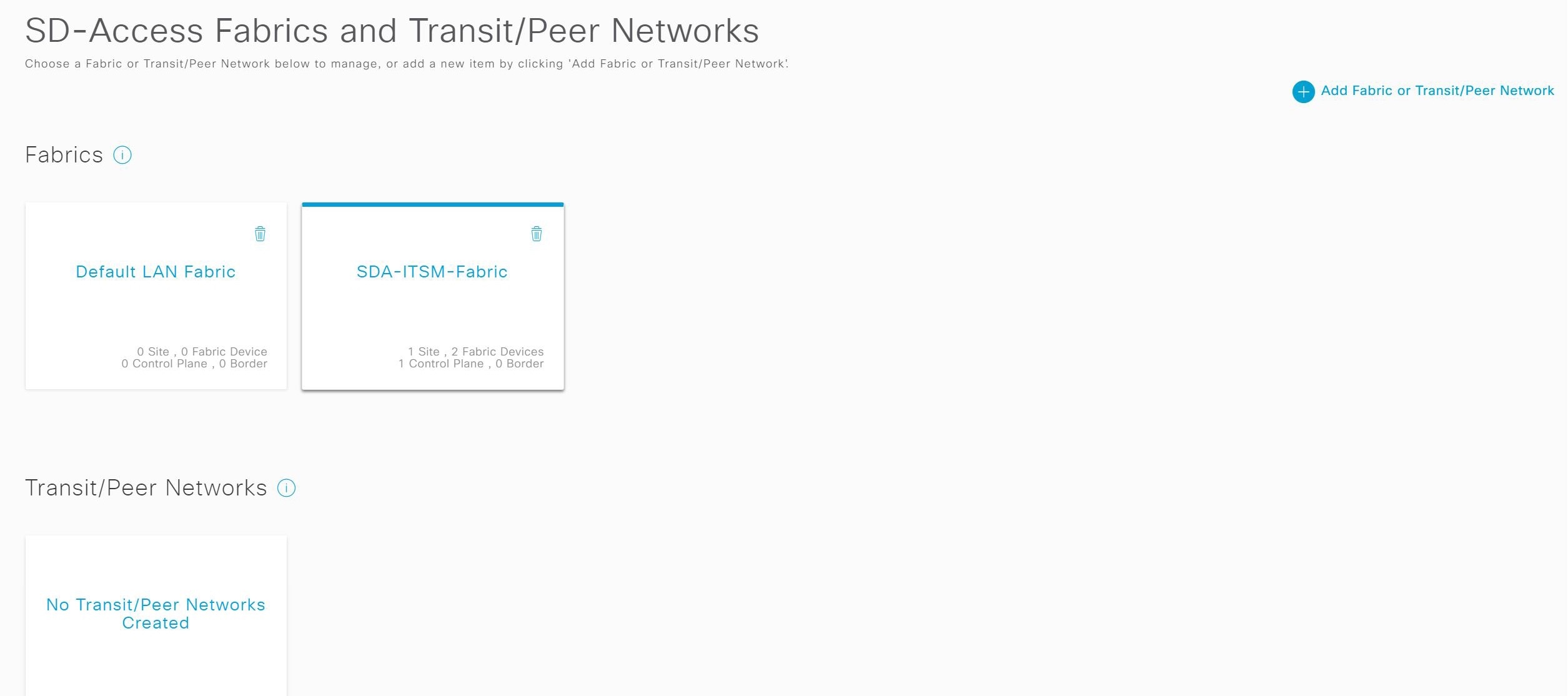
You can view all provisioned fabric domains in the window.
Step 7
From the list of fabric domains, select SDA-ITSM-Fabric.
Figure 23. Catalyst Center Platform fabrics
The screen displays all the fabric sites in the domain.
Step 8
Select a fabric site.
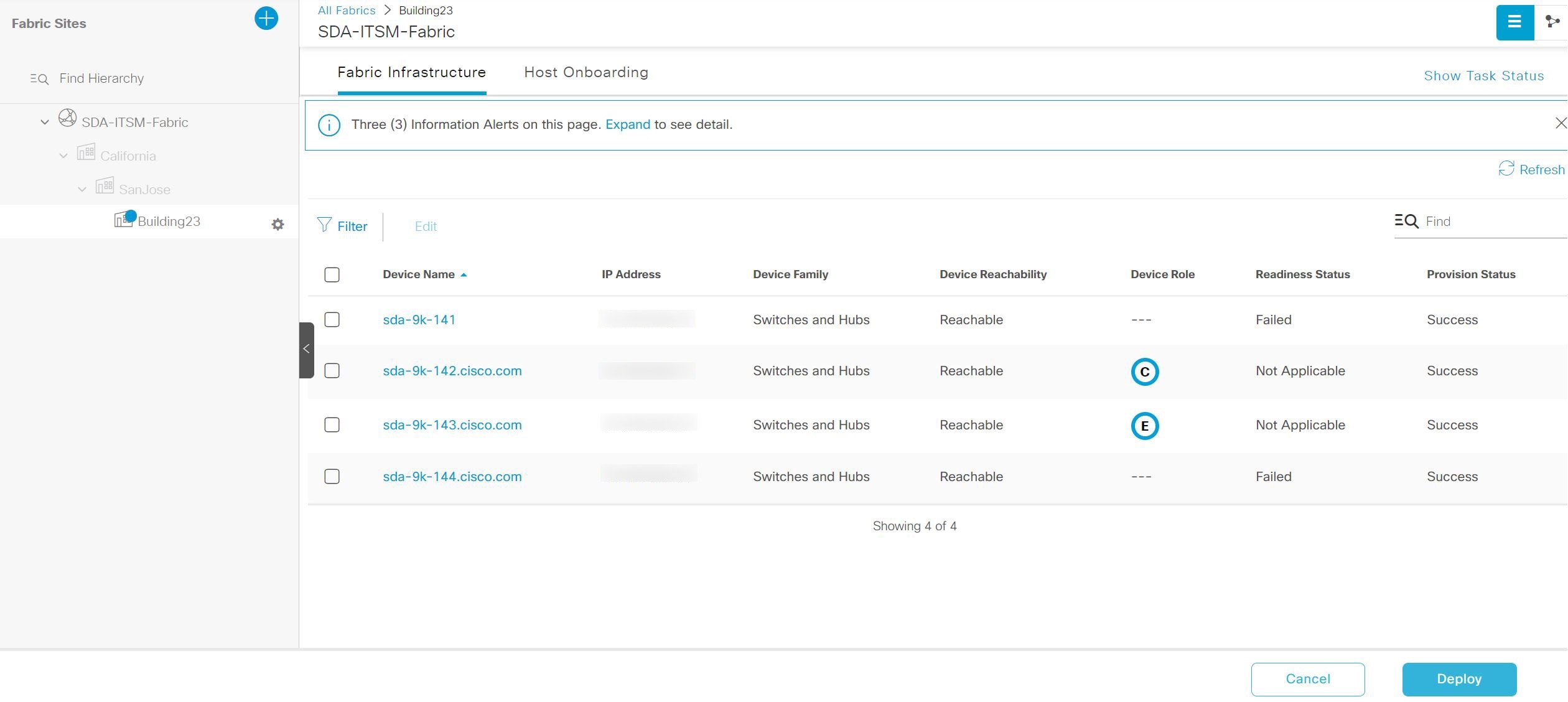
The Fabric Infrastructure table lists all devices in the network that have been inventoried.
Note
A blue circle indicates any device you add to the fabric in the Device Role column.
Figure 24. List of devices in Fabric Infrastructure
Step 9
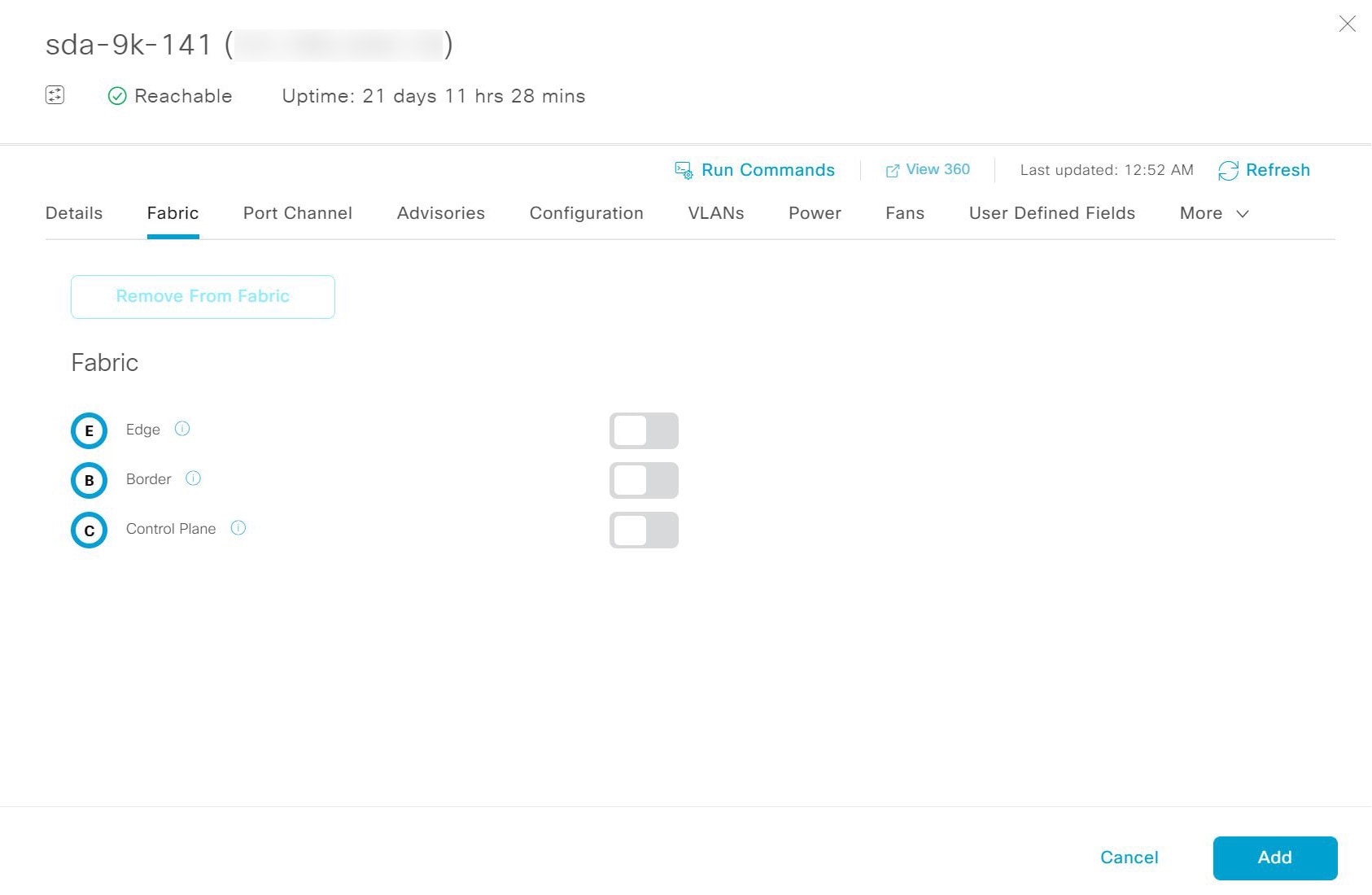
In the list view, click a device. The device details window slides in with these Fabric options:
Option
Description
Edge
Click the toggle button next to this option to enable the selected device as an edge node.
Border
Click the toggle button next to this option to enable the selected device as a border node.
Control Plane
Click the toggle button next to this option to enable the selected device as a control plane node.
Note
To configure a device as a fabric-in-a-box, select the Control Plane, Border, and Edge options.
To configure the device as a control plane and a border node, select both Control Plane and Border.
Step 10
Click Add.
Step 11
(Optional) To remove a device from the fabric, select the device and in the device slide-in pane, click Remove From Fabric.
Figure 25. Device Roles of a Fabric
Step 12
Click Deploy to assign the device role.
Step 13
In the Modify Fabric Domain window, click Now to create a ticket immediately or click Later to schedule the ticket creation at a specific time.
Step 14
Click Apply.
Note
If you select Later to schedule a ticket creation at a specific time, the request goes to the Catalyst Center scheduler.
Step 15
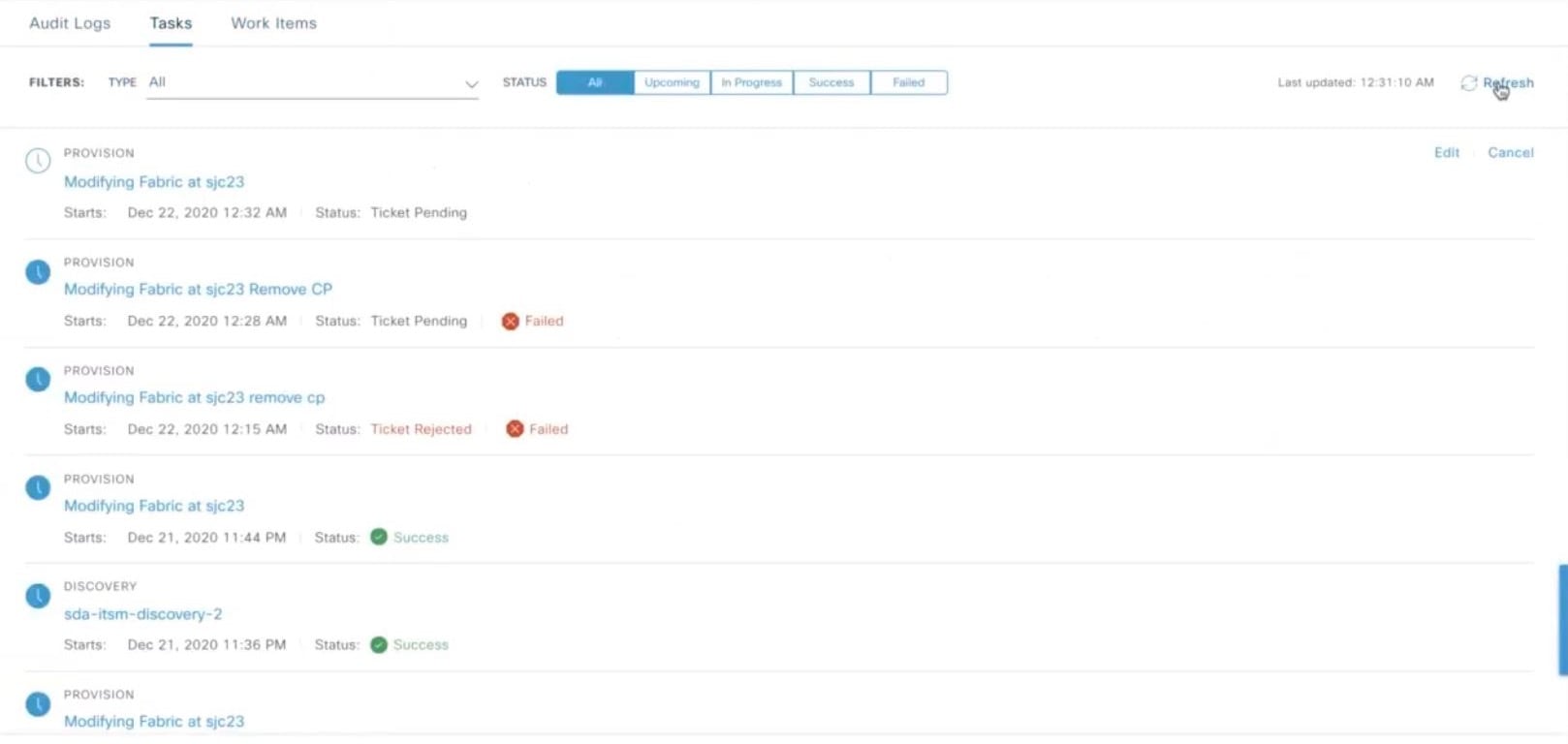
From the main menu, choose Activities > Tasks to view upcoming, in-progress, successful, and failed fabric tasks.
Step 16
In the Tasks window, the ticket status summary displays this information:
Status of the fabric ticket request: Ticket Approved, Ticket Rejected, or Failed.
Timestamp of the fabric ticket.
Figure 26. Status of fabric ticket requests
Step 17
To view the event summary of the Cisco SD-Access provision creation request, click the menu icon and choosePlatform > Runtime Dashboard > SDA Provision Creation Request.
The SDA Provision Creation Request slide-in pane displays the Event ID, Source, Destination, ITSM Workflow, ITSM Status, ITSM ID, ITSM Link, ITSM Last Updated
Time, ITSM Entity Severity/Priority, and Event Severity of an individual fabric event. For more information, see Review the Event Summary in the Cisco Catalyst Center Platform User Guide.
Catalyst Center endpoint attribute retrieval with ServiceNow
With this Catalyst Center release, you can configure Catalyst Center endpoint attribute retrieval with ServiceNow using the Cisco Catalyst app (version 2.3.1). You can schedule a synchronization or trigger an update between endpoint inventory and your ITSM (ServiceNow)
configuration management database (CMDB) using this app. Use endpoint attribute information from ServiceNow to profile endpoints
in your network. ServiceNow appears in the endpoint profiling workspace as an additional probe. Create custom profiling rules
using the attributes sent by ServiceNow.
Mapping between the ServiceNow CMDB fields and endpoint attributes occurs at the platform level. This process is accomplished
using the Endpoint Attribute Retrieval with ITSM (ServiceNow) bundle. Configure the Scheduler for ServiceNow Asset Sync integration flow to run on a set schedule. This setup invokes an internal Cisco API that retrieves endpoint attribute information
from ServiceNow.
This table describes the procedure to configure Catalyst Center endpoint attribute retrieval with ServiceNow.
Note
This procedure does not modify or delete any CIs on the existing ITSM (ServiceNow) tool.
Table 5. Catalyst Center endpoint attribute retrieval with ServiceNow
Step
Description
Step 1
Install or upgrade to the latest Catalyst Center release.
See your ServiceNow documentation for the installation and upgrade procedures.
Note
This procedure must be done by a ServiceNow administrator.
Step 3
Download and install the Cisco Catalyst app (version 2.3.1) into ServiceNow by following the documentation available at the ServiceNow website.
Note
Catalyst Center supports an application (Catalyst Center) that facilitates endpoint attribute retrieval with an ITSM (ServiceNow). This application or app is designed to work with
ServiceNow without its Event Management plug-in.
Click this link to access the ServiceNow Store website where the Cisco Catalyst app is located:
The Catalyst Center platform is enabled in Catalyst Center.
Configure and activate the required bundle or bundles in the Catalyst Center platform. For more information, see the procedures in the next section.
Note
These bundles have the required APIs that integrate with the Cisco Catalyst app in ServiceNow.
Configure the Endpoint Attribute Retrieval Bundle with ITSM (ServiceNow)
Perform this procedure to configure Catalyst Center endpoint attribute retrieval from the ServiceNow CMDB.
Before you begin
Ensure that you have ServiceNow running on a system that you will integrate with Catalyst Center platform.
You must have the appropriate permissions to completed the steps described in this procedure. For information about role-based
access control for the Catalyst Center platform, see the Cisco Catalyst Center Platform User Guide.
Ensure that you have installed or upgraded the latest Catalyst Center release with Cisco ISE version 3.1 or later.
Note
When configuring the ISE Configuration in the Cisco AI Endpoint Analytics configuration window, select the Enhanced Authorization Integration check box to avoid duplicate data being sent to Cisco ISE. For more information, see Publish Authorization Attributes to Cisco ISE in the Cisco Catalyst Center User Guide.
Procedure
Step 1
From the main menu, choose Platform > Manage > Bundles.
Review the displayed bundles and their current status.
Step 2
Click the Endpoint Attribute Retrieval with ITSM (ServiceNow) bundle link or icon (colored square with initial) for additional information about the bundle.
Additional information may include these details:
General information: Vendor, version, platform, tags displayed under the square icon.
Information: Tab that displays general information (purpose of bundle and how bundle works in the network), sample schemas, configuration
notes, and other data about the bundle.
Note
The specific endpoint attribute data that is retrieved is displayed in the Information tab. This endpoint attribute data will be retrieved from ServiceNow (with the display name in Catalyst Center within the parenthesis):
Asset Tag (CMDB asset tag)
Model Category (CMDB model category)
Model (CMDB model)
Managed by (CMDB managed by)
Serial Number (CMDB serial number)
Location (CMDB location)
Department (CMDB department)
MAC address (CMDB MAC address)
Display Name (CMDB display name)
Contents: Tab that accesses the APIs and integration flows that make up the bundle, or provides information about the integration
flows that make up the bundle.
Release Notes: Tab that displays the latest release information about the bundle, including its version.
Step 3
Click the Contents tab.
Step 4
Click the Integration Flows header.
The integration flows appear underneath the header.
Step 5
Click the Enable button to activate the integration flow links.
An Information field appears in the window.
Step 6
In the Information field, click the Enable button to confirm enabling the bundle.
After clicking the Enable button to confirm, a success message appears.
Step 7
Click Okay in the success message.
Step 8
Click the link for the individual integration flow to do these tasks.
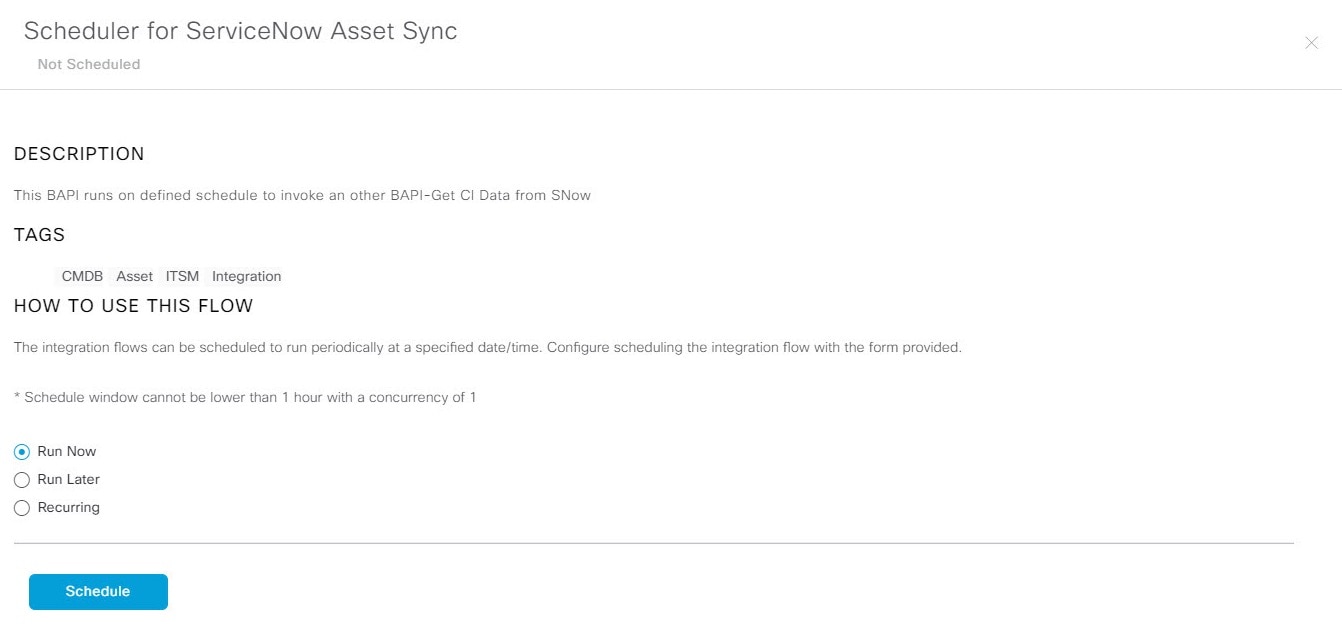
To perform the schedule-based integration flow (Scheduler for ServiceNow Asset Sync), complete these tasks:
Review the Description, Tags, How to Use this Flow, and scheduler.
Click Run Now to run the scheduler immediately. Click Run Later to schedule for a later time. Click Recurring to set up a recurring schedule.
To use Run Later, select a date, time, and time zone. To use Recurring, set a repeating interval (hourly, daily, or weekly), specify the interval duration (minutes or hours), and choose a start
and end date.
Click Schedule to enable the scheduler.
Important
After you configure the bundle, set up and enable the integration flow schedule. Return to this view and click Schedule. You can also click View Flows link in the Endpoint Attribute Retrieval with ITSM (ServiceNow)slide-in pane. You may also navigate to click the menu icon and choosePlatform > Developer Toolkit > Integration Flows > Scheduler for ServiceNow Asset Sync.
When you perform the synchronization once, it is always a full sync.
The incremental sync is performed only on the scheduled synchronization.
The Recurring synchronization is scheduled synchronization, while the Run Later synchronization is a one-time sync.
The first occurrence of recurring synchronization is also a full sync. You must configure a minimum of two occurrences for
the recurring synchronization.
To complete the first full synchronization, you must configure the synchronization schedule with an hourly difference of at
least two hours.
Figure 27. Scheduler for ServiceNow Asset Sync
Step 9
Click the X icon to return to the previous bundle window.
Step 10
Click the Configure button to configure at the bundle level.
A configuration slide-in pane appears. Review the Configure Endpoint Attribute Retrieval with ITSM (ServiceNow) information.
Step 11
Click the Configure button to configure at the bundle level.
A configuration slide-in pane appears.
Step 12
In the configuration slide-in pane, click ServiceNow Access Settings to configure a ServiceNow Connection instance.
Step 13
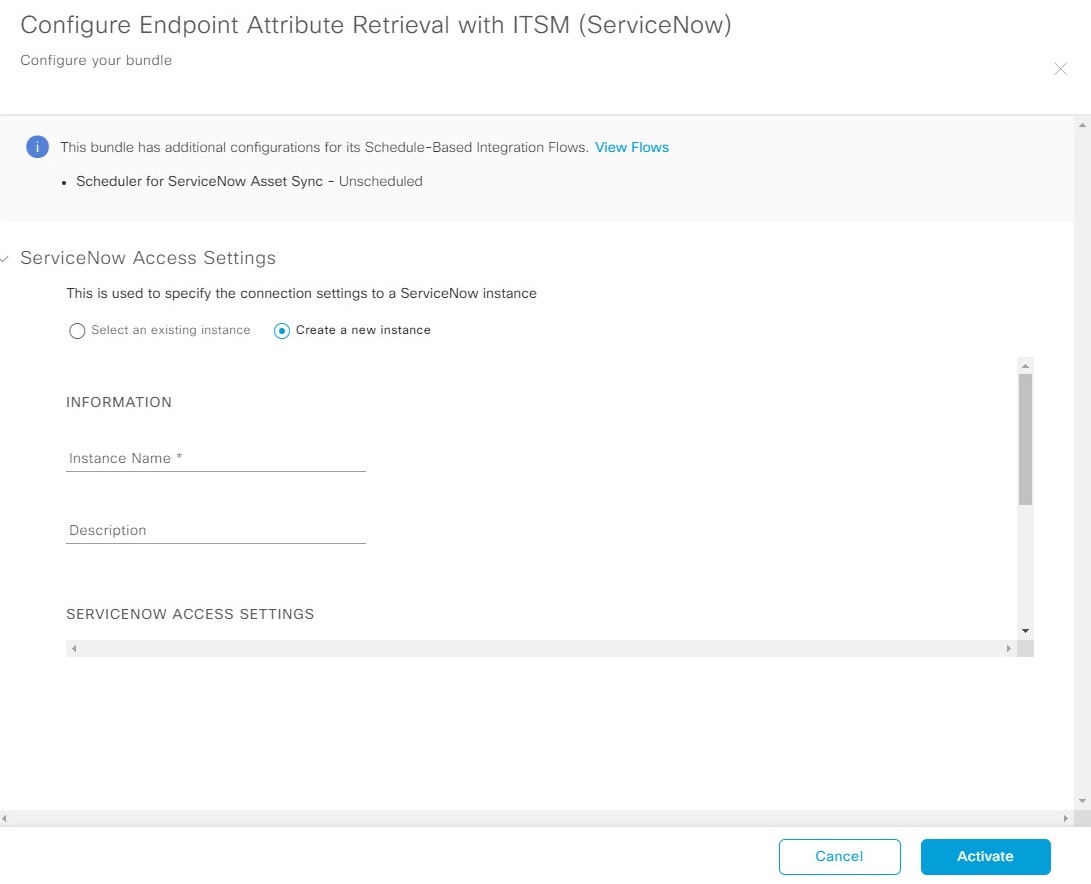
Click the radio button to configure an existing ServiceNow Connection instance, or configure a new instance.
Figure 28. Example of ServiceNow Instance Configuration Fields
To configure an existing ServiceNow Connection instance, select it from the drop-down menu in the window and click Activate.
Step 14
To configure a new ServiceNow Connection instance, you must enter this additional information:
Instance Name: Name of the instance.
Description: Descriptive text of the instance.
Host name: Hostname for the ServiceNow system.
Username: Username required to access the ServiceNow system.
Password: Password required to access the ServiceNow system.
Step 15
Click Check Connectivity to test whether you can connect to the server where the endpoint is located.
Step 16
Expand the Synchronization Options to define the incremental sync of endpoints and do these steps:
Click the Create a new instance radio button and configure a new ServiceNow connection instance:
In the INFORMATION area, enter the instance name and description.
In the SYNCHRONIZATION OPTIONS area, check the Incremental Sync check box to select the incremental sync of endpoints and specify the maximum limit for incremental sync records to pull
in each cycle.
Use Incremental Sync, which retrieves all the data from ServiceNow and in later interactions, pulls only the modified data.
Note
You can specify a maximum of 100 incremental sync records.
When you set up the synchronization for the first time, it is performed in full sync, even if it is an incremental sync.
When you edit the synchronization settings, it is done in full sync, even if it is an incremental sync.
Step 17
Click Save to save the bundle.
What to do next
Configure the integration flow (Scheduler for ServiceNow Asset Sync) for this bundle, using one of the available methods.

 Feedback