Cisco N9300 Platform Switches Data Sheet
Available Languages
Bias-Free Language
The documentation set for this product strives to use bias-free language. For the purposes of this documentation set, bias-free is defined as language that does not imply discrimination based on age, disability, gender, racial identity, ethnic identity, sexual orientation, socioeconomic status, and intersectionality. Exceptions may be present in the documentation due to language that is hardcoded in the user interfaces of the product software, language used based on RFP documentation, or language that is used by a referenced third-party product. Learn more about how Cisco is using Inclusive Language.
Organizations everywhere recognize that changing application environments are creating new demands for the IT infrastructure that supports them. Application workloads are deployed across a mix of virtualized and nonvirtualized server and storage infrastructure, requiring a network infrastructure that provides consistent connectivity, security, and visibility across a range of bare-metal, virtualized, and cloud computing environments:
● Application instances are created dynamically. As a result, the provisioning, modification, and removal of application network connectivity needs to be dynamic as well.
● Business units’ demand accelerated application deployments. IT departments have to provide shared IT infrastructure to address time-to-market needs and to increase their return on investment (ROI).
● With organizations deploying a mix of custom, open-source, and off-the-shelf commercial applications, IT departments must manage both security and quality of service (QoS) for environments that support multitenancy.
● Applications have been transitioning over time to a less monolithic, scale-out, multinode model. IT infrastructure that supports this model must scale with the speed of business and support both 10 and 40 Gigabit Ethernet connectivity.
The Cisco N9000 Series Switches include both modular and fixed-port switches that are designed to overcome these challenges with a flexible, agile, low-cost, application-centric infrastructure.
The Cisco N9300 platform consists of fixed-port switches designed for top-of-rack (ToR) and middle-of-row (MoR) deployment in data centers that support enterprise applications, service provider hosting, and cloud computing environments. They are Layer 2 and 3 nonblocking 10 and 40 Gigabit Ethernet switches with up to 2.56 terabits per second (Tbps) of internal bandwidth.
Table 1 summarizes the Cisco N9300 platform switch models.
Table 1. Cisco N9300 Platform Switches
| Model |
Description |
| Cisco N9332PQ Switch |
32 x 40-Gbps Quad Enhanced Small Form-Factor Pluggable (QSFP+) ports |
| Cisco N9372PX-E Switch |
48 x 1/10-Gbps SFP+ and 6 x 40-Gbps fixed QSFP+ ports |
| Cisco N9372TX-E Switch |
48 x 100M/1/10GBASE-T and 6 x 40-Gbps fixed QSFP+ ports |
| Cisco N9372PX Switch |
48 x 1/10-Gbps SFP+ and 6 x 40-Gbps fixed QSFP+ ports |
| Cisco N9372TX Switch |
48 x 100M/1/10GBASE-T and 6 x 40-Gbps fixed QSFP+ ports |
| Cisco N9396PX Switch |
48 x 1/10-Gbps SFP+ and up to 12 x 40-Gbps QSFP+ ports |
| Cisco N9396TX Switch |
48 x 100M/1/10GBASE-T and up to 12 x 40-Gbps QSFP+ ports |
| Cisco N93120TX Switch |
96 x 100M/1/10GBASE-T and 6 x 40-Gbps fixed QSFP+ ports |
| Cisco N93128TX Switch |
96 x 100M/1/10GBASE-T and up to 8 x 40-Gbps QSFP+ ports |
The Cisco N9332PQ Switch is a 1-rack-unit (1RU) switch that supports 2.56 Tbps of bandwidth and over 720 million packets per second (mpps) across thirty-two 40-Gbps Enhanced QSFP+ ports (Figure 1).

Cisco N9332PQ Switch
The Cisco N9372PX and N9372PX-E Switches are 1RU switches that support 1.44 Tbps of bandwidth and over 1150 mpps across 48 fixed 10-Gbps SFP+ ports and 6 fixed 40-Gbps QSFP+ ports (Figure 2). The Cisco N9372PX-E is a minor hardware revision of the Cisco N9372PX. Enhancements in the hardware are transparent in Cisco® NX-OS Software mode and offer feature parity.

Cisco N9372PX-E Switch
The Cisco N9372TX and 9372TX-E Switches are 1RU switches that support 1.44 Tbps of bandwidth and over 1150 mpps across 48 fixed 100M/1/10-Gbps BASE-T ports and 6 fixed 40-Gbps QSFP+ ports (Figure 3). The Cisco N9372TX-E is a minor hardware revision of the Cisco N9372TX. Enhancements in the hardware are transparent in NX-OS mode and offer feature parity.

Cisco N9372TX-E Switch
The Cisco N9396PX Switch is a 2RU switch that supports up to 1.92 Tbps of bandwidth and over 1500 mpps across 48 fixed 10-Gbps SFP+ ports and an uplink module (see Figures 9,10 and 11 later in this document) that can support up to 12 fixed 40-Gbps QSFP+ ports (Figure 4).
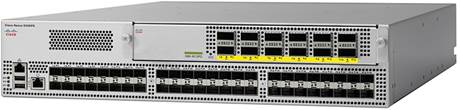
Cisco N9396PX Switch
The Cisco N9396TX Switch is a 2RU switch that supports up to 1.92 Tbps of bandwidth and over 1500 mpps across 48 fixed 100M/1/10GBASE-T ports and an uplink module (see Figures 9,10 and 11 later in this document) that can support up to 12 fixed 40-Gbps QSFP+ ports (Figure 4).
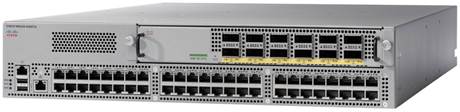
Cisco N9396TX Switch
The Cisco N93120TX Switch is a 2RU switch that supports 2.4 Tbps of bandwidth and over 750 mpps across 96 fixed 100M/1/10G BASE-T ports and 6 fixed 40-Gbps QSFP ports (Figure 6).

Cisco N93120TX Switch
The Cisco N93128TX Switch is a 3RU switch that supports up to 2.56 Tbps of bandwidth and over 750 mpps across 96 fixed 100M/1/10GBASE-T ports and an uplink module (see Figures 9,10 and 11 later in this document) that can support up to 8 fixed 40-Gbps QSFP+ ports (Figure 7).
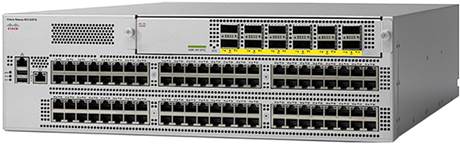
Cisco N93128TX Switch
All the Cisco N9300 platform switches use dual- core 2.5-GHz x86 CPUs with 64-GB Solid-State Disk (SSD) drives and 16 GB of memory for enhanced network performance.
With the Cisco N9000 Series, organizations can quickly and easily upgrade existing data centers to carry 40 Gigabit Ethernet to the aggregation layer or to the spine (in a leaf-and-spine configuration) through advanced and cost-effective optics that enable the use of existing 10 Gigabit Ethernet fiber (a pair of multimode fiber strands). Please see the Cisco 40GBASE QSFP modules data sheet for more details.
Cisco provides two modes of operation for the Cisco N9000 Series. Organizations can use Cisco® NX-OS Software to deploy the Cisco N9000 Series in standard Cisco Nexus switch environments. Organizations also can use a hardware infrastructure that is ready to support Cisco Application Centric Infrastructure (Cisco ACI™) to take full advantage of an automated, policy-based, systems management approach.
The Cisco N9300 platform switches are high-density, nonblocking, low-power-consuming switches designed for ToR, MoR, and end-of-row (EoR) deployment in enterprise data centers, service provider facilities, and large virtualized and cloud computing environments.
The platform offers industry-leading density and performance with flexible port configurations that can support existing copper and fiber cabling (Tables 2 and 3). With 1/10GBASE-T support, the platform can deliver 10 Gigabit Ethernet over existing copper cabling, enabling a low-cost upgrade from Cisco Catalyst® 6500 Series Switches when used in an MoR or EoR configuration.
Table 2. Cisco N9300 Platform Switches Characteristics: Fixed-Port Switches
| Model |
Cisco N9332PQ |
Cisco N9372PX and |
Cisco N9372TX and |
Cisco N93120TX |
| Ports |
32 QSFP+ ports |
48 fixed 1/10-Gbps SFP+ and 6 QSFP+ ports |
48 fixed 1/10GBASE-T and 6 QSFP+ ports |
96 fixed 1/10GBASE-T and 6 QSFP+ ports |
| Supported speeds |
40 Gigabit Ethernet speeds |
1/10 Gigabit Ethernet speeds |
100 Megabit Ethernet and 1/10 Gigabit Ethernet speeds |
100 Megabit Ethernet and 1/10 Gigabit Ethernet speeds |
| 40 Gigabit |
- |
6 fixed QSFP+ ports |
6 fixed QSFP+ ports |
6 fixed QSFP+ ports |
| Advanced QSFP+ optics enable connectivity using existing 10 Gigabit Ethernet fiber. |
||||
| The switch offers 25 MB of additional packet buffer space shared with all ports for more resilient operations. |
||||
| Power supplies (up to 2) |
650-watt (W) AC, 930W DC, or 1200W HVAC/HVDC |
650W AC, 930W DC, or 1200W HVAC/HVDC |
650W AC, 930W DC, or 1200W HVAC/HVDC |
1200W AC, 930W DC, or 1200W HVAC/HVDC |
| Typical power* (AC & DC) |
228W |
210W |
374.5W |
542W |
| Maximum power* |
508W |
537W |
694W |
948W |
| Input voltage (AC) |
100 to 240V |
100 to 240V |
100 to 240V |
100 to 240V *PSU redundancy is not supported when used in 110V |
| Input voltage (HVAC) |
200 to 277V |
200 to 277V |
200 to 277V |
200 to 277V |
| Input voltage (DC) |
-40V to -72V DC (min-max) -48V to -60V DC (nominal) |
-40V to -72V DC (min-max) -48V to -60V DC (nominal) |
-40V to -72V DC (min-max) -48V to -60V DC (nominal) |
-40V to -72V DC (min-max) -48V to -60V DC (nominal) |
| Input voltage (HVDC) |
–240 to –380V |
–240 to –380V |
–240 to –380V |
–240 to –380V |
| Frequency (AC) |
50 to 60 Hz |
50 to 60 Hz |
50 to 60 Hz |
50 to 60 Hz |
| Fans |
4 |
4 |
4 |
2 |
| Physical (H x W x D) |
1.72 x 17.3 x 22.5 in. (4.4 x 43.9 x 57.1 cm) |
1.72 x 17.3 x 22.5 in. (4.4 x 43.9 x 57.1 cm) |
1.72 x 17.3 x 22.5 in. (4.4 x 43.9 x 57.1cm) |
3.5 x 17.5 x 22.5 in. (8.9 x 44.5 x 57.1 cm) |
| Acoustics |
49.1 dBA at 40% fan speed, 65.6 dBA at 70% fan speed, and 78.5 dB at 100% fan speed |
48.5 dBA at 40% fan speed, 64.9 dBA at 70% fan speed, and 77.8 dB at 100% fan speed |
48.6 dBA at 40% fan speed, 65.2 dBA at 70% fan speed, and 76.5 dB at 100% fan speed |
|
| RoHS compliance |
Yes |
Yes |
Yes |
Yes |
Table 3. Cisco N9300 Platform Switches Characteristics: Switches with Uplink Module Slot
| Model |
Cisco N9396PX |
Cisco N9396TX |
Cisco N93128TX |
| Ports |
48 fixed SPF+ ports |
48 fixed 1/10GBASE-T ports |
96 fixed 1/10GBASE-T ports |
| Supported speeds |
1/10 Gigabit Ethernet speeds |
100 Megabit Ethernet and 1/10 Gigabit Ethernet speeds |
100 Megabit Ethernet and 1/10 Gigabit Ethernet speeds |
| 40 Gigabit |
6 or 12 QFSP+ ports active through the uplink module |
6 or 12 QFSP+ ports active through the uplink module |
6 or 8 QSFP+ ports active through the uplink module |
| Customers have the choice of either N9K-M6PQ or N9K-M12PQ for 40 Gigabit Ethernet uplink connectivity to aggregation or spine switches. |
|||
| 100 Gigabit |
Customer can have 100 Gigabit Ethernet uplink connectivity to spine switches or routers through the N9K-M4PC- uplink module, with CPF2 optics as well as the Cisco CPAK® 100-Gbps module through converters. |
||
| The N9K-M4PC-CFP2 offers 5 MB of additional buffer space for each port. |
|||
| Power supplies (up to 2) |
650W AC, 930W DC, or 1200W HVAC/HVDC |
650W AC, 930W DC, or1200W HVAC/HVDC |
930W DC, or 1200W HVAC/HVDC |
| Typical power* (AC) |
232W |
427W |
582W |
| Maximum power* (AC) |
455W |
712W |
853W |
| Input voltage (AC) |
100 to 240V |
100 to 240V |
100 to 120V (maximum output 800W) |
| 200 to 240V (maximum output 1200W) |
|||
| Input voltage (HVAC) |
200 to 277V |
200 to 277V |
200 to 277V |
| Input voltage (DC) |
–48 to –60V |
-48 to -60V |
-48 to -60V |
| Input voltage (HVDC) |
–240 to –380V |
-240 to –380V |
-240 to -380V |
| Frequency (AC) |
50 to 60 Hz |
50 to 60 Hz |
47 to 63 Hz |
| Fans |
3 |
3 |
3 |
| Physical (H x W x D) |
3.5 x 17.5 x 22.5 in. |
3.5 x 17.5 x 22.5 in. |
5.3 x 17.5 x 22.5 in. |
| Acoustics |
68.3 dBA at 40% fan speed, 78.8 dBA at 70% fan speed, and 84.5 dB at 100% fan speed |
68.3 dBA at 40% fan speed, 78.8 dBA at 70% fan speed, and 84.5 dB at 100% fan speed |
71.4 dBA at 40% fan speed, 80.2 dBA at 70% fan speed, and 85.7 dB at 100% fan speed |
| RoHS compliance |
Yes |
Yes |
Yes |
Table 4 summarizes the features of the Cisco N9300 platform.
Table 4. Cisco N9300 Platform Switch Features
| Feature |
Benefit |
| Predictable |
Latency of 1 to 2 microseconds with up to 1.28 Tbps of bandwidth enables customers to build a robust switch fabric scaling from as few as 200 10-Gbps server ports to more than 200,000 10-Gbps server ports. |
| Increased integrated |
Up to a total of 50 MB of integrated shared buffer space allows better management of speed mismatch between access and uplink ports. |
| Designed for availability |
Hot-swappable, redundant power supplies and fan trays increase availability. |
| Flexible airflow |
Port-side intake and port-side exhaust airflow configurations are both supported. |
| CPU, SSD, and memory |
Dual-core 2.5-GHz x86 CPUs with 64-GB SSD drive and 16 GB of memory provide enhanced network performance. |
| Power efficiency |
All Cisco N9000 Series power supplies are 80 Plus Platinum rated. |
| Advanced optics |
Cisco offers a pluggable 40 Gigabit Ethernet QSFP+ transceiver that enables customers to use existing 10 Gigabit Ethernet data center cabling to support 40 Gigabit Ethernet connectivity. This technology facilitates adoption of 40 Gigabit Ethernet with no cable infrastructure upgrade cost. |
The switches are designed to adapt to any data center hot-aisle and cold-aisle configuration. The switches can be installed with ports facing the rear, simplifying cabling of server racks by putting the ports closest to the servers they support. The switches can be installed with the ports facing the front, simplifying the upgrade of existing racks of switches in which network cables are wired to the front of the rack.
The two deployment modes support front-to-back cooling through a choice of power supplies and fan trays designed with opposite airflow directions, denoted by red and blue tabs (Figure 8).
The two deployment modes are available with AC power supplies. Additionally, DC power supply UCSC-PSU-930WDC (port-side intake) can be used for –48 to –60V DC (900W) deployments. For high-voltage AC or DC environments, customers can also choose the N9K-PUV-1200W, which supports either 200-277V AC or -200 to -380V DC and both airflow directions in one power supply unit.
To enhance availability, the platform supports 1+1 redundant hot-swappable 80 Plus Platinum-certified power supplies and hot-swappable N+1 redundant fan trays.
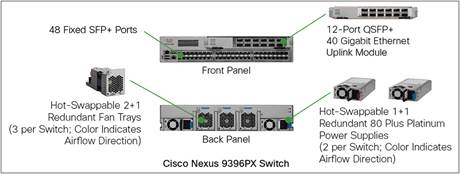
Cisco N9300 Platform Switch Components
Cisco N9300 Platform Uplink Module
The Cisco N9300 platform requires an uplink module to be installed for normal switch operation. This module can be serviced and replaced by the user. Three uplink module options are available.
The Cisco NM6PQ and NM6PQ-E uplink module provides up to 6 QSFP+ ports for 40 Gigabit Ethernet connectivity to servers or aggregation-layer switches (Figure 9). The uplink module provides 6 active ports when installed in the Cisco N93128TX, N9396TX, and N9396PX. The Cisco NM6PQ-E uplink module is a minor hardware revision of Cisco NM6PQ. Enhancements in the hardware are transparent in NX-OS mode and offer feature parity.

Cisco NM6PQ-E 6-Port QSFP+ Uplink Card
The Cisco NM12PQ uplink module provides up to 12 QSFP+ ports for 40 Gigabit Ethernet connectivity to servers or aggregation-layer switches (Figure 10). As specified earlier in Table 3, the uplink module provides 8 active ports when installed in the Cisco N93128TX, and 12 active ports when installed in the Cisco N9396PX and N9396TX. The 40 Gigabit ports on the uplink module do not support the break-out mode of four 10 Gigabit Ethernet ports, but they can be converted to a single 10 Gigabit Ethernet port with the QSFP-to-SFP adapter (QSA).

Cisco NM12PQ 12-Port QSFP+ Uplink Card
The Cisco Nexus N9K-M4PC-CFP2 uplink module provides up to 4 ports for 100 Gigabit Ethernet connectivity to aggregation-layer switches and routers (Figure 11). It supports CFP2 optics as well as Cisco CPAK 100-Gbps modules through converters. It provides 2 active ports when installed in the Cisco N93128TX, and 4 active ports when installed in the Cisco N9396PX and N9396TX.

Cisco Nexus N9K-M4PC-CFP2 4-Port 100-Gbps Uplink Card
For details about the optics modules available and the minimum software release required for each supported module, visit https://www.cisco.com/c/en/us/support/interfaces-modules/transceiver-modules/products-device-support-tables-list.html
The Cisco N9300 platform is a versatile data center switching platform with switches that can operate as ToR data center switches, as MoR and EoR access-layer switches deployed with or without Cisco fabric extender technology, and as leaf switches in a horizontally scaled leaf-and-spine architecture.
Top-of-Rack Data Center Switch
The Cisco N9300 platform is designed for a ToR architecture, with increased port density, deep integrated buffer space, and high performance (Figure 12).
With 48 fixed ports, the Cisco N9372PX/N9372PX-E, N9372TX/N9372TX-E, N9396PX, and N9396TX have enough ports to support the densest 1RU server configurations. A pair of these switches can support redundant connectivity to each server in a rack with ports to spare. In the configuration shown earlier in Figure 8, the 480‑Gbps uplink capacity from each switch is sufficient to provide full 10-Gbps bandwidth to each server with up to no oversubscription.
The Cisco N9300 platform can support multiple racks (or pods) of dense 1RU servers. For example, the 96‑port Cisco N93128TX and N93120TX can provide 10 Gigabit Ethernet connectivity to all servers across two racks, with a pair of these switches providing full redundancy. In less dense configurations with 2RU servers, the Cisco N9300 platform can support even more racks of servers in an MoR configuration.
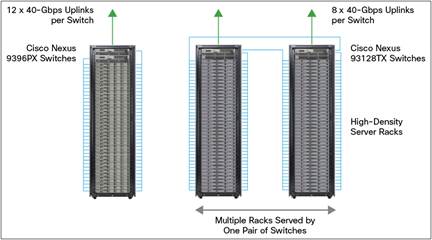
Cisco N9300 Platform Switch in ToR Configurations
End-of-Row Access-Layer Switch
In addition to being an excellent ToR switch, Cisco N9300 platform switches can be configured as MoR and EoR access-layer switches. They can connect to almost any blade or rack server through 1 and 10 Gigabit Ethernet connections including the following (Figure 13):
● Third-party and standalone Cisco Unified Computing System™ (Cisco UCS®) rack servers
● Third-party blade server chassis with chassis-resident switches or pass-through devices
● Cisco UCS
The Cisco N9396PX, N9372PX, and N9372PX-E can be used to connect both 10 and 40 Gigabit Ethernet - equipped fabric extenders, Cisco Nexus B22 Blade Fabric Extenders in Dell and HP blade chassis (not shown), and 10 Gigabit Ethernet - equipped servers and systems such as Cisco UCS. The Cisco N9372TX, N9372TX-E, N9396TX, N93120TX, and N93128TX provide excellent connectivity for large numbers of 10 Gigabit Ethernet - equipped blade or rack servers equipped with 10GBASE-T ports.
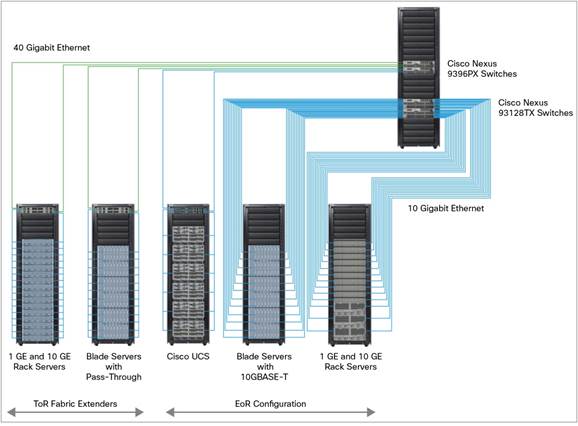
Cisco N9300 Platform Switches as EoR Access-Layer Switches With and Without Cisco Fabric Extender Technology
Collapsed Access and Aggregation Layers
As Figure 14 shows, the Cisco N9300 platform supports Cisco N2000 Series Fabric Extenders to establish a centrally managed yet physically distributed collapsed access- and aggregation-layer switch. Although each fabric extender resides physically at the top of each rack or within each blade server chassis, each device is handled as a remote line card of the Cisco N9300 platform switch, yielding massive scalability through flexible bandwidth oversubscription but with only a single point of management.
By using Cisco N2000 Series Fabric Extenders at the top of each rack, organizations can reduce the cabling complexity, overall power consumption, and number of management points. This approach facilitates a “rack-and-roll” deployment model in which individual server racks can be prewired using ToR fabric extenders, with the only connections required to bring them into the data center being network uplink and power connections.
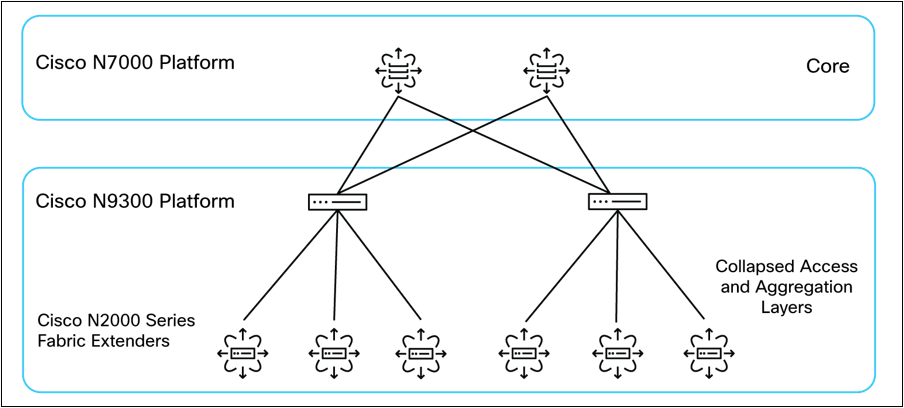
Collapsed Access and Aggregation Layers with Cisco Fabric Extenders
Leaf-and-Spine Architecture
Cisco N9300 platform switches are excellent choices for leaf switches in a leaf-and-spine architecture (Figure 15). The Layer 3 capabilities established by both the Cisco N9500 and N9300 platforms enable the two to be used with equal-cost multipath (ECMP) routing to accelerate the flow of traffic and reduce reconvergence time in the event of a failure. The degree of redundancy in a leaf-and-spine architecture delivers increased availability with a high level of flexibility in workload placement.
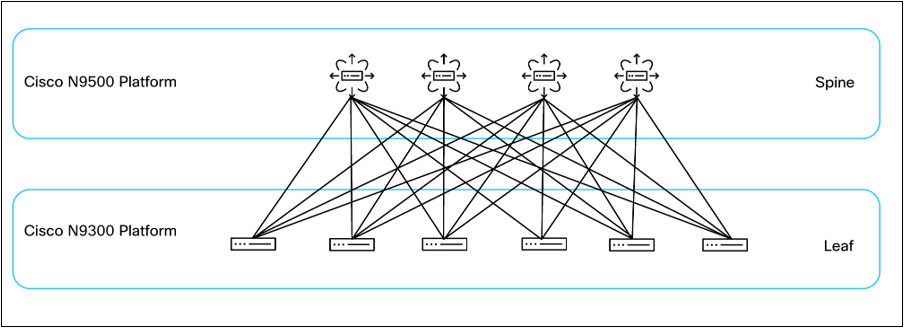
Cisco N9300 and 9500 Platforms in a Leaf-and-Spine Architecture
NX-OS is a purpose-built data center operating system designed for performance, resiliency, scalability, manageability, and programmability at its foundation. It provides a robust and comprehensive feature set that meets the demanding requirements of virtualization and automation in present and future data centers.
The Cisco N9000 Series uses an enhanced version of NX-OS with a single binary image that supports every switch in the series, simplifying image management. The operating system is modular, with a dedicated process for each routing protocol, a design that isolates faults while increasing availability. In the event of a process failure, the process can be restarted without losing state. The operating system supports hot and cold patching and online diagnostics.
Main features include the following:
● Power-On Auto Provisioning (POAP) automates the process of upgrading software images and installing configuration files on Cisco Nexus switches that are being deployed in the network for the first time.
● Intelligent API (iAPI) provides operators with a way to manage the switch through remote procedure calls (RPCs; JavaScript Object Notation [JSON] or XML) over HTTP/HTTPS infrastructure.
● Patching allows NX-OS to be upgraded and patched without any interruption in switch operations.
● Line-rate overlay support provides Virtual Extensible LAN (VXLAN) bridging and routing at full line rate, facilitating and accelerating communication between virtual and physical servers as well as between multiple data centers in a campus environment.
● Network traffic monitoring with Cisco Nexus Data Broker builds simple, scalable, and cost-effective network taps or Cisco Switched Port Analyzer (SPAN) aggregation for network traffic monitoring and analysis.
● Cisco Intelligent Traffic Director allows customers to build a highly scalable and flexible solution for hardware-based Layer 4 load balancing and traffic steering.
The software packaging for the Cisco N9000 Series offers flexibility and a comprehensive feature set while being consistent with Cisco Nexus access switches. The default system software has a comprehensive Layer 2 security and management feature set. To enable additional functions including Layer 3 IP unicast and IP multicast routing and Cisco Nexus Data Broker, you must install additional licenses. The licensing guide illustrates the software packaging and licensing available to enable advanced features. For a complete list of supported features, refer to Cisco Feature Navigator.
The Cisco N9000 Series supports Cisco NX-OS Software Release 6.1 and later. NX-OS interoperates with any networking operating system, including Cisco IOS® Software that conforms to the networking standards described in this data sheet.
The Cisco N9000 Series runs NX-OS on a 64-bit Linux kernel (Release 3.4.10) with a single binary image that supports both modular (Cisco N9500 platform) and fixed-port (Cisco N9300 platform) switches. The software image is based on NX-OS Release 6.1(2). The single image incorporates both the Linux kernel and NX-OS so that the switch can be booted through a standard Linux kickstart process.
For the latest software release information and recommendations, please refer to the product bulletin at http://www.cisco.com/go/n9000.
Table 5 lists the specifications for the Cisco N9300 platform switches. (Please check software release notes for feature support information)
Performance and Scalability
Table 5. Product Specifications
| Item |
Cisco N9300 Platform |
| Maximum number of longest prefix match (LPM) routes |
128,000* |
| Maximum number of IP host entries |
208,000* |
| Maximum number of MAC address entries |
96,000* |
| Number of multicast routes |
● 32,000 (without virtual PortChannel [vPC])
● 32,000 (with vPC)
|
| Number of Interior Gateway Management Protocol (IGMP) |
● 32,000 (without vPC)
● 32,000 (with vPC)
|
| Maximum number of Cisco N2000 Series Fabric Extenders per switch |
16 |
| Number of access control list (ACL) entries |
● 4000 ingress
● 1000 egress
|
| Maximum number of VLANs |
4096 |
| Maximum number of Virtual Routing and Forwarding (VRF) instances |
1000 |
| Maximum number of links in a PortChannel |
32 |
| Maximum number of ECMP paths |
64 |
| Maximum number of PortChannels |
528 |
| Number of active SPAN sessions |
4 |
| Maximum number of Rapid per-VLAN Spanning Tree (RPVST) instances |
507 |
| Maximum number of Hot-Standby Router Protocol (HSRP) groups |
490 |
| Maximum number of Multiple Spanning Tree (MST) instances |
64 |
| Maximum number of VXLAN tunnel endpoints (VTEP) |
256 |
Table 6 lists the environmental properties of Cisco N9300 platform switches, and Table 7 lists the weight.
Table 6. Environmental Properties
| Property |
Description |
| Operating temperature |
32 to 104°F (0 to 40°C) |
| Nonoperating (storage) temperature |
-40 to 158°F (-40 to 70°C) |
| Humidity |
5 to 95% (noncondensing) |
| Altitude |
0 to 13,123 ft (0 to 4000m) |
Table 7. Weight
| Component |
Weight |
| Cisco N93128TX without power supplies, fans, or uplink module |
32.56 lb (14.8 kg) |
| Cisco N9396PX without power supplies, fans, or uplink module |
22.45 lb (10.2 kg) |
| Cisco N9396TX without power supplies, fans, or uplink module |
22.45 lb (10.2 kg) |
| Cisco N9372PX/9372PX-E without power supplies or fans |
22.2 lb (10.1 kg) |
| Cisco N9372TX/9372TX-E without power supplies or fans |
22.6 lb (10.25 kg) |
| Cisco N9332PQ without power supplies or fans |
22 lb (10.0 kg) |
| Cisco N93120TX without power supplies or fans |
26 lb (11.8 kg) |
| 650W AC power supply: N9K-PAC-650W or N9K-PAC-650W-B |
2.42 lb (1.1 kg) |
| Fan tray 1: N9K-C9300-FAN1 or N9K-C9300-FAN1-B |
0.92 lb (0.4 kg) |
| 1200W AC power supply: N9K-PAC-1200W or N9K-PAC-1200W-B |
2.64 lb (1.2 kg) |
| Fan tray 2: N9K-C9300-FAN2 or N9K-C9300-FAN2-B |
1.14 lb (0.5 kg) |
| Fan tray 3: N9K-C9300-FAN3 or N9K-C9300-FAN3-B |
1.42 lb (0.64 kg) |
| 930W DC power supply |
2.42 lb (1.1 kg) |
| 1200W HVDC/HVAC power supply |
2.42 lb (1.10 kg) |
| Cisco NM6PQ/M6PQ-E 40-Gbps uplink module (1 per switch) |
2.0 lb (0.9 kg) |
| Cisco NM12PQ 40-Gbps uplink module (1 per switch) |
3.12 lb (1.4 kg) |
| Cisco NM4PC-CFP2 100-Gbps uplink module (1 per switch) |
2.6 lb (1.2 kg) |
| Fan tray 4: NXA-FAN-30CFM-B and NXA-FAN-30CFM-F |
0.92 lb (0.4 kg) |
Regulatory standards compliance
Table 8 summarizes regulatory standards compliance for the Cisco N9300 platform switches.
Table 8. Regulatory Standards Compliance: Safety and EMC
| Specification |
Description |
| Regulatory compliance |
Products should comply with CE Markings according to directives 2004/108/EC and 2006/95/EC |
| Safety |
● UL 60950-1 Second Edition
● CAN/CSA-C22.2 No. 60950-1 Second Edition
● EN 60950-1 Second Edition
● IEC 60950-1 Second Edition
● AS/NZS 60950-1
● GB4943
|
| EMC: Emissions |
● 47CFR Part 15 (CFR 47) Class A
● AS/NZS CISPR22 Class A
● CISPR22 Class A
● EN55022 Class A
● ICES003 Class A
● VCCI Class A
● EN61000-3-2
● EN61000-3-3
● KN22 Class A
● CNS13438 Class A
|
| EMC: Immunity |
● EN55024
● CISPR24
● EN300386
● KN 61000-4 series
|
| RoHS |
The product is RoHS-6 compliant with exceptions for leaded-ball grid-array (BGA) balls and lead press-fit connectors |
For details about the optics modules available and the minimum software release required for each supported module, visit https://www.cisco.com/c/en/us/support/interfaces-modules/transceiver-modules/products-device-support-tables-list.html
Table 9 presents ordering information for the Cisco N9300 platform switches. Note that you can order the Cisco N2000 Series Fabric Extenders either separately or along with the Cisco N9300 platform switches.
Table 9. Ordering Information
| Part Number |
Product Description |
| Base Part Number |
|
| N9K-C9396PX |
N9300 with 48p 1/10G SFP+ and 12p 40G QSFP |
| N9K-C9396TX |
N9300 with 48p 100M/1/10G-T and 8p 40G QSFP |
| N9K-C93128TX |
N9300 with 96p 100M/1/10G-T and 8p 40G QSFP |
| N9K-C93120TX |
N9300 with 96p 100M/1/10G-T and 6p 40G QSFP |
| N9K-C9332PQ |
N9300 with 32p 40G QSFP |
| N9K-C9372PX-E |
N9300 with 48p 1/10G SFP+ and 6p 40G QSFP+ |
| N9K-C9372TX-E |
N9300 with 48p 100M/1/10G-T and 6p 40G QSFP+ |
| N9K-C9372PX |
N9300 with 48p 1/10G SFP+ and 6p 40G QSFP+ |
| N9K-C9372TX |
N9300 with 48p 100M/1/10G-T and 6p 40G QSFP+ |
| N9K-M6PQ-E |
Uplink Module for N9300, 6p 40G QSFP |
| N9K-M6PQ |
Uplink Module for N9300, 6p 40G QSFP |
| N9K-M12PQ |
Uplink Module for N9300, 12p 40G QSFP |
| N9K-M4PC-CFP2 |
Uplink Module for N9300, 4p 100G |
| Power Supplies |
|
| N9K-PAC-650W |
N9300 650W AC PS, Port-side Intake |
| N9K-PAC-650W-B |
N9300 650W AC PS, Port-side Exhaust |
| N9K-PAC-1200W |
N9300 1200W AC PS, Port-side Intake |
| N9K-PAC-1200W-B |
N9300 1200W AC PS, Port-side Exhaust |
| N9K-PUV-1200W |
N9300 1200W Universal Power Supply, Bi-directional air flow and Supports HVAC/HVDC |
| UCS-PSU-6332-DC |
N9000 930W DC PS, Port-side Exhaust |
| UCSC-PSU-930WDC |
N9300 930W DC PS, Port-side Intake |
| Fans |
|
| N9K-C9300-FAN2 |
N93128 & 9396 Fan 2, Port-side Intake |
| N9K-C9300-FAN2-B |
N93128 & 9396 Fan 2, Port-side Exhaust |
| NXA-FAN-30CFM-F |
N9332 & 9372 Fan, Forward airflow (Port-side Exhaust) |
| NXA-FAN-30CFM-B |
N9332 & 9372 Fan, Reverse airflow (Port-side Intake) |
| Software |
|
| N93-LAN1K9 |
Enhanced L3 including full OSPF, EIGRP, BGP |
| NX-OS-ES-XF |
NX-OS Essential SW license for a 10/25/40G+ N9K Leaf |
| NX-OS-AD-XF |
NX-OS Advantage SW license for a 10/25/40G+ N9K Leaf |
| Power Cords |
|
| CAB-250V-10A-AR |
AC Power Cord - 250V, 10A - Argentina (2.5 meter) |
| CAB-250V-10A-BR |
AC Power Cord - 250V, 10A - Brazil (2.1 meter) |
| CAB-250V-10A-CN |
AC Power Cord - 250V, 10A - PRC (2.5 meter) |
| CAB-250V-10A-ID |
AC Power Cord - 250V, 10A, South Africa (2.5 meter) |
| CAB-250V-10A-IS |
AC Power Cord - 250V, 10A - Israel (2.5 meter) |
| CAB-9K10A-AU |
Power Cord, 250VAC 10A 3112 Plug, Australia (2.5 meter) |
| CAB-9K10A-EU |
Power Cord, 250VAC 10A CEE 7/7 Plug, EU (2.5 meter) |
| CAB-9K10A-IT |
Power Cord, 250VAC 10A CEI 23-16/VII Plug, Italy (2.5 meter) |
| CAB-9K10A-SW |
Power Cord, 250VAC 10A MP232 Plug, SWITZ (2.5 meter) |
| CAB-9K10A-UK |
Power Cord, 250VAC 10A BS1363 Plug (13 A fuse), UK (2.5 meter) |
| CAB-9K12A-NA |
Power Cord, 125VAC 13A NEMA 5-15 Plug, North America (2.5 meter) |
| CAB-AC-L620-C13 |
North America, NEMA L6-20-C13 (2.0 meter) |
| CAB-C13-C14-2M |
Power Cord Jumper, C13-C14 Connectors, 2 Meter Length (2 meter) |
| CAB-C13-C14-AC |
Power cord, C13 to C14 (recessed receptacle), 10A (3 meter) |
| CAB-C13-CBN |
Cabinet Jumper Power Cord, 250 VAC 10A, C14-C13 Connectors (0.7 meter) |
| CAB-IND-10A |
10A Power cable for India (2.5 meter) |
| CAB-N5K6A-NA |
Power Cord, 200/240V 6A North America (2.5 meter) |
| CAB-HVAC-SD-0.6M |
HVAC Power cable for Anderson-LS-25 |
| CAB-HVAC-C14-2M |
HVAC power cable for C14, 2 meters (no more than 240 V) |
| CAB-HVAC-RT-0.6M |
HVAC Power cable with right angle connector for RF-LS-25 |
| Accessories |
|
| N3K-C3064-ACC-KIT |
N3K/N9K Accessory Kit |
| N9K-C9300-ACK |
N9K Fixed Accessory Kit |
| N9K-C9300-RMK |
N9K Fixed Rack Mount Kit |
The Cisco N9300 platform has a 1-year limited hardware warranty. The warranty includes hardware replacement with a 10-day turnaround from receipt of a return materials authorization (RMA).
Cisco offers a range of professional, solution, and product support services for each stage of your Cisco N9300 deployment:
● Cisco Data Center Quick Start Service for Cisco N9000 Series Switches: This service offering provides consulting services that include technical advice and assistance to help deploy Cisco N9000 Series Switches.
● Cisco Data Center Accelerated Deployment Service for Cisco N9000 Series Switches: This service delivers planning, design, and implementation expertise to bring your project into production. The service also provides recommended next steps, an architectural high-level design, and operation-readiness guidelines to scale the implementation to your environment.
● Cisco Migration Service for Cisco N9000 Series Switches: This service helps you migrate from Cisco Catalyst 6000 Series Switches to Cisco N9000 Series Switches.
● Cisco Product Support: Support service is available globally 24 hours a day, 7 days a week, for Cisco software and hardware products and technologies associated with Cisco N9000 Series Switches. Enhanced support options delivered by Cisco also include solution support for Cisco ACI, Cisco Smart Net Total Care™ Service, and Cisco Smart Net Total Care*.
For more information, visit https://www.cisco.com/go/services.
Cisco Capital
Flexible payment solutions to help you achieve your objectives
Cisco Capital makes it easier to get the right technology to achieve your objectives, enable business transformation and help you stay competitive. We can help you reduce the total cost of ownership, conserve capital, and accelerate growth. In more than 100 countries, our flexible payment solutions can help you acquire hardware, software, services and complementary third-party equipment in easy, predictable payments. Learn more.
For more information about the Cisco N9000 Series and latest software release information and recommendations, please visit https://www.cisco.com/go/n9000.
| New or revised topic |
Described in |
Date |
| Changed product name |
Throughout the data sheet |
August 2026 |