5G NRF Overview

Feature Summary and Revision History

Summary Data

Table 1. Summary Data

Applicable Product(s) or Functional Area

5G-NRF

Applicable Platform(s)

SMI

Feature Default Setting

Not Applicable

Related Changes in this Release

Not Applicable

Related Documentation

Not Applicable

Revision History

Table 2. Revision History
Revision Details Release

First introduced.

2026.01

Product Description

The Network Function (NF) Repository Function (NRF) is one of the NFs of the 5G core network (5GC). The NRF is primarily responsible for intelligent discovery of other 5G NFs. It also enables stateful node selection, dynamic NF discovery, dynamic NF services discovery, NF-NF service authorization, slice specific NF selection, topology hiding, signaling proxying as a basis for advance 5G network automation, 5G core overall flexibility, and simplicity of operations. NRF product leverages and extends key 4G product assets in area of 4G node selection and 4G diameter signaling control.

A single instance of NRF provides the following functionality:

  • Maintains the NF profile of available NF instances and their supported services.

  • Enables other NF instances to subscribe to, and get notified about, the registration, de-registeration, or updates of new NF instances in NRF.

  • Supports service discovery function.

    It receives NF discovery requests from NF instances, and provides the information of the available NF instances based on certain criteria (for example, supporting a given service or containing a specific attribute).

The NRF offers the following services to other NFs:

  • NF Management

    The services operations defined for the NF Management service are as follows:

    • NFRegister

    • NFUpdate

    • NFDeregister

    • NFStatusSubscribe

    • NFStatusNotify

    • NFStatusUnsubscribe

    • NFListRetrieval

    • NFProfileRetrieval

  • NF Discover

    The services operations defined for the NF Discover service are as follows:

    • NFDiscovery

Deployment Architecture and Interfaces

The Cisco NRF is part of the 5G core network functions portfolio with a common mobile core platform architecture. These network functions include Access and Mobility Management Function (AMF), Session Management Function (SMF), Network Function Repository Function (NRF), Policy Control Function (PCF), and User Plane Function (UPF).

NRF Architecture

The following diagram illustrates the architecture of NRF.

Figure 1. NRF Architecture

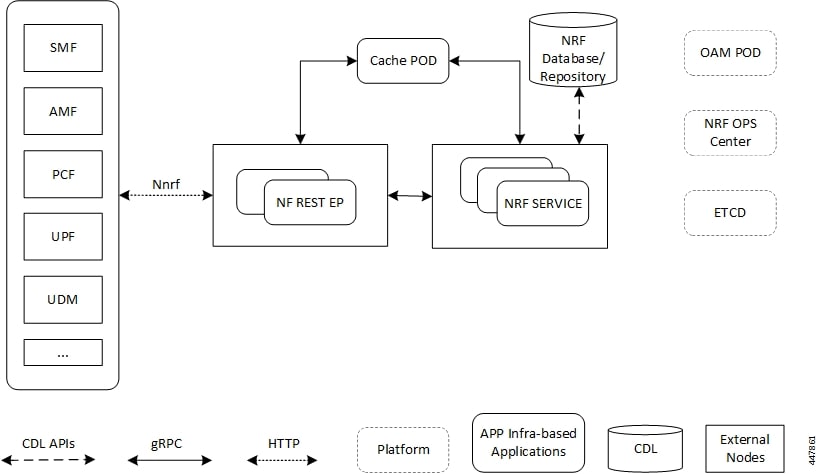
The following diagram illustrates the components of NRF.

Figure 2. NRF Components

NRF REST Endpoint

The API model definition is described using the OpenAPI specification.

OpenAPI Specification is an API description format for REST APIs. An OpenAPI file describes the entire API by describing the available endpoints, operations on each endpoint, the input, and output parameters for each operation.

The NRF REST Endpoint service is built by taking the API specification YAML as input, and the API model classes are generated using the service model framework during build time.

The Inter-process Communication (IPC) Layer is used for communication between the API Endpoint and the NRF Service Engine.

The API Endpoint service performs the following functions:

  • Starts an HTTP2 server endpoint and exposes the APIs as defined by the YAML.

  • Transforms the request from the OpenAPI generated request object to a Protocol Buffers (protobuf) based object which the worker service conforms to.

  • Uses the App Infra IPC framework to send the gRPC request with the protobuf-based object toward the engine.

The communication between the API endpoint to the engine is based on gRPC, which is handled by the App Infra IPC layer. The API endpoint acts as a gPRC client to the service exposed by the NRF Service engine.

NRF Service Engine

The NRF service engine is the entity that implements NRF business logic and interacts with the backend Datastore service to store, retrieve, update, and/or lookup data. The service engine receives the internal gRPC-based request from the API endpoint and based on the request type received, calls the appropriate service operation of the datastore endpoint.

Datastore Service

The datastore service provides backend database (DB) as a service. The datastore service exposes various methods to perform CREATE, FIND, UPDATE, and DELETE records on the backend database. The FIND operation can be based on the Primary key, the Unique keys, or a combination of non-Unique keys.

Datastore DB Record Schema

The DBRecord contains four major fields:

  • Primary key

  • Unique Keys

  • Non-Unique Keys

  • Data

Components

The NRF Cloud Native platform has the following components:

  • nrf-ops-center: The Ops Center for the NRF product which is used to configure, install, and upgrade the NRF product through CLI/API

  • nrf-rest-ep: The HTTP2-based REST endpoint for NRF based on the YAML specification.

  • nrf-service: The worker code that performs NRF business logic and interacts with the datastore service.

  • nrf-configuration: Contains configmaps charts for NRF configuration.

  • nrf-products: NRF application product pipeline that integrates all required Helm packages.

  • CDL: Provides Datastore endpoint APIs.

API

The NRF APIs are in compliance with 3GPP TS 29.510 v15.4.0. For API details, refer the UCC 5G NRF API Reference.

Supported Interfaces

NRF and other NFs in 5GC use the following:

  • Nnrf– Reference point between NRF and all the other NFs.

Use Cases and Features

This section describes the use cases that NRF supports in this release.

NF Management Service

The following sections describe use cases related to NF Management services.

NF Registration and De-registration

The NF Register and De-register service operations enable an NF instance to register or de-register its profile in the local NRF or another NRF located in the serving PLMN.

The following features are related to this use case:

Updating an NF Profile

The NFUpdate service operations enable an NF instance to update its profile in the local NRF or another NRF located in the serving PLMN.

The following feature is related to this use case:

NF Heart-Beat

The NF Heart-Beat service operation enables each NF that has previously registered in NRF to contact the NRF periodically (Heart-Beat). The NF invokes the NFUpdate service operation, in order to show that the NF is still active.

The following feature is related to this use case:

Retrieving a List of NF Profiles

The NFListRetrieval service operation enables NRF to retrieve a list of NF profiles, which are currently registered with NRF.

The NFProfileRetrieval service operation retrieves the NF profile, which matches the NF Instance ID specified in the URI.

The following feature is related to this use case:

NF Subscription, Unsubscription, and Notification in the Same PLMN

The NFStatusSubscribe service operation enables an NF instance to subscribe to notifications for profile or status changes of other NF instances.

The NFStatusUnSubscribe service operation enables an NF instance to unsubscribe the subscriptions registered in the NRF already.

The NFStatusNotify service operation enables the NRF to notify changes in status of NF instances to a subscriber of NF status. The service operation also provides information regarding newly registered and de-registered NFs.

The following features are related to this use case:

NF Discovery Service

The following section describes use cases related to NF Discovery services.

NF Discovery in the Same PLMN

The NFDiscovery service operation enables an NF instance to discover other NF instances based on their IP address(es) or FQDN. It also enables an NF instance to discover NF services that matches a certain input criteria.

The following feature is related to this use case:

Deep Validation of Service Request Parameters

NRF enables deep validation of API request parameters for all procedures. The deep validation of service requests are primarily performed at the API REST endpoints by NRF.

The following feature is related to this use case:

Hierarchical NRF Deployment in the Same PLMN

NRF supports registration and full profile update to another NRF. It also enables subscription and service discovery with intermediate forwarding NRF along with sending heart-beat messages to the registered NRF.

The following feature is related to this use case:

NRF High Availability

NRF supports an active-active model to increase the availability of its service operations toward NFs during NRF and its component failures.

The following features are related to this use case:

IPv6 Support

In this release, the NRF supports IPv6 for the following functionality:

  • The reception and processing of messages on an IPv6 network.

  • The NRF management and discovery services.

  • The NRF non-hierarchy and hierarchy deployments.

  • Sending notifications to an IPv6 address.

  • The IPv6 related IEs for applicable procedures.

The following features are related to this use case:

License Information

The NRF supports Cisco Smart Licensing. For more information, see the Smart Licensing chapter in this document.

Standards Compliance

Cisco NRF complies with the following 3GPP standards:

  • 3GPP TS 29.510 v15.4.0: 5G System; Network Function Repository Services; Stage 3 (Release 15)

  • 3GPP TS 23.502 v15.5.1

  • 3GPP TS 33.518 v0.4.0

  • 3GPP TS 33.501 v15.5.0

  • 3GPP TS 23.501 v15.5.0

  • 3GPP TS 29.500 v15.4.0

  • 3GPP TS 29.510 v15.4.0

Limitations

The NRF has the following limitation:

  • NRF recognizes timestamps in RFC3339 date-time format except for the time-stamps that have leap seconds.

    For example, NRF considers the time-stamp 1990-12-31T15:59:60-08:00 (RFC3339 format) as invalid because it does not support leap seconds.