CPC overview
Converged Policy and Charging (CPC) is a cloud-native network function (CNF) that provides unified, 3GPP-compliant policy control for both 4G and 5G networks. It integrates subscriber authentication, authorization, accounting (AAA), and policy management into a single, streamlined solution.
Benefits:
-
Simplified Migration: CPC eliminates the need for manual migration of user subscriptions during the transition from 4G to 5G.
-
Reduced Network Complexity: It supports incremental deployment of Standalone (SA) 5G networks by removing the requirement for complex inter-circle mesh connectivity, thus facilitating smoother network evolution.
System Composition:
-
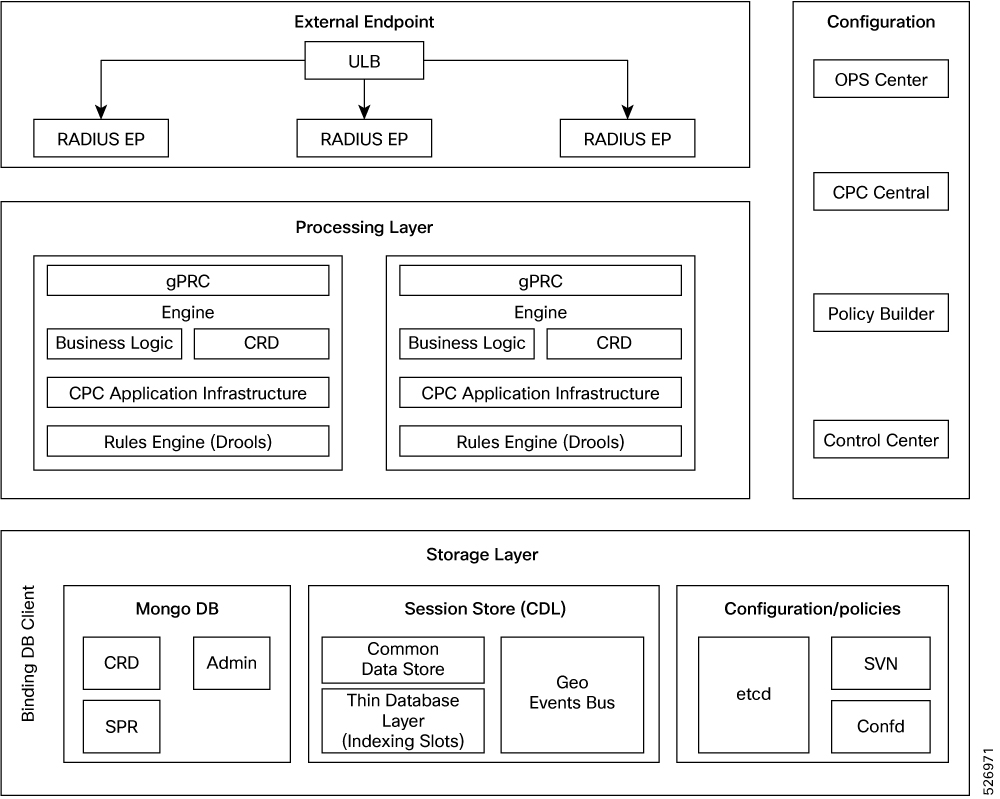
CPC offers a containerized, cloud-native architecture based on a three-tier microservices framework.
-
It supports AAA components using RADIUS servers for subscriber management, with protocol, service, and session tiers managing authentication, authorization, accounting, and data persistence.
-
The solution includes operational tools such as Policy Builder and Ops-Center for configuration and management, integrated with Cisco Cloud Native Data Plane (CNDP) services for logging, metrics, and alerts.
CPC architecture
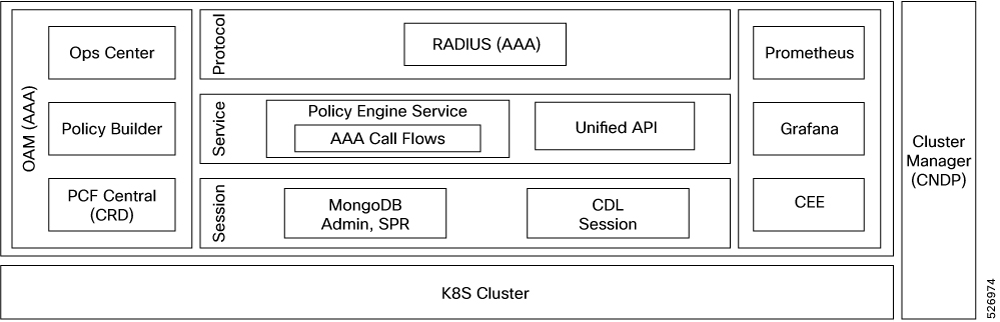
Cloud native AAA (cnAAA) is one of the components of Converged Policy and Charging (CPC). cnAAA integrates AAA components within a three-tier micro services framework. This architecture helps you manage tasks related to authentication, authorization, and accounting.
Key Capabilities
The cnAAA implementation provides these capabilities:
-
Protocol Tier: AAA services use the RADIUS Endpoint protocol. RADIUS endpoints manage protocol interactions. These endpoints forward requests from the Broadband Network Gateway (BNG) to the policy service and relay responses back to the BNG.
-
Service Tier: The AAA engine handles authentication, authorization, and proxy accounting messages. It manages AAA call flow procedures and selects policies for BNG based on subscriber profiles.
-
Session Tier: cnAAA uses MongoDB and a CDL endpoint to store data. The system includes an in-memory session store and a subscriber profile database that persists to disk.
-
Operations, Administration, and Maintenance (OAM): Ops-Center serves as the console for configuring and administering cnAAA. It supports CLI and RESTCONF API. Ops-Center enhancements include system configuration capabilities. You can configure the number of RADIUS endpoints and fine-tune buffers, queues, and thread pools for AAA services.
These OAM components are part of the Cisco Cloud Native Data Plane (CNDP) integration. CNDP provides common execution environment services for the cnAAA system.
-
Policy Builder (GUI/API): It is enhanced to manage AAA services and configurations. Enhancements include use case templates, service options, and subscriber-triggered groups (STG).
-
Custom Resource Definitions (CRD): Enable data-driven policy implementations through extensible CRD components. The CRD components are extensible, so customers can add new CRD tables as needed.
-
Integration with Common Execution Environment (CEE): The AAA implementation integrates with CEE services. These services include centralized logging, metrics collection using Prometheus, KPI dashboards with Grafana, and alerts.
-
 Note |
cnAAA provides support exclusively for features related to RADIUS. This document uses the terms CPC and cnAAA interchangeably. |
 Feedback