Multihoming in a BGP EVPN VXLAN Fabric

PDF

EVPN Multihoming Technology Overview

Want to summarize with AI?

Log in

Overview

Provides a brief overview of the industry-standard EVPN multhoming technology for traditional Layer 2 and Layer 3 networks.

The legacy networking protocols in enterprise campus networks have been a challenge for IT organizations.

The challenges include difficulty in eliminating Spanning Tree Protocol (STP) that can lead to inefficient network topologies, restrictions in traditional Layer 2 designs that limit the network switching capacity, lack of deterministic reliability that makes it a challenge to support real-time mission-critical applications, insufficient support for mobility in wireless and legacy application environments, and increased complexity in network management and troubleshooting.

This section provides a brief overview of the advanced industry-standard EVPN multihoming technology for traditional Layer 2 and Layer 3 networks. Each subsection focuses on various technology components enabling loop-free, high-performance and resilient Layer 2 networking solutions.

The following illustration captures the key benefits of EVPN multihoming technology for simplified and resilient enterprise campus networks.
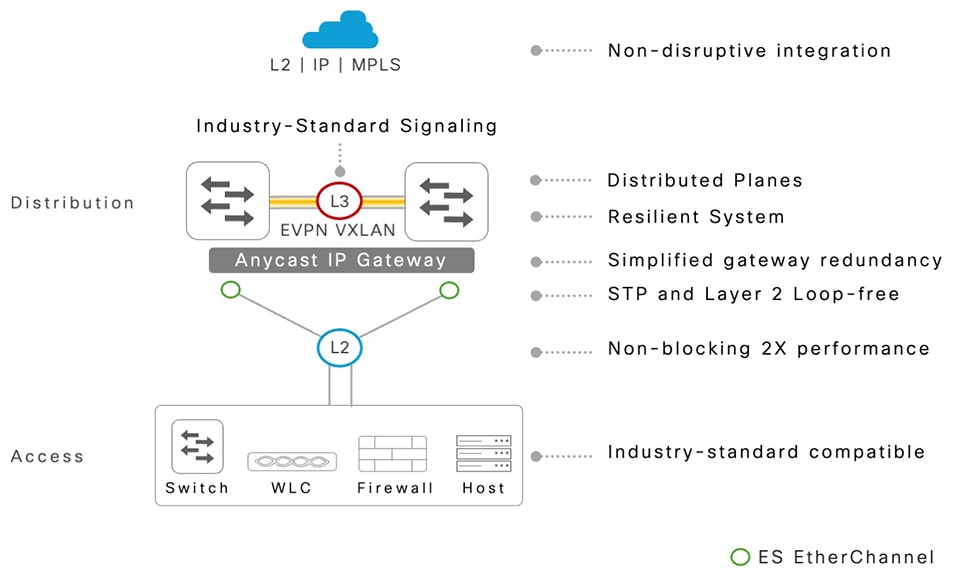
Figure 1. EVPN multihoming technology benefits
Benefits of EVPN multihoming technology

Refer to the Terms and Definitions section for the description and purpose of acronyms.

Network System Components

The EVPN multihoming technology comprises directly attached networking systems through traditional Layer 2 ports in trunk or access mode. The Cisco Catalyst 9000 series switches are required to provision in EVPN multihoming mode to provide a loop-free Layer 2 multipath EtherChannel to any type of downstream network device.

Ethernet Segment Redundancy Group

An Ethernet segment redundancy group is a physical grouping of network devices that form an EVPN multihoming network, enabling an all-active Layer 2 multipath solution.

The EVPN multihoming redundancy group consists of a single pair of Cisco Catalyst 9000 series switches, which provide physical connectivity and system-level redundancy. This architecture ensures continuous communication during both planned and unplanned failure events.

Ethernet Segment Switch

An Ethernet segment switch is a typical Cisco Catalyst 9000 series switch in core or distribution system configured to support the Layer 2 multihomed network with directly attached various types of Layer 2 systems.

The Ethernet Segment (ES) system can support multifunctional Layer 2 and Layer 3 networks for enterprise campus networks in classic and traditional non-fabric or modern fabric network roles. As a result, the ES switch is also known as a Provider Edge (PE) or Leaf or VTEP. Each ES switch operates and maintains fully distributed control, management, and data planes while solving legacy protocol challenges with industry-standard Layer 2 multipath solutions.

Note

Cisco Catalyst 9000 series switches in StackWise mode are considered as logical system Ethernet segment switches.

Ethernet Segment Switch Platform and Software

The EVPN multihoming technology operation between ES network devices—fixed or modular models, is no different from any of the other industry-standard networking protocols, like OSPF and BGP. A pair of ES switches can have different platform types, modules, interfaces, and so on. The ES pair switches can also have different Cisco IOS XE software versions to address stage upgrades and other conditions.

While the technology permits asymmetric platform and software versions on an ES pair, Cisco recommends a common platform and software version to deliver consistent performance and resiliency for non-disruptive business continuity during planned and unplanned failure conditions.

Ethernet Segment Client

The Layer 2 system is a directly attached single, dual, or multihomed connection to a pair of Cisco Catalyst 9000 series switches in an ES system. The Layer 2 ES client network can be of any device type but must follow the industry-standard Layer 2 networking technologies.


EVPN Multihoming Control Plane

The EVPN multihoming technology is built on industry-standard, highly flexible, and proven BGP routing protocol. The BGP control plane replaces legacy STP for Layer 2 loop detection and prevention techniques.

The L2VPN EVPN address-family is a multiprotocol extension that enables a network-agnostic multihoming solution. The BGP protocol provides four key functions: discover remote neighbor and ES ID, real-time synchronization of network states, distributed forwarding rule to select local-bias rules for optimal performance, and resiliency for deterministic and efficient rapid fault-detection and recovery.


Ethernet Segment

Ethernet segment (ES) is a pair of Cisco Catalyst 9000 series switches in the aggregation layer with a Layer 2 physical port that directly connects to an ES client device. It represents a single logical entity to enable loop-free, non-blocking all-active Layer 2 network connectivity.

An STP-Bridge Protocol Data Unit (BPDU) free Layer 2 network dynamically supports per-VLAN loop prevention while maximizing the network throughput to support accelerated application performance and resiliency.


Ethernet Segment ID

An Ethernet segment ID is a 10-byte (00:01:01:01:01:01:01:01:01:01) identifier for each Layer 2 port that is connected to an ES client device. A common ES ID is assigned to a pair of Catalyst 9000 ES systems on the Layer 2 physical port that connects to the same Layer 2 ES client device to enable all-active EVPN multihoming.

Cisco Catalyst 9000 series switches support 3 types of industry-standard ESI ID that is either auto-generated or IT-defined and manually configured.


Anycast Gateway MAC and IP Addresses

A Cisco Catalyst 9000 SVI interface with anycast gateway is provisioned with a shared virtual IP address and an auto-derived shared virtual MAC address with anycast-gateway mac auto command in the global settings, on pair of EVPN multihoming switches. The unified, resolved ARP and ND addresses between the distributed Catalyst 9000 IP gateway switches support optimal data load-balancing across all available bundled links and resilient networks during planned or unplanned failures for Wired and Wireless endpoints.


Designated Forwarder and Non-Designated Forwarder Roles

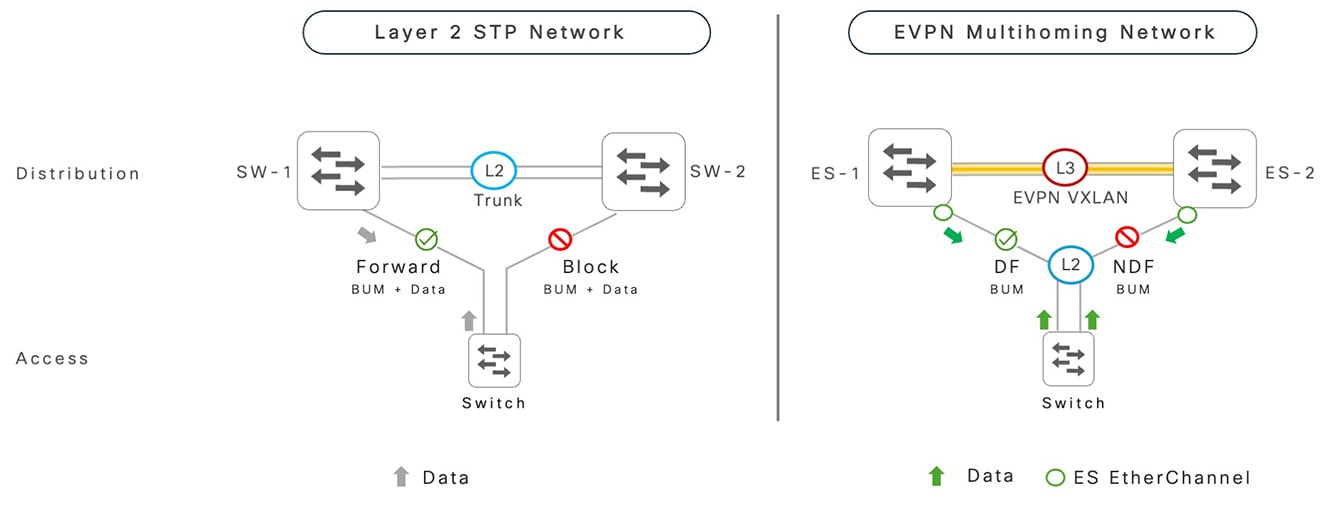
Traditionally, in Layer 2 STP-enabled networks, loop detection is achieved through a blocking link to transmit broadcast and business application data traffic. As a result, the network operates inefficiently at reduced bandwidth capacity. Additionally, protocol-based fault detection and recovery increase the network convergence time, which impacts the reliability of mission-critical applications during faults.

In EVPN multihoming-based campus networks, the same result is obtained using a very different logic. Instead of blocking links, the EVPN distinctly decouples network traffic types between broadcast categories and business applications. On a per ES port and VLAN basis, the pair of Cisco Catalyst 9000 series switches dynamically assign specific roles to forward BUM (Broadcast, Unknown Unicast, and Multicast) traffic in active and passive modes. However, business application forwarding traffic is unblocked in active-active mode.

The Catalyst 9000 series switch elected to actively forward the BUM traffic on a shared ES EtherChannel interface is known as Designated Forwarder (DF). The Catalyst 9000 series switch elected to block the forwarding of the BUM traffic on a shared ES EtherChannel interface is known as Non-Designated Forwarder (non-DF). The dynamic DF and non-DF role assignment is automatically derived based on the internal system modulo hash algorithm, which enables auto load balancing of the BUM traffic between a pair of Catalyst 9000 switches connected to same downstream Layer 2 network access devices.

Figure 2. Designated forwarder and non-designated forwarder roles

Designated forwarder and non-designated forwarder roles


Dynamic MAC and IP Learning and Synchronization

EVPN multihoming networks build and maintain the Layer 2 and Layer 3 network information using the control plane, between a pair of Cisco Catalyst 9000 ES switches.

The upstream data towards the IP core network is hashed from Layer 2 network devices, the dynamic MAC, IPv4, and IPv6 host addresses synchronized using the BGP control plane in real time between both the ES switches.

The common MAC or IP forwarding tables enable high performance and fully-distributed local forwarding while pre-programming the inter-ES Layer 2 VXLAN tunnel to bridge the downstream Layer 2 network traffic as the last-resort interface to reroute the data plane rapidly, upon local path failure, without relying on data-plane flooding.


IGMP Join and Leave Synchronization

The incoming Internet Group Management Protocol (IGMP) messages from multicast host receivers are locally processed by the connected Cisco Catalyst 9000 ES switches. The IPv4 or IPv6 multicast group-to-IP membership information is synchronized between the ES switches by using an extended BGP control plane that supports consistent multicast state across the multihomed Ethernet segments.

The Catalyst 9000 ES switch with a VLAN in the DF role transmits egress multicast traffic towards the receiver. The peer non-DF ES switch suppresses duplicate multicast frames to prevent loops and undesired multicast replication. This enables EVPN multihoming to support symmetric unicast or multicast application performance and resiliency during planned or unplanned failure events.