Understanding Cisco Identity Based Networking Services
Cisco IBNS feature provides a policy and identity-based framework in which edge devices can deliver flexible and scalable services to subscribers. Cisco IBNS provides an identity-based approach to access management and subscriber management. It offers a consistent way to configure features across technologies, a command interface that allows easy deployment and customization of features, and a robust policy control engine with the ability to apply policies defined locally or received from an external server to enforce policy in the network.
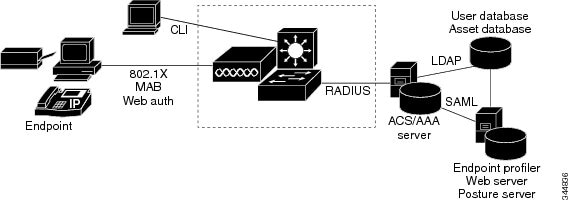
The figure below illustrates a typical deployment of Cisco IBNS in a physically distributed enterprise with a campus, branch offices, and remote workers.
By default, the access-session closed command is enabled in IBNS 1.0 and as a result, devices cannot perform any pre-authentication actions on the network when using IBNS 1.0. By default, authentication is open in IBNS 2.0, and devices can perform pre-authentication actions on the network. To close authentication on IBNS 2.0, configure the access-session closed command in interface-port configuration mode.
 Feedback