OSPF Forwarding Address Suppression in Translated Type-5 LSAs

Feature History for OSPF Forwarding Address Suppression in Translated Type-5 LSAs

This table provides release and platform support information for the features explained in this module.

These features are available in all the releases subsequent to the one they were introduced in, unless noted otherwise.

Release

Feature Name and Description

Supported Platform

Cisco IOS XE 17.18.1

OSPF Forwarding Address Suppression in Translated Type-5 LSAs: The OSPF Forwarding Address Suppression is an enhancement feature that modifies how NSSA ABRs translate Type-7 LSAs to Type-5 LSAs when sending external routes into the OSPF backbone.

Cisco C9350 Series Smart Switches

Cisco C9610 Series Smart Switches

OSPF Forwarding Address Suppression in Translated Type-5 LSAs

The OSPF Forwarding Address Suppression is an enhancement feature that modifies how Not-So-Stubby Area (NSSA) Area Border Routers (ABRs) translate Type-7 LSAs to Type-5 LSAs when sending external routes into the OSPF backbone. Specifically, it suppresses the forwarding address by setting it to 0.0.0.0 in the translated Type-5 LSA.

How OSPF Forwarding Address Suppression in Translated Type-5 LSAs works

In OSPF, NSSA areas use Type-7 LSAs to describe external routes. When an NSSA ABR translates a Type-7 LSA to a Type-5 LSA (so it can be advertised into Area 0), it usually copies the forwarding address from the Type-7 LSA. With Forwarding Address Suppression enabled, the ABR sets the forwarding address in the Type-5 LSA to 0.0.0.0—regardless of the original Type-7 LSA’s forwarding address.

Why to suppress OSPF Forwarding Address in translated Type-5 LSAs

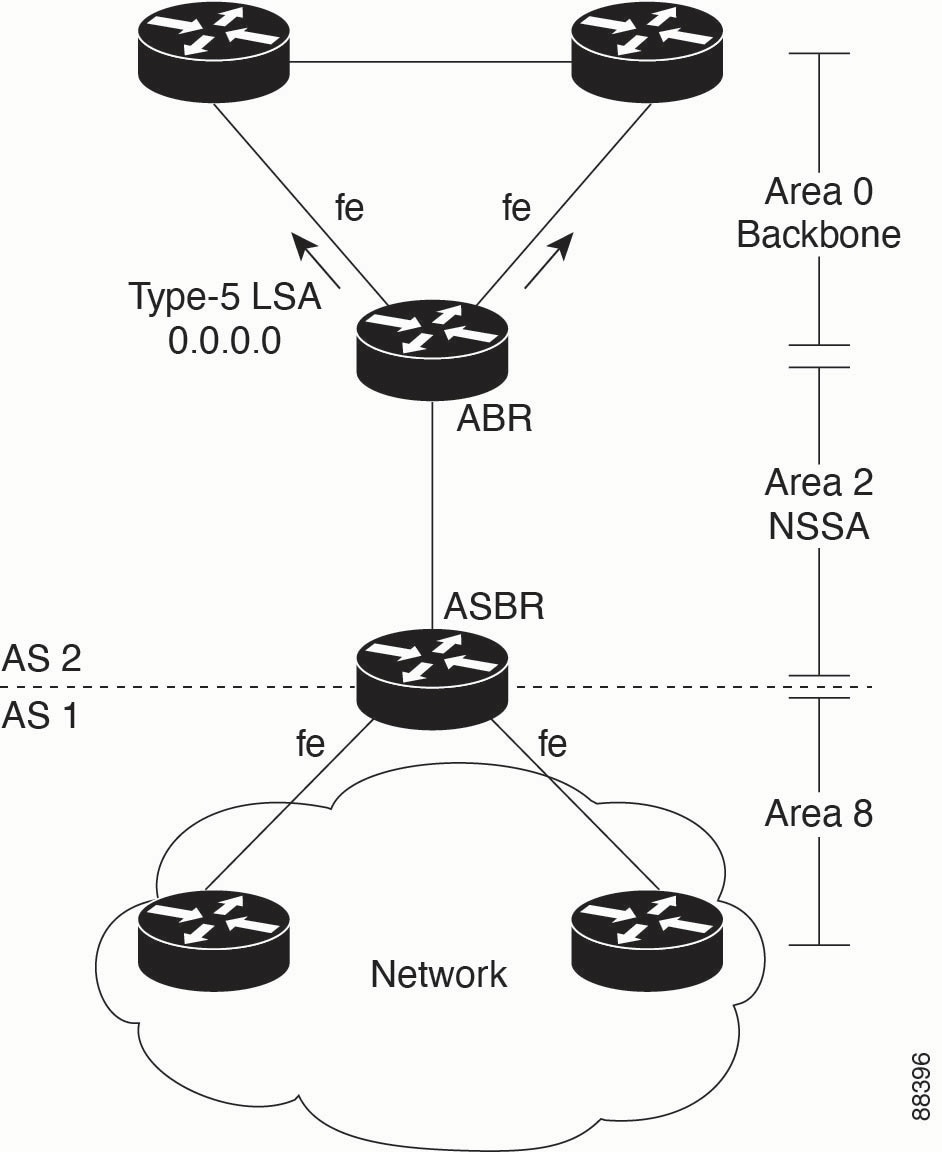
In large OSPF deployments, route summarization is used at area boundaries (ABRs) to reduce the size of routing tables in Area 0 (the backbone) and enhance network scalability. This is typically achieved using the area range command on ABRs. This command consolidates multiple more-specific prefixes from a non-backbone area, such as Area 2 and Area 8 in Figure, into a single summary route advertised into the backbone.

When an ASBR in an NSSA redistributes external routes, such as those from a connected network or another routing protocol (see ASBR in Area 2 in Figure), it generates Type-7 LSAs. These Type-7 LSAs are specific to NSSAs and are used to carry information about external routes within the NSSA. The NSSA ABR translates these Type-7 LSAs into Type-5 LSAs (Autonomous System External LSAs) before flooding them into the backbone (Area 0). See ABR connecting Area 2 to Area 0 in Figure. This allows the external routes to be propagated throughout the rest of the OSPF domain.

The Type-7 and Type-5 LSAs include a forwarding address—often the interface address of the ASBR that originated the external route. This address instructs OSPF devices where to forward traffic destined for the external prefix.

When the area range command is used, only the summary route is advertised into Area 0—not the specific prefixes or host routes within Area 2. If the forwarding address in a Type-5 LSA is a specific address within Area 2 that has been suppressed by summarization, backbone devices may not have a route to this address. As a result, the external prefix (though present in the routing table) becomes unreachable from the backbone, since traffic cannot be routed to the correct ASBR.

Before configuring this feature, consider the following caution.


Caution


Configuring this feature causes the device to be noncompliant with RFC 1587. In addition, suboptimal routing may occur if better paths exist to reach the destination’s forwarding address. Configure this feature only after careful consideration and once the network topology is understood.


Suppress OSPF Forwarding Address in Translated Type-5 LSAs

Perform this task to suppress the OSPF forwarding address in translated Type-5 LSAs.

Procedure


Step 1

enable

Example:

Device> enable

Enables privileged EXEC mode.

Enter your password, if prompted.

Step 2

configure terminal

Example:

Device# configure terminal

Enters global configuration mode.

Step 3

router ospf process-id [vrf vrf-name]

Example:

Device(config)# router ospf 15

Enables OSPF routing and enters router configuration mode.

  • process-id : The process ID is an internally used identification parameter that is locally assigned. Each OSPF process has a unique process ID.

    Process ID can be a positive integer from 1 to 65535.

  • vrf: Indicates that the OSPF process is being configured for a specific VRF.

  • vrf-name : Specifies the name of the VRF for which this OSPF process is being created.

Step 4

area area-id nssa translate type7 suppress-fa

Example:

Device(config-router)# area 10 nssa translate type7 suppress-fa

Configures an area as a NSSA and suppresses the forwarding address in translated Type-7 LSAs.


Configuration example of OSPF Forwarding Address Suppression in translated Type-5 LSAs

This example shows how to configure OSPF Forwarding Address Suppression in Translated Type-5 LSAs

Device> enable
Device# configure terminal
Device(config)# router ospf 15
Device(config-router)# area 10 nssa translate type7 suppress-fa