AS number representation methods
Prior to January 2009, BGP autonomous system (AS) numbers that were allocated to companies were 2-octet numbers in the range
from 1 to 65535 AS described in RFC 4271, A Border Gateway Protocol 4 (BGP-4). Due to increased demand for AS numbers, the Internet Assigned Number Authority (IANA) started to allocate four-octet AS
numbers in the range from 65536 to 4294967295. RFC 5396, Textual Representation of Autonomous System (AS) Numbers, documents three methods of representing AS numbers. Cisco has implemented these two methods:
-
Asplain—Decimal value notation where both 2-byte and 4-byte AS numbers are represented by their decimal value. For example,
65526 is a 2-byte AS number and 234567 is a 4-byte AS number.
-
Asdot—Autonomous system dot notation where 2-byte AS numbers are represented by their decimal value and 4-byte AS numbers
are represented by a dot notation. For example, 65526 is a 2-byte AS number and 1.169031 is a 4-byte AS number (this is dot
notation for the 234567 decimal number).
For details about the third method of representing autonomous system numbers, see RFC 5396.
This table shows the asdot only autonomous system number formatting:
Table 1. Asdot only 4-byte AS number format
|
Format
|
Configuration Format
|
Show Command Output and Regular Expression Match Format
|
|
asdot
|
2-byte: 1 to 65535 4-byte: 1.0 to 65535.65535
|
2-byte: 1 to 65535 4-byte: 1.0 to 65535.65535
|
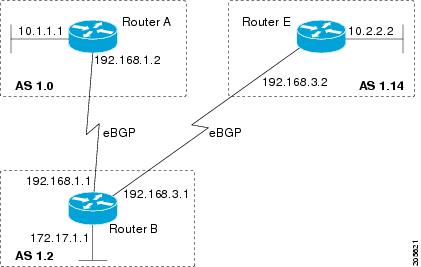
The 4-octet (4-byte) AS numbers are entered and displayed only in asdot notation, for example, 1.10 or 45000.64000. When using
regular expressions to match 4-byte AS numbers the asdot format includes a period, which is a special character in regular
expressions. A backslash must be entered before the period (for example, 1\.14) to ensure the regular expression match does
not fail.
The Cisco implementation of 4-byte AS numbers uses asplain AS the default display format for AS numbers, but you can configure
4-byte AS numbers in both the asplain and asdot format. In addition, the default format for matching 4-byte AS numbers in
regular expressions is asplain, so you must ensure that any regular expressions to match 4-byte AS numbers are written in
the asplain format. If you want to change the default show command output to display 4-byte autonomous system numbers in the asdot format, use the BGP
asnotation
dot command under router configuration mode. When the asdot format is enabled AS the default, any regular expressions to match
4-byte AS numbers must be written using the asdot format, or the regular expression match will fail. These tables show that
although you can configure 4-byte AS numbers in either asplain or asdot format, only one format is used to display show command output and control 4-byte AS number matching for regular expressions, and the default is asplain format. To display
4-byte AS numbers in show command output and to control matching for regular expressions in the asdot format, you must configure the BGP
asnotation
dot command. After enabling the BGP
asnotation
dot command, a hard reset must be initiated for all BGP sessions by entering the clear
ip
BGP
* command.

Note
|
If you are upgrading to an image that supports 4-byte AS numbers, you can still use 2-byte AS numbers. The show command output and regular expression match are not changed and remain in asplain (decimal value) format for 2-byte AS numbers
regardless of the format configured for 4-byte AS numbers.
|
This table shows the default asplain 4-byte AS number format:
Table 2. Default asplain 4-byte AS number format
|
Format
|
Configuration Format
|
Show Command Output and Regular Expression Match Format
|
|
asplain
|
2-byte: 1 to 65535 4-byte: 65536 to 4294967295
|
2-byte: 1 to 65535 4-byte: 65536 to 4294967295
|
|
asdot
|
2-byte: 1 to 65535 4-byte: 1.0 to 65535.65535
|
2-byte: 1 to 65535 4-byte: 65536 to 4294967295
|
This table shows the asdot 4-byte AS number format:
Table 3. Asdot 4-byte AS number format
|
Format
|
Configuration Format
|
Show Command Output and Regular Expression Match Format
|
|
asplain
|
2-byte: 1 to 65535 4-byte: 65536 to 4294967295
|
2-byte: 1 to 65535 4-byte: 1.0 to 65535.65535
|
|
asdot
|
2-byte: 1 to 65535 4-byte: 1.0 to 65535.65535
|
2-byte: 1 to 65535 4-byte: 1.0 to 65535.65535
|
The Cisco implementation of BGP supports RFC 4893. RFC 4893 was developed to allow BGP to support a gradual transition from
2-byte AS numbers to 4-byte AS numbers. A new reserved (private) AS number, 23456, was created by RFC 4893 and this number
cannot be configured AS an AS number in the Cisco IOS CLI.
RFC 5398, Autonomous System (AS) Number Reservation for Documentation Use, describes new reserved AS numbers for documentation purposes. Use of the reserved numbers allow configuration examples to
be accurately documented and avoids conflict with production networks if these configurations are literally copied. The reserved
numbers are documented in the IANA AS number registry. Reserved 2-byte AS numbers are in the contiguous block, 64496 to 64511
and reserved 4-byte AS numbers are from 65536 to 65551 inclusive.
Private 2-byte AS numbers are still valid in the range from 64512 to 65534 with 65535 being reserved for special use. Private
AS numbers can be used for internal routing domains but must be translated for traffic that is routed out to the Internet.
BGP should not be configured to advertise private AS numbers to external networks. Cisco IOS software does not remove private
AS numbers from routing updates by default. We recommend that ISPs filter private AS numbers.
Note
|
AS number assignment for public and private networks is governed by the IANA. For information about AS numbers, including
reserved number assignment, or to apply to register an AS number, see the url: http://www.IANA.org/.
|
 Feedback