Solution Overview

Overview

Cisco Catalyst SD-WAN is a secure, policy-driven software-defined WAN solution that

  • helps enterprises connect users, branches, data centers, clouds, and SaaS applications over any transport,

  • centralizes management,

  • improves application experience,

  • simplifies network operations,

  • integrates security across the network, and

  • integrates seamlessly with a variety of Cisco enterprise solutions.

Legacy Network Design

Describes legacy network design to compare with the Catalyst SD-WAN solution.

Legacy network design cannot scale to meet today’s needs for these fundamental reasons:

  • Lengthy installation times: Legacy networks that run on dedicated carrier circuits depend on the carrier to install new circuits, which can take several months. This can dramatically delay the launch of new branch locations.

  • Routing complexity: Legacy networks operate on the model of a distributed control plane, which means that every node in the network must be configured with routing and security rules.

    There’s no separation between a control plane and a data plane. There’s no separation between the hosts, devices, and servers on the service side of the network and the interconnects between routers on the transport side of the network.

    Policy and control decisions are embedded at every hop across the enterprise network.

    Security is time-intensive, requiring implementation of security policy either at every node in the network or by using centralized security servers to manage group keys.

  • Maintenance complexity: Remote site management, change control, and network maintenance represent major logistical challenges.

Requirements of a multi-site enterprise

For the complex needs of a multi-site enterprise, legacy network design struggles to meet requirements such as

  • Rigorous end-to-end security

  • Disparate transport networks

  • High-bandwidth cloud applications that are hosted in multiple data centers

  • Ongoing increase in the number of mobile end users

  • Any-to-any connectivity over fluid topologies

Cisco Catalyst SD-WAN Solution

Instead of treating each WAN circuit and router as a separate device-by-device configuration problem, Cisco Catalyst SD-WAN separates the control plane, management plane, and data plane.

Components of the Catalyst SD-WAN fabric

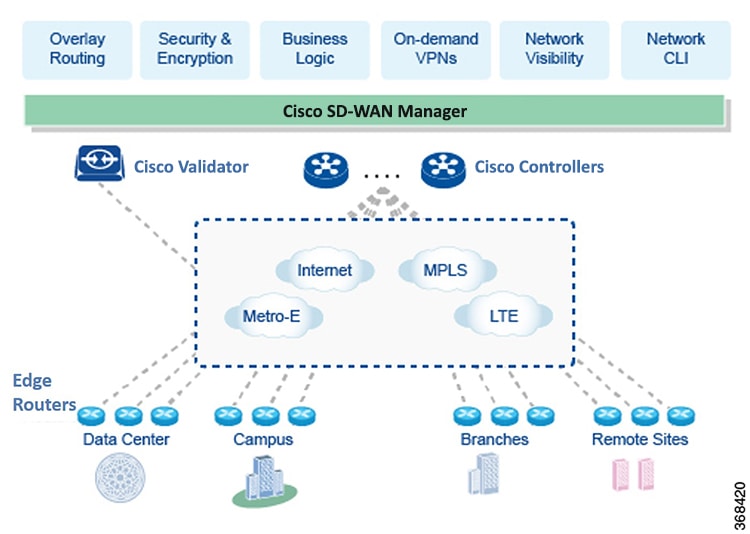
Cisco Catalyst SD-WAN employs three components, called SD-WAN Control Components, to manage the fabric.

  • Cisco Catalyst SD-WAN Manager is the centralized management system. It provides dashboards for operational visibility across the Catalyst SD-WAN fabric, tools for provisioning and configuring devices, license management, tools for upgrading device software, and more. SD-WAN Manager communicates with devices and SD-WAN Controllers over secure connections.

  • Cisco Catalyst SD-WAN Controllers manage the control plane of the overlay. They form secure control connections with edge routers, use the Overlay Management Protocol (OMP) to exchange routes, next hops, keys, and policy information, and distribute reachability information to the edge routers.

  • Cisco Catalyst SD-WAN Validator coordinates initial device onboarding. It authenticates devices, helps edge routers and SD-WAN Controllers find each other, and so on.

In addition to the SD-WAN Control Components, the fabric includes the data plane edge devices at branches, campuses, data centers, cloud environments, and other sites. They create secure IPsec tunnels, forward traffic, run routing protocols such as OSPF and BGP on the service side, support configured routing policy, and more.

Figure 1. Components of Cisco Catalyst SD-WAN

Underlay and overlay networks

  • Underlay network: The set of transport-layer network connections between an organization’s edge devices, across multiple locations, even distant geographies. The connections may include a mix of various transport types, such as the public internet, MPLS, broadband, LTE, and cloud connectivity.

    In this context, the underlay network is sometimes called the physical transports, but this is a shorthand, and does not imply that the underlay only includes layer 1, the physical layer, in the open systems interconnection (OSI) model.

  • Overlay network: This virtual IP fabric created by Catalyst SD-WAN consists of a set of transport-layer tunnels, generally IPsec or GRE, managed by SD-WAN Controllers. It is a level of abstraction above the underlay network. In some scenarios, you can partition a network’s underlay network into more than one overlay network, each optimized to meet diverse needs with distinct policies.

  • Fabric: In the context of Catalyst SD-WAN, the overlay network mesh of connections between nodes, is often simply called the fabric. The nodes in this mesh include routers and SD-WAN Control Components.

While the terms overlay and fabric are often interchangeable, overlay is useful when specifically distinguishing between the physical and virtual layers. The overlay is the virtual layer managed by SD-WAN Controllers, while the underlay is the layer of transports.

Transport side and service side

Cisco Catalyst SD-WAN employs a distinction, not exclusive to this solution, between:

  • Transport side: WAN-facing network, using the underlay transports tunnels between edge routers. The connections to edge routers use the Catalyst SD-WAN concept of transport locators (TLOCs), which are identifiers used for a connection between an edge device and a transport. The connections serve the control plane and the data plane, and use VPN 0, also called the transport VPN.

  • Service side: Connections between edge routers and end users, which may involve intermediate devices as well. Service side connection use the VPN range 1 to 65527.

This distinction allows network administrators to create policy, such as security policy, that affects only the transport side.

How it works

How Catalyst SD-WAN creates a fabric, manages routes, and allows traffic to flow.

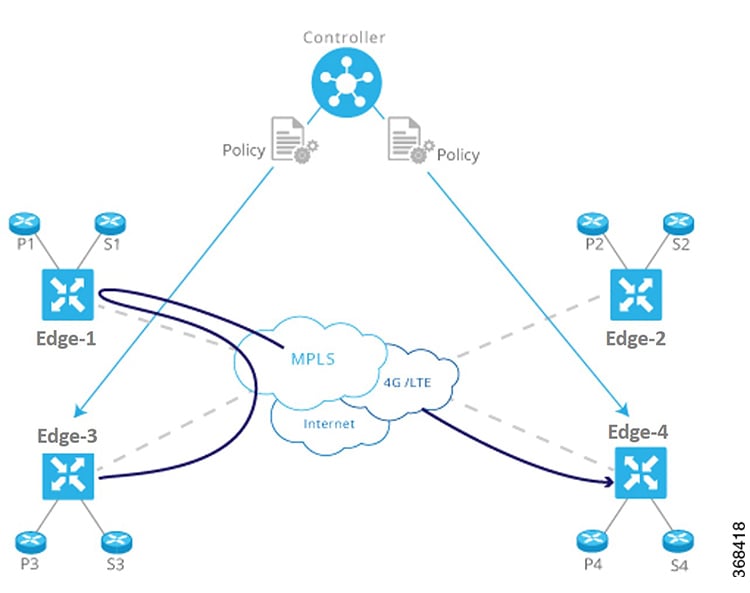
Cisco Catalyst SD-WAN builds an encrypted overlay across the underlay transports the organization uses, such as Multiprotocol Label Switching (MPLS), broadband internet, cellular, or cloud connectivity. The overlay abstracts transport details so that you can create policies in terms of business intent: which applications matter, which users or sites can communicate, which paths meet performance requirements, and so on.

  • The control plane is centralized through SD-WAN Controllers.

  • Edge routers advertise local routes to SD-WAN Controllers.

  • SD-WAN Controllers provide reachability and policy information to the edges.

Application traffic flows directly between edge routers, according to configured policy. This gives the network centralized policy control without forcing every data flow through a central device.

Figure 2. Policy configured through a centralized SD-WAN Controller

Network planes in Cisco Catalyst SD-WAN

How the network planes of the Cisco Catalyst SD-WAN fabric operate.

The components of the Cisco Catalyst  SD-WAN fabric can be described as operating in two planes:

  • Data plane

  • Control plane

Some discussions Catalyst SD-WAN further divide the control plane into a management plane mostly relating to SD-WAN Manager operations, and an orchestration plane for SD-WAN Validator operations that relate to onboarding devices into the fabric.

Data plane

In a Catalyst SD-WAN fabric, the data plane is the part that carries user traffic.

In practical terms, it is made up of the WAN edge devices and virtual edge routers such as Catalyst 8000V. These devices sit at branches, campuses, data centers, colocation sites, or cloud environments, and forward application packets between sites.

Relationship with the control plane

SD-WAN Controllers distribute routing and policy information, but do not carry the user traffic. The edge devices in the fabric learn the routes, policies, and security information from the control plane and build direct data plane connections to other edge devices. In short, the control plane manages the routing rules, while the data plane transports the traffic.

Data plane capabilities

Most data plane connections are secured with IPsec tunnels, but GRE is also supported. The tunnels form the secure SD-WAN overlay across whatever underlay transport is available.

The data plane enforces network segmentation, implemented with the Virtual Routing and Forwarding (VRF) technology, operationally equivalent to VPNs. This allows different business groups or traffic classes to remain isolated even while sharing the same Catalyst SD-WAN fabric and physical transports.

In addition, the data plane enforces routing policies, such as for QoS, application-aware routing, and so on.

Connection health

Bidirectional Forwarding Detection (BFD) is a protocol that monitors the health of the paths between devices, detecting failures so that Catalyst SD-WAN can respond quickly.

Catalyst SD-WAN uses BFD in data plane tunnels to measure path health, including reachability, packet loss, jitter, and delay. Edge devices use the measurements, together with configured policy, to choose the best paths for applications.

Control plane

In a Catalyst SD-WAN fabric, the control plane is the part that carries user traffic tells the WAN edge devices how to build the overlay and how to route traffic.

The main component of the control plane is the SD-WAN Controller, formerly called vSmart. SD-WAN Controllers exchange routing, policy, topology, and security information with WAN edge devices. In essence, they manage the rules, while the data plane carries the application traffic.

Overlay Management Protocol

For the control plane, the key protocol is the Overlay Management Protocol (OMP). OMP operates between SD-WAN Controllers and edge devices over secure control connections. It distributes overlay reachability, routes, transport locator (TLOC) information, policy updates, and encryption key information.

SD-WAN Controllers

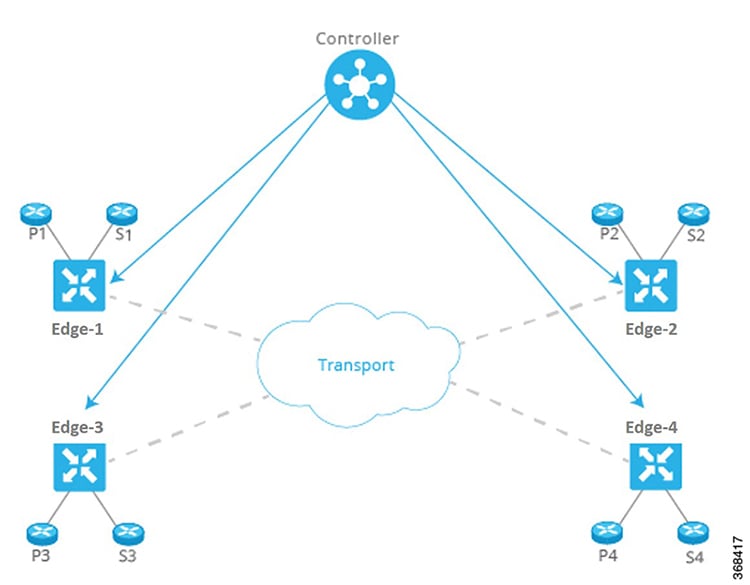
Edge devices advertise their routing information to SD-WAN Controllers. The SD-WAN Controllers apply centralized policy, then advertise the appropriate routes and instructions back to other edge devices. This is how Catalyst SD-WAN can create different topologies, such as hub-and-spoke, full mesh, or per-VPN segment-specific designs, without manually configuring every edge-to-edge relationship.

Figure 3. SD-WAN Controller and edge devices

Security

The control plane helps to secure the fabric. Edge devices generate encryption keys for each transport and send them to the SD-WAN Controllers. The SD-WAN Controllers distribute the keys to peers according to policy. This avoids traditional peer-by-peer internet key exchange (IKE) negotiation between every edge device pair, helping the fabric to scale efficiently.

In short, the control plane is the SD-WAN decision and distribution layer. It learns routes from WAN Edge routers, applies centralized policy, distributes routing and security information through OMP, helps build the overlay tunnels, and tells the data plane what paths are allowed or preferred, while never carrying the user data itself.

Multitenancy

Multitenancy is a Cisco Catalyst SD-WAN feature that supports multiple separate customers, business units, or organizations, called tenants, within a shared Catalyst SD-WAN infrastructure, while keeping their networks logically isolated.

The core idea is shared infrastructure, separate tenant experience. The value is reduced operational overhead. This can be important for small-scale organizations or business units that can benefit from Catalyst SD-WAN but don’t have the scale to warrant managing the entire infrastructure.

Deployment options

Cisco Catalyst SD-WAN deployment options are defined by where the SD-WAN Control Components are located, and who maintains them. Regardless of the deployment option, the edge devices of the fabric still operate at the branches, campuses, and data centers of the organization, and in the organization’s cloud infrastructures, if any.

Cisco cloud-hosted

Cisco builds, operates, and monitors the SD-WAN Control Components. This option reduces the operational burden on an organization because its network administrators can focus mainly on configuration and policy rather than infrastructure. With this deployment option, the organization handles fabric provisioning and maintenance through the Cisco Catalyst SD-WAN portal (formerly the Self Service Portal). The SD-WAN portal provides an easy to use interface for handling fabric operations.

Cisco cloud-hosted deployments include a range of options, depending on an organization’s needs.

On-premises

Self-managed deployment options are more hands-on, and the organization has the responsibility to install and maintain the SD-WAN Control Components. Self-managed options give the most control, and also the most responsibility: deployment, operations, monitoring, maintenance, server capacity, and scaling.

For the on-prem option, an organization deploys the SD-WAN Control Components in its own data center. This can be preferred for regulated sectors such as government, finance, healthcare, and utilities.

Self-managed cloud-hosted

This self-managed deployment option is similar to an on-premises deployment, but the organization installs the SD-WAN Control Components in its own public-cloud environment, such as AWS or Azure. This avoids the cost of extra data center infrastructure and can make scaling easier than with an on-premises deployment.

Major features

This section describes some of the major features of Cisco Catalyst SD-WAN.

Centralized management and automation

Cisco SD-WAN Manager provides a single dashboard for configuration, monitoring, provisioning, software upgrades, and troubleshooting. Configuration groups enable configuring each edge device router centrally.

Transport independence

The SD-WAN overlay can use MPLS, broadband, public internet, cellular, and other IP transports. This lets organizations mix private and public connectivity while still applying consistent policy and security.

Secure overlay fabric

Catalyst SD-WAN authenticates devices, uses secure control connections, and automatically encrypts site-to-site traffic.

Segmentation

The fabric supports segmentation, enabling you to isolate different groups, applications, or business functions, without building separate physical networks.

Application-aware routing

Policies can control path selection for traffic, based on the source of each traffic flow. You can set routing policy based on the business relevance of each network application, such as giving priority to specific applications or traffic categories, and using cheaper or secondary links for low-priority traffic.

SaaS optimization

Cloud OnRamp for SaaS can dynamically select the best-performing path for specific SaaS applications.

Cloud services integration

Cloud OnRamp for Multicloud helps connect enterprise WANs to cloud services such as AWS, Azure, and Google Cloud.

Integrated security and SASE readiness

Catalyst SD-WAN supports on-premises and cloud-delivered security, including integration with Cisco Umbrella. Services include enterprise firewall features, secure web gateway, malware protection, intrusion prevention, URL filtering, DNS-layer protection, and more.

Cisco ThousandEyes

The integration of ThousandEyes brings end-to-end visibility into application delivery and network performance beyond the traditional enterprise network boundaries. Organizations can deploy ThousandEyes agents through SD-WAN Manager integration, and can quickly pinpoint the source of issues, resolve them faster, and manage performance.

Analytics and visibility

SD-WAN Analytics aggregates telemetry data and correlates application performance with underlying networks for operational insights, with easy-to-use visualizations. SD-WAN Analytics enhances network visibility, establishes historical benchmarks, and expedites root-cause isolation, ultimately enabling enterprises to take the necessary corrective actions.