Cisco NCS 1004 Overview

This chapter provides an overview of the Cisco Network Convergence Series (NCS) 1004.

Cisco NCS 1004 units

A Cisco NCS 1004 unit is an optical transport platform that

  • supports up to 4.8 Tbps traffic in a compact two-RU form factor,

  • includes two redundant field-replaceable AC and DC power supply units; three redundant field-replaceable fans; a field-replaceable controller card; and SSD disks both on board the chassis and on the controller card. This configuration provides enhanced resiliency, and

  • features four line card slots per chassis, each capable of hosting a line card for scalable network expansion.

See Supported Line Cards, for more information.

Key features and benefits of Cisco NCS 1004

The NCS 1004 delivers these benefits:

  • Transport of any trunk rate from 150 200 to 600 Gbps wavelengths in 50 Gbps increments on the same platform through software provisioning.

  • Support of granular control of baud-rate and modulation format to maximize spectral efficiency.

  • One universal transponder optimized for metro, long-haul, and submarine applications.

  • Support for up to 350,000 ps/nm of residual chromatic dispersion compensation.

  • Ability to transport of 100GE and OTU4 client rates on the same platform through software provisioning.

  • 600G DWDM, providing unparalleled scale and density—64 channels of 600G at 75 GHz, delivering 38.4 Tbps in 16 RU.

  • State-of-the-art AES-256 encryption at scale—4.8 Tbps of encrypted trunk capacity per 2 RU.

Interoperability constraints and timing requirements for Cisco NCS 1001 and Cisco NCS 1004

Understand the interoperability constraints and timing requirements between Cisco NCS 1001 and Cisco NCS 1004.

Interoperability constraints and requirements

  • Traffic loss may occur under certain conditions when Cisco NCS 1001 with Protection Switching Module (PSM) is configured as non-revertive and operates with Cisco NCS 1004.

  • If traffic switches from the working path to the protect path, users must wait 120 seconds before performing a manual switch to prevent traffic loss.

  • A manual switch performed before the interval, followed by a protect path failure, can result in up to 13 seconds of traffic loss.

Timing limitations

The PSM switching time for the ONS-CFP2D-400G-C and DP04CFP2-M20-191 modules may exceed 50 milliseconds.


Note


PSM switching with x50G is not supported as the switching time is more than 50 ms.


Supported line cards

A supported line card is a hardware module for the Cisco NCS 1004 platform that

  • provides specific types and numbers of high-speed client interfaces,

  • supports variable trunk port configurations for flexible bandwidth and transmission rates, and

  • offers distinctive modulation, frequency, and error-correction capabilities tailored to deployment needs.

These line cards are supported on Cisco NCS 1004.

NCS1K4-1.2T-K9 C-band line card

The NCS1K4-1.2T-K9 (or 1.2 Tbps) C-band line card contains 12 QSFP-28 clients and two DWDM trunk ports. These trunk ports support multiple line rates and offer precise control of the modulation format, baud rate, and forward error correction. The trunk ports can be configured using software. The line card supports both module and slice configurations.


Note


"1.2TC" refers to the NCS1K4-1.2T-K9 C-band line card.


The features of the 1.2T line card are:

  • The card provides up to 12 100G or OTU4 client ports.

  • The baud rate can be controlled between 28 Gbd/s and 72 Gbd/s.

  • The frequency range is 191.25 to 196.1 THz with a default value of 193.1 THz.

  • The modulation formats can be QPSK, 8 QAM, 16 QAM, 32 QAM, or 64 QAM.

  • Configure hybrid modulation formats using 1/128 bits per symbol granularity.

  • Forward Error Correction (FEC) of 27% and 15% overhead across line rates (only 15% for 600G).

  • In Release 7.1.1, the trunk line rate can be configured from 150G to 600G in 50G increments.

  • In Release 7.2.1 and later releases, the trunk line rate can be configured from 50G to 600G in 50G increments.

NCS1K4-1.2TL-K9 L-band line card

The NCS1K4-1.2TL-K9 (or 800 Gbps) L-band line card has 12 QSFP-28 based clients and two DWDM trunk ports. The trunk ports are capable of several line rates with fine control of modulation formats, baud rate, and forward error correction and are software configurable. The line card supports module and slice configurations.


Note


"1.2TL" refers to the NCS1K4-1.2TL-K9 L-band line card.


Note


There is no support for GMPLS, remote management using GCC, and smart licensing.

The features of the 1.2TL line card are:

  • The card provides up to eight 100G or OTU4 client ports.

  • The client ports map to two trunk ports that operate on any rate between 200G and 400G with 50G increments.

  • The modulation formats can be controlled between QPSK, 8 QAM, and 16 QAM.

  • The baud rate can be controlled between 31.5Gbd/s and 72Gbd/s.

  • The frequency range is 186.10 to 190.85 THz with a default value of 188.50 THz. Only 100 MHz spacing is supported.

  • Hybrid modulations formats can be configured through 1/128 bits/symbol granularity.

  • Forward Error Correction (FEC) supports 15% and 27% overhead.

NCS1K4-OTN-XP line card

From R7.2.1 onwards, NCS 1004 supports the NCS1K4-OTN-XP card with 100G grey-optics support.


Note


"OTN-XP" refers to the NCS1K4-OTN-XP line card.


The OTN-XP card contains:

  • Eight QSFP 28 ports

  • Four QSFP-DD ports

  • Two CFP2 ports

The OTN-XP card supports up to 1.6Tbps of OTN aggregation switching functionality to optimize the available bandwidth. A single line card supports 8x100GE muxponder or 2x400 GE transponder applications. The OTN-XP card supports 400GE/OTUC4, 100GE/OTU4, 10GE/OTU2/OTU2e, 16G FC, and 32G FC client rates.

For more information on the mode configuration, see Muxponder Configuration on OTN-XP Card.

NCS1K4-2-QDD-C-K9 C-band line card

From R7.3.1 onwards, NCS 1004 supports the NCS1K4-2-QDD-C-K9 (or 2-QDD-C) C-Band line card. The card has eight client ports (QSFP28 and QSFP-DD) and two DWDM dual sub-channel module trunk ports. The FR4 and AOC are the two optics supported on the 400GE client ports. Each trunk port is capable of 200, 300, and 400 Gbps line rate with fine control of modulation formats, baud rate, and forward error correction. The trunk ports are software configurable. The line card supports module and slice configurations.


Note


"2-QDD-C" refers to the NCS1K4-2-QDD-C-K9 C-band line card.


The features of the 2-QDD-C line card are:

  • The card provides up to eight 100 GE or two 400 GE client ports.

  • The trunk line rate can be configured from 200G to 400G in 100G increments.


    Note


    The trunk line rates of 250G and 350G are not supported in R7.3.1.


  • The client to trunk port mapping is based on type of configuration and the line rate.

  • The modulation formats can be controlled between QPSK, 8 QAM, and 16 QAM including hybrid modulation.

  • Hybrid modulations formats can be configured through 1/128 bits/symbol granularity.

  • Forward Error Correction (FEC) of Soft Decision FEC 27% and Soft Decision FEC 15%.

  • The baud rate can be controlled between 28 Gbd/s and 72 Gbd/s.

  • The frequency range is 191.25 to 196.1 THz with a default value of 193.1 THz.

NCS1K4-QXP-K9 3.2T QSFP-DD DCO transponder line card

From R7.7.1 onwards, NCS 1004 supports the NCS1K4-QXP-K9 (or QXP) Line Card. The card has eight client ports (QSFP-DD) and eight trunk ports (QSFP-DD ZR+).


Note


"QXP" refers to the NCS1K4-QXP-K9 C-band line card.


The features of the QXP line card are:

  • Each line card supports up to 3.2 Tbps traffic.

  • A single line card supports 6 slices of:

    • 4x100GE (breakout) clients in muxponder mode.

    • 400GE clients in transponder mode.

    • 100GE clients in transponder mode.

  • The client rates that are supported are 400GE, 4x100GE, and 100GE Ethernet only.

  • The modulation formats supported are 16 QAM for 400GE Txp/4x100GE Mxp and QPSK for 100GE Txp.
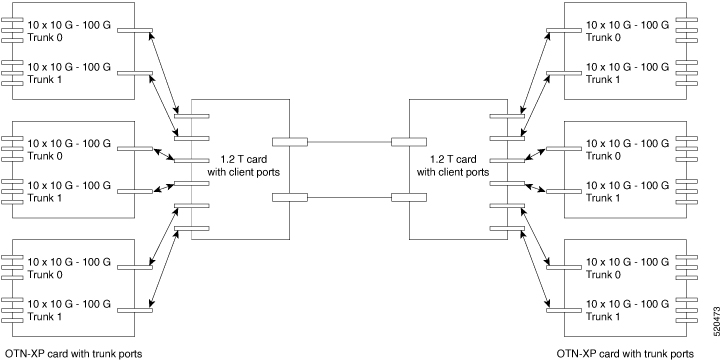
1.2T card interoperability with OTN-XP card

A card interoperability is a network capability that

  • enables different types of optical interface cards to exchange and transport data,

  • allows client cards to aggregate and convert multiple traffic streams for trunk transmission, and

  • requires compatible pluggable optics to ensure reliable communication between platforms.

The OTN-XP card can be interoperable with the 1.2T card. In an interoperability scenario, the 1.2T card can serve as a trunk port and the OTN-XP card can serve as a client port. The trunk port of OTN-XP can converge 10 x 10 G traffic and transmit as 100G traffic in the OTU4 mode. This OTU4 traffic can further be multiplexed to a higher bandwidth DWDM signal by connecting to 1.2T OTU4 client interface.

Additional reference information

For interoperability between the 1.2T and OTN-XP cards, supported pluggable optics are required:

  • On the trunk side (OTN-XP card): Cisco QSFP-100G-LR4 Pluggable Optics Module (ONS-QSFP28-LR4). The same module should be used on the client side of the 1.2T card to ensure compatibility.

  • On the client side (OTN-XP card):

    • ONS-QSFP-4x10-MLR

    • QSFP-40G-SR4

Prerequisites for interoperability with OTN-XP card

  • Configure the OTN-XP card in the 10x10G traffic mode.

  • Configure the 1.2T card in the OTU4 client mode with supported trunk rate.

  • Ensure that the software installed on both route processors and cards are stable in the supported traffic modes for the 1.2T and OTN-XP card.

Scenario on interoperability with OTN-XP card

Consider a topology in which the OTN-XP card is configured in 10x10G traffic mode and the 1.2T card is configured in OUT4 client mode with a supported trunk rate.

For the solution to work, the OTN-XP trunk optics must interoperate seamlessly with the 1.2T client optics.

Interoperability scenario

Figure 1. Interoperability Topology

Configure interoperability between the 1.2T card and the OTN-XP card

Establish communication and feature compatibility between the 1.2T card and OTN-XP card.

This procedure is required when you need two different card types—1.2T card and OTN-XP card—to operate together in mixed environments, ensuring optimal performance and interoperability.

Before you begin

  • Ensure both cards (1.2T and OTN-XP) are properly installed in your system.

  • Confirm that the system software supports the required features and modes.

Follow these steps to configure interoperability between the 1.2T card and the OTN-XP card.

Procedure


Step 1

Configure the muxponder mode on the 1.2T card, see Configuring the Card Mode.

Step 2

Configure the LC mode on the OTN-XP card, see Configure LC mode.

Step 3

Configure the OTN-XP card in muxponder mode, Configuring the Muxponder Mode for 10G Grey Muxponder.

Step 4

Run the no shut command on both trunk ports.

Example:

The is a sample to perform no shut on the trunk port.


            RP/0/RP0/CPU0:ios#configure
            RP/0/RP0/CPU0:ios(config)#controller Optics 0/1/0/0
            RP/0/RP0/CPU0:ios(config-Optics)#no shut
            RP/0/RP0/CPU0:ios(config-Optics)#description trunk port
            RP/0/RP0/CPU0:ios(config-Optics)#exit
            RP/0/RP0/CPU0:ios(config)#exit
          

Note


Ensure that there are no alarms generated and link recovery after events such as fiber cut, card reload, pluggable Online Insertion and Removal (OIR), and re-provisions.

Step 5

Optionally, perform additional controller configurations on the OTN-XP card’s grey optics and 1.2T OTU4 client optics.

  • Loopback
  • Trail Trace Identifier (TTI)
  • Maintenance
  • Performance Monitoring (PM) enable
  • Threshold

Interoperability between the 1.2T card and OTN-XP card is established with trunk ports enabled and optional controller features configured as needed.