Smart Licensing
Smart Licensing is a cloud-based licensing solution that simplifies the licensing experience across the enterprise by making it easier to purchase, deploy, track, and renew Cisco software through a single, simple user interface.
-
Provides visibility into license ownership and consumption.
-
Allows you to track the status of your license and software usage trends.
-
Helps you simplify three core functions: purchasing, management, and reporting.
Core functions of Smart Licensing
Smart Licensing helps you simplify the following core functions.
-
Purchasing: The software that you have installed in your network can be registered, without Product Activation Keys (PAKs).
-
Management: You can automatically track activations against your license entitlements. Also, there is no need to install the license file on every node. You can create license pools (logical grouping of licenses) to reflect your organization structure. Smart Licensing offers you Cisco Smart Software Manager, a centralized portal that enables you to manage all your Cisco software licenses from one centralized website.
-
Reporting: Through the portal, Smart Licensing offers an integrated view of the licenses you have purchased and what has been deployed in your network. You can use this data to make better purchasing decisions, based on your consumption.
Smart Licensing features
Smart Licensing provides the following features.
-
Your device initiates a call home and requests the licenses it needs.
-
Pooled licences - Licences are company account-specific, and can be used with any compatible device in your company. You can activate or deactivate different types of licenses on the device without actually installing a license file on the device.
-
Licenses are stored securely on Cisco servers.
-
Licenses can be moved between product instances without license transfer. This greatly simplifies the reassignment of a software license as part of the Return Material Authorization (RMA) process.
-
It provides a complete view of all the Smart Software Licenses used in the network using a consolidated usage report of software licenses and devices in one easy-to-use portal.
Cisco Smart Account
NCS 1004 integrates with Cisco Smart Accounts to simplify license management.
Smart Accounts provide a centralized, organized, and simple-to-use solution for managing Cisco software licenses across an entire organization. They act as a container that holds all Cisco software assets, allowing customers to view, store, manage, and move these assets as needed. Smart Accounts enable full visibility into license entitlements and usage, helping optimize software management. Smart Accounts support license pooling, portability, and provide compliance reporting.
When creating a Smart Account, you must have the authority to represent the requesting organization. After you submit the request, it goes through a brief approval process. Access http://software.cisco.com to learn about, set up, or manage Smart Accounts.
Cisco Smart Software Manager
Cisco Smart Software Manager enables you to manage all your Cisco Smart software licenses from one centralized website. With Cisco Smart Software Manager, you organize and view your licenses in groups called virtual accounts (collections of licenses and product instances). Use the Cisco Smart Software Manager to do the following tasks:
-
Create, manage, or view virtual accounts.
-
Create and manage Product Instance Registration Tokens.
-
Transfer licenses between virtual accounts or view licenses.
-
Transfer, remove, or view product instances.
-
Run reports against your virtual accounts.
-
Modify your email notification settings.
-
View overall account information.
Virtual Accounts
Virtual Accounts are customizable subaccounts within a Smart Account used to organize and optimize Cisco licenses. They can be structured to reflect business units, product types, or geographic locations, allowing better planning and utilization of assets. They are created and maintained by the Smart Account administrator. Smart Licencing allows you to create multiple license pools or virtual accounts within the Smart Software Manager portal. Using the Virtual Accounts option that you can aggregate licenses into discrete bundles that are associated with a cost center so that one section of an organization cannot use the licenses of another section of the organization. For example, if you segregate your company into different geographic regions, you can create a virtual account for each region to hold the licenses and product instances for that region.
All new licenses and product instances are placed in the default virtual account in the Smart Software Manager, unless you specify a different one during the order process. After you access the default account, you may choose to transfer them to any other account, provided you have the required access permissions.
Use the Smart Software Manager portal to create license pools or transfer licenses.
Product Instance Registration Tokens
A product requires a registration token until you have registered the product. On successful registration, the device receives an identity certificate. This certificate is saved and automatically used for all future communications with Cisco. Registration tokens are stored in the Product Instance Registration Token Table that is associated with your enterprise account. Registration tokens can be valid 1–365 days.
Product Instances
A product instance is an individual device with a unique device identifier (UDI) that is registered using a product instance registration token (or registration token). You can register any number of instances of a product with a single registration token. Each product instance can have one or more licenses residing in the same virtual account. Product instances must periodically connect to the Cisco Smart Software Manager servers during a specific renewal period. If you remove the product instance, its licenses are released and made available within the virtual account.
Smart Licensing workflow
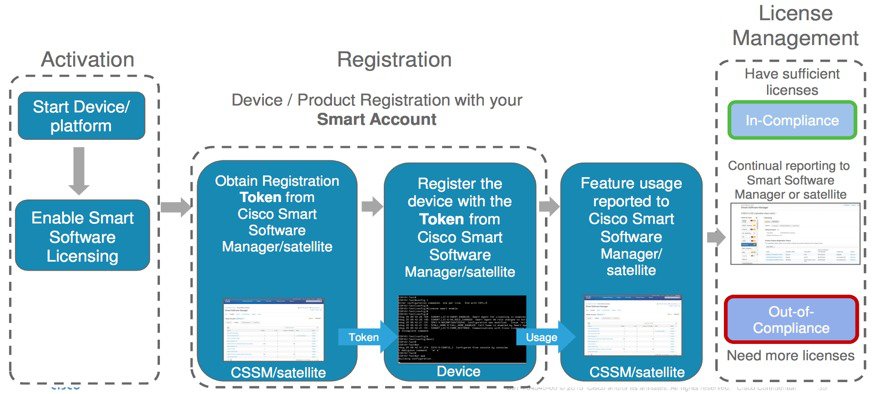
The following figure depicts a working model of smart licensing that involves a three-step procedure.
-
Setting up Smart Licensing: You can place the order for Smart Licensing, to manage licenses on the Cisco.com portal. You agree to the terms and conditions governing the use and access of Smart Licensing in the Smart Software Manager portal.
-
Enabling and Use Smart Licensing: Smart Licensing is enabled by default. You can use either of the following options to communicate:
-
Smart Call Home: The Smart Call Home feature is automatically configured when Smart Licensing is enabled. Smart Call Home is used by Smart Licensing as a medium for communication with the Cisco license service. Call Home feature allows Cisco products to periodically call-home and perform an audit and reconciliation of your software usage information. This information helps Cisco efficiently track your install base, keep them up and running, and effectively pursue service and support contract renewals. For more information on Smart Call Home feature, see http://www.cisco.com/c/dam/en/us/td/docs/switches/lan/smart_call_home/SCH_Deployment_Guide.pdf.
-
Smart Software Manager Satellite: is a component of Cisco Smart Licensing and works with Cisco Smart Software Manager (SSM). It helps customers intelligently manage product licenses, providing near real-time visibility and reporting of the Cisco licenses they purchase and consume.
For customers who do not want to manage their installed base using a direct Internet connection, the Smart Software Manager satellite is installed on the customer premises and provides a subset of Cisco SSM functionality. After you download the satellite application, deploy it, and register it to Cisco SSM, you can perform the following functions locally:
-
Activate or register a license
-
Get visibility to your company's licenses
-
Transfer licenses between company entities
Periodically, the satellite must synchronize with Cisco SSM to reflect the latest license entitlements.
For more information about the Smart Software Manager satellite, see http://www.cisco.com/c/en/us/buy/smart-accounts/software-manager-satellite.html.
-
-
-
Manage and Report Licenses: You can manage and view reports about your overall software usage in the Smart Software Manager portal. Compliance reporting describes the types of Smart Licensing reports.
Smart licensing benefits for Cisco NCS 1004
Smart Licensing for Cisco NCS 1004 offers several important advantages. These benefits streamline license management, enhance operational flexibility, and improve visibility of software assets across Cisco NCS 1004 deployments.
-
License pooling: Licenses can be pooled and reused across the entire organization, enabling flexibility across organizational boundaries.
-
No lock-out on over-consumption: Configurations can be performed even if license usage exceeds the purchased limit. When this occurs, out-of-compliance notifications are issued, allowing continued operations while prompting the user to buy additional licenses as needed.
-
Asset management visibility: Smart Licensing provides detailed information for software asset management, which helps organizations plan and track their license usage.
Smart Licensing in Cisco NCS 1004
Cisco NCS 1004 supports a set of line card product IDs (PIDs), each with specific licensing characteristics that determine whether smart licensing applies and how the licenses are charged.
-
NCS1K4-1.2T-K9—High-cost PID. This card does not support smart licensing.
-
NCS1K4-1.2T-L-K9—Licensed PID for 1.2T line card and the licenses are charged per port.
-
NCS1K4-OTN-XPL—Licensed PID for OTN-XP line card.
-
NCS1K4-QXP-L-K9—Licensed PID for QXP line card.
-
NCS1K4-QXP-K9—Non-licensed PID for QXP line card.
-
NCS1K4-2-QDD-CK9L—Licensed PID for 800G QDD Line Card - C-band.
-
S-NCS1K4-ULE-400=—Licensed PID for 400G encryption for OTN-XP Card.
You can use either one or a combination of both types of the 1.2T line card in the NCS 1004.
Software entitlements of Cisco NCS 1004
Software entitlement is a system that consists of a license manager on Cisco NCS 1004. The license manager manages licenses for various software and hardware features. The license manager parses and authenticates the license before accepting it. The following table lists the features and its corresponding entitlements that can be enabled on Cisco NCS 1004 using licenses:
|
Feature Name |
Release Information |
Feature Description |
|---|---|---|
|
Smart Licensing Support on 2-QDD-C Card |
Cisco IOS XR Release 7.9.1 |
Smart licensing is now supported on the 2-QDD-C card. Being a cloud-based software license management solution, it enables you to automate the licensing process and provides some of these functionalities:
|
|
Feature |
Software Entitlement |
|---|---|
|
NCS1K4 Smart License-one QSFP28 client |
S-NCS1K4-LIC-100G= |
|
NCS1K4 Smart License - one QSFP28 client with encryption |
S-NCS1K4-LIC-100X= |
|
NCS1K4 Smart License - 100Gbps of client bandwidth |
S-NCS1K4-100G-CL= |
|
NCS1K4 Smart License - Long Haul |
S_NCS1K4_LONGHAUL |
|
NCS1K4 Smart License - Subsea |
S_NCS1K4_SUBSEA |
|
NCS1K4 Smart License - 100Gbps of client bandwidth |
S_NCS1K4_100 |
|
NCS1K4 Smart License - 400Gbps of client bandwidth |
S_NCS1K4_400 |
The licenses are charged per port basis and dependent on the number of trunk ports and client ports that you configure. The license count for the configuration of 4 x 100GE client ports or lesser is zero. For configurations greater than 4 x 100GE client ports, the license count is incremented by one for every 100GE client port configured at the slice level. The license count for the trunk port is incremented based on the BPS & optics configuration.

 Feedback