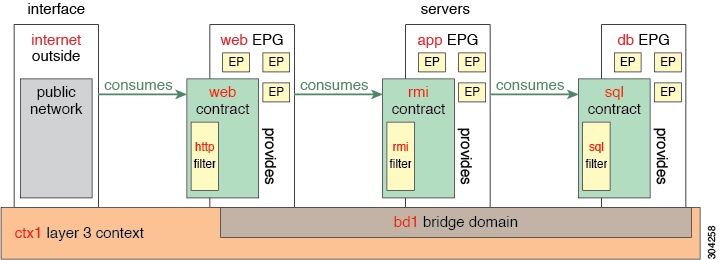
A three-tier application policy uses application profiles, filters, and contracts to control communication among web, application, and database tiers.
A three-tier application deployment separates application components into web, application, and database tiers.
-
The web tier uses Hypertext Transfer Protocol (HTTP) filters.
-
The application tier uses Remote Method Invocation (RMI) filters and contracts.
-
The database tier uses Structured Query Language (SQL) filters and contracts.
Three-tier application components
To deploy an application policy, create the required application profiles, filters, and contracts. The APIC fabric typically hosts the three-tier application within a tenant network.
The HTTP filter applies to the web tier, the RMI filter applies to the application tier, and the SQL filter applies to the database tier. The application tier consumes the SQL contract to communicate with the database tier. The web tier consumes the RMI contract to communicate with the application tier.
Traffic enters through the web tier and flows to the application tier. The application tier then communicates with the database tier. The application can also communicate with external networks.